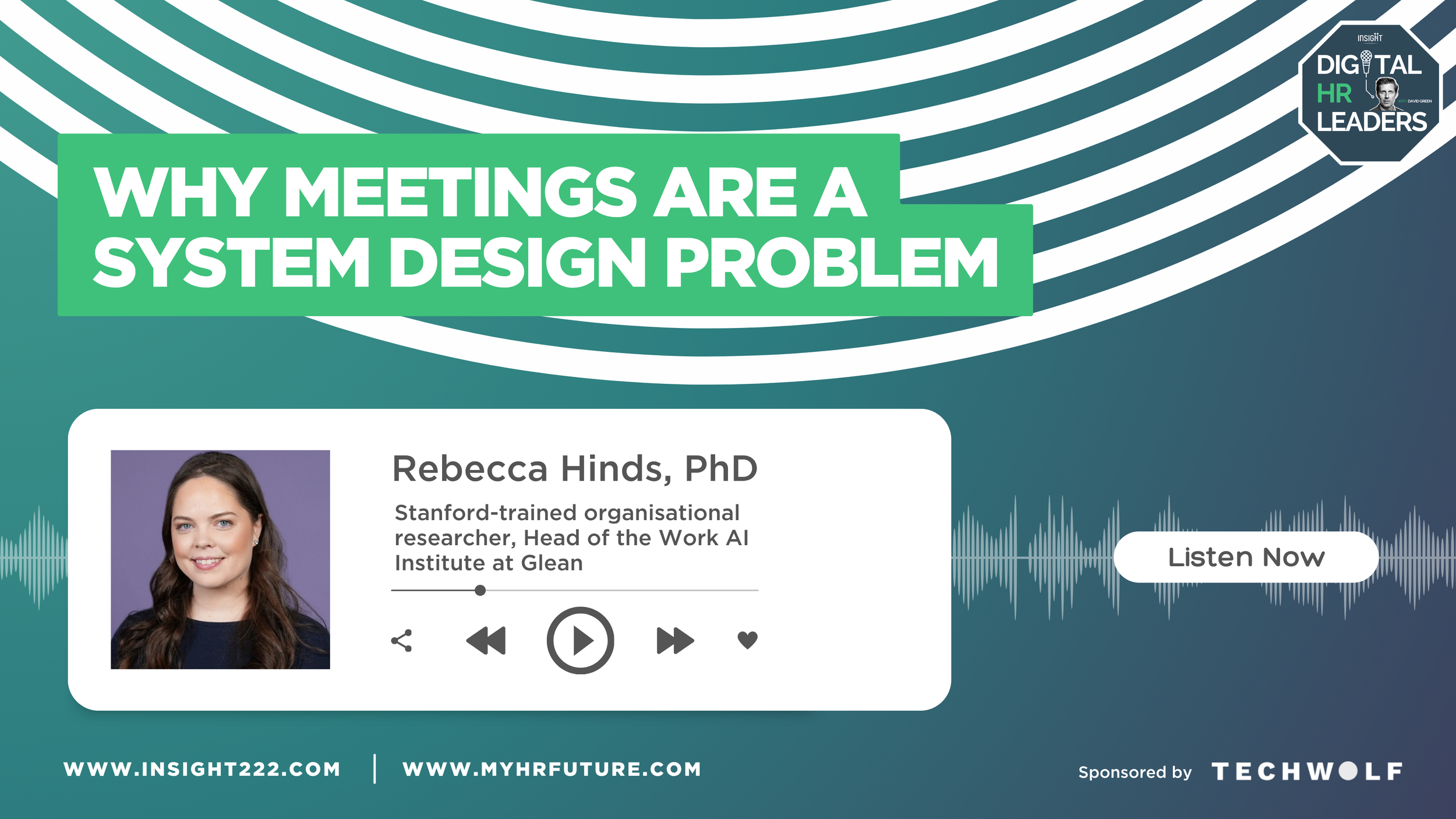
Episode 272: Why Meetings Are a System Design Problem (with Rebecca Hinds)
Are your meetings actually working? Or has your calendar just become a system nobody knows how to switch off?
In this episode, David Green is joined by Rebecca Hinds, Stanford-trained organisational researcher, Head of the Work AI Institute at Glean, and author of Your Best Meeting Ever: 7 Principles for Designing Meetings That Get Things Done.
In this conversation, David and Rebecca discuss:
Why organisations should treat meetings as a product, and what that actually means in practice
The concept of meeting debt, and why calendars accumulate bloat in the same way codebases accumulate technical debt
What a 48-hour calendar cleanse involves, and what typically happens when organisations rebuild their calendars from scratch
The patterns that show up most consistently when mapping how work actually moves between teams
How AI is being used to improve meetings, and the ways it can make dysfunctional meeting culture worse
What the conversation looks like in the room when CHROs start rethinking collaboration for the AI era
This episode is sponsored by TechWolf.
The world of work is being rewritten faster than HR systems can keep up. Skills age in months. Roles get redesigned quarter by quarter. CHROs have quietly become AI transformation leads, and the data they need to lead it doesn't exist in any HR system.
That's why the world's most forward-looking enterprises such as HSBC, AMD, T-Mobile, GSK, ServiceNow, Pfizer, have built on TechWolf.
As the data layer for the AI era of work, TechWolf gives enterprises the skills, they need to move faster and lead with confidence. Skills Intelligence, Work Intelligence, and Market Intelligence, in one layer. Visit techwolf.ai.
Resources: Your Best Meeting Ever: 7 Principles for Designing Meetings That Get Things Done
This episode of the Digital HR Leaders podcast is brought to you by TechWolf.
[0:00:08] David Green: How much time did you spend in meetings last week? And I don't just mean the big ones, I mean the check-ins, the catch-ups, the recurring ones that have been in your calendar so long, nobody can quite remember who called them or why. I know I have weeks where I look at my calendar and genuinely wonder when any actual work is supposed to happen. We all know there is a meeting problem going on, but isn't it interesting how we treat it as a culture problem, a norms problem, something to fix with a memo about meeting-free Fridays, or a gentle nudge to be more intentional? But today's guest argues it's actually a system design problem. In fact, she wrote a whole book about it, Your Best Meeting Ever: 7 Principles for Designing Meetings that Get Things Done. Rebecca Hinds is a Stanford-trained organisational researcher, Head of the Work AI Institute at Glean, and one of the most rigorous and practical thinkers I've come across on the topic of organisational meeting behaviour. And honestly, if you've ever felt like your calendar is working against you, Rebecca is exactly the person you want to hear from.
So, today, Rebecca explains why meeting debt builds up the way it does, what it actually takes to clear it, and what happens when organisations start from scratch with their calendars. We also get into how AI fits into all of this, because how can we not talk about AI? But more specifically, we look into whether it's going to fix our meeting problem, or just exacerbate it and give us a faster way to make it worse. We have loads of ground to cover. So, with that, let's get started by hearing from Rebecca.
Rebecca, welcome to the show. Let's start with you, as you're our guest. I'm curious, what was the journey that brought you to focus on understanding and supporting organisations and improving their meeting efficiency?
[0:02:02] Rebecca Hinds: Sure. And David, thank you so much for having me. I was telling you before, I'm a big, big fan of yours and looking forward to the conversation today. So, I think I've been fascinated by collaboration for as long as I can remember. And I think it really hit a ceiling for me when I came to the US to compete for swimming. I was a competitive swimmer and came to the US and was just in awe at the team spirit around me, and the fact that you could bring a group of people together from all walks of life all over the country and world and have an environment that truly extracted the best out of them, and where the whole was very much greater than the sum of the individual parts. And as I was transitioning from a world and career of athletics to industry and academics, I started to think very carefully about, okay, how might we reconstruct an environment, similar to that we might see on the sports field, in an organisational setting, and started to study collaboration, network science, the science of team work and all of the great work and insights that have come before me in terms of understanding how to design an effective organisation.
In so many ways, meetings are the tip of the iceberg. I often say, and I truly believe, they're not the fundamental problem. Often, we think we'd love to blame everything that's wrong with work on meetings. Usually, they're a symptom of a bigger problem, and that is a broken communication system. And that's why you can often tell a lot about whether a communication system is functional or dysfunctional based on their meetings. As we all know, people have this visceral negative reaction to meetings where they're often very excited about the prospect of improving. It's not often, but often more than collaboration at large, meetings spark this visceral negative reaction.
[0:04:03] David Green: What I love about your approach is that you kind of view meeting collaboration not just as a cultural issue, but also a system design problem as well. And in fact, in your recent book, Your Best Meeting Ever: 7 Principles for Designing Meetings that Get Things Done, I've always been told that you must mention the book title when you do these things, you talk about treating meetings as a product. Could you share more about what this entails?
[0:04:28] Rebecca Hinds: Sure. And that's very much the premise of the book, is we need to treat meetings as a product, right? Meetings are the most important product in our entire organisations. They're where decisions get made, alignment gets set, priorities get set, culture gets built or broken, and yet they're the least optimised. We often use them as a knee-jerk reaction for all of our problems. When we have uncertainty, we schedule a meeting; when we have a problem, we schedule a meeting; and a large part of that is because the communication system around the meeting is broken. When people don't know when to use email versus when to use Slack versus when to use Asana, meetings start to feel like the most reliable way to move work forward. There are a whole host of other reasons why we cling to meetings. That is one of them, that they tend to give the aura of productivity and performance and moving work forward, regardless of whether anything productive happens in the meetings. And so, if we are going to treat meetings like a product, well, we should be applying the same product design principles that we know make our everyday products great.
So, each of the seven chapters of the book walk through a product design principle applied to meetings, everything from user-centric design. Often, we design meetings for ourselves as the organiser. Typically, two types of people leave the meeting most satisfied, that is the organiser and the person who talks the most, right? We need to design these meetings for the attendees, the users of the meetings. There's a chapter on technology, how do we think about innovating our meetings with technology? There's a chapter on systems design, how do we ensure that meetings are serving a purpose and they're the last resort, a very important but expensive last resort and not our knee-jerk solution?
[0:06:17] David Green: Yeah, because if you're asking ten people in one organisation, I just picked ten because it's an easy number, to give up an hour to join a meeting, presumably some of them might prepare beforehand, some of them will be given actions afterwards. That's quite expensive, isn't it? And as you said, and I love how you say it, it's almost like we don't know you know how to communicate in the right channel or other ways of communication which don't involve everyone getting on a call, so we just go to that easy option of just scheduling a meeting and expecting everyone you've invited to turn up. And again, you mentioned at the start, you love collaboration, you love network science. I mean, the two of those seem to go together quite well, because obviously, hopefully one of the purposes of meeting, as you said, is getting decisions that drive actions and drive revenue and everything else. But it's also about collaboration, I guess. And the one you painted, the only two people that usually leave are the meeting organiser and the person that speaks most of the time, that doesn't sound like a great recipe to me.
[0:07:23] Rebecca Hinds: No, and I've often thought it's helpful to distinguish between three C's: communication, coordination and collaboration. And we see that the types of mechanisms and methods and processes we need for each type of C is different. The problem is we often use meetings for everything, when meetings so expensive, they're the most expensive form of collaboration because they require real-time synchronous interaction. And that's best for collaboration, right, when we need to iterate off of each other, build off of each other, we're inspired by an idea and we're taking it that next step forward. We don't need meetings for communication, right? That's usually something that an asynchronous communication channel, email or Slack, can more efficiently handle. And often, we don't need meetings for coordination as well. Sometimes we do, but if we're strictly trying to move work forward, often asynchronous is better because you have it documented. You have a single source of truth that people can rely on and hinge on outside of the meeting, and often gives people more accountability and felt responsibility to move that work forward, to do the action item, as opposed to just vocalising it in the meeting and hoping that someone will take action.
[0:08:43] David Green: And again, before we sort of delve into some of the work that maybe you're doing with organisations around this, it almost felt that during the pandemic, for example, meetings actually served a really good purpose in terms of helping people feel connected. Maybe that's another C there, I just made that one up! I don't know, I get the feeling, and it's not just from personal experience, that meetings were run maybe better and it wasn't just the organiser and the person that spoke the most that got most out of the meetings during the pandemic. So, I don't know, I wonder if there's some good practice. Obviously, that was a unique time in many respects, let's hope it's a unique time, but there's probably some good practice from that time that we can feed into how we manage meetings today; would you agree?
[0:09:30] Rebecca Hinds: Absolutely. And this is a topic I'm very passionate about. Actually, I was doing my PhD through the pandemic, and a big part of my thesis looked at how the experiences of virtual workers changed pre- and post-pandemic. So, for these workers who were in the minority in their organisations, being predominantly in person, how did their experiences change? And we framed the paper around this levelling effect that we saw happen in these organisations, where so often, remote workers are denoted lower status within the organisation, right? They don't have visibility bias, they don't have proximity bias. Oodles of research suggests that they're denoted low status, despite overwhelming evidence that you can be very productive working remotely. What we saw through the pandemic is the technology we use to communicate didn't change all that much. But what did change was how organisations enacted that technology.
So, previously, they did have Zoom or Slack or these asynchronous tools, but they were not using them properly in an asynchronous way. They didn't have the norms and practices in place to enable the remote workers to self-serve the information, for example. And so, we saw these pretty stark shifts in the use of the technology that enabled remote workers to feel a greater sense of inclusion and belonging within the organisation, documentation, clarifying and delineating and documenting how decisions are made within the organisation. All of these things enable us to rely less on meetings, because we can self-serve the information. And what's fascinating is we did see meetings become more dysfunctional when we look broadly through the pandemic. And that is because workers didn't have clarity. They didn't have clarity in most cases in terms of how to use these platforms, these tools. And what we see consistently is when work lives in five different places, when no one's sure where the real work is happening, meetings again start to feel like the most reliable way to move things forward.
[0:11:41] David Green: This episode of the Digital HR Leaders podcast is sponsored by TechWolf. The world of work is being rewritten faster than HR systems can keep up. Skills age in months, roles get redesigned quarter by quarter, CHROs have quietly become AI transformation leads, and the data they need to lead it doesn't exist in any HR system. That's why the world's most forward-looking enterprises have built on TechWolf. TechWolf is the data layer for the AI era of work. It connects three data sets that have never lived together, the skills your workforce has, how their work is changing under AI, and where the labour market is heading. Skills intelligence, work intelligence, and market intelligence in one layer. HSBC, AMD, T-Mobile, GSK, ServiceNow, Pfizer, and many more rely on TechWolf to deliver measurable impact, including cutting time to a unified skills foundation from 18 months to three, servicing 800-plus deployable internal candidates in under 30 days, and unlocking more than $8 million in projected L&D savings at one global biopharma. If skills, work, and labour market data is what's standing between your enterprise and its AI transformation, talk to TechWolf, the data layer for the AI era of work. Visit techwolf.AI.
Obviously, you're working with organisations to help them alleviate some of these challenges. So, when you go inside these companies and you start mapping how work actually moves between teams, what are some of the patterns that tend to show up again and again?
[0:13:42] Rebecca Hinds: Consistently, the biggest pattern, I think broken meetings are one. Everyone's struggling with meetings. Now with AI, there's a real hunger to understand how do we use AI to fix our broken meetings, in particular in this efficiency era we're all in. But I think the bigger problem consistently are organisational silos. And silos are not always bad, but in every organisation I've worked with, there have been harmful, dysfunctional silos that the organisation is tangentially aware of but not deeply aware of in terms of how these silos are creating bottlenecks. And it's different for every organisation. Sometimes, it's vertically within the organisation. The executives are not talking to the middle managers, who are not disseminating information down the chain. Often, it's horizontal. We see different functional groups matter more for different types of outcomes.
So, when we're thinking about AI adoption right now, for example, if your HR team is not very closely collaborating with the IT team, HR and IT, if that relationship is not stronger than it's ever been before, well, your AI adoption is probably suffering. Sometimes, we see it across product lines, often we'll see it across regions. I'll often work with large global organisations, and the Tokyo office is not collaborating with the San Francisco office. Well, obviously that's going to have big impact not only on the strength of innovation and value props for customers, but also in terms of culture and wellbeing for employees.
[0:15:19] David Green: One concept in the book, in Your Best Meeting Ever, is what you call meeting debt, and I think we can all recognise this. So, this is the idea that calendars accumulate in the same way technical debt does in software. And I think anyone that's worked in a large organisation, maybe not just a large organisation, will recognise that immediately. Why is it so hard then to actually do something about it? Why do these meetings, those standing meetings that we're probably all familiar with, even if they don't necessarily achieve much, why do they just stay?
[0:15:52] Rebecca Hinds: There are a few reasons. One is, and my longtime collaborator and mentor, Bob Sutton, will talk a lot about addition sickness, how we as humans, we are hardwired to solve problems through addition. And we all feel this, right? We have a problem in our organisation. Our reaction is, well, let's throw more money at the problem, let's throw more people, let's throw more meetings, more people in the meetings, more meeting minutes. And eventually, our meetings, our calendars become this broken, bloated mess, where we haven't thought strategically about, what does our calendar need in terms of meetings right now? What's fascinating is there's also research by my friend and colleague, Leidy Klotz, at University of Virginia, that shows, well, if you prime people to subtract, it can effectively dislodge that addition sickness, and they start to adopt a subtraction mindset. It's often not that we as humans don't like subtraction, it's often it doesn't even occur to us as a reality or a possibility. And that's why some of these calendar cleanses, when you're explicitly priming people to subtract, it can effectively not only clear the calendar and save time, but also start to challenge our core assumptions about what actually deserves to be a meeting.
The other big part of this is the immense social guilt so many people feel when they think about cancelling meetings or not showing up for the meeting. Because meetings are so tribal in nature, they're part of our human ethos, we often feel that cancelling meetings is not just cancelling the meeting, it's cancelling the person behind the meeting. People take it very seriously. And because of that, if you're not having an organisational mechanism, or don't have a reset, that gives people explicit permission to remove those meetings, that guilt, that sense of personal pressure is going to kick in overwhelmingly. And it starts to feel like, "Oh, it's easier to show up to this dysfunctional meeting I know is not worth my time, than try to push back and figure out what exactly to say".
[0:18:04] David Green: And I guess a lot of those standing meetings, particularly in large companies, are organised by a senior person. So, it might be your direct line manager or your manager's manager, and they just stay in it. And I guess the social guilt, but it's more maybe a little bit of fear, I guess, of not going to the meeting
[0:18:26] Rebecca Hinds: Yes, exactly. And the number 1 culprit in so many organisations is often new managers, because we also have this association of leadership with meetings. And you start to see situations, and I've seen them for the past 15 years, where you have new managers come into the picture, and they start to think, well, they should be running meetings. That's what a manager or a leader does. And disproportionately, these new managers haven't been trained on meeting design, meeting hygiene, and they over-index on the meetings, and that triggers a lot of also downstream impacts. Because direct reports then think, "Okay, this is business as usual. This is what I should do. This is how work moves forward", and it becomes this dangerous domino effect.
[0:19:11] David Green: And in a way, I guess that we are replicating what we used to do in the analogue world, where you would meet primarily in person, I guess, occasionally on those conference calls. And now obviously, we have video meetings. I don't know in your research, I presume the number of meetings has increased since we've had the option of doing video meetings and more virtual?
[0:19:37] Rebecca Hinds: Yes, and it depends on how you look at it and during which time. But definitely throughout the pandemic, we saw more meetings, we're seeing more ad hoc meetings than we've ever seen before. I see this particularly acutely in AI-native startups, where they're just moving so quickly, they need to be so agile. There's a real sense of winning where these ad hoc meetings have balloons all hours, certainly outside of the nine-to-five workday. And it becomes the norm and the assumption that if you're at your computer, well, you're ready for an ad hoc Slack huddle or meeting.
[0:20:18] David Green: Yeah, it's interesting. I remember, and you would have definitely studied this with Bob and others, I remember during the pandemic, but it just doesn't matter that it was during the pandemic I don't think in this case, there was a Harvard Business Review article, and it had Uber in there at the time that RJ was running the people analytics function. And what they'd seen in their surveys was people saying that they didn't feel as productive and that their wellbeing scores were going down. And when they then looked at some of the digital footprint, they were seeing that people were in more meetings, so they weren't having that focus time as they needed. And obviously, you can tell me better than many guests, this science shows us the focus time of two- or three-hour blocks are important when you're doing deep work, but that wasn't happening. And they ran a kind of A/B test where they gave 50% of people a tool that would help them reorganise their calendars to give them focus time, and they left the other 50% as they were. And what they showed through that A/B test were that the people who had that tool self-reported feeling more productive and their wellbeing went up, and obviously their focus time was going up as well. So, they were able to roll that across the company.
Now, That's just one example, there are many examples like that. Is there anything like that in the book or is there anything like that you've seen in some of your research as well, this focus time, and helping educate people and managers around the importance of it?
[0:21:50] Rebecca Hinds: Yes, absolutely. And we know from a research perspective, meeting effectiveness, how people feel about their meetings, is a significant driver of employee engagement. There's a strong, strong correlation, even if you control for the usual subjects in terms of managers and the organisational factors at large, focus time is a big part of this. And I often in the book, I talk about the contracting time effect, how as soon as a meeting lands on your calendar, even if it's a single one, even if it's hours away, well, our brain starts this mental countdown, right? We know it's coming. So, either subconsciously or very consciously, we avoid diving into deep work, because we know that eventually, we're going to be interrupted. And that's why we see positive results from things like no-meeting days as well. Because if you don't have any meetings on the calendar, well, that contracting time effect isn't going to start.
I've been working very closely with the Doodle Time Institute, which is their independent research centre at Doodle, the scheduling platform. And we just finished a study with a group of Stanford folks. And what we essentially looked at is something called task legitimacy, how often we don't feel negatively about our time because it consumes more time, because there's more volume of time wasted. Often, it's very much a reflection of how legitimate we feel the task is and how much a sense of purpose or value we're gleaning from the task. And I think that's underestimated in organisations. Just because we have space on our calendar that can be filled with a meeting, well, if the employee doesn't feel a sense of purpose or meaning, or doesn't feel like that time is spent legitimately, well, that's going to trigger a whole host of different outcomes in terms of employee engagement and morale as well.
[0:23:52] David Green: I want to take a short break from this episode to introduce the Insight222 People Analytics Program, designed for senior leaders to connect, grow, and lead in the evolving world of people analytics. The programme brings together top HR professionals with extensive experience from global companies, offering a unique platform to expand your influence, gain invaluable industry insight and tackle real-world business challenges. As a member, you'll gain access to over 40 in-person and virtual events a year, advisory sessions with seasoned practitioners, as well as insights, ideas and learning to stay up-to-date with best practices and new thinking. Every connection made brings new possibilities to elevate your impact and drive meaningful change. To learn more, head over to insight222.com/program and join our group of global leaders.
Let's get practical, Rebecca, and you said something a few minutes ago about cleanse, calendar cleanse. So, what can organisations do to prevent and also resolve this meeting debt that you talked about? So, I do recommend a calendar cleanse at least once a year. And again, not just to clear your calendar, but to clear your assumptions about what actually deserves to be a meeting. What's exciting, David, is I've started to work with more and more organisations to use AI as part of this process, and that becomes very exciting for the senior executives. It also becomes much more objective than in the past. And if AI knows enough about your team, yourself, your organisation, well, it can help you identify these dysfunctional meetings on your calendar. And suddenly, it becomes less of an onus and burden on the individual and more something that we can delegate to the AI in terms of making that recommendation.
Every organisation also needs some sort of, at Amazon they call it a bureaucracy mailbox. I call it a friction fighter forum with Bob Sutton at some of the organisations we've worked with, some place where if employees don't have that psychological safety to go to the meeting organiser or go to their manager and say, "Hey, this is dysfunctional. This is a legacy meeting that is dysfunctional", well, having an anonymous forum that they're able to flag that and there's real leadership buy-in in terms of fixing it, is important. And then, the third aspect is what's sometimes called speed bumps or guardrails, right? How can we use technology or rules to help us buffer against dysfunctional meetings? So, in some organisations, this is tooling built into the calendar system, where I was working with a large organisation recently where they built in checks and balances to the calendar, such that if there's not an agenda 24 hours in advance; if half the attendees haven't accepted the meeting 24 hours in advance; if, on average, more than half of the people show up late; auto-deleting the meeting, because that signals and is a positive predictor of meeting dysfunction. I think the more we can rely on technology, the less it feels personal, and the more safe the lower ranks within the organisation feel to push back on that bad meeting.
[0:27:37] David Green: That's really good. I mean, you shared an example there and you mentioned Amazon's bureaucracy mailbox. I noted that one down, I like that. So, when organisations, maybe some other examples, when they go through this calendar cleanse or they're very intentional about how they're looking at meeting hygiene, shall we say, and they start rebuilding their calendars from scratch, what are some of the things that tend to happen? What are some of the benefits? I guess some of those are employee-focused, some of those presumably business-focused as well.
[0:28:11] Rebecca Hinds: And it depends on who you're talking about. So, I often work with HR leaders, and often meetings are the first the first area of investigation that we'll work together on. And very quickly, we'll start to see, okay, meetings are just the tip of the iceberg. And it encourages a hunger for a more data-driven, evidence-backed approach and one that involves employees. All of my work is very much focused on employee empowerment, and these aren't ever top-down initiatives. There's an element of top-down leadership that's involved and necessary, but it's very much putting the power in the hands of employees, whether that's putting the data, putting the tooling, or having them do the calendar cleanse on their own instead of having it top-down from an IT team. So often, it triggers more conversation around, "Okay, how do we start to reset collaboration broadly? How do we start to rethink our asynchronous practices?" Now, if there's an element of AI, there's a lot of excitement because I think HR in particular is being either directly or indirectly tasked with leading this AI transformation, in particular from a human standpoint. And once you start to see the power of AI in helping us fix our meetings, the next step is often, "Well, how can I help us fix performance reviews? Or how can I help us fix the feedback mechanisms within our organisations?" And it becomes a really healthy conversation around those lines as well.
[0:29:49] David Green: Obviously, there's a lot of enthusiasm around AI as a fix, not just for meeting overload, but actually managing meetings. I mean, there's transcripts, summaries, action, scheduling tools, etc, plus what you've talked about as well. So, what other ways are you seeing that organisations are using AI to make meetings better? And maybe on the flipside, can AI make meeting overload actually worse? And what should people managers and HR professionals listening to this episode particularly be cautious about or look out for?
[0:30:22] Rebecca Hinds: Sure, and it's, it's such an important question. And unfortunately, I'm seeing more evidence of AI making meetings more dysfunctional than the reverse. And that is because there is this overwhelming pressure right now to AI-ify everything in our organisation, and to treat the technology so performatively. It's enough to do the thing, rather than to think carefully about how it's done. The other big problem is, as a society, we are over-indexing on this tool as a personal productivity tool. And we know from so much research that that can easily create what's sometimes called the tragedy of the commons, right? If we are hyper-fixated on using this technology to boost our individual productivity, and we're seeing this every day, an individual uses AI to generate content faster than they've ever done before, to generate code at lightning speed, And we don't think enough about the coordination, it's sometimes called coordination neglect. We as humans systematically underestimate how hard it is to coordinate work and move it forward. And so, yes, you can generate a whole bunch of great content and code yourself, while you've often just created a lot of slop for the rest of the organisation to clean up. And we see this in meetings where people are sending their digital twins or digital notetakers to meetings instead of showing up themselves. For a whole host of different reasons, that negatively impacts the team and organisation. It's immensely distracting to have half the attendees be bots. And it also very clearly signals that your time is more important than anyone else's.
So, as I work with organisations on AI transformation, the first step is to understand, okay, what are the incentives and what are the metrics through which we're measuring success? Because often they are very superficial vanity metrics that inevitably are encouraging the wrong types of behaviours.
[0:32:23] David Green: Yeah. And I suppose the risk is that people send their AI bots, so by sending their AI bot, then they can attend more meetings. And then, if it's senior people doing that, then potentially you have even more meetings in the calendar.
[0:32:39] Rebecca Hinds: Yes. And it's often a scapegoat, because you think that, "Oh, wow, there's going to be a transcript for every meeting now. Even if I'm not sending my digital twin, I'll have access to the transcript", while very few executives are going back and reading the transcript. And so, it creates this false sense of security, where you have a way to consume information, but most organisations are not automatically feeding that information back into the organisation in a way that people are actually consuming it.
[0:33:09] David Green: And what should HR professionals or HR leaders listening to this conversation, what can they do to prevent AI making meeting overload worse? What should they look out for?
[0:33:21] Rebecca Hinds: There are so many different facets of it, everything from governance. We know that having a policy and a set of principles around what is this technology in service of, is it in service of humans, truly, just as we would have values for our organisation at large, we see that when people understand the why behind the policy, they are significantly more likely to buy into it, and they're much more confident in AI strategy. Very few organisations have a set of principles that are specifically around AI. The policy is important for experimentation. And if we want employees to experiment and push the boundaries, well, they're significantly more likely to do that, sometimes counterintuitively, when there's a policy in place, because they know the rules of the road. Thinking about documentation in terms of, "Okay, what are our AI tools meant to be used for? What is this meeting transcript supposed to be used for?" Technology versus an email AI tool, having clear delineation in terms of, "This is our standard tool stack, and this is the purpose of each one", is important.
Then my number one recommendation is establish a super strong relationship with your IT team, because the best AI transformations right now are a combination of deep human change, recognising the massive resistance to change, the massive fear that's in so many organisations, and pairing it with technology that is secure, scalable, and robust across the organisation, and using data to understand what's working and what's not. That's our best bet for moving forward, is to learn every day, iterate every day, and we're not going to do that if we don't have that strong relationship.
[0:35:11] David Green: Yeah, so maybe explore that HR/IT relationship a little bit more. Obviously, last year, there was a lot of press when Moderna combined the roles. And I think at ServiceNow, the CHRO there is also the Chief AI Enablement Officer as well. And of course, lots of people get very excited about HR and IT maybe combining, which could be right in some organisations, as I'm sure it is in Moderna, but probably isn't for the majority of organisations. What we're actually talking about here is better collaboration between the two, aren't we? And in terms of that, what do you see? I mean, if you can share examples, great, but if not, what are some of the practices that you're seeing where that's working well in some of the companies that you're working with?
[0:35:57] Rebecca Hinds: Yes, it's a great point. And I think this formal combination can work in some cases. I don't think it's a recommendation for most organisations, especially the more complex ones, for a whole host of different reasons. But I'm seeing so many examples of informal collaboration strengthening across these two teams, that I think very much can be replicated in other organisations. I've spent a little bit of time with the CHRO at one of the largest healthcare providers in the world. And one of the first things he did was move his office physically to be next to the Chief IT Officer, the Chief Digital Officer within the organisation, because in his words, he wanted to be able to influence them, and he wanted them to be able to influence him. And physical proximity matters. This is network science 101. Physical proximity, as much as we like to believe it doesn't matter all that much, well, it matters a lot. And if we're thinking about AI transformation, having not just close virtual communication between IT and HR, but also having close physical proximity, matters a lot.
The other big piece of this is metrics. What we're seeing is HR and IT around AI tend to have very different metrics. For IT, it tends to, not always, but it tends to be more skewed towards efficiency and productivity versus HR tends to have a more holistic approach. Well, we see in the best organisations, the most successful ones, they're aligning on what are those holistic set of metrics. And they are vetoing AI initiatives that don't align with the organisational values. IBM is a great example of this. Their CHRO will talk about how they're not using AI in specific facets of the organisation, even when they know the technology is valuable and objectively better than humans, because it misaligns with the values. And having that alignment across the board, and in particular, IT and HR, is very important right now. We're not going to roll this technology out if it doesn't do X, Y, and Z. And in the best cases, it's a trifecta of efficiency and productivity, employee experience, and some measure of quality.
Zapier does this really well, where they don't push an AI initiative forward unless it hits the bar on all three. If it over-indexes on efficiency in a way that negatively impacts the employee experience, well, that doesn't move forward. That's another example of the Chief AI Officer also holding the role of Chief People Officer, CHRO.
[0:38:45] David Green: Yeah, it's interesting, isn't it? I mean, I'd love to get your reaction to this. I was at the UNLEASH event a few weeks ago in Las Vegas, and Stacia Garr, who you probably know, as well, one of the leading analysts in the field. I think through several conversations that she had there, she captured it much better than I did, and others, frankly. She talked about Little AI, which is where most companies are at the moment, distributing tools, rolling out products from vendors, giving employees access to all the features, and business outcomes haven't really moved. And then, she talked about Big AI, which is where we need to get to, which is arguably the big opportunity for HR as Ii'm listening to you as well, Rebecca, you know, she's actually redesigning how work gets done, restructuring tasks and workflows, and rethinking who makes which decisions. And most companies haven't built, you mentioned a couple that have in terms of IBM and Zapier, they haven't built the governance, the skills infrastructure or the workforce planning capability yet to do it. I just wonder, what's your reaction to that? And does that kind of resonate with what you're seeing as well?
[0:39:57] Rebecca Hinds: Absolutely. And I think the components you mentioned, governance, skills absolutely important. But what I'm seeing make the difference more than anything else is giving people space and empowerment to experiment. Because when we think about redesigning processes we love to think that we can bring in a consultant who hasn't been living and breathing our organisation to rewire things. The reality is, in the best cases, organisations are empowering those subject matter experts to redesign practices and giving them the space to do that. It's so exciting when you think about the potential of AI to fundamentally restructure how we work. In my PhD, I studied a large digital retail company as they were rolling out AI to every facet of the organisation. And essentially, we framed the paper along the lines of, AI is coming into tension with the way we structure our organisational charts. Because if we think about org charts, well, the purpose of org charts is to fundamentally remove complexity, reduce complexity, right? Org charts give us a lot of information in terms of who to delegate work to, who to escalate work to, our spans of control. Well, AI can handle that complexity in a way that humans cannot. And I've seen this time and time again, where the AI starts to make recommendations that go beyond and individual's remit or silo within the organisation.
So, at this specific retail company, we were seeing AI could make recommendations for the organisation at large, but no human or group of humans had the authority or autonomy or responsibility to act across those silos. And so, unless we start to fundamentally rethink how we form teams, how we create organisational structures within our organisation, well, we're going to continue to see this tension between AI's capabilities and what humans are tasked with doing within the organisation. In the best case, you can imagine a world where everything happens incredibly dynamically. And I'm starting to see this, including in several HR functions. It's definitely rare. But the tooling that will enable us to dynamically form teams based on what are the right mix of people right now, not just based on skillsets and capabilities, but also in terms of personalities and growth opportunities within the organisation, you can start to do a very complex calculus. Most organisations are nowhere near at that point.
But there are some that are definitely starting to create, sometimes it's called a flash team-type environment, to dynamically disband these teams to solve problems, and then disband and create a new team from scratch. And that becomes very exciting, because it doesn't just help us move work forward and help us innovate, but it also creates so many great opportunities for growth within the organisation if you also understand, okay, what is the trajectory of the individual? What do they care about? What's meaningful to them? You can bake that into the equation as well.
[0:43:15] David Green: And as you said, the absolute criticality is that organisations create the space for people to really develop their curiosity, to experiment, to recognise that you will fail sometimes a lot, probably with AI to be fair, but you will learn from that and that will lead to success down the line. And obviously that's the culture piece that we talked about right at the start. And, Rebecca, going right back to the start of our conversation, you talked about your life as a swimmer and how you were inspired by how teams came together and developed success. And then obviously, wanting to apply that into workplace, post your sporting career. And I'd love to hear from you, and we've heard a bit of it already actually, but do you think that the way organisations are going to collaborate in the future, as AI becomes significantly embedded into everyday work, are going to change? And what's your thinking about how that might happen? And I appreciate that you might not get everything right, because this is a safe space where we can do some experimentation.
[0:44:22] Rebecca Hinds: Yes, it's so hard to predict anything beyond four, five, six months. But the reality is, I think, for most organisations in the short term, things are going to run largely business as usual. What we're seeing is AI does not magically transform any part of our organisation, right? It amplifies what already exists, for good or for bad. And so, if you have an organisation already where there is a bias around improving collaboration, and we see this in the most successful organisations, they are significantly more likely to measure and reward effective collaboration as opposed to individual performance. Well, in those organisations, what I'm seeing is a rethinking of collaboration, what does it look like to now have AI agents or workflows as part of our team ethos and ways of working? What's fascinating is we're seeing night and day differences between people who are conceptualising AI as a tool versus a teammate. That is fundamentally changing how they're interacting with the technology in positive and negative ways.
But perhaps counterintuitively, the people who are trusting AI as a teammate are actually not trusting it out of the gate, they're trusting it to iterate with them over time. They're not accepting the first prompt, they're recognising the technology is imperfect, just as a human teammate, and they're iterating over time in a way that's resulting in greater productivity and quality of their work. And so, thinking about not just in terms of, "Can this AI agent or workflow be embedded in the team?", but, "What is the mental model through which employees are perceiving the technology?" is very important. And in great organisations that have this bias toward collaboration, they're rethinking not only workflows, but also how do we get employees in the right mental model and state such that they're embracing the technology? Because if there is this resistance, what we start to see very quickly is symbolic use of the technology, or hiding, people downplaying how much they're using AI, or exaggerating it because they think that that's what is now a status symbol within the organisation. There's so much psychology at play here, where I'm pretty convinced the organisations that are going to get this right, in terms of creating the right team environment, AI plus human, are going to think much more carefully about the human piece than even the technical piece.
[0:47:01] David Green: Those companies that maybe have been prioritising collaboration and have been measuring and rewarding collaboration and are now rethinking collaboration, when you work with the CHROs or senior leaders in those organisations on how they rethink meeting culture, what's the conversation like in those rooms? What are some of the things that they're doing as they kind of re-evaluate collaboration, because obviously meetings are a part of that? Where are they starting from? What are they finding hardest to let go of?
[0:47:33] Rebecca Hinds: This is so organisational-specific, and it really does boil down to values and metrics and what the organisation rewards. I'll work with organisations that are extremely hierarchical. And in those cases, what we see is the power dynamics within the meeting, that is one of the first areas we need to rethink. You have executives who are overscheduling the meeting, they're dominating the airwaves, they're creating environments where employees don't feel safe to voice ideas or disagree with the leader. In some cases, it's a very performative culture, where doing the thing is more important than how we do the thing. And we see that very quickly translate into AI in terms of, it's enough just to invest in the technology, it's enough just to do the meeting. And so, thinking about, "Okay, what is the substance of the meeting? What are we trying to accomplish?" In the best cases, there's a recognition that this is a multifaceted problem, and we need to tackle it at multiple different levels. And as we think about our tooling, having the meeting be part of the bigger communication system conversation and not an isolated component is often the hallmark of the organisations that are truly able to make the shift, recognising that it doesn't just happen in the meeting, it happens in all the infrastructure around the meeting.
[0:49:02] David Green: This is part of the series that's going to be kindly sponsored by our friends at TechWolf. So, this is a question we're asking everyone in this series of five episodes, and I think it ties in quite nicely with what we've been speaking about, actually. Where should HR leaders start if they want to turn AI into real impact at work?
[0:49:22] Rebecca Hinds: I think the intentionality behind this is very important. Often, HR leaders recognise this more than any other group within the organisation. I see this massive tension right now between HR leaders and CEOs in particular. I was at a large AI conference, one of the biggest ones, a few weeks ago, and HR leaders are facing immense pressure right now to flatten. Flattening is the fad of the moment, and they'll have their CEO come back from a conference and say, "Okay, we need to flatten by 15% or 20%", like there's this magic number. And the best HR leaders are thinking from first principles and understanding, "Okay, what is the real potential of the technology right now? Is flattening the answer?" Usually, it's not. Usually, it's dumping a whole bunch of coordination tax on middle managers in a way that very quickly backfires. But even if they're flattening, even if they decide that roles can be restructured, well, they're making sure they understand the impact of the technology on a small scale before they roll up.
Bob and I spoke to a fantastic leader at a large tech organisation a few months ago, and they are vigilant in terms of they're not going to make any headcount cuts until they pilot this technology on a small scale and understand whether it can really displace or replace a part of a role or an entire role. And I think that's the vigilance that HR leaders, the best ones, are having right now, recognising that it's easy to paint broad strokes in terms of the potential and promise of the technology. The reality of the technology is often lagging behind that significantly.
[0:51:13] David Green: And it's a challenge, isn't it, for CHROs? Because we've seen in the press, I'm not going to necessarily name any names, but several organisations recently letting a lot of people go, claiming that it's to do with the productivity that they're getting from AI. That may be true in some cases, probably not in many of the others. It may be that they over-hired, etc. And we see that their share price goes up, and from an investor perspective, the investors and the shareholders are quite happy with that. Obviously, what they're not factoring in is any contagion that does down the line, in terms of other employees, probably employees they don't want to lose in the organisation as well. But that's hard for a CHRO because as you said, the CEOs, this becomes a vicious cycle, I guess. The more companies that do it, the more CEOs that will ask their CHROs to lead this within their own company.
[0:52:14] Rebecca Hinds: And I think that's why data, it's hard. There's no silver bullet. But the more we can understand, okay, what is the actual impact on this technology? And we see it on a small scale, where I think one of the biggest mistakes organisations are making right now is automating work that employees find deeply meaningful. There was a Stanford study a while back that found that 40% or 41% of all Y Combinator AI startups right now are building products to automate work that people would prefer to keep human. Well, in a workplace, that becomes very detrimental, because it's that work that gives people purpose and compels them to work hard and give back to the organisation. And I know there's a real danger in automating work just because it can be automated, if we're not thinking holistically about the bigger picture and what brings employees meaning and purpose at work, because that has significant impact on the hard numbers as well.
[0:53:20] David Green: Well, Rebecca, thanks for such a wonderful conversation. You've made me think quite a lot, and I've written a few notes, and I'll be thinking more afterwards. Really fascinating. Where can people connect with you, find out more about your work with Bob Sutton, and I think other stuff that you're doing as well? I seem to remember, I think it was with Bob actually, you published a really excellent piece of work around Christmas time to do with AI. And how can people find out more about Your Best Meeting Ever?
[0:53:50] Rebecca Hinds: Sure. So, the book is everywhere at your local bookstore. My website's rebeccahinds.com. Workai.institute is the Work AI Institute page. We published a piece in December and have some really exciting research, including with Bob, coming out in a few months that will be accessible there as well. And I'm on LinkedIn.
[0:54:12] David Green: Brilliant. Well, we'll put all those in the show notes, Rebecca, and I look forward to that research coming out. And thank you very, very much for being on the show. And hopefully, we'll see each other at an event at some point this year or early next.
[0:54:26] Rebecca Hinds: Yes. Thank you so much for having me. This has been great.
[0:54:30] David Green: Thank you again, Rebecca, for joining me today. I really enjoyed that conversation. And I suspect a lot of you listening have already started mentally auditing your own calendars. On that, I'd love to know what stood out most for you. Find my LinkedIn post about this episode and let me know in the comments. I read every single one, and the conversations that happen there often add to the ones we have on the show. And if you think a colleague or friend would get something out of this episode, please do share it with them. It really does help us bring more of these conversations to HR professionals around the world. And one last thing before we go. For those who would like to keep up with what we're working on at Insight222, follow us on LinkedIn, or head to insight222.com. You can also sign up for our bi-weekly newsletter at myHRfuture.com to get the latest thinking on HR, people analytics, and everything shaping our field. Right, that's us for the day. Thanks for listening and we'll be back next week with another episode of the Digital HR Leaders podcast. Until then, take care and stay well.