
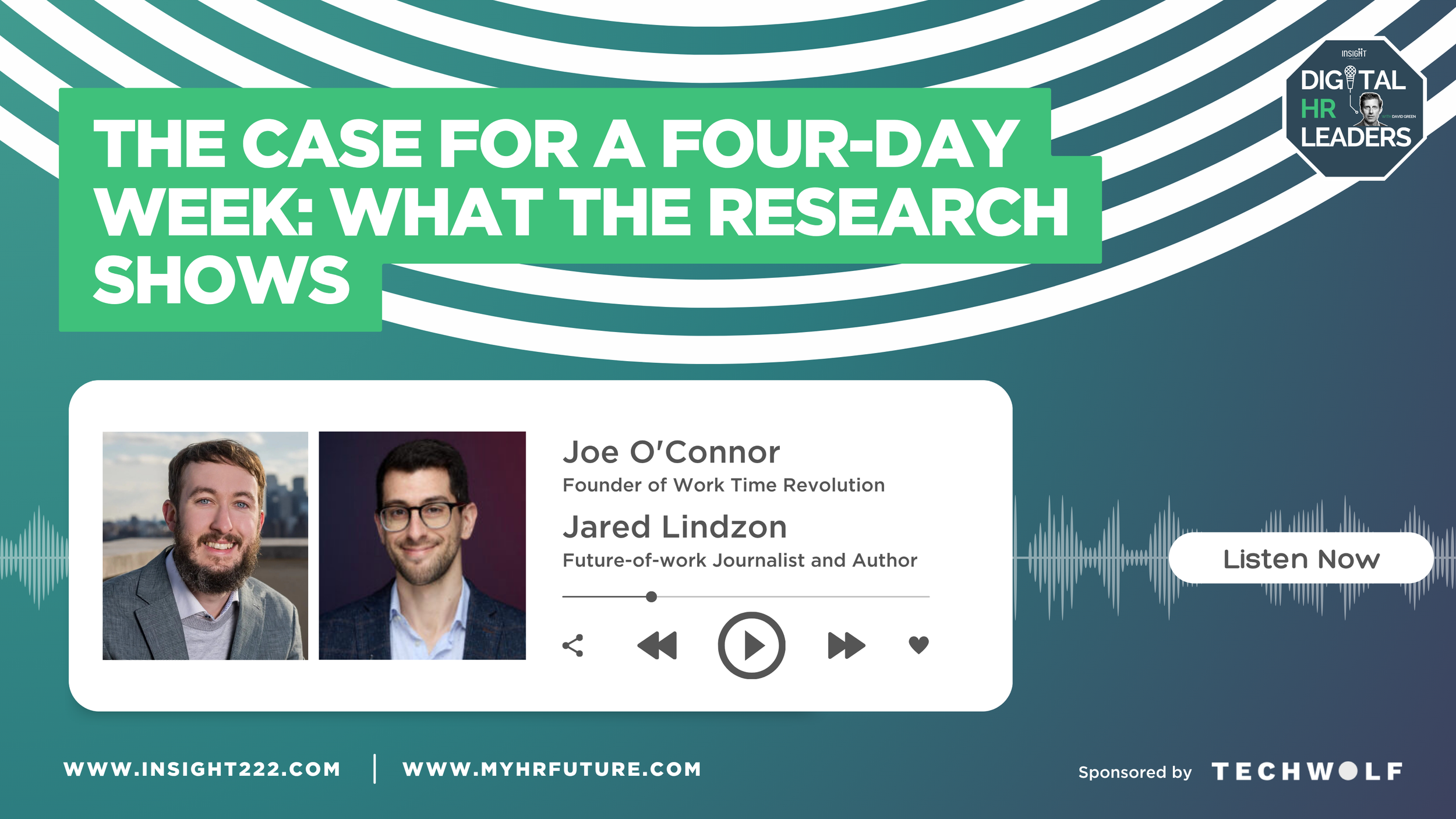
Episode 271: The Case for a Four-Day Week: What the Research Shows (with Joe O'Connor and Jared Lindzon)
Most organisations are asking how to get more from their people. But what if the real question is how to get more from the time they spend at work?
In this episode of the Digital HR Leaders podcast, David Green is joined by Joe O'Connor, founder of Work Time Revolution, and Jared Lindzon, future-of-work journalist and author, to explore the research-backed case for the four-day working week, and what it means for how HR leaders design, lead and transform work.
Join them as they discuss:
Why the five-day working week is a relic of the industrial age
What the evidence from global pilots shows about productivity, wellbeing and retention
Why organisations moving to a four-day week are also becoming faster AI adopters
What it actually takes to make the transition work - and why culture and trust are the real foundations
How HR leaders can shift the conversation from top-down mandate to shared, enthusiastic change
This episode is sponsored by TechWolf.
The world of work is being rewritten faster than HR systems can keep up. Skills age in months. Roles get redesigned quarter by quarter. CHROs have quietly become AI transformation leads, and the data they need to lead it doesn't exist in any HR system.
That's why the world's most forward-looking enterprises such as HSBC, AMD, T-Mobile, GSK, ServiceNow, Pfizer, have built on TechWolf.
As the data layer for the AI era of work, TechWolf gives enterprises the skills, they need to move faster and lead with confidence. Skills Intelligence, Work Intelligence, and Market Intelligence, in one layer. Visit techwolf.ai.
Resources: Do More In Four by Joe O'Connor and Jared Lindzon
This episode of the Digital HR Leaders podcast is brought to you by TechWolf.
[0:00:08] David Green: How many of you have got to the end of a busy week and realised you haven't actually done the work that mattered most? I know I have. Now, multiply that across hundreds or thousands of people in an organisation. This is exactly what today's guests have spent years trying to solve. Joining me are Joe O'Connor and Jared Lindzon, co-authors of Do More In Four: Why It's Time for a Shorter Work Week, a book grounded in deep primary research that makes the case that the five-day working week is a relic of the industrial age, and a working model that is actually hindering organisational productivity more than it benefits it.
Joe, the Founder of Work Time Revolution, has spent the last eight years working directly with organisations on this topic, and has led one of the biggest four-day workweek pilots in the world, involving 61 organisations in the UK, with 92% of them deciding to make it permanent. And Jared is a Future of Work journalist, based in Toronto, who has been writing about this space for over a decade. So, today we are going to dig into their research and explore why the evidence for change is now stronger than most people realise. We talk about why organisations that move to a four-day week are also becoming faster at adopting and driving value from AI, and what that tells us about how to get employee buy-in for change. We get into the idea of pseudo-work, a term which most of us will recognise immediately when we hear it described; and we look at what it actually takes to make this transition work in practice. It's going to be a fascinating conversation. So, without further ado, let's get started.
Joe, Jared, welcome to the Digital HR Leaders podcast. To kick things off, please could you kindly give a brief introduction to yourselves and how you both came together to write Do More In Four, which for those watching on the video, I'm just holding up to the camera now. Maybe Joe, you may want to start.
[0:02:16] Joe O'Connor: Sure. Pleasure to join you, David. I run a consulting, research and advisory firm called Work Time Revolution. I have been working on the topic of shorter work weeks and reduced work time for about eight years now. I first got interested in this in my home country of Ireland. I'm now based here in Canada. And so, I'm sure we'll get into this during the conversation, but I managed to end up finding myself at the centre of a lot of the big global pilots of a shorter work week that took place between really the beginning of COVID and 2023, worked alongside hundreds of organisations to help them make this change. And so, yeah, Jared and I ended up meeting shortly after I moved to Toronto, and we decided that collaborating on a book together felt like a good idea.
[0:03:01] David Green: Great. And Jared, let's hear a bit about your background as well.
[0:03:05] Jared Lindzon: Yeah, no, I'm glad Joe went first, because my intersection with this topic is very much based on Joe's work in the field. So, I'm a freelance journalist based in Toronto. I've been doing that for 13 years now. And my primary focus for the majority of that time has been the Future of Work. That includes a whole lot of different areas. I was writing about remote work long before the pandemic, I was writing about freelancing as a freelancer myself. But one of the topics I kept coming back to was the four-day work week, because there's a lot of compelling data, a lot of interesting pilots, a lot of promise in that field. And especially, I saw similar trends in other places, where there was this sort of groundswell of data prior to a significant shift. And so, I actually found myself calling Joe on a pretty regular basis to talk to him about this data as it was coming out and the pilots that he was working on. And then, some years after, we had started talking on a somewhat regular basis as a source and interviewer, we actually met in person. Joe had just moved to Toronto. And as Joe said, we decided we should work on a book together.
[0:04:10] David Green: Well, looking forward to it. It's a topic that personally I'm very interested in. I know the likes of Adam Grant have been proponents of a four-day week, and as you could certainly tell us or tell me and tell our listeners, there's a lot of data and a lot of evidence that suggests that a four-day week is perhaps a more sensible way to go. I love it, and again, for the benefit of readers who haven't got the book, I love the back of the book, and it pretty much says that the five-day working week is a hangover from the industrial age. So, maybe we can get into that a little bit as well. So, for anyone who hasn't picked up Do More In Four yet, either of you can maybe take this, can you give us a 60-second version? What's the core argument of the book?
[0:04:54] Joe O'Connor: I think we start by setting the scene in that historical context. I think most of us, the five-day work week is all we've ever known. So, we're trying to remind readers that this is something that is a human invention that is relatively recent, when you think about our overall history. We then go on to argue why this is the right moment for a change because of a whole range of different factors, from generational shifts in preferences, to the climate crisis, to artificial intelligence. We show how this is possible through some case study deep dives of a variety of different organisations who have done this successfully, many of whom I've worked with directly. And then, really the book closes by a call to action for readers, whether you are a leader who is interested in implementing this in your own organisation, employee who's interested in advocating for this or making the case for this, or just somebody who wants to figure out how they can apply some of these principles and practices into their own day-to-day work to make themselves more productive and to create a better balance between their work and life. That's really the journey that we try to take readers through in the book.
[0:06:02] Jared Lindzon: Just to quickly add to what Joe is saying, he did sum it up very well there, I just wanted to add that we have found through Joe's pilots and through research that the switch to a four-day work week, it tends to not go well for those who just try to flip the switch and to cancel a day of the work week on an ongoing basis and expect better results. It takes a lot of planning, it takes a lot of changes to the way things have always been done. And this book is beyond trying to explain the value of a five-day work week from a societal and an individual level, is also trying to explain to businesses how they can do it in a way that actually provides benefits to the organisation.
[0:06:38] David Green: Yeah, and I guess we'll get into this, but it's a bit like AI, isn't it? You potentially need to redesign work and how work gets done as well. As you said, it's not just shifting, going from five days to four; there's a lot more involved in that. So, great. And you've both sort of alluded to this. What makes you think that it's now, maybe before you did the research, before obviously all the trials that you've been involved with, Joe, as well, what was it that made you think that the way we structure work needs to be discussed now?
[0:07:12] Joe O'Connor: So, I mentioned I'd been working on this for eight years. And really, my introduction to the topic was based on some research I was doing in the Irish Public and Civil Service, where we were looking at working time, productivity, well-being, work-life balance, a whole range of different factors. And one of the things that we discovered, which is certainly not the primary thing that we were looking for, was that we had a lot of working parents, mostly women, who had already opted to reduce their work time, often to drop down to four days. And this was very common for people who were returning from maternity leave, people who were trying to find a way to better balance caring or other responsibilities outside of work. And what we found was that in almost every case that we studied, these employees were reporting, and indeed their managers were reporting, that their job expectations and responsibilities had largely not changed, and that the amount of work that they were getting done in the condensed timeframe was broadly in line with their colleagues. And so, that's what really got me interested in this idea that we have the productive capacity and the technological tools at our disposal to work less and to achieve the same or better, if we can find a way to create better incentives and better alignment within the workplace.
[0:08:21] David Green: And Jared, is there anything you'd like to add to what Joe just said there?
[0:08:25] Jared Lindzon: Yeah, so from my perspective, as mentioned, I've been writing about the future of work for 13 years now, and a lot of these trends, I kind of saw starting from very little, sort of bubbling up in different places, certain corners, certain experiments, before they went mainstream. I'm talking about things like remote work, like the rise of the gig economy and freelancing. These are things that I was writing about, back in 2013, 2014, long before they became major topics. And so, when I looked around the landscape to try and consider what's the next thing? What do I think is potentially inevitable in the future? Where is the data pointing that this works, and what's preventing it from going mainstream is really primarily superficial, and not borne out in the real experiences of those who have experimented and in the data that's resulted? And the four-day work week just pointed me in that direction. There was so much compelling evidence by the time that Joe and I sat down to write this book that maybe didn't exist five or ten years before. And I saw, again, a lot of the same kind of early signs in this trend that I had identified in other trends that have since gone mainstream. So, it really felt like this was the time to look at this particular subject.
[0:09:36] David Green: Great. Well, I imagine we'll have some people listening who maybe are already doing a four-day week, either through individual choice or in their organisations; we'll have others that are quite keen to explore it; and we'll probably have others maybe are a bit sceptical about it and maybe thinking, "This sounds great in theory, but it wouldn't work in my organisation". Now, from your research and from all the companies that you've studied and worked with, Jared, what's the one thing that surprises you most when you compare what CEOs think will happen when they move to a four-day week versus what actually happens?
[0:10:12] Jared Lindzon: I think the biggest thing, and actually we wrote a whole chapter about it, is that there's this expectation that if I'm not available at my desk in the office for five days a week, my clients are going to notice, my stakeholders are going to notice, they're going to be furious, they're going to have expectations, "Why aren't you available on this fifth day?" And this challenge really looms large in the mind of folks before they make the switch. They feel like it's going to be a huge issue for them once they make the transition. And what we often find is that it's a lot more intimidating in theory than it proves out to be in practice. That's for a lot of reasons. Firstly, a lot of organisations find creative solutions for managing the gap of being a four-day company in a five-day world. That might be, for example, designating one staff member on a rotating schedule to be at their desk for that fifth day so that there's somebody available to answer immediate client needs. But the reality is that very often, the answer to that question is, "Well, what do you do if a client needs you on a Saturday or Sunday today?" There's a lot of ways to respond to urgent needs now that we have mobile technology at our disposal. But there's also a lot of stuff that can probably be pushed 'til Monday and isn't really a big deal. And so, I think if we had existed in a world where work really did stop at 5.00pm on Friday afternoon, and then all of a sudden it's going to stop on Thursday at 5.00 pm, it was going to be a much harder transition. And that feels like a bigger challenge than it really is, because the reality is we have lots of ways to address urgent client needs, for example, when we're not in the office.
[0:13:52] David Green: This episode of the Digital HR Leaders podcast is sponsored by TechWolf. The world of work is being rewritten faster than HR systems can keep up. Skills age in months, roles get redesigned quarter by quarter, CHROs have quietly become AI transformation leads, and the data they need to lead it doesn't exist in any HR system. That's why the world's most forward-looking enterprises have built on TechWolf. TechWolf is the data layer for the AI era of work. It connects three data sets that have never lived together, the skills your workforce has, how their work is changing under AI, and where the labour market is heading. Skills intelligence, work intelligence, and market intelligence in one layer. HSBC, AMD, T-Mobile, GSK, ServiceNow, Pfizer, and many more rely on TechWolf to deliver measurable impact, including cutting time to a unified skills foundation from 18 months to three, servicing 800-plus deployable internal candidates in under 30 days, and unlocking more than $8 million in projected L&D savings at one global biopharma. If skills, work, and labour market data is what's standing between your enterprise and its AI transformation, talk to TechWolf, the data layer for the AI era of work. Visit techwolf.AI.
Joe, in the book, you talk about Cal Newport's term, pseudo-work, where a lot of organisations have inadvertently incentivised pseudo-work. You might want to explain what pseudo-work is as well to our listeners. So, being seen as responsive, being in every meeting, always having the green dot on, I think we can all recognise that a little bit. It makes me wonder a little bit, have we been incentivising productivity incorrectly, and how can we change that, when and if we move to a four-day working week?
[0:14:06] Joe O'Connor: Yeah, I think that cuts to the heart of what this conversation is really all about. And it's our view that we have this broken incentive structure within modern work. And so, if we think about the person who is always the first in the queue to adopt new tools, new ways of working, they're always finding new and different ways to become more efficient in their jobs, integrating innovations in how they work that actually frees up time and space. Typically, the only reward that they get is this performance punishment, where more tasks and more workload is actually loaded onto their plate. On the reverse of that, we have this, as you call it, pseudo-work, or you can also describe it as performative busyness or productivity theatre, where we are rewarding activity and responsiveness and availability more than achievement, results, and impact. And so, one of the data points that we draw on in the book from Atlassian found that 65% of knowledge workers think that it's more important to respond quickly to a message than it is to make progress on their top priorities, which really we thought was quite startling and shows you how we have kind of culturally hardwired this phenomenon into modern work.
Another study found the existence of a detachment paradox, where managers recognised that it was good in the long run for their employees' ability to actually perform at a high level and to sustain that performance if they were able to detach from work, if they're able to put up boundaries and have quality time away from work. But they were also more inclined to view those same employees as being less promotable or less committed. And so, this is fundamentally the challenge that we have. And what we see with the shorter work week is it acts as a forcing function to kind of take the focus away from this sense of being always on, being very active, really towards what are the true drivers of value and productivity within the workplace?
[0:16:04] David Green: Do you find that organisations that move to a four-day week, those that do it successfully, of course, are they actually really challenging a little bit more that meeting culture and that kind of always on, responding to emails as soon as possible? Do you find that companies are better at doing that maybe when they're working four days than five days?
[0:16:23] Joe O'Connor: Yeah, I mean, it's about shifting the expectations and shifting the norms of what does high performance look like in our organisation. And so, I'm actually working with a client at the moment whereby they have guidance which suggests that if you want to have focus time, you can put on your notifications off, you can put up these kind of technological boundaries to enable you to really zone in. But only some people do that. And the majority of people continue to kind of feel like they always need to be engaging, responding to messages immediately, active in their Teams channels. And so, the challenge is that if we have a workplace culture where the more visible you are in that way, the more likely you are to be seen and to be regarded as being somebody that is contributing a greater amount to the organisation's success, the more likely it is that those behaviours that we know from the research, in terms of how negative context-switching and distraction is for people's ability to actually deliver good work, then we're not likely to actually move the needle on that. Whereas if you create this environment where the expectation or the norm has really shifted, it really acts as an enabler, where now all of a sudden, that permission structure is there to really behave quite differently when it comes to focus, when it comes to, is this really a meeting I need to be on? Does this meeting need to be this length of time? Are we using our communications tools in a very intentional, deliberate, disciplined way? These are the kinds of conversations that we're trying to engage employees in through this initiative.
I think one of the most powerful things that happens with a shorter workweek is it just creates this very powerful alignment between the interests of the organisation and the interests of employees, because they are engaging in this in the knowledge that if they get it right, there is this very life-changing benefit at the end of it for them.
[0:18:19] David Green: Yeah, really interesting. So, let's maybe talk about some examples and maybe some of the benefits that companies that moving to four-day weeks experience. So, when these companies do move to a four-day week, firstly, what actually changes in how people work? And I think you've got some examples you can share. And then, linked to that, what are some of the benefits that those organisations are experiencing? And I guess there's soft benefits in terms of things like engagement and retention and stuff, but also maybe harder benefits and anything around business performance as well. I'd love to hear some examples.
[0:18:52] Jared Lindzon: Yeah. Well, so we very intentionally in the book tried to provide a wide variety of examples, different organisation sizes, different industries, different geographies, so that individual readers can sort of identify businesses that look like themselves in the book. And that was sort of the goal, because we do see different benefits at least mattering to a different degree at different organisations. So, for example, if employee attraction and retention is a big deal to you, then that might be a primary motivator and you might shape the four-day programme a little bit more in that direction. Whereas if it's really about organisational efficiency, getting rid of organisational waste, then there's certainly organisations that have used it effectively to accomplish that. We have a lot of different examples that we could draw from. So, I'll throw out one for you.
There was a law firm in Vancouver. There's actually a lawyer in Vancouver, I should say, who graduated out of law school, extremely ambitious, wanted to work for a really intense organisation. She actually quit her job at a boutique law firm because they weren't pushing her hard enough. She really wanted to go work for, as she said, a shark. And so, she quit her job, this is a woman named Lena, and she spent two years working for one of British Columbia's most intense and largest corporate law firms. And after a couple of years, she started experiencing debilitating migraines and had to leave the workforce for a period of time in order to recover. And ultimately, she decided to start her own firm. And at first, things were going great. Lena was working around the clock once again, but she was really enjoying what she was doing and she was feeling really good. But over time, the migraines started to return as the business expanded, and she had to once again take some time away from work.
So, she decided that in order to sustain peak performance, she was going to reduce her schedule and her employees' schedule down to four days of nine hours, which might sound like a lot to the average person, but to a lawyer, that's still a pretty generous schedule. And not only did the migraines go away, but the organisation was able to recruit some of the best and brightest legal minds in the country, and a lot of especially senior legal professionals, who were looking for a more sustainable relationship with work at that period of their lives. And so, originally, Lena had reduced her staff's billable hours by 10%, expecting that the staff would not be able to achieve the same targets once they reduce the schedule by 10%. However, much to her surprise, business was able to actually continue reaching those same billable hours' targets, they were able to recruit and retain better talent, and they were one of the fastest-growing law firms in the country in the 18 months that followed the experiment.
So, that's just one example where an organisation and particularly a leader got into it for the mental health and wellbeing benefits, and really focused on that, but ultimately found greater success in the recruitment and retention benefits as well.
[0:21:55] David Green: And I mean, it's a great example, a very powerful example. And Joe, from your side, maybe another example that you can share that's in the book?
[0:22:04] Joe O'Connor: Yeah. We talk about one firm that's actually based here in Toronto, called Sensei Labs, who I think are an interesting example on two fronts. Number one, they talk about how, as a small to mid-sized SaaS firm, they were competing with the likes of Meta and Google and Amazon for product developers and engineers, and really could not compete with those organisations on salary, also probably couldn't compete on the strength of their brand name. And so, they really needed to change the rules of the game in order to be able to actually attract and retain talent in those scarce, talent-rich kind of fields. And so, a four-day work week provided that for them. It was a very significant competitive differentiator, because they knew it was something that it was very unlikely those Big Tech behemoths were going to pursue, certainly at this point in time.
What they also found in the process was that they asked their staff to undergo a process to think about their own personal productivity and also how their team's productivity, performance, and output should be measured and quantified within the context of the pilot. And what they found was a pretty significant discrepancy between the things that the employees believed were value-generating and were really making an impact on the organisation's bottom line and ROI, and the things that weren't. And so, it created this sense of clarity around what are the areas that are really most critical within the workweek. And so, again, it comes back to that sense of alignment that really a four-day work week, when it's designed and implemented correctly, can really generate within an organisation.
[0:23:47] David Green: I want to take a short break from this episode to introduce the Insight222 People Analytics Program, designed for senior leaders to connect, grow, and lead in the evolving world of people analytics. The programme brings together top HR professionals with extensive experience from global companies, offering a unique platform to expand your influence, gain invaluable industry insight and tackle real-world business challenges. As a member, you'll gain access to over 40 in-person and virtual events a year, advisory sessions with seasoned practitioners, as well as insights, ideas and learning to stay up-to-date with best practices and new thinking. Every connection made brings new possibilities to elevate your impact and drive meaningful change. To learn more, head over to insight222.com/program and join our group of global leaders.
I remember reading, there was quite a big study or a pilot done in the UK around the four-day week, which no doubt you're both aware of. And actually, the number of organisations that reverted to a five-day week was actually quite low. I was wondering if that's what you've seen with other organisations that have either moved to a four-day week or piloted it. Do most of them stay with four days?
[0:25:22] Joe O'Connor: I led that pilot in the UK. There were 61 organisations involved. I think in the end, it was 92% of those organisations decided to stick with it, so 56 of them, which actually compared to some of the other pilots in North America, we had 41 and all 41 actually ended up sticking with it. So, this is something that we find, you know, most of the friction tends to happen in the upfront design and planning phase. And I think once organisations actually work through those operational, logistical, cultural barriers to adoption and actually move ahead with having the comfort and the confidence and the bravery to actually pilot this, that they find that there are benefits to this that maybe they didn't initially consider, and maybe some of the risks and the downsides maybe loomed larger in the mind than in reality. And so, one example that we talk about in the book is the sense that often those challenges, as Jared's spoken about earlier, that this is going to be something that is going to be unmanageable from a client service perspective, we find that that's something that tends to be more of a conversation pre-pilot than it is post-pilot.
[0:26:34] David Green: And if I do my maths correctly, if you add the Canada and the UK pilot together, that's 97 out of 102 organisations that stayed with the four-day week. That's pretty compelling.
[0:26:45] Jared Lindzon: I believe globally, the number is somewhere around 94%. Joe can confirm that one. But I believe across all of the pilots, we're in the mid-90s of sustaining the programme after the pilot ends.
[0:26:58] David Green: That's pretty compelling. I can't think of any other examples and such a significant change to the way companies work that it sticks in the 90%. So, there's something there, isn't there?
[0:27:12] Joe O'Connor: And I want to be fair here, because I know that often with this subject, it runs the risk of almost being a product of its own success, whereby leaders hear this data and they feel like it's almost too good to be true. And I think I would certainly acknowledge that there is some degree of self-selecting bias here, because the types of organisations that were in those early pilots tended to be the types of organisations that were well set up to make this a success. So, we're talking about organisations who already had very nimble, agile cultures, they had very forward-thinking leadership, they had often implemented remote or hybrid transitions where they adopted new asynchronous ways of communication. So, they had a lot of the foundational building blocks in place in order to make this a success.
So, I do think, do I believe that we would have that level of success if every company across the economy were to run a pilot on this next year? No, I do not, because I think that this is something that, depending on the industry you're in, depending on your organisational context, is going to take more time, maybe this isn't the right solution for everyone right now. But certainly, what we're arguing in the book is that this is something that can work in a lot of different contexts, well beyond what I think most people envision, and that often the arguments that we hear against this, at this point we now have, I would say, a relevant case study in almost every industry we could point to that say, "This is something that can be made work with the right approach".
[0:28:51] David Green: The topic du jour, of course, is AI. And what I found fascinating in your research was how organisations that move to the four-day week are more likely to use AI extensively in their everyday work. I'd love to hear your hypothesis on why you think that might be happening. I'm now putting two and two together; does that make the four-day week potentially an AI adoption accelerant?
[0:29:18] Jared Lindzon: We definitely found that in our research. And there is research to show that organisations that adopt a four-day work week are also more likely to be early adopters of AI. That is for a few reasons. One might be the little bit of selection bias that we will admit is perhaps out there. More forward-looking organisations are probably more open to doing things differently. That might include both AI and a four-day work week. However, one thing that I thought was very interesting in reporting of this book, and which we did not expect going into to it, especially because AI was still very new when we started writing it, and several months later we had seen some of these experiments and these integration attempts happening in practice, and what we found was an extreme amount of resistance among frontline staff to adopt the technology. And I've reported on this independently as a journalist. We also included a lot of this data in the book. And so, in recent years, as organisations look to integrate more artificial intelligence tools and reshape how work is done in order to better accommodate those tools, we're finding that frontline staff are not on board. A lot of them are not only passively rejecting the adoption, but they're actively sabotaging their organisation's efforts, in significant numbers, to adopt the technology simply because they don't stand to benefit. In fact, they might even see it as a threat to their own job stability. There's so much talk about AI job disruption that people are afraid of making this easy on their employer, and what that means for their own employability in the long run.
So, the four-day work week completely changes that conversation by saying that, "This new tool is to the benefit of the entire organisation. We are going to save a lot of time. And you, as the frontline worker, get to enjoy some of that added time personally", which is not a proposition that most workers are getting right now. It's, you know, "We found this tool, it's going to intensify your work, it might reduce your job security. But hey, shareholder value is going to go through the roof". It's not a really tempting proposition. Whereas if you bring it as a shared opportunity for mutual gains, it's a very different conversation, and you find enthusiastic employee buy-in which, when we're talking about the frontline staff that are really responsible for integrating the technology into their day-to-day, that is the difference between a successful AI integration and one that is a very expensive, difficult failure.
[0:31:52] David Green: Actually, listening to you both as well, it feels that this, and my own reading, this isn't just about reducing the hours or the days of working, it's about redesigning how work actually happens. You've talked a little bit to this already, but maybe we can explore in a bit more depth now. What do organisations need to rethink in terms of leadership, performance management, or even culture to make this work, Joe?
[0:32:20] Joe O'Connor: I'd like to respond by drawing on your own observation that there's lots of parallels between how you need to lead for productivity in a four-day work week setting, and also the types of leadership changes that we can anticipate as a result of AI's impact on the workplace. And so, if you think about the fact that AI is likely to, over the course of the next five to ten years, take over a lot of the volume components of people's jobs, all of the repeatable parts of people's jobs, this is fundamentally going to mean that leading for efficiency and managing for efficiency is no longer going to be enough. Because right now, work is about not just efficiency, but also effectiveness, people's ability to come up with creative ideas, make good decisions, solve problems, connect and build relationships with their colleagues or with their customers. And so, what we're going to see, in our view with AI, is this shift where those kinds of softer skills, those capabilities that we could define as effectiveness are going to become much more important for the people within our organisations. And our technology is going to take over a lot of the efficiency domains.
So, where we have managers and leaders who are much more comfortable with acting as task managers, rather than kind of leading people on the basis of motivation, managing their energy, managing their recovery, I think that is going to need to change. And actually, a shorter work week can act as a really effective way to force that transition. Actually, this is about leading differently, and this is about the things that are necessary for high performance in an AI-enabled era are very different to the types of things that maybe more traditional leaders and managers would have focused on in the past.
[0:34:13] David Green: Can the four-day week be used to help with the return-to-office mandate that a number of organisations are either implementing at the moment, or maybe stepping up the number of days that they're requiring their people to be in the office?
[0:34:29] Jared Lindzon: Well, there is data to suggest that if you were to ask the average employee, "Would you prefer five days hybrid or remote, or would you prefer four days fully in office?" the vast majority are taking four days in office. So, this can be a way of incentivising, again, enthusiastic return to work, not a begrudging return to the office, whereby folks are coming in with lower morale and motivation as a result of feeling like they're being forced to do something against their will. We also find that if you ask individuals why they want remote work or hybrid work, and you ask folks why they want a four-day work week, often there's a lot of overlap in the responses. So, not everyone expects to necessarily have both, or at least they can get a lot of the benefits that they might feel they're losing by having less remote workdays, by getting a four-day work week. We're talking about things like lower costs for commuting and lunches and things out, we're talking about more time spent with family, less time commuting. There's a lot of benefits that overlap the two. So, it does make the transition back into the office, for those organisations that want to move in that direction, a little bit smoother, a little bit easier and allows them to do so without taking a morale hit.
[0:35:43] David Green: Although a hypothesis will be that the CEOs are advocating loudly for their people to be back in the office four or five days a week, maybe the CEOs are less likely to embrace a four-day working week. I don't know if that's something you've seen?
[0:35:59] Joe O'Connor: I'm inclined to agree with you, David, in that I think that this is something that can be an effective incentive, particularly for those organisations for whom in-person work or in-person collaboration is a prerequisite or a necessity for them to get their work done effectively. And so, we know that there are some industries for whom it isn't as easy to operate on a hybrid or remote schedule. And so, this can be a really effective counterweight when it comes to maintaining a very attractive employee value proposition. If we can't offer location flexibility, we can instead offer time flexibility. I do think that you're right that in those organisations who are demanding RTO, not because it's necessary for work to get done, but just because they couldn't be bothered re-imagining the way that they work, and so they default back to the old way of working, that's probably a slightly different scenario.
[0:36:51] Jared Lindzon: Yeah. It goes back to what you identified earlier, that the folks who are still very much squarely focused on presence as a metric of output or productivity are going to struggle with both allowing remote work and a four-day work week, because they're seeing their people less in either circumstance. And to them, that is a proxy for dedication and effectiveness, which we would argue strongly is a poor metric for measuring that.
[0:37:18] David Green: And I think a lot of the outliers, some of them are large, prominent companies that have moved back to a five-day working week. If you look, I mean as I'm sure you do, if you look at the data from the likes of Nick Bloom and Brian Elliott, it's pretty much most companies, I think the average is somewhere between two and three days a week in the office. And that's not really moved that much in the last two or three years. And I guess it applies to the four-day working week as well. Ultimately, we need to be not guided only by the data, obviously it supports the decision-making. If I think of an example as it relates to days in office, Microsoft have published a lot of stuff throughout the last few years around how they've been thinking about hybrid work.
We had Dawn Klinghoffer, the Head of People Analytics, on the podcast last September, and she was talking about how their latest data showed that their employees that thrive the most, which is how they measure engagement, they're also the ones that actually are more productive and generate more value for the organisation. Those people tended to fluctuate between three and four days in the office, and that allowed them to provide some guidance around the number of days that people should be in the office without actually mandating it. And I guess it's the same with this. What's the sort of data points that companies that pilot the four-day week or move to a four-day, what are some of the data points that they're looking at just to guide them that they've moved in the right direction?
[0:38:47] Joe O'Connor: Well, I just wanted to make the point that I think it's very important what you've reminded people, that being guided by the way these giant organisations are behaving when it comes to flexible work, remote work, new work models like a shorter work week or AI, is probably not the reality for most SMEs across the economy in terms of the strength of their brand name, their ability to attract and retain, the fact that a lot of these decisions are being made based on enormous real estate investments that many of these other organisations do not have, the fact that actually, if 20% of the workforce decide to leave, that might not necessarily be interpreted as a bad thing. Whereas if you're leading an SME, losing 20% of your most talented people is going to be a crisis. And so, I do think it's a very, very different equation, and I think it is important to separate out those two things.
I think we have lots of indicators. When we talk about things like employee experience, employee wellbeing, recruitment and retention, sick leave, which is something that we always see typically reduced significantly, or absenteeism reduced significantly in these organisations, we can measure those things quite uniformly from organisation to organisation. But I think the challenge here is that we are not going to present you with, "Here is the single magic productivity metric that all of these organisations use", because actually what we're encouraging is for leaders to get away from the easy solution of, the reason why we still talk about productivity often as output divided by hours, even though that is a hugely outdated definition, is because it is universal. It can apply to a cocoa farmer as easily as it can to a tech worker. I think the challenge that we're seeing with these organisations who do this is that they recognise that in a world where, particularly with AI, much of the quantitative parts of people's jobs are going to be outsourced to tools. And so, we have to lean into this reality, this kind of messy middle, that it is going to be the qualitative parts of work that we need to get better at evaluating the value of. And that is not going to be universal from org to org, from industry to industry, and even from team to team.
So, actually challenging organisations to come up with those metrics that are most sensible and applicable for their context, there's no easy way out of that. That is something that has to be a very custom tailored process within each org.
[0:41:14] David Green: Yeah, and you talked about the law firm, and they saw that their billable hours had no impact when they moved to four days from five days. And I guess for a law firm, billable hours is one of the key metrics. And as you said, there's no one size fits all, is there? You've got to look at both the people and the business metrics that matter most for your organisation, I guess, and really focus on those.
[0:41:35] Jared Lindzon: I mean, despite what Joe just said, there is one metric that I like to throw out there. He mentioned the North American pilot from a while back. It was 41 companies across North America over the 12-month pilot period. Average revenues increased by 15%, which might be one metric that we could slap across the entire group. But Joe is absolutely right that the whole point of this exercise is to figure out what metrics actually matter to the business and really focusing on maximising those, because a lot of the times individual workers are focused on metrics that don't really matter to the organisation so much as they matter to their own personal wants and needs as employees, things like being seen as responsive rather than delivering on projects and real business outcomes. So, yes, absolutely, we need to find better metrics to measure. And once you set the bar, what we really emphasise is getting a good handle on those metrics, ensuring that they are being maintained or improving during the transition to a four-day work week. And if they're not, we recommend reducing the programme going back to four-and-a-half days or five days, until such time that those metrics are where they need to be.
[0:42:47] David Green: Yeah, that makes a lot of sense. So, I mean again, listening to you both, it sounds like particularly for SMEs, particularly for those SMEs that are competing against big brand names to attract and retain talent, the four-day working week potentially gives them quite a competitive advantage; it can give them quite a competitive advantage.
[0:43:07] Joe O'Connor: In the recruitment and retention in particular, I think that's one of the areas where they are actually finding themselves competing head to head and not really able to compete across the traditional employee perks, like brand recognition, like salary, and so they need to find a new way to compete. And so, particularly when it comes to that issue, that is one way that they can stand out.
[0:43:28] David Green: Yeah, very good. And I'd love to understand, maybe on a personal level, maybe, Joe, starting with you, obviously you've been studying this for eight years, you've written the book, what's been the biggest change for you in how you work or how you think about work since writing the book?
[0:43:44] Joe O'Connor: I mean, I would say very generally, I've been so fortunate through this work to work with the types of companies that have done this, that have really been at the cutting edge of early adoption. They tend to be extremely innovative organisations, who are doing lots of interesting things, who are very pioneer in leadership. And so, I felt very fortunate to be close to that work for many years, and it's definitely influenced how both I work personally and the way I work with other organisations. I think that the one universal takeaway is this concept of giving every hour within the work week a mission. And that doesn't mean intensifying your work so you need to be full throttle every minute of every hour of the work week, because we know that that's not sustainable. But actually, thinking about your circadian rhythm, thinking about the times in the day when you have your peak focus, your peak energy, strategically planning your work based on that. So, that might include strategic microbreaks within the work week, so you're getting that continual recharge. But being very, very deliberate and intentional how you plan each day and your week as a whole I think is probably the biggest universal takeaway, in terms of how I work today versus how I would have worked seven or eight years ago.
[0:44:59] David Green: Really good. And Jared, would you add anything to that? What's your big aha?
[0:45:04] Jared Lindzon: Well, yeah, it sort of builds off of what Joe was saying. I think previous to writing this book and getting into this topic, I would schedule meetings, I would have time in between meetings to answer emails, and then I would look to do the stuff that really matters, the heads down, the focus work in whatever time remained. And in that way, I was deprioritising the most important tasks of the day in order to accommodate what was probably the least important tasks of the day. And I think that this book sort of reoriented my time around what matters and made me feel a little bit less guilty or a little bit less concerned when I'm not as responsive via email, or I put down the Slack window and don't open it for a few hours while I strive to get things done. Because it was just a powerful reminder of how we spend our time at work and how we're often squarely focused on the things that only matter at the superficial level, but don't actually drive outcomes.
[0:46:05] Joe O'Connor: We have something within the book, David, where we talk about how if you give gold-level effort and energy and attention to every task, then inevitably you're going to end up giving bronze-level effort, energy, and attention to some things. And they may not be the things that you would intend, that you would plan, or you would structure to say, "I want to give that". So, you have a choice. You can either plan it where gold, silver, and bronze is determined upfront, or you can just make it this accidental thing, where certain things just end up losing the level of care that really they should have.
[0:46:37] David Green: Maybe for organisations that are curious about maybe looking at a four-day week, where should they actually start? What are the first principles that they probably need to get right?
[0:46:48] Jared Lindzon: Yeah, so I think the most important thing and the thing that we've already mentioned a few times, but I think is really important to just reiterate, is the fact that this is a process. It's not a moment, it's not a decision that just happens where you flip the switch and say, "Hey, starting next week, we're going to be on a four-day schedule and expecting the same results". It is often a lengthy process, a transition. Some take six months, some takes 12 months to really reorient their organisation, to rebuild some of these longstanding structures in order to make the four-day work week successful once they do finally go to that pilot. And again, it's often an iterative process. So, you might start with a summer Friday programme, do a nine-day fortnight on the way to switching to a four-day work week. But I think a lot of folks hear this idea and think it's either five days or four days; and if we decide four days, that it's an automatic decision that just goes into effect. That's where a lot of organisations are going to go wrong.
Another important piece of this is the fact that it's not necessarily a set it and forget it. Once you have done that process and you get to the point where you're able to do more in less time, this needs to be an ongoing incentive contingent on results. And as we've said already, organisations that are finding that they're slipping below the metrics that they've set out as benchmarks that are necessary to evaluate the success of the programme, if they're slipping below those metrics, it's time to reverse the policy a little bit, or at least have a conversation about whether or not the policy should continue as it exists. And I think the organisations that often struggle with this are the ones where they make the transition, and then it becomes permanent, and it becomes expected. And so, that push to consistently and continuously find new efficiencies and improvements, the enthusiasm starts to wane over time.
Then finally, similar to the other two points that I made, it's really a collaborative process. This is not a top-down effort. Joe referenced earlier that there was some participants in the UK pilot that did not succeed with this programme. We found that at least one of them we know really, when all the participating organisations got on a Zoom call to talk about the programme right before they went into effect, one of them had balloons in the background. And when they were asked, "Why do you have balloons?" they said, "Because we're about to go announce this to the team that we're doing this". This is days before the pilot was going to launch. And that was inevitably one of the organisations that did not succeed, because this has to be a collaborative process. Nobody knows where the efficiencies are in your day-to-day workload like you. And so, it's really hard for a manager to say, "Here's how you can do things better on a microlevel". This has to be a shared opportunity and a shared project. Otherwise, it's doomed to fail. So, that's what I say are the most important principles to me.
[0:49:41] David Green: So, Jared, let's finish with the question of the series, and this is a question we're asking every guest in this series of the podcast. And we've covered this a little bit here already, but we're really looking at HR leaders now. Where should HR leaders start if they want to turn AI into real impact at work?
[0:50:01] Jared Lindzon: Yeah, so as we discussed a little bit earlier, we find that one of the biggest challenges organisations face in implementing AI is the resistance that they often face because individuals are less excited about that transition. They often have a lot of fear and anxiety around AI adoption, and they're the ones that are ultimately going to determine the success of the programme. And so, we often find that organisations that share in the benefits of artificial intelligence, which we would advocate for doing in the form of a four-day work week, have much better results when making that transition. So, I would suggest looking at the four-day work week as a viable option to change the conversation from a top-down sort of command of adopting AI, to a collaborative, shared, and enthusiastic project where individuals are just as excited about finding efficiency gains as the leadership because they get to share in those gains.
[0:51:05] David Green: Very good. And I guess that's all part of effective communications and being transparent and building trust as well.
[0:51:14] Jared Lindzon: Yeah, absolutely. There's a whole lot of precursors that, as we've described earlier, are sort of attached to both. Organisations with high levels of trust, with strong communication, with a culture of accountability, these are organisations that are going to be better set up to both adopt new tools and technologies, but also to move to a four-day work week. What we've described in the book is that through the last 30, 40 years, there have been all these different major trends in business organisations, whether it's, I think it was Five Sigma and the Kaizan and continuous improvement, all of these efforts are ultimately doomed to fail without enthusiastic employee buy-in. And so, change management is always a big sort of differentiator and determinant of success. And when it comes to change management, the four-day work week has proven itself a very powerful tool.
[0:52:13] David Green: Very good. Well, Joe, Jared, it's been an absolute pleasure to talk to you both today and learn more about the work and more about the book, Do More In Four. Jared, where can people find out more about the book? I know it's out, it came out in January, is my understanding. And also, to follow your work, is it following you on LinkedIn, or are there other places that people should go as well?
[0:52:36] Jared Lindzon: Yeah, absolutely. So, the book is available wherever books are sold, Amazon, your local bookstore, wherever you choose to shop for books these days. You can find more about us and this book project at domoreinfour.com. You'll find a lot of our media, where to buy the book, and also some case studies of organisations that have made the transition, some that we included in the book and some that didn't quite fit. If you want to find more about my work, you can find all of my recently published articles and some of my speaking at jaredlindzon.com. And of course, you can follow both Joe and I on LinkedIn.
[0:53:11] David Green: That's great. Well, thank you both. It's been, as I said, it's been an absolute pleasure learning more about this. And I think this is something that we're going to see a lot more of in the coming years. So, it's good to hear from the two of you that are helping organisations and individuals understand the potential benefits of moving to a four-day working week. So, thank you very much.
[0:53:33] Joe O'Connor: Thanks so much, David.
[0:53:36] David Green: Thank you again to Joe and Jared for joining me today. It really was a fascinating conversation, one that I'm sure will be an eye-opener for many of our listeners. For those of you that are listening, I'm curious, what stood out for you the most from today's episode? Was it the AI connection, the pseudo-work idea, or just the reminder that the way we've designed work isn't as fixed as we think? Whatever it was, find my LinkedIn post about this episode and let me know in the comments. I read every single one, and the conversations that happen there often add to the ones we have on the show. And if you think a colleague or friend would get something out of this episode, please do share it with them. It really does help us bring more of these conversations to HR professionals across the world. And one last thing before we go, for those who would like to keep up with what we're doing at Insight222, follow us on LinkedIn or head to insight222.com. You can also sign up for our bi-weekly newsletter at myHRfuture.com to get the latest thinking on HR, people analytics and everything shaping our field.
Right, that's us for the day. Thanks for listening and we'll be back next week with another episode of the Digital HR Leaders podcast. Until then, take care and stay well.