
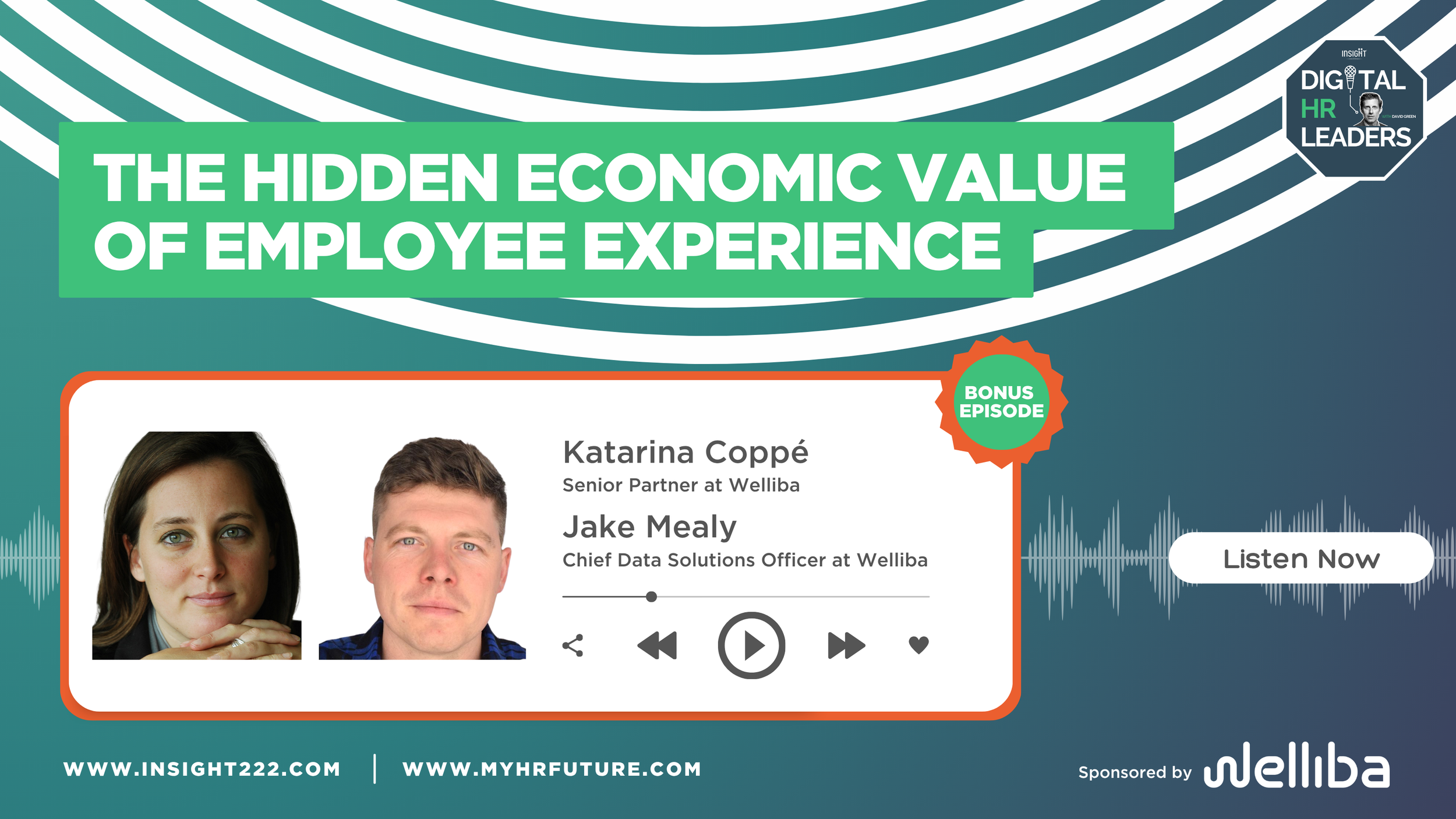
Bonus Episode: The Hidden Economic Value of Employee Experience (with Katarina Coppé and Jake Mealy)
What’s the value of employee experience if you can’t tie it to business performance results?
In this special bonus episode of the Digital HR Leaders podcast, host David Green is joined Katarina Coppé and Jake Mealy, respectively Senior Partner and Chief Data Solutions Officer at Welliba.
Drawing on new research analysing over 25 million data points across the S&P 500, they unpack the direct link between employee experience and financial performance, showing why companies with stronger employee sentiment consistently outperform the market.
Join them to learn more about:
Why traditional employee listening models are breaking down and what’s replacing them
How external data can reveal competitive blind spots in attraction and retention
The surprising link between employee experience and shareholder returns
Why “fixing the floor” matters more than chasing high engagement scores
How HR can bring employee experience into board-level and investor conversations
Practical steps to move from insight to action - faster
Welliba, winner of the 2024 HR Unleash Global Startup Award, is redefining people, culture and organisational insights.
Using the latest AI technologies combined with behavioural science, their EXcelerate solution, instantly analyses all available public data, delivering deep insights into people and organisations - without the need for surveys. Discover how you can elevate your talent strategy, transform your workforce, and stay ahead of your competitors.
Learn more at offer.welliba.com/insight222-2026
This episode of the Digital HR Leaders podcast is brought to you by Welliba.
[0:00:08] David Green: As people and HR leaders, seeing your organisation's employee engagement score rise from 78 to 80 may feel like progress, but progress towards what exactly? How does that compare to your talent competitors? And does it actually tell you anything about whether your people strategy is contributing to your business performance? It's a question a lot of us are still struggling to answer, and it's exactly what today's conversation gets into.
Joining me today are Katarina Coppé and Jake Mealy, respectively, Senior Partner and Chief Data Solutions Officer at Welliba, who have been doing some genuinely fascinating research to connect employee experience to financial performance at scale. So, today we're going to discuss why traditional employee listening, however well executed, leaves a critical blind spot, and what passive listening from public data can reveal that surveys simply cannot. We get into Welliba's Hidden Economic Value of Employee Experience study, which found that the top 100 EX firms on the S&P 500 outperformed the rest by 5% in total shareholder return over five years, and what that means for how you make the case for employee experience at board level. We also explore what the data reveals about the one factor that consistently drives employee experience across every country and industry they studied, and why, despite what it might suggest, it's actually a warning sign rather than a reason to relax. We have a lot to cover, so without further ado, let's get into the conversation.
Katarina, welcome back to the show, and Jake, welcome to the show for the first time. Katarina, can you believe it's been nearly a year since you last joined the show with David? What's been happening with you and Welliba since? I know you're on a rocket ship, basically, aren't you?
[0:02:08] Katarina Coppé: Yeah, it's been great, to be fair. Indeed, time flies. We've been evolving our thinking, but also our hands-on measurement approach on public employee sentiment data. So, we really want to find out what are the key drivers to help organisations across all industries, all kinds and sizes, but really, what are the drivers that can really get people, analytics and HR teams to understand what to do to drive competitive advantage? So, we've shared a few stages. We were at the People Analytics conferences more recently, also last week in London. But yeah, what's really interesting and the proof is in the pudding, in my opinion, is if also clients are willing to share the stage with us. So, global brands like Medtronic, but also Louis Vuitton, have been actually sharing stories and how really valuable some of the activities and works that we've been doing with them applying this new approach.
So, yeah, it's really great to have different clients, not only the big brands, but also some lesser-known organisations, like Arvesta in agriculture, but also airports. Healthcare organisations have been listening to the podcast last year and then evolved their thinking and working with us. So, thank you very much for having us again. And hopefully, the listeners today will hear some of the latest thinking that Jake and team have also been working on.
[0:03:20] David Green: And actually, Katarina, I must admit, I do get reaction. People give me feedback on different episodes, particularly when technology vendors like you are on. And I spoke to several people after the episode that you and David did last summer, and I know several of them contacted you, and I think they've ended up being clients, I'm obviously not going to name names or anything like that, which is fantastic, because you think you're really onto something now. Not everyone listening to this episode maybe listened to the episode last year with David. I recommend you do, maybe after you've listened to this one. But for listeners that are not familiar with Welliba, Katarina, can you give us a little bit of a sense of what you do?
[0:03:56] Katarina Coppé: Yes, absolutely. So, at the moment, our mission is really to help organisations redefine how they access and analyse people, culture and organisational insights. So, why? Because we think HR leaders business practitioners, they want intelligence to move the needle, drive business performance and competitive advantage. So, there's a lot of data, we know there's a lot of data in HR teams typically, or in people analytics teams, but how does it drive towards outcomes? And we use basically the latest of AI technologies with combined behavioural science to really understand what is moving the needle, what can we use, and actually all of that without additional traditional survey approaches. So, we are really hopefully disrupting the game of employee listening.
[0:04:41] David Green: Yeah, I think you are, because you're bringing external data in, aren't you, from a myriad of different sources, which as you said, is very different to the traditional approach of understanding engagement, because it's an internal survey, or other internal data that companies are looking at. And I think, obviously, you're using AI to do that. But I think importantly, you also have that strong behavioural science aspect to it as well. I mean, most of your team are behavioural scientists, aren't they, as well, so they know how to interpret the data and everything. So, I don't know if you could talk a little bit more to that.
[0:05:13] Katarina Coppé: Yeah, so behavioural science, why? Because indeed, people will say, "Oh, it's only disgruntled people who will speak on public fora or share on public fora. So, if it's only extremes, then there's not really going to be usable data". We think we can analyse it, summarise it, aggregate it in ways that is meaningful. So, we can actually mirror almost the same type of data that people get from traditional surveying without having to survey anyone. And I'm not saying surveying will never need to be done again because it quite nicely complements potentially traditional survey approaches, but we've seen that analysing what's there already in terms of positive and negative sentiment is a way, we call it passive listening. It's actually a new way of listening to your people. Previously, employees, if you wanted to listen, it's always equalled surveying, it's equalled pulsing, survey sampling approaches. Like, everyone has perfected the listening oiled machines. But basically, it comes to a point that has added friction, expectations, and people, yeah, they might have good participation rates, but we're not really seeing good insights to really drive to different outcomes, I think.
[0:06:24] David Green: Yeah, I think that's one of the things, let's talk a little bit more about the traditional model, I guess, and why might now be the right time to rethink it. Now, obviously you can get benchmarks. If you're working with a survey provider, they'll tell you how you compare maybe to other organisations that are using that tool as well. But I think one of the big challenges sometimes for executives is just think, "Okay, our engagement score has gone up from 78 to 80. Is that good? Is it good by location? Is it good by industry? Is it good for a certain category of employees, our business critical staff?" all those sorts of things. So, I think you help provide that additional lens to do that. And I guess the technology is there now to actually do this at scale as well.
[0:07:05] Katarina Coppé: Yeah, exactly. As you mentioned, many technology providers will say, "Yes, we have benchmarks", but typically those benchmarks are anonymous, are aggregated up by the clients they're serving. So, if you want to really look at an aspirational named talent competitor, you are not seeing any differences, really narrative differences, or score differences even, because at the moment, the way people measure, they measure themselves in isolation. So, they don't compare themselves actually against any anyone specific, and that's totally new. And think of even candidate experience as well, people always use surveys to solve. It's almost like, it's always the same tool. To understand something, you use a survey. With candidate experience or candidate NPS, again, if you survey people, why would a candidate that is not hired to a process give almost invaluable feedback? It's going to be a skewed sample, you don't get as valuable information. So, if you can use public data to really give you insights in where there's friction in terms of the hiring process, but also where's the candidate experience potentially broken, and how is your competitor taking a lot of your candidates; well, what are they doing differently? So, we think that that's a new way of passive listening that can help to compliment what's currently being done, and add a layer of sophistication, insight, but specifically also some recommendations on what to do to fix the issues.
[0:08:31] David Green: And I think one of the things that I took from the conversation last year with David and subsequent conversations with you and the team, Katarina, is that your competitors are different depending on if you're a big organisation, where your location is. So, I don't know, if we've got an operation in Shanghai, then our competitor will be very different from maybe our competitors in New York. Yes, you've got your traditional industry competitors, but ultimately every organisation is a potential competitor for the talent that you either want to hire, retain, develop, etc. And I think, again, maybe talk to this, but my understanding of what you offer, you can really, really help companies understand that.
[0:09:15] Katarina Coppé: Exactly, any named competitor with a certain size. So, imagine a new organisation is setting up an entity and in that geography or that region, there's not a lot of employees available. So, well, if someone, not necessarily your product competitor, joins the region, well, what are they doing potentially differently that might mean you need to revamp your employee value proposition, attract differently? So, the idea is, where are attraction and retention risks against who's relevant. And as you said, relevant in a region, relevant in a role, relevant in a segment. If there's enough volume, we will be able to tell you what are the drivers that make the difference, and that can sharpen the attraction strategy, but also make sure the retention of key talent stays at the right and healthy levels.
[0:10:01] David Green: Right. Well, I mean, Katarina, this episode was kind of prompted a little bit by when we saw each other in Zurich, actually, in February for People Analytics World there. And you presented some new research that you've been doing at Welliba, correlating employee experience with stock performance. So, I'm going to turn to you now, Jake. Thanks for waiting patiently to speak. And maybe, as you've not been on the show before, please, when you answer this question, please start with an introduction to yourself and your background as well. I think that's always helpful. Now, I know you've recently published a study, The Hidden Economic Value of Employee Experience, which as I said, studies the link between employee experience and stock performance in the S&P 500. Very impressive report. Definitely recommend listeners check it out. You had 25 million data points, 150,000 websites, and not a single employee directly surveyed, to Katarina's earlier comments there. So, I'm curious, again, maybe you can go into a little bit more detail around that. What kinds of sources are you drawing from to help to do this study? And maybe, sorry, I'm asking you multiple questions, so introduction to yourself, the sources, and then give us an overview of what the study was about and why you did it.
[0:11:17] Jake Mealy: Sure. Well, thank you very much for having me, David. Definitely, it was very easy to stay quiet while you and Katarina were talking there. Always really interested to hear Katarina's perspective. So, yeah, I've been at Welliba for about 18 months now. I'm one of the few non-psychologists in Welliba. I'm a data scientist and storyteller by background, so I previously would have worked in big HR tech platforms, like Indeed. And really, my role is about analysing the kind of data that we're seeing at scale, and trying to draw out these common factors, common insights, and like this S&P 500 study, so that we're really starting to make the connection between employee experience, and like Katarina was saying earlier, actual business outcomes, you know. So, what levers do we need to press? And when we press them, what will actually happen in our business? Those are the kind of questions we're able to answer now.
So, you asked a little bit about the data sources that we looked at, or that were used as part of this study. And Katarina kind of touched on it a little bit there in using this phrase, 'publicly accessible data'. And really, what we're talking about is anywhere on the internet where employees might be discussing or reviewing their workplace. So, the obvious kinds of places that people will be familiar with are places like Glassdoor, and Indeed. These are dedicated platforms designed to take employee feedback. But where our system goes much, much further is into these more discursive or long-form narrative-type data sources. So, think of your message boards, think of your Reddits, even things like professional networks, LinkedIn, of course all of the local equivalents of all of these sites. So, you've got the likes of OpenWork in Japan. There's a vast, vast quantity of data out there. And it's been available for quite some time. The internet isn't that new anymore, and people have been online discussing their employment since the internet came about. But really what we're seeing now is now we finally have the ability to get out there and get our hands around all this, and then bring it all into one place and analyse it sensibly, using those psychometric principles that Katarina was talking about. That's really, really important.
This has been really exciting, right, and we've obviously come up with lots of different questions that we want to answer with this data, but one of the key ones is this connection between employee experience and financial performance, right? So, we selected the S&P 500 as our cohort set of companies. Okay, they're American large caps, but they're very well-known, well thought of, and their financial performance is public knowledge. So, it makes for a very good experimental setup. Our first port of call here was quite simplistic. We just measured the employee experience from this public data, like I said, for these 500 companies, and we just stack ranked them. We listed them from basically the happiest company at the top to the unhappiest company at the bottom. We cut off our top 100, so we took the top 20%, and said, "Okay, these are our top EX performers now. These are the happiest companies in the S&P 500". And then, we just looked at their stock performance over the last five years. In fact, we looked at their total shareholder return, so we folded in dividends as well as stock growth, right? So, that's a really, really powerful metric for, like, how valuable these companies are. And it was really clear that that top group were outperforming the market by 5% over the last five years.
So, really, to put that in context, If you were an investor in 2021, and you had used employee experience as your decision-making tool to build a portfolio, you'd be 5% better off now than if you would just passively track the market. So, 5% maybe doesn't seem like a very big number to some of your listeners, but you've got to remember that these are trillions of dollars in the S&P 500. So, we're looking at billions of dollars of shareholder value potentially being left on the table if companies don't get this right. So, it's been really, really eye-opening, really, really interesting.
[0:15:38] David Green: This episode is sponsored by Welliba. Welliba, the winner of the 2024 HR UNLEASH Global Startup award, is redefining people, culture, and organisational insights. Their EXcelerate solution uses the latest AI technologies, combined with behavioural science, to instantly analyse all available public data and deliver deep insights into people and organisations without the need for surveys. Discover how you can elevate your talent strategy, transform your workforce and stay ahead of your competitors. Learn more at offer.welliba.com/insight222-2026.
One of the challenges, I guess, in HR is, we've been measuring engagement for years. And obviously, as Katarina talked about, the technology is getting more sophisticated. So, we've gone from doing annual surveys to doing monthly pulses, even daily pulses at companies like Microsoft. And that gives us a lot of data. And obviously, we've got other passive listening from internal data that we can do around how people are interacting with each other on various different platforms and everything else. And it certainly gives you a myriad of data. But one of the challenges, I guess, sometimes for HR professionals is to get beyond executives thinking, "Okay, I want to get from 78% to 80%", as the numbers I gave earlier. It's like, "Well, so what? What's the impact on business performance?"
I think what you've done with this study, you've actually shown that there is an impact on business performance, certainly relative to the S&P 500, which is pretty representative, I guess, of maybe the largest organisations in the UK, in Europe, in Asia. And it shows that actually, if you've got high employee experience, then you'd like to perform better as a company as well. And that's important stuff, isn't it? And that's how you get executives to care about this sort of stuff, isn't it?
[0:18:06] Jake Mealy: Yeah. And I think that's what we're going to start to see very quickly now, is that these kind of metrics aren't going to and shouldn't remain locked in the HR department. These are going to start to become standard practice when a board meets, for example, and challenges their executives on the business performance. It's going to be a fundamental metric, just like your cost of goods or your cost of capital, a really fundamental business metric that executives are going to be held to account, especially when investor analysts start to realise this, that there's potential value being left on the table when employee experience isn't being looked after. Now, of course, and we can talk about this in more detail maybe later, but of course, it's still possible for a company to perform with a beaten-down and unhappy workforce. We can all think of examples of that. But the point is, in general, we see that if the employees are happier, more engaged, higher levels of sentiment, that the company is going to perform better. And we can put numbers on that now. And I think that's where we're going to see that shift in how people use this data and how it gets connected in those kind of investor relations and executive level conversations.
[0:19:18] David Green: What's been some of your kind of clients' reaction to this? And Katarina, step in if you want to step in as well. What's been some of your clients' reaction to this when they've seen this study?
[0:19:27] Jake Mealy: The thing that makes people sit up and all of a sudden pay attention is this utterly transparent and instantly visible insight into the company down the road. Because when you initially look at some of the insight that we're producing, when you look at it just in the context of your own company, it looks and feels very similar to what you would understand from a survey. But it's when you put that kind of data in the context of the competitor down the road or a cohort of companies that you know that your executives care about, for example. Then, all of a sudden, there's this eye-opening moment where it's like, "Wow, I can have a much more powerful conversation with the other business leaders in my company about why we need to invest in this, about why it's important, about why we need to get it right. And I can frame that conversation in a way that will make them pay attention".
[0:20:19] Katarina Coppé: And just to add to what Jake is saying, for me, those board discussions are on topics, right? It's not on the generic employee experience, because again, that still sounds fluffy. It's like, should we invest in physical workspace upgrades? Should we invest in technology? Should we invest in return to work? Or should flexible working policies need to be dialled down? I think having that data of, "Okay, well, here's what the impact might be on retention. Here's what my key competitor is already doing or not doing", well, that gives a different story then suddenly. Because otherwise, the board asks a question, we have to analyse it. But this gives immediately, "Well, in the ecosystem of players in this region, if we start doing it, it's suicide. We would lose our talent. We will probably lose the people that make the business here". So, I think it's having the really data-driven insight into more granular drivers of employee experience, so that these are actually more actionable and are things people would like or not like to invest in.
[0:21:21] David Green: Some people listening will say, "Well, hang on. It's just the loudest voices on the internet with Glassdoor, Indeed and Reddit". I think with your background, Jake, you can probably dispel that. But people tend to post when they're unhappy. So, where is this approach really strong? And where do we still need to be a little bit careful with looking at the external data?
[0:21:42] Jake Mealy: Yeah, it turns out there are angry people on the internet, you know, who knew? So, yes, look, of course, you're going to have that classic disgruntled employee sort of flinging grenades and burning bridges on their way out, right? And they do turn up at the odd time in Glassdoor reviews and on Reddit, in the same way that they show up in surveys as well. But actually, what we're seeing is real nuance, particularly when we go to these other types of data sources, the long form, the discursive, where you're getting these really thoughtful discussions between employees who genuinely, not only do they want to represent their workplace fairly, but they're trying to help other people understand what it's like. And so, actually, we've nearly found that the opposite is that we've had to work very hard to tune our scoring model to be able to differentiate the nuance in what people are saying, particularly in these long-format discussions.
That might be another thing that your listeners are sort of thinking to themselves, is to be like, "Oh, I could probably just lob a question into ChatGPT, and I can ask ChatGPT to do a bit of research for me, and it'll be able to tell me what the employee experience is like down the road at my competitor". This is one of the areas, there's lots of reasons why that doesn't work, but this would be one of the key reasons, right, which is that the psychometric model that you use and how you score against it, and how you help the AI to understand what's a little bit negative versus a little bit positive versus very negative versus very positive, that's really, really tricky. And so, for me, as a sort of a non-psychologist looking at this data, that's one of the things that's been really interesting and really eye-opening.
So, I'll give you an example of a bit of a rabbit hole I went down. I was doing an analysis of the top 100 airlines in the world. And so, one of the data sources that kept coming up, which I'd never heard of before, might be familiar to some of your listeners, but it was this messaging forum called PPRuNe, which is used by commercial pilots. And I ended up reading this really detailed discussion of this group of pilots talking about their relative impact of their carriers' fuel management policies. So, the pilots are put under a lot of pressure, obviously, to carry as little fuel as possible, because that's more efficient. But obviously, that's quite stressful, right? Whatever about range anxiety in your EV on the way to the shops, range anxiety in a 737, I'm sure, is pretty different. And so, there was just this really interesting conversation that was developing that was kind of, okay, yeah, there's workplace stress involved, but there's also incentives. The pilots are ranked and the ones that are best at this are given performance incentives, so it relates to compensation. There was all of these aspects being brought in.
This is just one thread on one site that I happened to stumble across as I was doing this research. And that's a level of nuance and richness that you're probably not even getting from a survey. You scale that up across hundreds of thousands of websites across billions of pages, and there's just a massive amount of richness in there. And so, actually differentiating that nuance is actually the challenge. It's not really dealing with the extremes. Dealing with the extremes is quite easy from a methodological perspective, but it's that nuance, which is what's so powerful, but also interesting to deal with.
Then the other part of your question, I suppose, in terms of what do people still need to be careful about? Well, just like with a survey, it's cohort selection really. It's about selecting the group that you're going to measure. So, to take the airlines again as an example, if you measure an airline in aggregate, you're going to be looking at feedback from pilots and from cabin crew and from ground staff and from back office, all rolled up into one. And that might be very interesting, but it'd probably be not terribly useful. And so, just like with a survey, yeah, it's about your configuration and the intent. What exam question are you asking when you go to do this analysis? And that's really the watchword when we're engaging with clients as well.
[0:25:45] Katarina Coppé: For me, it's the granular information around the nuance and what is actually going on, more than just numbers or averages. But for me, the other part of what we do in the analysis is actually looking at recommendations. What should you be investing in that other companies are doing? And typically, you have to go to conferences to hear what the leading practitioners are doing. You have to see them on stage, you have to hear them talk about the initiatives they're deploying, whereas actually our solution democratises best practices, in my opinion. So, it's suddenly giving access to, if you're a smaller or bigger company, you don't really have those opportunities to network and see all of the best players. Now suddenly in your dashboard and in your insights, you get recommendations on what other best players are doing that you might be considering if you want to move the dial. So, I think it's just, it's data, it's insight, but it's also what to do next. And I think that's missing bit is where HR and people analytics leaders are typically struggling. They don't really have that information on what is it that I should do? What is it that I should recommend the business leader to go for? I think that solves part of the problem.
[0:26:47] David Green: So, key to get from insight to recommendations, to decisions, to outcomes.
[0:26:51] Katarina Coppé: Exactly. And we basically want to speed up the analysis bit to get more time on discussing recommendations and then action, right; if you can speed up the analysis of what's the assessment of the current diagnosis, basically. And weeks and weeks, we're spending analysing survey data. Now, suddenly you can have that in a couple of hours, days, "That's the state of play, or here's what we can do, here are the investment bets", and that's a much more interesting conversation, but also for consultancy firms, right? They suddenly can spend on implementation of best practices, rather than analysing. And we get stuck in analysis paralysis too quickly, especially when we're dealing with survey data.
[0:27:34] David Green: I want to take a short break from this episode to introduce the Insight222 People Analytics Program, designed for senior leaders to connect, grow, and lead in the evolving world of people analytics. The programme brings together top HR professionals with extensive experience from global companies, offering a unique platform to expand your influence, gain invaluable industry insight and tackle real-world business challenges. As a member, you'll gain access to over 40 in-person and virtual events a year, advisory sessions with seasoned practitioners, as well as insights, ideas and learning to stay up-to-date with best practices and new thinking. Every connection made brings new possibilities to elevate your impact and drive meaningful change. To learn more, head over to insight222.com/program and join our group of global leaders.
Have you done similar studies using, say, the same or similar methodology on others that confirm or differ from what you found in this particular one?
[0:28:54] Jake Mealy: Yeah, the first time I did another one, I was waiting with bated breath to see was it going to agree or disagree, as you say, but it's been remarkably consistent. So, we've looked at the FTSE 100, we've looked at the Nikkei 225 in Japan. We've looked at the Euronext 100, the top caps in Europe, and it's the same result each time. It's when we stack rank the companies by EX and we look at their trailing total shareholder return, yeah, there's more value being delivered by the high-sentiment companies. And in fact, the S&P turned out to have one of the more modest performance gaps, that 5%. You look at somewhere like Japan and the Nikkei, and the gap was nearly 30%. So, it's been really, really interesting to see some of those differences in that the trend is always the same, but that gap can be quite different, depending on what you're measuring. So, that's been the most consistent thing.
As Katarina has said a couple of times, so far we've been talking about employee experience or EX in general. But obviously, there's a lot of different factors that go into making up how people interpret and understand their experience at work. And so, it's been very, very interesting to look at those underlying factors. And again, our methodology can draw all of this out in real, real detail. And the one common factor across all of these groups of companies across all of these countries is the positive impact that human-to-human interaction has on people's experience at work. It seems to be universal. So, you take in the S&P, for example, two-thirds of companies that we measured listed people's colleagues as one of their top boosting factors. And so, I think it's just such an interesting and timely insight. We're obviously having this big, huge debate at the moment about how AI is going to change the workforce, what are organisations going to look like, not just in the future, but in the near future, in terms of combinations of humans and agents and how we're all going to work together. And it is really arresting to see how universal this concept of what people get out of working as part of a group. There's something really fundamental, really primal about that, I think.
That holds true even for companies that are in general unhappy, as in employees who are, broadly speaking, unhappy; their one bright spot in their experience is their interactions with their colleagues. So, that's been a universal positive. But what I would say is, and what we're seeing, is that's table stakes, right? So, it's kind of a word of warning to listeners who might be looking at their own internal survey results. Maybe you've run a survey recently and you consistently get these high scores on people's interpretation of their team dynamics or their direct managers or their communication with their colleagues. By all means, take a moment, celebrate that. It's certainly better than getting low scores on those kinds of topics. But you should be aware that what our research is showing is that the likelihood is that your competitors are getting similar results, and that everyone probably does pretty well, or most people that you would care about do pretty well on those kinds of factors. So, where the performance gains are, and Katarina's kind of alluded to this already, is at the other end of the scale. The phrase we've been using is, "Fix the floor before you look at the ceiling". That's where the differences are to be made. And it turns out that there's much fewer universals at the bottom end of the scale than there is at the top.
So, this human interaction thing, that's a positive, and that seems to be fairly universal. But the negative aspects, the blocking factors for employee experience seem to be way more industry-, even company-specific. And that's where the gains are to be made in terms of improving and moving to that next level.
[0:33:05] David Green: We'll go into that a little bit now, but before we do, I was just listening to you, Jake, and listening to what you were saying as well earlier, Katarina, and any plans to do more analysis on this data at the moment? So, for example, do you know that one of the case studies in the Excellence in People Analytics book, National Australia Bank found that employee engagement, and specifically the scores related to the leader in their bank branches, was a leading indicator for customer satisfaction and branch financial performance. So, they had an early warning signal. So, if they saw that the engagement level started to drop, they had a chance to go in and do something about it before it started to have an impact on customer and financial performance. Have you done any analysis around that? For example, did you see companies that were picking up over a period of time for their employee experience? And did you see that also have a positive impact on their financial performance? And if so, how much later?
[0:34:05] Jake Mealy: Yeah, I think that's exactly what we need to start doing now, is using it as a lead indicator. And I think also measuring it against, like, not everyone is going to care about total shareholder return. There's lots of ways to measure success, so your example of customer satisfaction in banking. In fact, one of the other studies that we did recently, which is really interesting, was we looked at 35 or 40 of Europe's biggest banks, all governed by the European Banking Authority. And the banking authority publishes the operational risk that they attach to each of those banks, so basically how risky they think their portfolios are. And there is a really strong correlation, a really strong correlation, between the employee experience and the risk, as in the lower the experience, the lower the sentiment, the higher the risk of the portfolio. And we control that across portfolio size. It was quite arresting. And interestingly enough, as you mentioned earlier, David, about the Swedes and the Nordics and their happiness, yeah, they run happy banks and they run low-risk banks, it turns out.
So, yeah, I mean you think about that as like a lead indicator for a regulatory authority, where you're trying to keep track or keep control of a regulated industry like banking or telecoms, or something else. And if you had employee experience measured in real time or close to real time, like we can do now, and we're able to show that that could be the canary in the coal mine in terms of a financial portfolio crossing a risk threshold, like really powerful. We're also looking at things like patient outcomes in hospitals. We've looked at 200 of the biggest NHS trusts, for example, and the star rating given by the NHS to their trusts and how that correlates with the experience of the employees. So, anywhere where humans are coming together to interact and to produce organisational outcomes, this is relevant. So, absolutely, a lot more work to do on that in terms of using it as a lead indicator, as a warning signal. But the early indications are that it's really important in a lot of areas.
[0:36:20] David Green: Yeah, very good. And I know you've done some analysis, there's a lovely two-by-two in the study as well, and you found that high growth and high employee experience don't always necessarily go hand in hand. What does that tell us? And maybe you could walk through the four quadrants that you've got there.
[0:36:39] Jake Mealy: Yeah, sure. So, for those following along at home, if you go on our website, you can see, like, the full S&P 500 data set, we've made it publicly available, and we've made it interactive, right? So, people can go and they can explore the data, and they can pick particular companies, whatever. But anyway, this 2x2 that you're referring to is there. So, if people want a visual aid, then they can follow along that way. But yeah, the easy ones to talk about are where we see this correlation, where we see this high sentiment, high EX, and high growth. And likewise, the corollary of that, where we see the low sentiment and the low EX and the low growth. And those are governed by the things that we've already talked about, the positive human interactions and fixing the floor before you aim for the ceiling, those kind of things. That all kind of explains those two quadrants. But like you, I was immediately drawn to the two opposite quadrants, where the contrarians are, shall we say, where companies that don't fit that mould are dropping into.
So, the top left, I suppose, where we see low sentiment, low employee experience, but the company is still outperforming the market in terms of shareholder return, we refer to these as the unhappy performers. And it's a pretty risky place to be in. Of course, it's possible, as we said at the top of the show, for a company to perform with a whole downtrodden and really annoyed workforce. But it's likely not going to be sustainable, right? And this is what we see here. We see really low scores, particularly around working conditions, so people complaining about their workloads, people complaining about their rewards and compensation. That's important because employees in the S&P 500 can read a stock ticker just like anyone else. And so, if you're working in one of these businesses and you see that your share price, your company's share price is going to the moon and you're not being brought along on that ride, that's going to be pretty fundamental to how you feel about where you work. And that is exactly reflected in the data. We see the lowest scores in terms of employees' interpretation of their company's business strategy. So, they feel totally disconnected from the success that their business is seeing. So, by all means, if you're a leader in one of those businesses, take some time to enjoy the ride. But I would be fixing the floor there fairly quickly if you want your high-performing talent to stay.
Then, the flip side of that coin, the bottom right, is what we call the sleeping giants. So, these are places with really high employee experience, but maybe lower than average stock growth. The S&P is a pretty high-performance index. So, lower here is a relative term. It doesn't necessarily mean unsuccessful. It's just they may be not growing as fast as some of their peers. But we see really, really high engagement with the business strategy in these companies. So, employees really approve of the direction of travel of their companies. But what's really interesting is the highest scores of any cohort in terms of career progression are down here in that bottom-right place. So, really what we're seeing is employees feeling like these companies are places that they can grow, that they can develop over the long term. So, we would expect there to be high retention factors down here. That's one of the things we're going to start to look into, is how all of this relates to employee retention over the long term. And so, that's a really luxurious place to be if you're a business leader down there, because you know you can rely on a loyal and stable and positive workforce to make whatever changes or to make your next strategic move.
So, yeah, some really interesting differences there when we draw out the two-by-two and look at each cohort individually.
[0:40:30] David Green: Take it a little bit more to the positive drivers and the blockers. You alluded to those a little bit earlier, Jake. And it's quite striking what drives positive EX and what blocks it. The positive drivers are actually, as you've talked about, they're quite consistent, that kind of colleague interaction, the enjoyment of working with people in your team. But the blockers are highly specific, as you said. Can we dig into that a little bit more? And what does that tell us about where organisations should be focusing?
[0:41:00] Jake Mealy: Yeah, yeah, exactly. So, to throw some numbers on the whole thing, so I kind of mentioned earlier that in the S&P 500, the two most common boosting factors, the two most common positive factors, are experience of colleagues and experience of direct manager. And they were like 66% and 64%, as in they appeared in 66% and 64% of the companies, so two-thirds. On the flip side, our most common blocking factor was bottom-up communication. And that appeared in about half of the companies. And then, the next most common, there was a bunch of rewards and workload and stuff, but they were all 24% or less, so way less common. And in fact, I think the bottom-up communication piece is connected to those others, right? If you, say, for example, are an employee who's been complaining in your survey about the new shift schedule for the past three quarters and nothing has been done about it, well, now you're not only annoyed about the new shift schedule, you're also annoyed about the fact that you're being ignored when you're trying to give this feedback, right? So, that's where that bottom-up communication piece kind of comes in.
So, I actually think that bottom-up communication thing is a bit of a red herring, right? I think the things that companies should be focusing on are those other more structural factors that are real negatives in the company. And once employees see that the things that they care about are being addressed, then that naturally addresses that issue of bottom-up communication. But it's striking in terms of the differences in commonality, 66% versus 24%. There's a big gap there. So, yeah, it's definitely important for leaders to pay attention to their specific situation as regards what the negatives are.
[0:42:46] Katarina Coppé: An action I think people leaders can also take is bottom-up communication, you don't want to fix it with a survey again. Use public data to understand the feedback rather than going surveying again, because you're raising expectations on actions that you might not take. So, this new way of passive listening is a way to tackle and listen to interesting feedback on innovation, on work culture changes. So, I think it's a new way of dealing with this key blocker that seems to be present in all of the companies in the top five.
[0:43:18] David Green: Katarina, so turning this to you, interpreting really the findings of the study, which I presume correlates with a lot of the work that you're doing with clients anyway, and thinking of the people listening to this episode, how should HR and people analytics leaders use this kind of external intelligence? Is it a diagnostic, benchmarking tool, something you bring into board conversations, or all three or more?
[0:43:43] Katarina Coppé: All three, I would say, for sure, yeah. So, whether you're a consultancy firm or an enterprise organisation, diagnosing is key, right? Understanding and surfacing where attraction and retention risk are occurring, that's really key. And the sooner you get to that insight, the better. So, shortening the analysis phase is definitely super, it's a great diagnostic case. But as we discussed earlier, even with mature employee listening platforms and oiled machines in very mature companies, this extra hybrid listening approach helps to monitor reputation more quickly and specifically workforce reputation, because that's a monetisable aspect of employee experience. We know this costs money if your reputation is deteriorating, whether it's right or wrong, where the gap is. But specifically, where are the levers between the gap? Is perception reality or what do we need to fix? And as Jake said, these employee experience drivers that need fixing, we can see them at a very granular level for any organisation. So, that's really interesting.
Number two topic, you mentioned benchmarking for sure. Traditional survey platforms do benchmarks, they give generic, broad industry-level benchmarks, but we know that complex organisations need more granular information. And a bit with what you said earlier with workforce intelligence data, we know now by using those systems, we know where transitioning talent goes, we know where they go to, we know where they come from, but we don't know why. So, if I now see, "Okay, well, there's a lot of talent moving to one specific competitor that I wasn't aware of". Now, I can actually analyse them in the same depth as I would analyse my own company, and actually benchmark where and how they do different, how do they treat their people? What are they doing differently that potentially attracts and gives them a better employee value proposition? So, that benchmarking capability against named competitors is a very interesting specific use case. And as I said earlier, democratising best practices, because I think, again, learning from the best players, If we learn from good approaches to dealing with your people, new flexible work arrangements, even in settings like service centres, where maybe flexibility is not as easy to implement, there are always good ideas, and these surface now as well by doing this public data analysis.
I think we mentioned the board level one, right, earlier. Any board level decision, return to office, upgrading facilities, those types of discussions should be made not just in isolation, with numbers only from our internal analysis, but we should look at the ecosystem of players within your region, what are they doing differently that creates different experiences, so that we can really redesign decisions around investments, around value and outcomes, rather than the assumptions and the anecdotes that we might hear too loudly.
[0:46:36] David Green: If an HR leader is listening to this conversation and wants to take some action and walk away, what's the first concrete step that you'd recommend? And I appreciate that depends on their context, but generally, what's the first concrete step you'd recommend they take?
[0:46:52] Katarina Coppé: Well, I hope that we both inspired and all three of us inspired some of the listeners in smaller organisations, sizing 500 people and more. Any organisation, any industry can actually access this. This is within reach for everyone. And as Jake said before, we've analysed thousands of companies already. It literally takes a few hours and maximum few days to get the insights into your hands, into basically understanding what's the perception of your workforce against the named competitor. There's no friction, there's no data transfers, there's no tech onboarding. So, it's basically all public data analysis. So, it's basically scoping, what do you need to find out? What's the question you want to ask? What's the business question that you're not able to address with some competitive insights? We will be able to scope and analyse it for the organisation who's interested. And that literally doesn't require any change management processes or big effort, friction. That's a very simple approach. So, I would say there's no good reason not to look at it. And it's actually, as I said, it's a game-changing approach. It's those innovative companies who will get the real advantage, because understanding what your key competitors are doing, that's going to be uncovering insights that get you to a few steps ahead of the other ones. So, the sooner we get people to jump on the bandwagon, I think it's in the interest of everyone to thrive more quickly.
[0:48:17] Jake Mealy: Yeah, and maybe just to add a little bit to what Katarina was saying, I think one of the things, when we see real success using this methodology, it always comes hand in hand with a very well-defined business problem, right? So, Katarina kind of said it there. So, "I am losing talent to this place, but I don't know why". And so, that's a really good exam question that this kind of analysis can answer. But defining that exam question can sometimes be tricky. And so, I think having a real clear idea in your head of, "Okay, my CEO won't listen to me because I want to implement a flexible working policy. How do I prove to them that the flexible working policy will have an impact?" That's a really good exam question for this kind of analysis. This methodology can answer that in a definitive way and put a dollar number on it. So, I think that's probably the challenge to people now. Because as Katarina was saying, doing the analysis is sort of easy, or certainly, we can do it in a couple of hours. But thinking of the question and deciding what success is going to look like, that's what each of us as an HR or as a people leader probably needs to really nail down.
[0:49:33] David Green: The classic Einstein quote attributed to Einstein, "If I had an hour, I'd spend 90% of the time thinking about the problem and 10% trying to solve it". Yeah, very good. Katarina, Jake, wonderful conversation, really fascinating study. Where can people find out more about the study, The Hidden Economic Value of Employee Experience, and also learn more about Welliba and everything that you're doing? Katarina, maybe because you're probably both on LinkedIn, so I'll come to you first and let Jake finish.
[0:50:01] Katarina Coppé: Yeah, definitely on our website. So, while you have a link as well with all of the assets which we collated for your listeners, the study is definitely publicly available on our website, the SMP study; but yeah, we are definitely available on LinkedIn. We are at different conferences, as you have seen last week and in previous months. So, really great to catch up with some of the listeners in person. But of course, the connection, the human connection is where it all comes to results. And I hope that we can inspire people to see what it looks like for their own organisation and reach out to us if they want to see what these types of data sets would look like if we present it on their own workforce.
[0:50:37] David Green: Great. Jake, anything to add?
[0:50:40] Jake Mealy: The only thing is from a purely biased and selfish perspective, is I'd love for people to get on the website and interact with that S&P data. So, it's not just a report that you read. The data is interactive. You can look at it, you can cut it, slice it different ways, compare different groups. So, I mean personally, I'd love people to engage with it. And by all means, give us feedback, ask us questions. That'll make us better, make me better. So, as I say, I'm biased because I'm proud of the work, but that's where I'd encourage people to start their journey.
[0:51:10] David Green: Well, you're right to be proud of the work. And as I said, we've got the links in the episode, I think, where we do the jingle a bit earlier, but also in the show notes as well. So, we'll make sure the links are there. And on the LinkedIn post that I'll put, I'll make sure the links are there as well in one of the comments so people can follow up. And actually, I'm not going to ruin it, I'm going to let people access the study. You've actually got the top 25 companies that came out of it all listed in there as well. So, yeah, really good stuff. Fantastic. Thank you so much for being on the show again, and look forward to seeing you at a conference very soon, both of you again.
[0:51:45] Katarina Coppé: Thank you very much, David.
[0:51:46] Jake Mealy: Thanks, David. It's a pleasure.
[0:51:49] David Green: A huge thank you to Katarina and Jake again for joining us today. I enjoyed the conversation, and congratulations to them on the publication of The Hidden Economic Value of Employee Experience study. We'll put the link in the show notes. For those of you listening, I'm curious, what stood out for you the most from today's episode? I'd love to hear your thoughts. So, please do head over to LinkedIn, find my post about this episode, and let me know what resonated with you. I always read the comments and love learning about the different perspectives in the field. And if this conversation got you thinking, please subscribe to the podcast if you haven't already, and share it with a colleague or friend who might benefit from hearing it too. It really does help us bring more of these conversations to HR professionals across the world.
For those who would like to stay in the loop of what we're working on at Insight222, follow us on LinkedIn or head to insight222.com. You can also sign up for our bi-weekly newsletter at myHRfuture.com, to get the latest thinking on HR, people analytics, and everything shaping our field. Right, that's us for the day. Thanks for listening, and we'll be back next week with another episode of the Digital HR Leaders podcast. Until then, take care and stay well.