
Episode 270: Leading People Analytics Through Business Transformation (with Mattijs Mol)
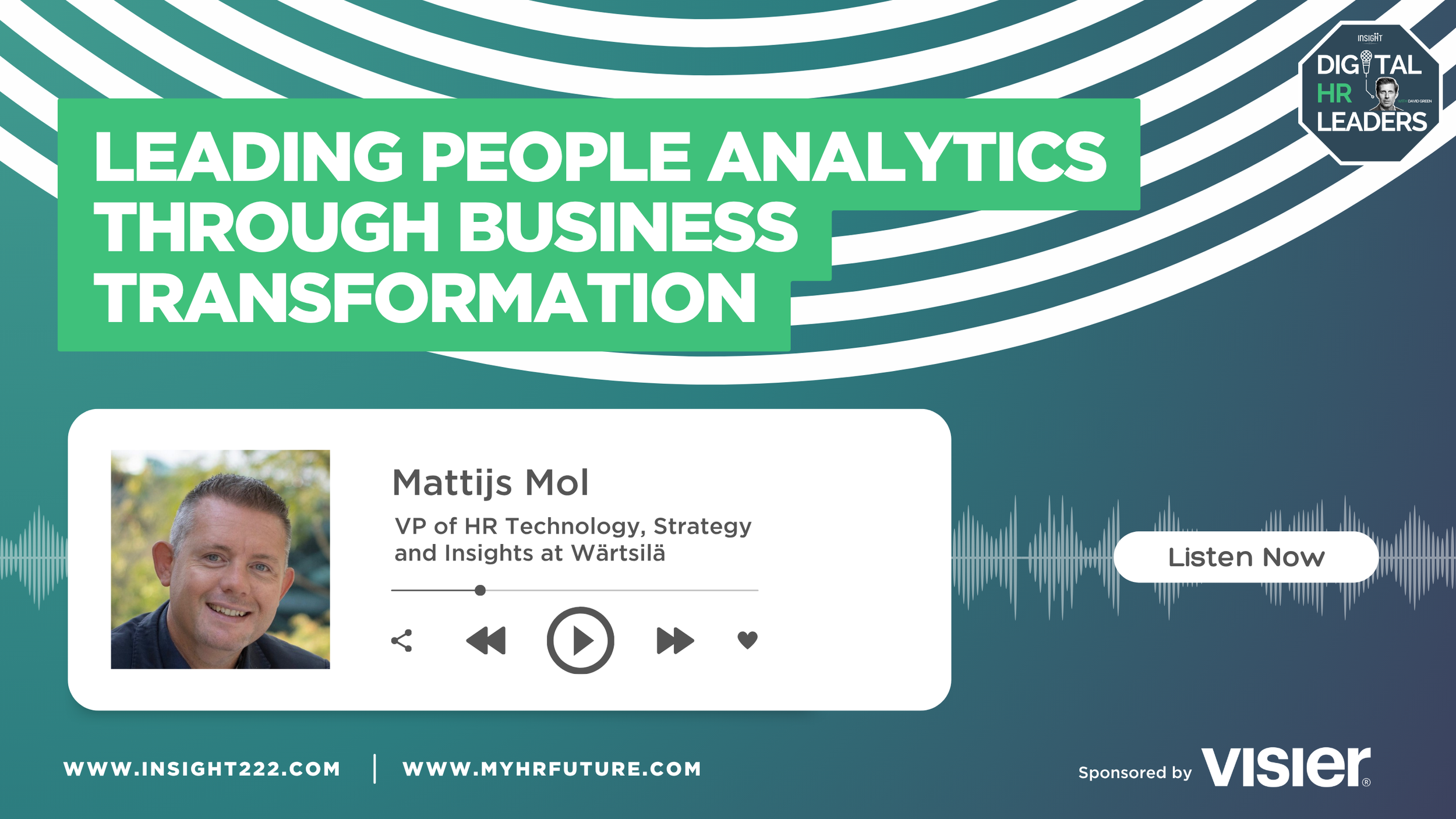
When your business is transforming, how do you make sure your people strategy is part of leading that change?
In this episode of the Digital HR Leaders podcast, David Green is joined by Mattijs Mol, VP of HR Technology, Strategy and Insights at Wärtsilä, to explore what it really takes to run a people analytics function inside a business undergoing fundamental change.
Join them, as they discuss:
Why transformation creates new demands on people analytics and how to meet them
What capabilities matter most when bringing workforce data sources together
How to make wellbeing land with the business by connecting it directly to performance
How AI is reshaping the people analytics function and the wider workforce
Where the boundaries should be when AI starts influencing real workforce decisions
What the people analytics function could look like in five years
This episode is sponsored by Visier.
Visier Workforce AI is your GPS for workforce decisions. Spot attrition risk, uncover pay gaps, measure leadership impact, and track skills shortages before they slow growth. Then act. Align talent to real business outcomes.
Across industries, HR and business leaders are using Visier Workforce AI to navigate the biggest workforce shifts of our time. Move from knowing to doing, faster.
See it in action at visier.com
Also, make sure to read to explore Visier’s latest research on strategic workforce planning in the AI era.
This episode of the Digital HR Leaders podcast is brought to you by Visier.
[0:00:07] David Green: If your organisation is going through a major transformation, how do you make sure your people strategy is keeping pace with everything else that's changing around it? That's the underlying theme of today's episode, as I am joined by Mattijs Mol, VP of HR Technology, Strategy and Insights at Wärtsilä, a global manufacturing and technology company at the forefront of the decarbonisation transformation in marine and energy. Mattijs has spent nearly two decades building people analytics capability across some of Europe's most complex organisations, including Philips and ASML, and he is one of the most thoughtful practitioners I've come across in this space.
Given that we live and breathe people analytics every day at Insight222, I'm excited to discuss with Mattijs what it really looks like to run a people analytics function inside a business under major transformation. But equally, I look forward to hearing Wärtsilä's approach to building the capabilities that turn workforce data into insights the business can actually use, how Mattijs is thinking about AI for his own function for the wider workforce, and how much we should really be letting it into the decisions that matter most. So, if you're trying to figure out how to keep your people strategy ahead of a business transformation, I think you're really going to enjoy this episode.
Mattijs, welcome to the Digital HR Leaders podcast. It's wonderful to have you on the show. To start, it would be great to hear a little bit about you, Mattijs, your journey that led you into the world of people analytics and HR technology and to Wärtsilä as well.
[0:01:50] Mattijs Mol: Thanks for being here, thanks for the invitation, David. Finally!
[0:01:54] David Green: Yes, finally!
[0:01:56] Mattijs Mol: We know each other quite some time, so it's great to be in the show. Much appreciated. Where to start actually? I've been in Wärtsilä now for about five years. So, maybe a few words about the company. I can imagine not everybody is familiar to it. So, Wärtsilä is a global leader in the marine and energy atmosphere, energy industries. We're in the forefront of digitalisation, decarbonisation, and life cycle service in marine and energy markets. Just an example, there are about 100,000 vessels worldwide. One third of them are carrying our equipment, engines, etc. In the energy market, we provide energy power plants, energy storage, optimisation technology, also for the entire life cycle. 20,000 employees, close to, a little less, active in almost 80 countries, 200 locations. And I'm heading actually three different domains. So, I'm responsible for the HR technology, HR strategy, function, and analytics, everything from standard regulatory reports up to advanced analytical projects and everything in between. And I'm in this people analytics space for, I don't know, 15 years more or less, although we probably call it differently these days. So, that's in a nutshell.
[0:03:17] David Green: Great. And as you said, let's stay with Wärtsilä for the moment, then we'll come on to your career in people analytics and your impressions of how the field has evolved. Obviously sounds like your industry, marine and energy, is going through some significant shifts. You mentioned decarbonation, you mentioned digitalisation, and I think even the transition that you're going through from a manufacturing business to becoming much more of a technology-driven company as well. From your vantage point, from HR technology, HR strategy and people analytics, what does that kind of transformation mean? And what are the priorities that you're focused on in your role?
[0:03:58] Mattijs Mol: It means a lot. It's a great time to be around in the company. Like you said, there are many things going on in the industry, right? Decarbonisation, future fuels, big emphasis on digitalisation in general. And it requires a lot from regulatory point of view, but also from a competence and skills management point of view. So, what is it that we expect? What is it that our workforce at scale actually needs to remain competitive, to serve our customers, not only today, but also in the years to come? And that puts a lot of pressure and demand also to HR to deliver the right things with the right value when it comes to competence management, skills management, but also locations. How do we serve our customers best? A great part of our work is service business. So, how do we make sure that we have the right people at the right moment serving the vessels before they depart the harbour again? So, there are a lot of strategic questions actually that that are important for the business and where we can deliver strategic value and direct impact.
[0:05:03] David Green: Yeah, and we start there because, as I'm sure we'll talk about throughout this, the best people analytics is about solving business challenges or supporting the business achieve its strategic aims. You mentioned also that you've got those three remits, HR technology, HR strategy, and people analytics as well. Talk to us a little bit about the mix of technology, strategy and analytics and how that helps you in your role.
[0:05:30] Mattijs Mol: I'm very passionate about these three domains and I'm happy that they're all belonging to my scope, and I think there's a lot of synergies actually between these three. So, maybe if we start with the strategy piece, it's a combination actually of strategy facilitation and turning the business strategies in Wärtsilä in the Wärtsilä way, Wärtsilä enterprise strategies into people strategies, and making sure that we do the right things. That's number one. Then if you boil it down, it's also a lot about project management at PMO. So, we have a certain methodology implemented for managing our bigger projects. It's always easy to start a lot of initiatives in HR based on demand, we're all people people, we like to please, we like to support. It's easy to start initiatives, but it's difficult to bring them to the finish line. And there, we help our experts in scoping, project management, timing, budgeting, etc. Also, of course, the wider portfolio management around it in terms of competing resources and how do we make sure that we bring the right projects to the finish line. We support in the enterprise initiatives, like continuous improvement as well, bring that to HR from a content point of view, from a competence point of view, to help our people think in a more, let's say, process-oriented manner.
So, strategy is an important piece actually to help setting up the HR function for success. I'm a big believer that you need to run HR like a business. And with that comes structure, rigour, and discipline actually. Then from a technology point of view, some people hate it, but when I say that HR is also a process business, it's not only about people, it's a lot about life cycle processes. It's talent acquisition, onboarding, offboarding, merits, performance management, a lot of processes, and they need to be supported by technology. And I think many of the projects that we nowadays run, the activities that we undertake in HR, do have at least a process, and in many cases, a technology component. So, that's already the overlap between these two. And the last one, data sits in everything. And if it's about operational data, creating a contract where information flows from one process to another, from one domain to another, it needs to get governed, give you data quality in place, etc. So, you need to really think about that. Also, as part of the bigger strategic projects, you need to have your data act together and not only come up with ideas or experiences, but also back it up with facts.
So, for me, the technology strategy and insights is actually the Holy Grail. Sometimes I joke, it's everything that the others in HR don't like to do. But I think it's a pivotal triangle to uplift the entire HR function and help the content experts set them up for success.
[0:08:23] David Green: So, you mentioned at the start, Mattijs, you've been in the people analytics field for around 15 years. The function has definitely evolved, the practice has evolved during that time. When you look back over that time, what do you think has changed the most in terms of how organisations view people data, workforce insights, but also hopefully not just the data and then the insights, but the decisions and the outcomes that it can drive?
[0:08:45] Mattijs Mol: I think we moved away from being considered as the lunatics in HR, the geeks, the nerds, the weirdos, and we became mainstream. And that's a very good thing. I still believe that there's a world to win and maybe touch on AI and everything that comes with that as well, and what the future of people analytics will be. But I think we're now in a stage that we've become mainstream, that we're an integral part of HR functions. It's something that businesses like and appreciate a lot, that we bring data to the mix. Maybe one step back, from a technology strategy and insights point of view actually, our premise or mission is that we want to increase decision quality about work and workforce. We call it data-informed decision-making. And sometimes people say that semantics, it's data-driven, but I believe it should be data informed, because it's always a right mix between zeros and ones, figures, facts, and things you probably cannot quantify, good feeling, experience, local context, ecosystem that is difficult to quantify.
But eventually, it's about increasing decision quality around work and workforce. And when zooming out and going back to 15 years ago, that simply wasn't there. And I was always surprised and sometimes shocked by the lack of factual decision-making when it came to bigger workforce decisions. And it was always a lot about, "In my previous company we did this; in my previous company we did that; I have great experience with this or that", without actually having a strong grip on what is actually the decision that we're going to take? How are we going to take the decision? And what kind of data do we need to take a decision and to justify some kind of an outcome? And that evolved in the last 15 years a lot. And I'm very happy to see that.
[0:10:50] David Green: This episode of the Digital HR Leaders podcast is sponsored by Visier. When top talent leaves and skills gaps appear, how do you find your way? Visier Workforce AI is your GPS for workforce decisions. Spot attrition risk, uncover pay gaps, measure leadership impact, and track skills shortages before they slow growth, then act. Align talent to real business outcomes. Across industries, HR and business leaders are using Visier Workforce AI to navigate the biggest workforce shifts of our time. Move from knowing to doing faster. See it in action at visier.com/demo.
You talked about how you're bringing all that data together into an aggregated layer from all the various places in HR and the HR technology ecosystem, different providers that you're using there, and different systems and platforms that you're using. In your experience, and obviously you've done this now at three companies, I think, Philips and then ASML and now Wärtsilä, as organisations strive to bring together the different workforce data sources and make better decisions, what are the capabilities that you find are the most important to help you to do that? And then, I guess the extension is then, how do you make sure that you're connecting that workforce data to business data?
[0:12:37] Mattijs Mol: Yeah, there are different angles probably to answer this question. I think one thing that may be one of the biggest hygiene factors or prerequisites is indeed having your data in a governed, managed manner, preferably one place. That's step number one. And the second thing is how to productise it. I think there are always two camps in the people analytics space, right, the famous build-versus-buy discussion. I was a firm believer until not that long ago about the build domain. So, you have your data in your human capital management stack, and then HR has access and builds a few Power BI dashboards around it, and then there you go. And then you do with some kind of a 'crown jewel project' based on demand coming from senior leadership or board of management, for instance. And that's nice, that's a starting point. And of course, you need to have the people who can drive that, your people analytics partners, your consultants, your translators, whatever you want to call them, who can then advocate for insights in the business.
Actually, a few years ago, we realised that we had to abandon that pattern. It's in my world, or in our situation, maybe a little bit of a dead end street, and our ambitions were bigger. And also, I think technology is supporting us to automate and scale a lot of data and turn your data into insights and insights into actions. And I want to have a people analytics team or functional HR function that focuses on the latter, turning the insights into actions and value and impact in the business. And for that, we had to abandon the path. If you have people working, it was a little bit black and white, but sitting in the basement, doing your data-crunching and your data-coding, that's super-nice. But every hour they spend in certain Excel files, for instance, it doesn't make sense; plus, that all your dashboards are pretty standard. You cannot easily combine. It's maybe advanced reporting and not true analytics or people analytics consulting. So, it has its limitations.
So, we decided to move away from that path and build some more advanced engines in between, that allows our people analytics team to focus on true business problems and give them the flexibility also to scale basic or advanced reporting and workforce insights to managers as self-service. I was always wondering why should there be an HR person sitting in the room? Let's imagine we have a management team meeting and there's questions about attrition pop up and I need to reach out to the HR person who needs to do some crunching in the system. It takes a couple of hours, momentum disappeared, it vanished. And then ta-da, I have my figure. And in the meantime, the meeting is already two or three, four hours later talking about something differently. And that's something that I wanted to get rid of and have a business partner that has information on demand, where line managers, leaders have information on demand and can take that as a starting point to talk about a decision instead about the data generation and the data accessibility and data availability.
I think these are a few elements that helped us in uplifting the impact of our people analytics function, in particular, maybe HR in general.
[0:15:59] David Green: So, you kind of went from building it yourself to a kind of buy situation, is that right?
[0:16:05] Mattijs Mol: Yes. I know there are a few vendors on the market, and we picked one that was best for our context, our solution. And that's something that started to pay off from the get-go. If you're an HR tech, you don't work for kudos, I will say. If your technology stack works, then it's considered as a hygiene factor. But when you're down-timing your talent acquisition suite, for instance, people immediately know where to find you, and it's never perfect. And so, there's always complaints about ease of understanding, user experience. But now, with the solution that we have in place, we got actually proactively applause from the business saying, "Hey, finally, HR provided something that is technology-wise suitable and brings value to us". And that's a difference of day and night, and that's super-powerful and sets many in HR up for success, and we give them give them back a lot of administrative hours. There are not that many in HR who have a passion for Excel or a passion for VLOOKUP, or these kinds of things pivot tables. And now, we help them to actually process insights instead of producing graphs, and that triggers a lot of different discussions.
Like I said, it's nice for HR, it's good for HR, but eventually it's impactful to the business, and that's where we're for eventually.
[0:17:31] David Green: Well, as you said, if you're in that situation, you're in a leadership team meeting or a board meeting, or whatever, and there's a question around attrition in one of your countries or a region, or something like that, as you said, it's frustrating, isn't it, that someone has to then take that away, do a couple of hours work, come back. And as you said, the conversation's moved on there. If you can actually give the answer there, plugging in a question, maybe even in actual language, which we can do now, and as long as the data quality that you talked about earlier is there, you can get an answer back and get some insight and then drive the discussion down there. It's a very different situation, isn't it?
[0:18:09] Mattijs Mol: Yeah, it is. And eventually, nobody cares that much if attrition is 4% or 8% because what's the point? The point is, is it impacting customer deliveries? Is it impacting our commitments to customers? Is it impacting productivity of the team? And the discussion should be around that. And it's only about a certain figure. And HR was famous for that, I think, in the dark ages. And we brought these kind of figures to the table, and then it stopped. And now it's stopped with that. And that gives you completely different dynamics, and it triggers different questions on the HR side, but also on the business side. And sometimes I call it the Trojan horse. It's not about the data as such, but it triggers different discussions and a different atmosphere. And like I said, it's eventually about decision quality. And if we're there to increase the decision quality, the higher the decision quality, the bigger the probability of an outcome that we expect or that we want or that we need.
[0:19:05] David Green: I mean, one of the things that people data is starting to do, particularly when we combine it with organisational data, is it's starting to show there's growing evidence that if you focus and invest on employee experience and employee wellbeing, it actually translates into organisational performance. Now, a lot of us in HR would have had that hypothesis before, but now we've got the data to back it up. And when we've got the data to back it up, then it's easier, not easy, easier to get executives to see that as well. I know everyone listening to this episode, some people will recognise that and know that it's driven positive conversations for those, but others will probably find it difficult to land with their business, saying to a CEO, "Actually, if we invest more time and money in employee experience and employee wellbeing, it's actually going to help our share price, our customer satisfaction scores", whatever the key metric is that they're looking to drive. How are you approaching that at Wärtsilä?
[0:19:58] Mattijs Mol: Our wellbeing is a nice example. It's a topic that I love and that I hate, to be honest. And the reason for that is that it's always perceived from a soft, fluffy HR point of view standpoint. And I don't know, every Tuesday afternoon, there's a webinar about breathing exercises. Nobody shows up, maybe two lost souls from internal communication, something like that, but the business is too busy. And they don't have time for this nonsense and come up with better things to do, "We need to call the customer, we need to deliver spare parts, we have a big project going on. So, forget about it". So, this is as an example. Wellbeing is a project that we started a year ago to approach it from a slightly different manner, really taking the business impact as a starting point, actually. And you can come up with a thousand different initiatives. So, when it's wellbeing, like I said, the breathing exercise or giving, I don't know, ice cream for free on Thursday afternoons, sending people home on Fridays with paid leave, probably has a nice impact on wellbeing. But does it move the needle from a business point of view, productivity point of view? And then, most likely the answer is no. And we said, "Okay, so we need to position wellbeing in a different manner".
We call it sustainable performance, because eventually with our nine-to-five-ish roles, we're here to provide value to the company. But do we set each other up for success, and do we position ourselves and please each other in a healthy situation to be productive and to give the best version of ourselves? And for that, we were thinking about, okay, can we create or position wellbeing as sustainable performance in such a manner that we can measure it? The literacy study, we reached out to the academic world and we used common sense quite a bit. And with that, we actually built an in-house model based on three variables actually, demand, control and support, where demand is people's perceived workload. That's perception as well, because you can not always, at least enterprise level, come up with one definition of what productivity or workload means. So, it's based on information or input from our surveys about how people actually experience their workload.
Then, control is about, do you have actually access to tools, to knowledge, to authority actually to manage your work-life balance in a certain manner? And the third component is support, support from your peers and support from your line managers. And our hypothesis actually was that when demand is high, but when control and support are high as well, that at least in the short- and maybe also in the mid-run, you probably don't have a problem. There's nothing wrong by working hard, sweating a little bit, as long as you feel support and you also have the tools to deliver. The other way around, of course, is when demand is high, but you don't have control and you don't feel supported, then you might end up in issues.
So, we built that model based on survey data with a response rate close to 90%, so unbelievably high, great. And with cluster analysis, now it becomes maybe a little bit technical, but with cluster analysis, we were able to identify actually three different clusters in the company, one cluster where demand was high, but control and support as well; a bit of a middle cluster; and also a lower cluster, where demand was perceived as high, but control and support were lower. And that's nice, you can statistically sign it off as having a nice p-value on everything. The question actually is, what are the common denominators in these three different buckets? Because then, from an HR point of view, you can help in coming up with tailor-made or more focused programmes or activities or projects or services that are relevant for the ones that suffer most. And then we figured, for instance, out there are some demographic factors. We figured out there were some hierarchical figures in terms of distance from our CEO.
Where we saw differences in these scores, some other demographic factors, we learned that there's a huge impact of wellbeing talks and safety walks. It's an engineering company, so there are a lot of safety walks done, we investigated our field service engineers, our frequent travellers to figure out what their wellbeing scores or sustainable performance scores were; but we also figured out what actually the tipping point is of healthy travelling. And then, of course, good old attrition, we also figured out that the ones that were in the lower part had a way higher probability of leaving the company. And for each of these components you can actually add a quantitative price tag, and you can calculate the price for lack of wellbeing and lack of support. And you can come up with, like I said, way more tailored interventions to help the ones that require help, or bring the ones that have the highest scores or in connection with the ones or connect them with the ones in the lowest scores to see if they can change the IDs, etc. That has a direct impact on your bottom line, your financial bottom line. And then, you actually connect the soft topic, wellbeing, as something that is perceived as HR is soft and fluffy, with some more logic, rational effects.
The side effect, actually, the funny thing was that we believe that our studies, and we had a lot of discussions in the business about the figures, but the funny thing is actually that it triggered different kinds of conversations. So, again, it was also a Trojan horse, but people saying, "Hey, that's interesting". And it triggered a lot of discussions, people thinking about, "Hey, but what does it mean for me? What does it mean for my team?" And it created some kind of a safer space to have these kinds of discussions, which is pretty difficult to ask if you do not have any data to open the door to have these kinds of discussions. And that's actually, I think, where the power of people analytics sits. It's probably not directly about, is it 0.6 or 0.7? It's about driving that discussion and driving change and driving impact for the better.
[0:26:28] David Green: I want to take a short break from this episode to introduce the Insight222 People Analytics Program, designed for senior leaders to connect, grow, and lead in the evolving world of people analytics. The programme brings together top HR professionals with extensive experience from global companies, offering a unique platform to expand your influence, gain invaluable industry insight and tackle real-world business challenges. As a member, you'll gain access to over 40 in-person and virtual events a year, advisory sessions with seasoned practitioners, as well as insights, ideas and learning to stay up-to-date with best practices and new thinking. Every connection made brings new possibilities to elevate your impact and drive meaningful change. To learn more, head over to insight222.com/program and join our group of global leaders.
You talked about learning and upskilling, and obviously that's becoming ever more important than reskilling. So, let's talk AI. And obviously, given that you look at people strategy, technology, analytics, I imagine it's a big part of your day-to-day work. How are you thinking about it, both for HR itself, but more importantly, the wider workforce and the business and HR's role in enabling the workforce and the business?
[0:28:05] Mattijs Mol: Maybe I was naïve, but a few years ago, I was thinking AI is another tool in the toolbox that can help you with your tiny algorithm assistant sitting next to you that can answer questions. But now, it becomes more and more a tsunami. When started with taking AI more than seriously in HR, I think two years ago, when we hired our first AI digitalisation lead, we were maybe a little bit early to the party at that point. But now it's starting to pay off. And we approach AI actually in three different layers. One is about individual productivity, so your Copilot and everything that comes with that. Second one is embedding AI within the HR function or in people processes, helping line managers to create better performance goals. We built some competence management frameworks with the use of AI. We have a couple of pilots that are currently going on, so actually to improve the efficiency and effectiveness and the impact of the HR function. And the third one, and that's of course the big one, is about what is the impact eventually on enterprise level on work and workforce? And that's a question that probably triggers a thousand other questions. And maybe we are probably, or maybe even more, not only from a technical point of view about what is technically possible, but also what is legally allowed, and moreover, what about the ethics part? What kind of company do you want to be in the long run? And of course, there are different scenarios, I think, going on in the world.
People or experts say in, I don't know, five years from now, 80% of white-collar jobs will get replaced or removed or tasks will vanish. But I say, we've seen a couple of industrial revolutions in the last 150 years. In the meantime, it actually only created additional jobs. And is AI different or is it, I don't know, time will tell. And there, I think, there's evidence for different scenarios. But no matter what, work will change, that's for sure. And we need to be prepared, and like I said, not only from a technical perspective, what can it do, or from a legal perspective. We're in Europe, our headquarters is in Finland, so we have to deal with GDPR, EU, AI acts, etc. When I talk to peers in the US and China, they say, "Poor you". We are with way more freedom; true. Then still, the most important question is the ethical one. What kind of company do we want to be? And let's imagine that, and again, this is purely speculation and hypothetical scenarios, but let's imagine the technology in five years from now, that AI can take over 40%, 50%, 60%, 70% of your white-collar roles. What kind of company do you want to be? Do you want to go that deep? And what's the impact on the organisation, but also on society? And these kinds of questions will pop up somewhere in the upcoming year or years, and I think we have the responsibility to think about it.
Maybe AI is hype to some extent, and we won't go that deep, and it's a nice, indeed, additional tool that helps in terms of productivity. But if you go way more and more Star Trek kind of thinking, then it will create all these more conceptual, ethical questions. And I would rather be prepared and get ourselves organised for that instead of being surprised and, "Oh, the impact is actually bigger than we were thinking". So, these three layers, technically possible, legally allowed, and ethically right, are actually the backbone of our AI work starting point to make things happen.
[0:31:53] David Green: I mean, as AI starts to get closer to actual workforce decisions, so promotions, compensation, who to assign to a project, how are you thinking about how you would potentially build AI into those conversations?
[0:32:09] Mattijs Mol: That's a very relevant topic or example. And again, if you applied it, let's imagine that in two years from now, you have sufficient data and technology is smart enough to tell you that I should get a 1% salary increase and Jim should get a 10% salary increase. Then what? So, it will trigger a lot of these questions about who's going to make decisions. And add the famous human-in-the-loop kind of statements, eventually it's a human being. But if you take a look at your Google Maps and your navigation systems, if your system tells you you need to go left, most likely you will. So, if the system tells Matthijs 1% salary increase, Jim 10%, okay, are you going to challenge the platform or the decision or the algorithm, or do you simply take it for granted? Apparently, it's the best way to go. And that's what I also mean with the ethical question. So, if it's technically possible to identify what the best setup is for a certain project team, or who you need to give a promotion, or who needs to get fired in terms of performance management, those are very impactful decisions.
So, you need to be very, I think, explicit and clear about what is the place the AI or the algorithm takes in the decision-making process. And again, otherwise, if technology doesn't care, it simply continues, it grows, it becomes better, impactful, whatever. And it requires, I think, a lot from us human beings to push back and to remain pretty critical about our own role in these kind of people processes.
[0:33:52] David Green: Where do you see people analytics going? And I won't hold you to it, don't worry, but because the pace of change in the people analytics space is so extraordinary. As you said, we've gone from being on the edge of HR to being central to the work that HR is doing. What do you think the function looks like in five years' time?
[0:34:11] Mattijs Mol: What I hope and maybe expect in the upcoming years is that it becomes more and more mainstream still and scalable. Sometimes, we say that it's also maybe a little bit provocative, but I think we need less HR in HR, not downplaying the competence and the capabilities and the expertise that we have in other HR functions and in other companies. But I think additional competences or skills are required, and that is indeed business acumen. So, being extremely data-savvy, extremely savvy about process management, continuous improvement and technology. That said, I expect that a lot of mainstream people analytics work, when it comes to reporting, advanced reporting, will become extremely self-service and there will be no need to dig into a platform or tool anymore, only human-to-system communication. But there will be a lot of information coming to you based on prompting, based on asking questions. So, you won't go to a place where you see a lot of dashboards and graphs and trends, etc, but information will come to you, you ask questions where, "What's the risk of my workforce?" And then, probably end up in a conversation where information will come to you and recommendations will come to you.
Then, the big question is what's left for the people analytics partners, if many of the current bread and butter will be cannibalised by technology? Then, my answer would be, it's a lot about interpretation of the data. How should we interpret it? And the art of decision quality and decision-making will become bigger and bigger. And taking good decisions, I think, is a science. The theory, of course, is in common sense, the more good decisions you take, the probability of outcomes or good outcomes is getting better. And I think that's where the future of people analytics sits. So, spending even less time in the basement, less time behind the screen, but increasing business proximity, increasing time spent with the business and helping them in taking better decisions about work and workforce. And like we said, there's so much going on, big megatrends will impact that, that the need for better decisions is, in my world, a potential game-changer or strong competitive edge for companies. So, I think the future for people analytics still is bright and shiny, although different skills are probably also needed.
[0:36:46] David Green: Yeah, which I guess is the same for all functions. The skills mix is going to change, you would think, and our early research at Insight222 suggests, that AI will amplify people analytics rather than replace it. But I guess ultimately, it's about making sure you're focusing on the right challenges for your organisation, which leads me nicely to this question, Mattijs. For those HR leaders or people analytics practitioners listening to this episode, who are navigating similar transformation challenges in their own organisation, what would be your biggest piece of advice?
[0:37:29] Mattijs Mol: A long time ago, I read Marcus Aurelius' book about meditations. Although it's, I think, 2,000 years old, or something like that, there's quite some wisdom in it. Or maybe it's written in such a general manner that it's still applicable 2,000 years later. And every now and then, I get it to just give it a read. And now, my eyes strike on one of the quotes that was in that was about, "Only focus on getting better in what you do, and the rest actually is waste". And I like that a lot because we simply don't know what the magnitude of AI will be, huge, extremely huge, marginal. You can have your personal opinions about that and time will tell. But the only thing actually is to focus on getting better in what you do. And so, that would be my first advice or lesson that I always take closely with me. And focus on the process, focus on getting better, and then the results will come. And if you only focus on the results, most likely it's not sustainable in the long run. And I want to build something that works today, tomorrow, and in a year from now, and that's about trusting the process.
The second piece is, if you do what you did, you get what you got. It's, be extremely thought-provocative, think always, I don't know, 180 degrees differently. If you take a completely different stand on what you probably did or what your preferences are, take that angle and challenge the status quo. And if that's a starting point, let me be extremely curious and business-focused, then it's the perfect recipe to remain extremely relevant for your organisation.
[0:39:15] David Green: Yeah, I think you're right. That curiosity and that strong focus on the business should make for better HR professionals and better outcomes as well through free people. Last question, Matthijs. This is the one we're asking every guest in this series of the podcast, which is kindly being sponsored by Visier. How can HR move fast with AI without losing trust, fairness, and governance?
[0:39:42] Mattijs Mol: Transparency. If I need to phrase it in one, summarise it in one word, it's transparency, and don't do things in isolation or hidden or whatever. I think we need to be extremely transparent in the kind of use cases that you have around. Invite your IT colleagues, invite your enterprise architects, cybersecurity, legal, bring everybody. And maybe it sounds a lot of overhead and admin and then it will slow things down. Simply start, give it a try, come up with potential, relevant use cases that provide impact, and then start to pioneer, experiment, learn, bring people in and give it a try. And if it works, you can scale. And then, in the meantime, you can think about your governance. And I think the worst thing is to only focus on governance, because then you remain in your, I don't know, public policy kind of approach, and you do not create products or AI tools that will deliver value and just learn on the fly.
Bringing in your colleagues from tech, cyber security, legal, will help you. And by that, the ethical question is maybe big, but if you cut the crap, it's also a lot about common sense. And as you start to build an AI tool that, I don't know, identifies if you believe it's a good idea to figure out what the correlation is between zip code and location of your office, to see where the probability of getting rid of people is the highest, yeah. Does that feel good if it's about your parents or about your neighbour or about your kids? Most likely not. I think you can think for ages about ethics, but eventually, it's also a lot of common sense and how do we feel about certain decision and about a certain AI, if it's going to take decisions. And if it feels bad, then probably it's a stupid idea.
[0:41:34] David Green: Mattijs, I've really enjoyed the conversation. It's great that we finally managed to do this after knowing each other for over a decade. Where can people find and follow you and also find out more about Wärtsilä?
[0:41:47] Mattijs Mol: I'm not so keen on socials, but of course, LinkedIn, that's the place to be. linkedin.com/matthijsmol. And I'm very passionate about this topic. So, feel free to reach out, questions, comments. If you disagree with the statements as well, let me know. I'm always open to have conversations to drive this topic further and to increase, to make people analytics even more mature and more impactful than where the community is nowadays. So, always open to get challenged and to have discussions about this topic.
[0:42:21] David Green: That's how we progress and learn, isn't it, by having those open conversations? Fantastic. Mattijs, hopefully see you at an event in the not-too-distant future. Great to speak to you again, and thanks very much.
[0:42:34] Mattijs Mol: Thanks for having me, David. Much appreciated.
[0:42:38] David Green: Once again, a huge thank you to Mattijs for a stimulating discussion, and for sharing his knowledge and experience with us on the Digital HR Leaders podcast. For those of you listening, I'm curious, what stood out for you the most from today's episode? I'd love to hear your thoughts. So, please head over to LinkedIn, find my post about this conversation, and let me know what resonated with you. I always read the comments and love learning about the different perspectives in the field. And if this conversation got you thinking, please subscribe to the podcast and share it with a colleague or friend who might benefit from hearing it too. It really does help us bring more of these conversations to HR professionals across the world.
For those who would like to stay in the loop with what we're working on at Insight222, follow us on LinkedIn or head to insight222.com. You can also sign up for our bi-weekly newsletter at myHRfuture.com to get the latest thinking on HR, people analytics, AI, and everything shaping our field. Right, that's us for the day. Thanks for listening, and we'll be back next week with another episode of the Digital HR Leaders podcast. Until then, take care and stay well.