
Episode 257: What Tesla Taught One HR Leader About Courage, Power, and Agency (with Kristen Kavanaugh)
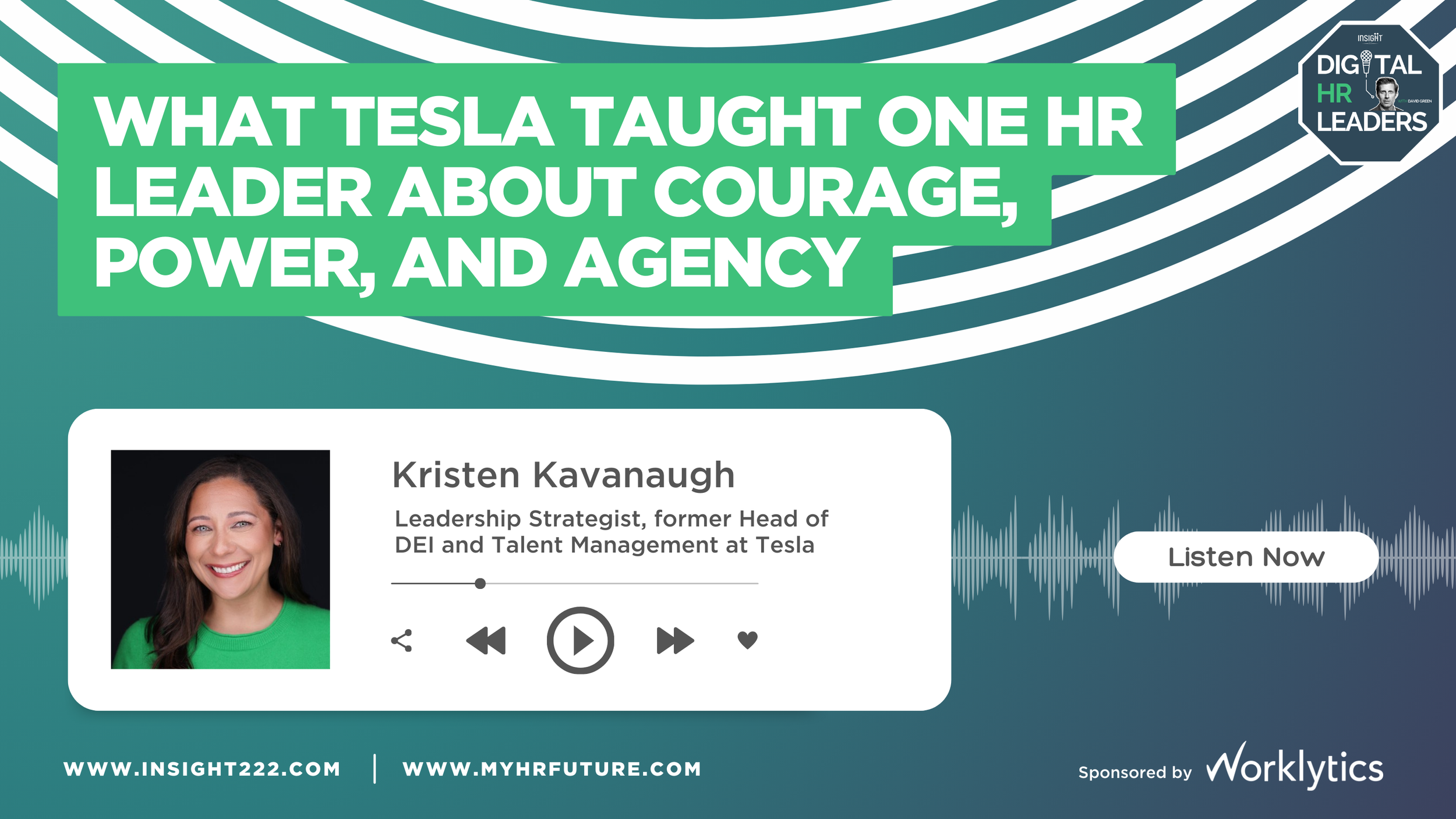
Why are so many HR leaders experiencing “what just happened?” moments at work - and what does it really take to respond to authoritarian leadership with courage instead of fear?
That’s the question Kristen Kavanaugh, Leadership Strategist, former Head of DEI and Talent Management at Tesla, explores in this episode of the Digital HR Leaders podcast.
In this episode, host David Green sits down with Kristen to unpack what happens when fear quietly becomes the operating system inside organisations, why authoritarian leadership styles are becoming increasingly normalised, and how HR leaders can reclaim their agency in environments shaped by power, pressure, and public leadership behaviour.
Tune in and learn:
Why fear-based leadership creates short-term gains but long-term damage
Why HR leaders often underestimate the agency they actually have
How Kristen’s Agency Loop framework helps leaders navigate tension, misalignment, and difficult decisions
What courageous leadership looks like as AI reshapes roles, skills, and power at work
Why HR has a once-in-a-generation opportunity to shape a more humane future of work
This episode is sponsored by Worklytics.
How productive is your organisation, really? Worklytics makes it clear — with privacy-first insights from everyday work data. See how meeting volume, manager effectiveness, collaboration health, and AI adoption are impacting your team’s focus, efficiency, and outcomes — so you can make smarter decisions, faster.
No surveys. No assumptions. Just clear insight into work. Right now, Worklytics is offering podcast listeners a free 30-day trial of their productivity analytics dashboard.
Learn more at worklytics.co/productivity
Link to resources:
This episode of the Digital HR Leaders podcast is brought to you by Worklytics.
[0:00:08] David Green: If you're an HR leader right now, chances are you're navigating more than just organisational change. You're dealing with geopolitical volatility, economic uncertainty, AI transformation, and leadership models that seem to reward dominance over collaboration. It's all a bit overwhelming. But what if the answer isn't about having all the answers? What if it's about taking one small, courageous step at a time? That's exactly what today's episode explores, which is why I'm delighted to welcome Kristen Kavanaugh to the show. Kristen is a Leadership Strategist, a former Head of Diversity, Equity and Inclusion, and Director of Talent Management and Learning and Development at Tesla. Kristen is also the Co-author of the fascinating book, Courage Over Fear, a timely exploration of how leaders can reclaim agency and lead more intentionally in moments of uncertainty. What I love about Kristen's approach to leadership is that she doesn't just ask leaders to be superheroes. Instead, she talks about courage as something incremental, being just 5% more courageous than you were yesterday.
In our conversation, Kristen draws on her own experience working at Tesla, navigating one of the most intense, high-pressure, and infamous leadership environments out there, exploring what happens when fear quietly becomes the operating system, and why so many leaders are experiencing those what-just-happened moments. We dig into Kristen's agency loop framework that helps leaders move through authenticity, agency, decisions, and growth. And we also look ahead to what courageous leadership really looks like as AI reshapes roles, expectations, and power at work. So, without further ado, let's welcome Kristen to the show.
Kristen, welcome to the Digital HR Leaders podcast. To kick things off, can you share with our listeners a little bit about your life story and career journey that brought you to where you are today? Who is Kristen Kavanaugh? There we are.
[0:02:13] Kristen Kavanaugh: Well, thank you so much, David, for having me. I'm really excited to be here for the conversation. Yeah, my journey started in a small town here in the United States. I went to the same high school that my parents went to and even had some of the same teachers. And so, it was that small. But what my parents always wanted for me was something better that they had in their life, the better they have. And so, I knew college was in my future. And so, I found that opportunity in the United States Naval Academy. I never thought that I would go to a military school, it wasn't on my list. But the second I stepped on campus, I knew that that was the place for me. There was just something about it that drew me to the school. And then, that was the only school I applied to. So, that's where I was going to go.
First leader that I met was a Marine Corps officer, a female Marine Corps officer. I had no experience with Marines up to that point, but I looked at her and I said, "That's who I want to be. I don't know what it is, I don't know what it takes, but that's the kind of person that I want to be", and I kind of set my sights on that. Throughout my schooling, I realised that I was a lesbian and that was illegal in the military at that point. And so, I really had a choice of, do I want to go back home and give up an opportunity of a lifetime because I got kicked out of school? Or is this something about my personality and my life that I'm going to put behind me and continue to serve? And so, I decided that service was more important. And so, that moment played a big part in my life and how I think about the workplace now, and how policies really do impact people on the ground.
Ended up becoming a Marine Corps officer, deployed to Iraq in 2004. Ultimately got out after that deployment, again because I saw how the policy was really manifesting in the way that I was able to perform and folks around it to perform around me. Went back, got my degree in social work, started thinking about mental health and the role that that played in workplaces, specifically in the military. And I really got excited about the systems work and how systems come together and people come together and can work together. I started doing some community organising, that got me involved in politics, really all over the board after my time in the military. But I found this little job at a place called Tesla and it was an HR manager job. And so, I read the job description and I said, "Yeah, that sounds like social work inside a company. I think I can do that". And so, I got in. I was an HR manager for the production and manufacturing side of the business. And immediately, when you show up at Tesla, everybody kind of knows this now, you get two or three jobs. And so, my secondary job was to build leaders inside our factory; and so, to really think about what leadership was meant to look like at Tesla and how to build that from the ground.
Did that for a couple of years. My heart was really in the DEI space. Like I said, I'm a social worker by education. And so, when Elon decided to bring in a DEI leader, I was the first person on her calendar to say, "Look, I want to be doing this work and really work on the culture here". So, we had a lot to work on, as we all now know. And so, I did that for a couple years, ended up becoming the head of DEI, also Talent Management and Learning and Development. Again, they give you six or seven jobs while you're there. But I had a blast, and it was really the best job of my career. But sometimes things change, a culture change, and people change. And so, I think we all now know a little bit more about who Elon is as a leader, at least in this phase of his life. And those things just more congruent in how he was talking about certain things outside of the workplace and what we were trying to do inside the workplace. And so, I decided to step away in '22.
The goal was to retire, but that lasted about three weeks. I couldn't shake what had happened and the experience that I had there and what I learned and what went right and what went wrong. So, I ended up starting a company with a business partner. It's called the Agency Initiative. And so, it really is about courageous leadership and helping leaders find their agency, because that's what we found was the problem at Tesla. There were times where we felt like we didn't have agency or we didn't know how to step into our agency. I really think that's the key to leadership right now and getting people the courage to do it.
So, from the Agency Initiative, we wrote a book called Courage Over Fear, which I'm really excited to talk about today, and that's what brought me here, to really make sure that we're helping people step in and be courageous, especially at this moment in our country and our world's history.
[0:06:34] David Green: So, let's get a little bit more into the book. So, as you said, you've recently co-authored a fantastic book, together with Mike Randolph, Courage Over Fear: Harness the Power of Agency to Lead in Uncertain Times. Kind of said a little bit already, but what really pushed you to write the book? And then maybe, what do you mean by courage and what do you mean by agency as well?
[0:06:55] Kristen Kavanaugh: Yeah, absolutely. So, we both left Tesla in our own ways. Mike likes to say now he was doged before doge was a thing. And I found myself being in a position where my values were no longer aligned with the company. And so, we both had very different decision points. But what was common for us is we left and couldn't stop thinking about it and trying to understand what the heck happened to us over those six years that we were there. And the more we talked about it, the more we started working with our clients, we started to recognise that it really was about agency and recognising that leaders do have a lot more agency than they think. But what gets in the way of that agency is fear, and it can be fear of a lot of different things. At Tesla, it was fear of losing your job, it was fear of doing something wrong, it was fear of maybe looking stupid. But for other people, it might be identity loss, or it might be more of a loss sensation. And so, there are a lot of different ways that people feel the fear.
But the commonality is, we have to find the courage to push through those fears in order to exercise our agency and kind of get to the point where we're making the right decisions for our teams, for our companies, and for ourselves. And so, we came up with this idea of Courage Over Fear and really started looking at where are we seeing the similarities here? And so, it's not just in our corporations. Fear-based organisations, it's happening in our government, it's happening in our society, it's happening in our corporations. And so, fear seems to be permeating everywhere. And so, if we're surrounded by it, the last thing we want to do is be consumed by it and do nothing. And so, this really is a way to push people to recognise the ocean that we are all swimming in and normalise that, and also normalise action that can come out of it and the good that can come out of it.
[0:08:54] David Green: That's really helpful. I think in the book, I've got it up next to me here, so I'm just turning to the screen, you describe agency as, "The ability to make intentional decisions based on your values", and I guess, not just in Tesla, I think we're seeing it in other organisations as well. I think perhaps with Tesla, it's magnified a bit more just because of Elon being the CEO and seeming to like being in the public domain, it's very fair to say. You talk in the book about, you describe it as what-just-happened moments or WTF as well, I think, perhaps what you've probably thought on a lot more occasions. And these are moments that many leaders experience. I suspect it was magnified for you and obviously for Mike during your tenure with Tesla. As you outlined, it's the ones that force you to question what you're doing a little bit. As I said, I don't think Tesla is the only organisation where this is happening, maybe more frequently before. Why do you think those moments are becoming more common in organisations today?
[0:10:03] Kristen Kavanaugh: Yeah, I think it's a great question. And I don't think it's just Tesla. But I think HR leaders in particular experience these quite often. And so, and to your point, they're happening more and more often now because we're seeing organisations clamp down on power and control. And so, a lot of times, HR leaders unfortunately are not the recipients of the power or the control. And so, it can feel like things are happening to you that you don't have any control over or any influence over. And so, I think it is the wins of the way that leadership is looking right now. We have a lot of examples of really bad leaders, and those styles are being normalised. Like, you look at Elon, you look at Donald Trump, you look at others. And the authoritarian style of leadership is really being normalised right now and celebrated. And so, I think HR leaders, when you feel those feelings, and so we talk about the feelings first, we talk about the tension that you feel, your body knows when something is happening that is wrong and where you've got to step in and make a decision.
When you feel the tension and you start to recognise your values are in conflict with what's going on, it's incumbent upon you to do something about it. And I think that's where we're really saying this is where HR leaders can make a difference right now. Because if we don't, we are the gatekeepers to people and to culture and to the way that people feel the second they walk into our companies. And so, we're the ones that can do something about the way people feel the second they walk into our companies. But we have to be willing to take some risks and stand up for those values that we know and believe are true and right for our companies, and not the ones that are in fad right now. And so, it really is HR leaders who unfortunately have a lot of work to do right now to face their fears, but they can also be the heroes too.
[0:12:03] David Green: This episode is sponsored by Worklytics. How productive is your organisation, really? Worklytics makes it clear with privacy-first insights from everyday work data. See how meeting volume, manager effectiveness, collaboration health, and AI adoption are impacting your team's focus, efficiency, and outcomes, so you can make smarter decisions faster. No surveys, no assumptions, just clear insight into work. Right now, Worklytics is offering podcast listeners a free 30-day trial of their Productivity Analytics dashboard. Learn more at worklytics.co/productivity.
For an HR leader, it is challenging. It's always challenging when the CEO is a particularly strong personality and he's trying to force something through. But what I'm hearing from you here is it's better to be courageous and stand up, try and do what's best for the workforce; and it isn't just about their feelings, it's also about business performance ultimately as well; be courageous, but be prepared to step away from it perhaps if people aren't going to listen.
[0:13:34] Kristen Kavanaugh: That's right. I mean, we talk about it in terms of calculus. And so, everybody has their own decision calculus in this. And so, there are some times where your calculus says, "This isn't the one that I'm going to stand up for. This isn't the hill I'm going to die on". But then there are some times that the calculus says, "This is absolutely the one that I'm going to stand on everything that I am made up for and go down with the ship". And so, what I haven't seen Is that happening that often, people that are willing to risk it all or risk more than they think that they can. And so, I think that's because folks really don't know what their equation is or what their calculus is, and so you have to start thinking about that. Because, for me, when I decided to leave Tesla, what the maths was telling me was I was going to be okay, my family was going to be okay, my kids were going to be okay. But could I sleep at night knowing that I was defending tweets that I didn't believe in, or I thought was just as wrong as our employees thought. And so, you're going to have to live with those actions and those decisions you take, or don't.
So, when your calculus is telling you you can take a little bit more risk, what we're saying is it's incumbent upon you to do it right now. Because now, we don't know what the next ask is going to be, and what the next ask is going to be. And next thing you know, you've gone way too far, and then you've totally lost your moral compass. And so, really asking yourself today, "Am I going far enough to fight for what I know and what I believe is right?" And if the answer is no, well, what can you go to just a little bit farther tomorrow?
[0:15:10] David Green: So, maybe before we get into this conversation around what HR leaders who have maybe been in a similar predicament to what you and Mike were in, even maybe if it's not quite as public as it was in Tesla, I mean firstly, I think you chose to resign or leave Tesla in 2022. And if anything, that decision has been vindicated by what's happened since. But give our listeners an understanding of what you can share, obviously, but how did working in Tesla's environment shape your understanding of courage, agency, and what happens when leaders operate in fear based systems? And if there's examples that you're able to share, probably some of the ones I guess in the book, then please feel free to do so.
[0:15:58] Kristen Kavanaugh: Sure. I mean, I think Tesla will be the classic example of this. I think we were all conditioned, you know, this is an American movie reference, but you don't talk about Fight Club. And so, nobody talked about Fight Club. But the culture was what we all knew it to be and what we were all fighting to change on the inside. And I don't think the HR team at Tesla gets enough credit for all of the work that they were doing to make sure that we were taking care of our employees and doing the best we could under the circumstances. But once Twitter was bought and Elon was out in the public, then everybody got to see what we had all known for years.
What was transpiring, though, was this culture like, I wasn't afraid when I went to Tesla, I was really excited about it, I was stoked about the mission. But once you get into a culture like that, and you realise that fear is what is driving every decision in every person, you very quickly get sucked into it. And so, you become part of the system that perpetuates the system. And so, in the book, we think about leaders in particular, but we talk about accidental authoritarians, so people that are looking at leaders like Elon or looking at some of our executives and saying, "Well, that's how you succeed here. I can talk to people like this, I can say things like that, I can treat people this way, and that's the way you get promoted". And so, what we saw was a breeding ground for people to learn this way of leading. And so, that's scary to me. That's more scary to me than having an Elon or having a CEO that is like that, when you're teaching an entire generation of leaders that this is the way we do things and the way that leaders are successful.
So, I think for us, it really was about, how do we start to do something different and find places to have courage? In my particular case, a lot of times I had to deal with Elon's tweets, the unfortunate messenger to our employees, about what he really meant or what he wasn't trying to say or how we were really doing things versus what he was saying publicly. And so, you're right, I do talk in the book about, we call it the 'pronouns tweet' now. I won't repeat it, you can go and find it on the internet. And so, as a member of the LGBTQ community, that's my community, I know the importance of pronouns and what that can mean to people. And so, we came in the next day and people were rightly upset. Our employees were rightly upset that he had tweeted that out of nowhere with no context. And so, I had to listen and try to understand where they were coming from and empathise with how that could feel to have your CEO say something, such nonsense, and then also figure out how to have the courage to act. I knew there was nothing I could do about the tweet, I knew more of them were probably coming. But what I could do is step into my HR role and think about, what can we do to make sure that our LGBTQ employees know that we do support them and we do have their back?
So, we looked at our benefits and what we were offering. And so, out of that, we ended up adding gender-affirming care. We ended up adding specific health care providers that understood the LGBTQ+ community. And so, there were some really good things that came out of that tweet. But it didn't have to be that way, it shouldn't have happened that way. And so, I think you have this balance of, I'm being taught one way to lead and one way to show up at an organisation, and you have the pull to be that way. But then you also have your morals and values and your own agency to be able to say, like, "Actually, don't have to do that. There's a different way that I can show up in this moment, no matter what is going on around me", and break that cycle of showing people what good leadership actually looks like. And so, I think those were a lot of the choices that we would see from the HR leaders, from other leaders throughout the company.
[0:20:12] David Green: It must have been hard. Obviously, you'd taken on the role of putting the DEI agenda into Tesla, and presumably that was something that was supported by senior people within the organisation.
[0:20:25] Kristen Kavanaugh: Supported by Elon.
[0:20:26] David Green: And supported by Elon himself. So, he's clearly been on some sort of journey. But you must have felt like the rug had literally been pulled away from you. And obviously, you're less thinking about yourself, you're thinking about people in that community that are in the organisation as well, who have willingly come to Tesla, because they think it's a good place for them to work, not just from their career, but obviously from a DEI perspective as well. That must have been tough.
[0:20:53] Kristen Kavanaugh: It was rough. It was rough, but it was a good place to work. In some pockets, I think it was a good place to work. I remember people emailing me and saying, "My manager just said, 'Eid Mubarak', and they've never acknowledged the fact", and they were people that were doing things differently and saying things differently and treating people differently. And I think that's what gets lost in the Tesla story. It's like, there were people who were really trying. And I do think there are people who are still there that are really trying. I think it's overshadowed by one person.
[0:21:26] David Green: Yeah, very hard. We'll talk a bit more about the DEI agenda in general, obviously because that's had an impact in the US over the last year. I mean, certainly from most of the companies we're working with, this agenda is still being pursued, even if it's being done a little bit more behind closed doors, which isn't great because it's an agenda we need everyone to kind of be bought into and to see the progress that's being made. But one thing that really stands out in the book, Kristen, is that you talk about this idea that courage isn't a grand heroic act, it's something that's practiced through small intentional steps, which actually probably one would hope would make it a little bit easier to do, perhaps. You even describe it as being, "Just 5% more courageous", which I guess is a step that hopefully that people feel they can take. What does that actually look like in day to day leadership? And what does it look like maybe from an HR perspective as well?
[0:22:24] Kristen Kavanaugh: Yeah, I think it's a great question. And the way that my coach would always talk to me about things, if we were doing some planning. She would say, "What is the smallest big step you can take that feels a little risky, but also feels safe enough that you can just go do it today?" And so, that's really where the 5% came from. It doesn't have to be something huge and monumental, we're talking about baby steps here. And so, one that I talk about in the book, I remember I was in the Head of DEI role, and we were going to pitch getting time from our manufacturing production leaders to work with the leaders of the factory on some DEI and inclusive leadership work. And so, time is precious in manufacturing environments. That's something you just don't get. And so, I knew it was going to be rough going, and I also knew it was going to be rough because we were asking to take people to do training to talk about touchy-feely things and how to treat people better. And so, what I did was I thought, "What can I do to build a little bit of rapport?"
So, I decided to wear my Tesla veterans t-shirt. And so, walked in, it says 'veteran' across the chest, and the director of production said, "Oh, you're a veteran?" I said, "No, I'm a Marine". And you could just see him step back and like, "Oh, okay". And immediately, people saw that interaction. They were like, "Wait a minute". And I said, "Did you serve?" And he said, "Yeah, I was in the army". And I said something like, "Oh, I'm sorry, you weren't good enough to be a Marine". And so, just that little bit of interaction, by wearing a little bit of a signal, being vulnerable about who I was, started a conversation and built a rapport. We walked out of that meeting not with just getting one day of training. I got in the staff meeting every single week and on the agenda. And so, that was huge for my team to be able to walk in and immediately have a seat at the table because I wore a t-shirt, and I was willing to push back on somebody who was kind of giving me a little bit of, you know.
So, I think it's things like that, of what can you do to be a little bit more authentic, to be a little bit more vulnerable? And when you have these relationships that might have a little bit of tension, where do you find the connection point? There's got to be something. Like, I didn't know that that guy was an Army veteran. And so, it is putting yourself out there a little bit more and finding ways to build a bridge. And then, once you have the bridge, ask for the thing that you need. And I think that's where we have to go a little bit further. It could have been enough that we had a great meeting, but you know what? I wanted exactly what my team needed and we asked for it and we got it.
[0:25:07] David Green: That's really good. And kind of the main framework of your book is what you've coined the 'agency loop', so authenticity, agency, decisions and growth. Could you walk us through how HR leaders can use this loop to navigate tension, misalignment, difficult choices?
[0:25:28] Kristen Kavanaugh: Yes, absolutely. This is really the core of the book. We wanted to give a framework that was simple and repeatable. And so, I think the first thing to know is it is all driven by courage. So, these three steps all start with, do you have the courage to be authentic and be yourself? And so, even in that example I talked about, the courage to talk about being a veteran and own the fact that being a veteran is something that was an asset to Tesla, and something that was an asset in that particular conversation. And so, understanding your values and how your experience makes you who you are and how you bring that to the table, that's the first step.
Second step, you're going to find yourself where those values are tested in your environment, and you're going to have a decision point. And so, there's always a decision point. This is the agency phase of the loop. And so, when you're faced with that decision, we want you to (1) be decisive, you're going to have to make a choice; and (2) be intentional. So, how are you making sure you're bringing those values and that experience forward into that decision and making a choice that is based on those values? Once you make a choice, you have to learn and grow from it. This is where I think a lot of people fail. It's these last two bits of the agency loop. So, you have to look back and be willing to say, "What went right? What went wrong? What did I learn from it? What can I appreciate from making that choice?" and really do some analysis around it.
Once you do that analysis, that's not the end of the loop. You learn something about yourself. And you have to take that and incorporate it back into who you now have become. And I think this is where Elon goes wrong a lot. I think he will make decisions, which is great to be decisive, but if you're not looking back at the impact of those decisions and how those decisions impacted other people, and then doing something differently because you learned a lesson, then you're not actually becoming the leader that you could be. And so, really having the courage to say, "I have now changed, maybe I'm a little bit different, maybe my values are a little bit different, and the next time I'm faced with a decision point, I might make a different choice and I'm going to learn and grow from it". And so, it is a loop because this always keeps perpetuating, and it is driven by the courage to be yourself, make good choices, and then the courage to be wrong and learn and grow from it.
I think HR leaders especially can use this as a simple framework because they're making decisions all the time. Even though they may feel helpless or powerless, they're always making decisions and they always have the ability to do that. But what are you learning and growing from? And then, how's that impacting who you're showing up as?
[0:28:07] David Green: I want to take a short break from this episode to introduce the Insight222 People Analytics Program, designed for senior leaders to connect, grow, and lead in the evolving world of people analytics. The programme brings together top HR professionals with extensive experience from global companies, offering a unique platform to expand your influence, gain invaluable industry insight and tackle real-world business challenges. As a member, you'll gain access to over 40 in-person and virtual events a year, advisory sessions with seasoned practitioners, as well as insights, ideas and learning to stay up-to-date with best practices and new thinking. Every connection made brings new possibilities to elevate your impact and drive meaningful change. To learn more, head over to insight222.com/program and join our group of global leaders.
We're increasingly seeing strong versions of leadership that are rooted in dominance, fear, autocracy, and control. What do you think this means for the future of leadership? Are we at risk, perhaps, of a fear-based leadership dominating leadership models over the next few years?
[0:29:35] Kristen Kavanaugh: Absolutely, and that is not a fun thing to say. But I think we are at a point where that is a style and a way of being that is being celebrated right now. And it has short-term gains. And so, I think those short-term gains get confused with being effective as a leader. And so, you lose sight of the performance that you lose from people, the wellbeing that you lose from people, the stand-up, everything. People are not meant to live in fear over long periods of time, our bodies are just not meant to operate that way. And so, if we're keeping all of our employees, who are producing our products, who are building the most innovative products in the world, in a fear state, they actually aren't producing the best work that they could. And so, this falls apart pretty quickly if this is how we're going to treat our workforce. And we can't look to AI or the robots to save us from that. And so, we have to make sure that we're treating our humans in ways that they stay in the game and they keep producing the best products and the best services there are.
One of the reasons that we wrote the book is if you look at the dedication, it's to our kids. And so, I've got two boys, they're 5 and they're 8. And I don't want them looking at people like Elon and others and thinking that this is the way that we lead. That's not a healthy way to teach our children. And so, we wrote the book to make sure that we were being good examples in who we were putting in front of our kids as how we want them to treat people and how we want them to show up as leaders.
[0:31:28] David Green: If we had AI into the mix as well, obviously it's reshaping work at a speed that many, or where most organisations haven't really fully caught up with, and obviously Elon is one of the proponents of AI in many of the businesses that he runs. From your perspective, what does courageous leadership look like when AI is reshaping what people do and what organisations need? And again, maybe then I'd add a little bit, okay, what's HR's role in that?
[0:31:58] Kristen Kavanaugh: Right, yeah. I mean, we wrote an entire chapter about this because we think this is one of the most important things that leaders have to contend with. And so, again, we're hopeful about it. I think the robots aren't coming to take everybody's jobs. I think we have to be willing, first and foremost, to have that conversation with our employees and with our teams, and really level-set about what AI is, what AI isn't, and get on the same page about what we can do here. And so, I think in that transparent level-setting conversation, we can start to see what are the benefits of AI and how is that really going to help us perform and do our jobs better and be a value add, not a replacement. And so, I think in having those conversations, then that takes some of the fear of being replaced out of employees' minds, and then we can get to the place of like opportunity.
So, if I can leverage AI to help me in my job, what that means is I've got some space to learn something new. And so, I think that's a part of a leader's job is to say, "All right, yeah, you're probably going to lose 50% to this AI agent. But you know what that lets us do? It lets us do these five things over here. We may not have the skillset to do it now, but how are we going to figure out together how to get you skilled up in a way to do these five things that the AI agent is never going to be able to do?" And so, I think that's where leaders really need to have transparent conversations with people, just to lower the temperature a little bit and lower the fear a little bit, and then start to think strategically about where you can skill-up people or they can go on their own and be re-skilled. But that's the conversation that needs to happen.
I think from an HR standpoint, This is this is an exciting time for us. We are on the front edge of a transformation inside our companies that is once in a generation. And HR leaders have got to have a seat at the table, not just in, "How do we use ChatGPT?" or whatever, but how do we really think about what does it mean for people to sit next to an agent? And how does that increase productivity and the experience that people have inside our company? And so, I really think you have to be more of a transformationalist at this point, and be strategic in how you're looking at what are the true requirements for jobs? They're not the same as they were before. What are the true skillsets that you need? And so, I think getting back to skills-based job descriptions is going to be really, really important, and being honest and true about what it takes to do this specific job. It's a lot of work to go skills-based. We were trying to do that at Tesla, right, to look, what does it really take to do certain jobs? It's a lot of work. But I think if you put the effort in now to understand the true skills you need, then you get the right people in the door that can help you build a culture that is inclusive of, I guess, AI and not replaced by AI.
So, I think it's a really exciting time for HR folks, but they have to push their way to the table and find a way to make this a strategic and transformative conversation.
[0:35:12] David Green: Where are you seeing signs of hope? What positive examples of courageous leadership really stand out to you right now?
[0:35:19] Kristen Kavanaugh: Yes. I mean, so the last chapter of the book is called, "Courage is Hope", because that's what we think this period is. Now, this is not the hope and change that we talked about in 2008 and 2012, this is not what we had in mind. But we're here, and this is what we have to deal with. And so, with this change, there is opportunity. And the systems have been destroyed, and so systems are going to need to be rebuilt in a way that is more inclusive, in a way that is more humane, and in a way that brings people together. And so, I think this works if and only if leaders are going to be courageous right now in this moment, so that we don't go too far into dystopia that we can't recover.
But I do think that there is opportunity here to rethink what is the workplace supposed to look like? What is the HR profession supposed to look like? And that's what is exciting about this time. I know there isn't a lot to get excited about, but that is what can be exciting. We have a once-in-a-generation opportunity to rebuild our society in a way that works for more people. That is something that should be something you can look back on and really be proud of. But it's going to take having courage in this moment right now to do some really hard things. And so, whether that's stepping up and being vocal about your values in meetings, whether that's quitting your job, whether that's starting a new company, there are a lot of ways that you can be courageous right now.
But for me, and I bring this back to my kids, I don't want them to look back on this moment and say, "What did you do?" I want them to know exactly what I did in this moment to try and shape the world in a way that is beneficial for their generation and the most people. And so, that's the question that I would leave people with. What are you doing right now to shape the world in your own little, tiny piece of it in a way that's going to be better, in a way that's going to build this better for other people? And so, I really do think that there's opportunity here, but it's going to take the courage to actually put a little strain on the system.
[0:37:44] David Green: So, if we kind of direct that at HR leaders that are listening, Kristen, so let's be honest, most HR leaders have got a lot on their plate at the moment. What's one small courageous step that those HR leaders that want to can take maybe this week that you feel could genuinely make a difference?
[0:38:07] Kristen Kavanaugh: This is probably not conventional, but I've talked to enough CHROs who are so lonely and isolated and they feel like they're in it by themselves. That's just not true. And so, if you could reach out to one of your colleagues, you all need each other right now to be able to just say, "We can get through this". And maybe there's something that they're doing at company A that you can do at your company, or maybe they're doing something over here or tried something. But that connection has just been lost, and people feel like they are out on an island on their own, and they're suffering. And so, from a human side, reach out to one of your colleagues that you haven't talked to in another company and just commiserate for a little bit and have a little bit of empathy for each other, start rebuilding those connections.
I think inside your company, you've got an ally somewhere that you don't know about on your leadership team. And so, I would challenge you to think about all of those leaders who you think will say no, or who have not been supportive of your work, or maybe the ones that have. Who's your biggest ally? Go talk to that person and try and find ways that you can strategically get on the same side of the table and bring some of the work forward. A lot of times in HR, it feels like we don't have the power to do this or the power to do that. Who's that person that's a roadblock and how do you go get curious about them and why you think they're a roadblock or why they're making certain decisions? And I know that can be hard, especially in virtual environments, where you can't just go have a cup of coffee with somebody. But if you can, find a way to spend a little bit more time with those people so you can get some help and not feel isolated.
[0:39:55] David Green: Really good. We'll get to the question of the series now, and then I'm going to ask you one more question afterwards. So, this is the question we're asking everyone in this series. We're at the start of a new year in 2026. So, I'm going to ask you to look into your crystal ball a little bit. What do you see as being the key role of HR in 2030, in four years' time?
[0:40:18] Kristen Kavanaugh: One, that's hard to believe that 2030 is in four years. I don't know where time has gone. But I really do think it's AI, right, and how HR leaders are being the strategic champions of melding the human side and the AI side of our work cultures. And I think people who are really willing to lean into that now will shape the work environment for generations to come, because we're not going to go backwards, we know that. But having the strategic forethought to think about how to build it correctly now, I think is really going to pay off in the future. And if you don't know how to do that, most of us don't, then where are you going to go get some learning to figure out how to do it? Because I think that's only going to help you in the long run. So, be the strategic and the transformational champion of AI in your organisation, and you'll have a winner.
[0:41:15] David Green: Great. Well, that's a great way to end it. And for this last question, though, just listening to your journey, Kristen, and particularly at Tesla, I mean when you reflect back, is there anything you would do differently? And maybe, what's the key lesson that you've learned along the way?
[0:41:34] Kristen Kavanaugh: Yes, there are a lot of things that I would do differently. I don't know that I have a time to go through all of them, but yeah, there are a lot. I mean, I think the big regret for me was that I had a lot more agency than I thought I did, and I probably could have gotten a lot more done if I wouldn't have been scared. And so, I think if I could go back and do it again, I'd rip that place apart and then, not there anymore anyway, so what does it matter? But I think that's the lesson. You have a lot more agency than you think you do. Don't be afraid to use it, because you'll regret it if you don't when you're gone.
[0:42:14] David Green: What a perfect way to end the conversation, Kristen. It's been a real pleasure speaking to you and learning more about your journey. Can you share how best listeners can find out more about you, follow you, find out more about the Courage Over Fear book, but also the Agency Initiative and all the other great work that you're doing as well?
[0:42:31] Kristen Kavanaugh: Yeah, find us on all socials. So, we're on Instagram. I'm on Instagram and LinkedIn, Kristen Kavanaugh Official on both. Courage Over Fear, same thing on Instagram and LinkedIn. You can find the book on Amazon and Barnes & Noble to order. And then, we're on LinkedIn for the Agency Initiative. If you want to learn more about how we can come in and help your company think strategically about courageous leadership, that's the place to find us. It's agency-initiative.com. But really excited to have the conversation. This was lovely, and I'm excited for 2030 and the world that you're going to help HR leaders build in the next four years.
[0:43:07] David Green: Wow, 2030, that just sounds frightening! Kristen, thanks so much, it's been a real pleasure speaking to you. Just to listeners, we'll put that stuff, those links, we'll put those in the show notes as well so you can find out more. Thank you very much, Kristen. It's been a pleasure to speak to you.
A huge thank you to Kristen for joining me today for what was a fascinating conversation. To everyone listening, I'd love to hear your reflections. What resonated most with you from the conversation with Kristen? You can join the discussion on LinkedIn. Just look out for my post about this episode and share your thoughts. I always enjoy hearing what you take away from the podcast. And if you found today's episode valuable, be sure to subscribe, rate and share it with a colleague or friend. It really helps us keep bringing these kinds of thoughtful, forward-looking conversations to HR leaders and professionals around the world. To stay connected with us at Insight222, follow us on LinkedIn, visit insight222.com, and sign up for our bi-weekly newsletter at myHRfuture.com for the latest research, tools, and trends shaping the future of HR and people analytics.
That's all for now, thank you for tuning in and we'll be back next week with another episode of the Digital HR Leaders podcast. Until then, take care and stay well.