Episode 256: The Real Reason Hybrid, AI, and Change Initiatives Keep Failing (with Brian Elliott)
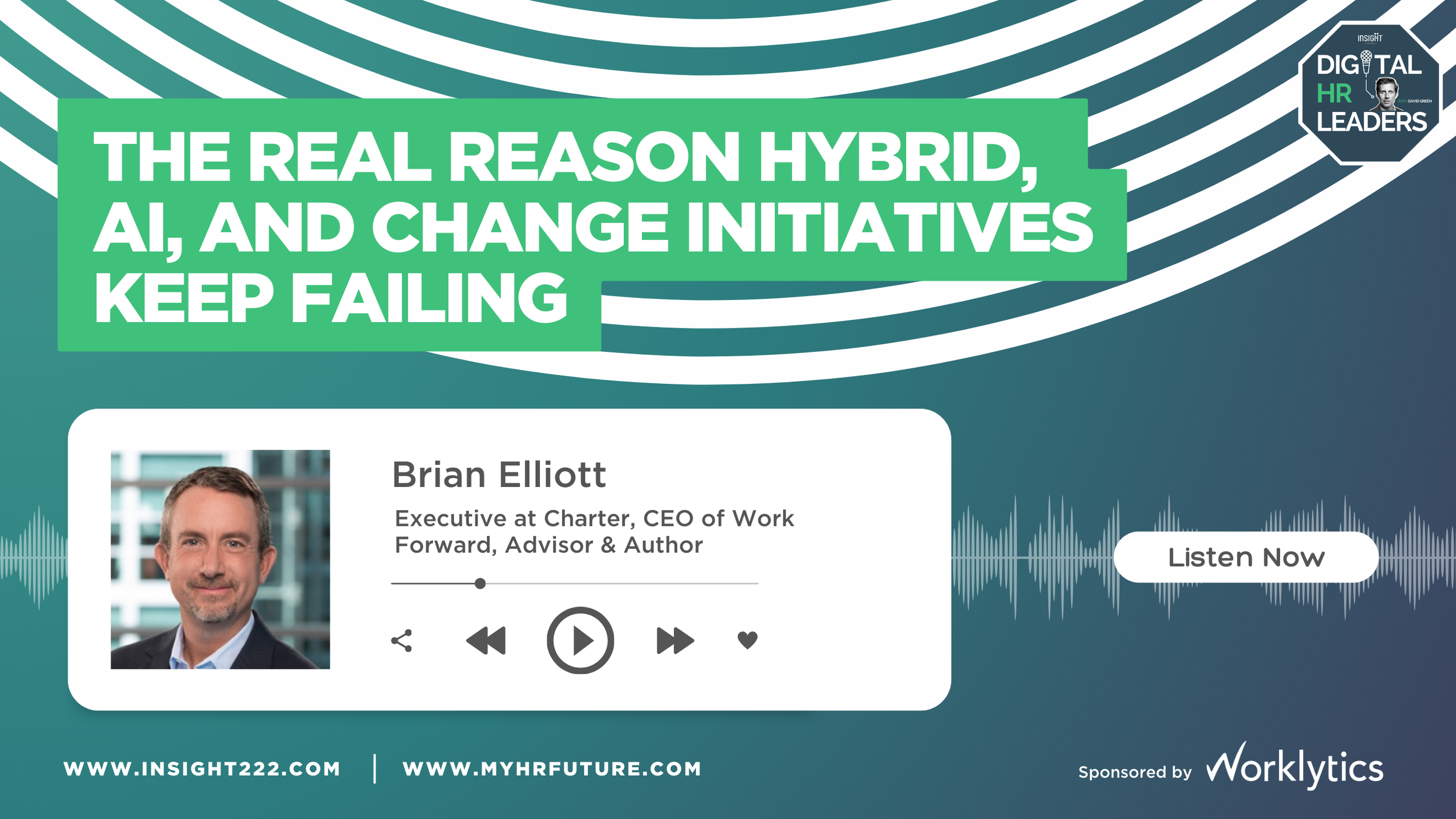
Why do organisations keep repeating the same mistakes when it comes to hybrid work - and are they now doing the same with AI?
That’s the question Brian Elliott, one of the most respected voices on the future of work, explores in this episode of the Digital HR Leaders podcast.
In this episode, host David Green sits down with Brian to unpack why the hybrid and return-to-office debate continues to create tension between leaders and employees, despite years of data and experience, and the striking parallels between how organisations handled hybrid work and how many are now approaching AI adoption.
Tune in and learn:
Why the hybrid and return-to-office debate continues to divide leaders and employees
What the evidence says about making hybrid work effective for both people and the business
The similarities between hybrid work decisions and today’s AI adoption challenges
How AI is changing entry-level roles and long-term talent pipelines
The biggest barriers organisations face when trying to change long-established ways of working
Why leadership behaviour ultimately determines whether change sticks
This episode is sponsored by Worklytics.
How productive is your organisation, really? Worklytics makes it clear — with privacy-first insights from everyday work data. See how meeting volume, manager effectiveness, collaboration health, and AI adoption are impacting your team’s focus, efficiency, and outcomes — so you can make smarter decisions, faster.
No surveys. No assumptions. Just clear insight into work. Right now, Worklytics is offering podcast listeners a free 30-day trial of their productivity analytics dashboard.
Learn more at worklytics.co/productivity
Link to resources:
This episode of the Digital HR Leaders podcast is brought to you by Worklytics.
[0:00:08] David Green: If you step back and look at the big debates shaping work today, hybrid and return to office, AI adoption, employee expectations, they often appear as separate conversations. But the reality is that the challenge isn't really about where people work or which technologies are being introduced. It's about how decisions are made, how change is led, and whether operating models are evolving at the same pace as expectations placed on people. That's exactly what today's episode of the podcast explores, which is why I'm absolutely thrilled to welcome Brian Elliott to the show.
Brian is the CEO of Work Forward and a leading expert on the future of work. A former Google and Slack executive, Brian also serves as a senior advisor to BCG and an Executive in Residence at Charter. He has spent several years researching how organisations navigate major shifts in where and how work gets done. I'm particularly excited about this conversation, as Brian and I explore why the hybrid and return to office debate remain so difficult to resolve and what the evidence actually tells us about making hybrid work effective for both employees and the business. We draw parallels between how organisations approached hybrid work and how many are now approaching AI, moving quickly on technology but more slowly on leadership behaviours and ways of working. And we even go deep into how AI is reshaping entry-level roles and early career development, the barriers organisations face when trying to change long-established ways of working, and why leadership styles, particularly the resurgence of command-and-control approaches, play such a critical role in whether change sticks or stalls. There's lots to cover, so without further ado, let's get the conversation started.
Brian, welcome to the show. To kick things off, could you share a little bit about yourself and your career journey that brought you to where you are today, and also give a little bit of introduction to what you're doing now, because I know you've got you've got your hands in lots of different pies at the moment?
[0:02:16] Brian Elliott: I do, more than I care to admit some days. David, great to be here. Thank you for having me. I've been looking forward to this conversation with you. Your stuff is fantastically insightful. So, I started my career as a consultant way, way back in the day, age of the dinosaurs, 1990s, all that kind of good stuff. Jumped into technology though in the late '90s, into dot-com-bubble land here in San Francisco, and didn't look back. I spent 25 years in tech, startup CEO, spent a number of years at Google, at Slack, at Salesforce, leading business units, product technology teams. And a big part of what I learned over the course of that was the old phrase, "Culture eats strategy for breakfast" was really true.
So, in 2020, I kind of combined my love of learning, my sort of background in being a bit of a data geek when it comes to research, with storytelling around what are great examples of companies that are actually finding better ways to work together that are good for people as well as good for organisational outcomes, and start a think tank. And I've been doing that type of work ever since. So, over the last five years, going on six years at this point, I'm doing a lot of work that is senior executive advisory type of work with Fortune 500 companies, often around how do we think about work transformation, leveraging technology, whether that's remote work and flexible work, whether that's generative AI, which is all the rage these days. But at the heart of it, a lot of it is just about people and engagement and how we create productive cultures.
So, these days, yeah, multiple hats. I do my own work through Work Forward, which is my group. I also am an Executive in Residence with Charter. They do fantastic work in terms of sort of media around future of work and insights. And then I'm also a senior advisor with BCG. So, that's the range of Brian's portfolio approach these days.
[0:04:15] David Green: And just for those listeners, if you don't already subscribe to a lot of stuff that Brian does, we will put the links in the show notes as well. So, yeah.
[0:04:25] Brian Elliott: I write a bit more than I should these days, it feels like at times, but I love doing it.
[0:04:29] David Green: You are a prolific writer, as you said, and you've written a lot on the hybrid return-to-office debate, which continues to burn on really. And it's a bit of a disconnect, I think, between leaders and employees, although I think the stuff we read sometimes in the press is kind of more the outlier organisations. Why do you think so many organisations or leaders, perhaps shall we say, are still struggling with this topic?
[0:04:56] Brian Elliott: I think it comes down to a couple of core issues. So, the MIT Sloan Management Review just published a piece that was me co-authoring with Nick Bloom and Raj Choudhury from London School of Economics, talking about the fact that this actually is a leadership issue at the end of the day, not a policy issue. So, I've worked with enough companies that I've found ways in which firms make really productive use of flexibility. It gives them more access to talent, it gives them more engaged talent. And the challenge that I've seen more often than not though is at the very senior-most level. It is these days the CEO who is still concerned that people aren't working hard enough if they're working from home. The old phrase that I got several years ago still resonates, which is, "I don't know that they're walking the dog four hours a day at home, but I know they can't be walking the dog four hours a day if they're in the office".
It's that level of mistrust that actually creates the challenge as well, right, because the conversation I had with that particular CEO is I said, "Look, what percentage of your workforce do you think is really doing that?" And his answer is, "It's probably not more than 5%". And I said, "Okay, what does the other 95% feel like when you tell them that three days a week isn't enough, they need to be in the office five days a week", because you're trying to manage for that outer boundary of underperforming employees? And it resonated with him and it caused him a little bit of a pause in doing it. But I do think that sort of need and desire for control and the worry, especially given the pressure that CEOs are under these days of, "Are we getting enough?" is a big factor in it.
The other big factor that's pretty clear, because it's showing up in a lot of different research and reports, is if you're going from sort of a hybrid programme of three days a week to five days a week, you're almost always looking to crank up turnover. It's often about wanting people to leave without paying severance. The big challenge then of course is, to be blunt, it's one of the dumber ways that I know of to reduce cost, because it is untargeted. I think that a lot of senior executives think that what you get rid of are the people who aren't in it to win it, right? They're not fully dedicated and hardworking enough; when what you're more likely to lose are the people who have choice in a job market. It's the folks that are the data scientists that the managers are now going to sit there and say, "Am I really going to enforce this on these people who are good performers, because I can't risk losing them because the pressure that's on me as a manager is too high?" But those people will still walk because they have options.
The other group that walks is women. There's a couple of research reports that have shown this consistently, that women more than men desire workplace flexibility, and they're more likely to leave. And it's not just caregivers. It's actually women who don't have kids as well, because the workplace itself has been shown, not saying that these groups want to be fully remote, but they do want more flexibility, so they get a chance to recharge their energies outside of what's typically a more male-dominated workplace that bluntly, according to the research, can show more bias and discrimination when you're in the office than when you're working from home.
[0:08:01] David Green: So, from that research, what really makes it work for both employees and the business?
[0:08:06] Brian Elliott: Yeah, we were doing this back in the Future Forum days. We've asked people for years, like, "What do you want?" The answer is very all over the place. But most people want two or three days a week in the office together with their team, as long as their team is co-located in the first place; meaning, David, if you and I both are on a team that happens to be based in London or in San Francisco, there's actually benefit to us being together a couple of days a week, socialisation, if nothing else, right? And so, the firms that have done well by this have had that conversation and said, "Hey, look, we're not saying that we're going to enforce a policy, we're not going to measure and monitor you. But what we do expect is that our leaders are going to actually sit there and say, 'Hey, look, this team is collocated. I'm going to be there on Tuesdays and Thursdays, I'll have an hour open for lunch, we're going to do lunch and learns on Tuesdays, we're going to do a training programme on Thursdays. I'll try to bring in a customer every once in a while to have a conversation with you'", and makes it both like the anchor-day move of, "Here's the reasons why to come in", telling people which days, because that way people aren't guessing which days other people are going to show up in the office. That actually works pretty well.
What doesn't work so well is saying three days a week is the answer, Tuesday, Wednesday, Thursday, when a team is spread out across the globe, right? It's the guy who protested at JP Morgan because his team of IT folks, weren't any of them in the same office, right? And so, saying, "Be back five days a week", when they're all spread out didn't work so well.
So, the things that do work pretty consistently are finding that meeting point in the middle, making leaders be responsible for figuring out what works for their team, because what works for a team of junior salespeople is going to be different than a globally-distributed IT organisation. And that learning goes a long way towards making these types of programmes work.
[0:09:56] David Green: And it seems to me there's two factors here. There's trust. And if you're a CEO or a senior leader and you don't trust your team, now that's really not a good place to be, is it? And it's common sense, isn't it? There's no one size fits all. And we've seen companies, I mean Microsoft's a great example, I know we've spoken about it previously and I've seen you cite it in your articles, and Dawn Klinghoffer was on the podcast a few weeks ago. They're led by the data, not by the opinions of senior leaders. And I think that's where you really want to be, isn't it?
[0:10:31] Brian Elliott: Exactly. Dawn and team worked on this data for years, and they watched what happened subsequently over multiple years as things unfolded, right? The shift to fully remote, to a hybrid programme that was a bit too loose probably, in all context, to the discovery that three days a week actually did matter for them in terms of their thriving metric. And so, they used that data, they debated that data, they discussed it ad nauseum. And at the end of the day, what they said is, "We think this is important. We're going to roll it out, we're going to back it up with data", which also, by the way, was pretty unique in how these things typically happen. And they also said, "At the same time, we recognise different business units and different functions may have different needs. So, we're not going to make this a mandate, we're not going to monitor everyone, but we are going to ask leaders to work with their teams to say, 'Hey, look, if we're all coming together, let's figure out which three days a week it is that we're going to do it', because that's, in our data, what shows evidence of thriving".
The other word that you used was trust. And I think the challenge often is that they don't pair it up with accountability inside of firms. You can't just say, "Trust your employees to a CEO". You also need to back it up by saying, "How is it that we're going to make sure that we've got accountability to goals?" That's often where the harder work comes in. Synchrony Financial has actually been a great example for this one. They actually moved to a hybrid programme. And part of what they talk about is they also dramatically shifted their approach to performance management. They moved away from the annual performance appraisal process to quarterly goal-setting and quarterly assessments of how people are doing. If you can actually, once a quarter, have a conversation with everybody that says, "What are your goals? How will we measure success here? Are we moving the ball in the right direction?" not only do you get a CEO much more comfortable with more flexibility, because then you're focused on the business, not just on a policy statement, you're also going to get better results out of people. And that one's been shown more than once to actually work out pretty well. And the firms that have been successful have had to make that sort of outcomes-driven move as well.
[0:12:37] David Green: This episode is sponsored by Worklytics. How productive is your organisation, really? Worklytics makes it clear with privacy-first insights from everyday work data. See how meeting volume, manager effectiveness, collaboration health, and AI adoption are impacting your team's focus, efficiency, and outcomes, so you can make smarter decisions faster. No surveys, no assumptions, just clear insight into work. Right now, Worklytics is offering podcast listeners a free 30-day trial of their Productivity Analytics dashboard. Learn more at worklytics.co/productivity.
So, let's connect this topic, this conversation around flexible working or hybrid, or whatever you want to call it, there's all sorts of different words, to AI transformation. So, I know this is another topic that you're particularly passionate about and you've written a lot about and do a lot of work for organisations on. I'm partly biased towards an article that you recently published in Charter, I think about three or four weeks before Christmas. Do you see any similarities between the way companies are handling AI today and the way they handled or maybe still handle hybrid work?
[0:14:17] Brian Elliott: Yeah, at a high level, the similarities are kind of scary in the following sense. A lot of the sort of hybrid approaches have been policy driven, right, that there's a magical number of days a week that is the right number of days a week for everybody to be in the office, and that the way we're going to measure success is we're going to monitor activity. So, the magic number of days a week is three or four or five. And the way we'll figure out if we're successful or not is we will monitor whether or not people are coming in three, four or five days a week, or what percentage of that we actually capture. None of that actually is a business result, right? That's just, "Are we being compliant with a policy?" When it comes to AI, too many firms have taken the same approach. It's a surface-level demand, "We want everybody to adopt and use AI. We want it to be peanut butter spread across the organisation, everybody should be doing this. And we'll measure success as the percentage of our employees who are using our tool of choice at least once a week", for what outcome? You can't quite articulate it, right? And then, what you get into is also the problem of doubling-down on that by saying, "We want you to adopt AI because of efficiency".
When you say efficiency to people, what they often translate it to in their heads is layoffs. So, employees start getting fearful that their job is at risk, they don't feel the trust and leadership in the organisation, and so therefore, they're resistant. So, both of these have that sort of common negative framework. The piece you're referring to was Brandon Sammut, who was the Chief People Officer at Zapier, is now the Chief People and AI Transformation Officer at Zapier. They've actually been one of the leading examples for the past year-plus of AI adoption. So, they got 89% of Zapier employees using their internal tools and external tools multiple times a week, etc. They're actually moving way beyond that. They've actually transformed already their customer service organisation in ways that are actually pretty people-centric. And they're now taking that same, like, "We're going to go deeper and transform how we work", into other parts of the organisation.
In talking with Brandon, what I found was a lot of the same patterns they used to be successful in being highly flexible, their remote-first, were what they were using to transform the organisation with AI. And one really clear starting point on that is they're able to really clearly articulate specific workflows inside of the organisation, right? The classic example in hybrid work is, "How do I redesign my onboarding process", right? Which activities should be done in person, which activities can be done remotely and asynchronously. You can do the same exact thing with AI. It requires having some design-based thinking about how we work, not just where we work, and putting the effort into that redesign gives you places where you can automate, where you can take toil out of the process. And that gives you opportunity to accelerate the work and make it happen faster, raise the bar in terms of quality and, God forbid, make employees happy in the process, because you're making their jobs a little bit easier.
So, there's sort of a shift in mindset that you've seen companies like Dropbox, Allstate, Atlassian, the sort of classic great examples of hybrid companies that got it right, take that are really around thinking about how we work, that leverages in the past, distributed, Zoom-based, asynchronous collaboration, that now they're able to take that same approach and use AI to make work even better.
[0:17:50] David Green: Yeah, I think that's an important element of it, isn't it? It's not just changing some task and using technology to do it, it's actually changing how we work, hopefully make work better even, and healthier and everything else. It's not just about automation versus augmentation. It's a lot more than that, isn't it, it's a lot more nuanced?
[0:18:12] Brian Elliott: Yeah. That last point about making work better is really critical, because back to that topic of why employees are fearful of AI, it's because of the job displacement aspects of it, right? It's that word 'efficiency'. There's two changes that can actually address that. One is the shift to outcomes-based thinking. So, the same thing that have made remote companies more successful also is important when it comes to AI. If I can say to a team, "The goal of adopting this is not just efficiency, it's actually to accelerate our roadmap. It's to help us go faster, to build into new markets, to actually attract more customers, to raise our revenues faster than we have before", you've got more job security out of that conversation than you do the word 'efficiency' by far, right? So, that's super-helpful in terms of getting people engaged in the first place, and building the trust so that people will experiment, so they'll actually share what they're doing and what they're learning with each other, as opposed to feeling like this is a competition for who can generate the most output the fastest. And why would I share with somebody else when I'm afraid that 20% of us are going to get cut?
[0:19:16] David Green: That leads nicely to another topic, Brian, which I know you've also written about, entry-level work. We've seen some of the data around that. Clearly, this AI transformation, that we're still in the really early days of really, is arguably one of the biggest shifts that we've had in work since the Industrial Revolution. In one of your recent articles, you talked about how AI is reshaping entry-level work. How do you think leaders should be rethinking early career development and talent pipelines in the new world of work?
[0:19:45] Brian Elliott: Yeah, right now what you're seeing, because we're sort of in this third year of efficiency, especially in larger organisations, you're seeing a lot of companies walk away from entry-level employees, partly because the uncertainty in the economy, right, we're just going to slow down hiring, period; partly because the more experienced employees often are the ones who are able to make better use out of the AI tools. I've worked with a lot of software development organisations on this, and what they seek on a consistent basis is that while entry-level employees can really crank up their skill level using AI, people who really can articulate the outcomes they're trying to drive, that know how the workflows work inside the company, that know their codebase inside and out already, are actually getting greater gains. So, why not just focus on them and make them faster?
What gets missed in that is, who's your next generation of leaders? Who's the next generation of people that are going to step into that role? And there's a bit of an interesting argument, if you think about it, like, all of those people that are your five-year employees, that are the sort of magical sweet spot that people think are getting the most leverage out of AI, eventually go someplace else, right? They eventually turn over. If you're all competing with each other to hire each other's fifth-year employee, how are you generating that experience in the first place? So, there are companies that are taking a different approach, which is, "We're going to balance this out. We may be slower in hiring entry-level employees than we were in the past, but we still want to bring people in because we do want to develop them over time". But also, they have some really different insights. They often come at this with a more digital-native approach in the first place.
Most every young adult coming out of college these days has been playing around with these tools for a while, often longer, often with more creativity, than a lot of their peers inside of the organisation. And so, there's a learning opportunity to be had there too. And I think we need to think about the long-term here, not just the short-term efficiency gains.
[0:21:46] David Green: Actually, one thing you said about Zapier is actually quite interesting. There seems to have been, again, everyone latches onto it if two or three companies do something, but there does seem a combination now of some companies, Zapier's one, Moderna's another, ServiceNow's another, where they're combining the traditional Chief People Officer role with the IT role, and you've got the Chief AI Officer or Work and AI Officer. I know you've done some work with Phil Kirschner as well, talking about a Chief Work Officer. Is this something you see? Again, you don't have to mention other companies that might be thinking about doing this, is this something you see actually becoming more common, moving forward?
[0:22:27] Brian Elliott: I think it is, and I think it will be becoming more common. We lived in a more static universe five years ago, right? The world of work changed, was changing, but how employees worked was shifting slowly, right? It felt like a more continuous shift. And so, the combination of workplace, people, and policies, and training and capabilities, and IT on the back end, it was often rough and not the best coordinated set of efforts across those teams for years. But that was okay when the pace of change felt like it was slower. Now, it's so fast that those teams have got to be coordinated in order to enable employees to do great work. You saw this during the course of the pandemic between workplace and HR teams in particular. If those two teams were aligned, then you weren't saddling a workplace person with like, "You're now responsible for compliance on a policy you didn't even set in the first place, that you can't control because the leaders aren't there". And you also weren't putting people leaders in a position where the workplace team wasn't aligned with them and not able to deliver the spaces that people were looking for.
Fast-forward, it's pretty easy to see that that the same set of challenges still exists. But now you're layering into it massive shifts from what IT needs to be and what they need to do. I've done a little bit of work on this with an outside partner where CIOs themselves too often are focused on vendor management, compliance and policy types of issues, as opposed to deeper employee enablement and workflow redesign type of work. The companies that are doing this right are the ones where they've actually got embedded teams that think through, "How do the tools we provide change how employee work gets done?" which means they're actually taking a more sort of design-centric approach in the first place. I really do believe that you've got to bring that sort of employee enablement set of functions together, whether it's under one human being or whether they are tied at the hip through common goals. One way or another, those functions have got to cooperate much more than they have in the past. And I do think it's going to be easier if there is someone who's sitting across those functions that's got the sort of redesign work mindset in the first place, employee enablement attitude, meaning we know we can get the best out of people if we enable them to do great work, as opposed to thinking about how do we minimise the cost of those functions.
[0:25:05] David Green: And actually, I suppose if we think about it, if we think that HR or traditional HR is going to be more of a product organisation moving forward, then you would argue that's just how we work with customers in many organisations as well, and we're thinking about experience, than customer experience. If you want to think about employee experience, then as you said, you need to bring those pieces together, so really think about that in its totality rather than just individual components of it?
[0:25:32] Brian Elliott: Yeah. Look, I was a product manager, I've led product managers, I've done that job for decades, almost since its inception; 20-plus years ago in tech was when product managers became a thing, right? A product manager is somebody who thinks about the customer journey. They're somebody who lives and breathes sort of a customer-centric way of thinking because they want to take the company's business outcomes and grow them through making customers happier, through loyalty, through engagement, through repeat usage, all the rest of that. That same mindset would be fantastic from a people-centric perspective. The challenge is companies have spent 10 to 20 times the amount of money understanding their customers than they do their own employees. The amount of time and effort that goes into customer journeys, into focus groups, into research is massive.
As you know better than almost anybody else, employee insight and understanding how our employees work is a thriving field, but it's one that doesn't get the sort of focus, attention, and often resources that it deserves, because if we can get the same engagement out of our employees, we know we get more productivity, we know we get more effort, we know we get more discretionary push against goals. But you've got to put the tools, training, capability out there to make it work. And I do think a lot of the same approaches, in terms of deeper understanding of what their drives and motivations are, the sort of process journey mapping that goes across the entirety of, you know, from recruiting through onboarding, through initial productivity, that typically today sits in 15 different silos and 20 different tools, an approach that says, "Hey, we're going to redesign that fundamentally to make it more effective, to make people happier through it, to get people through it quicker, to raise our odds of success at the other end of it", would go a long way towards improving business outcomes as well as employee happiness.
[0:27:33] David Green: I want to take a short break from this episode to introduce the Insight222 People Analytics Program, designed for senior leaders to connect, grow, and lead in the evolving world of people analytics. The programme brings together top HR professionals with extensive experience from global companies, offering a unique platform to expand your influence, gain invaluable industry insight and tackle real-world business challenges. As a member, you'll gain access to over 40 in-person and virtual events a year, advisory sessions with seasoned practitioners, as well as insights, ideas and learning to stay up-to-date with best practices and new thinking. Every connection made brings new possibilities to elevate your impact and drive meaningful change. To learn more, head over to insight222.com/program and join our group of global leaders.
What are the biggest barriers you see when it comes to changing long-standing ways of working?
[0:28:51] Brian Elliott: Change is hard.
[0:28:52] David Green: Yeah, it is hard, isn't it?
[0:28:54] Brian Elliott: We all know this. There's an element to this, which sitting with a group of executives at one point and another person who'd been at this for a while could say, "Can we just say this out loud? This sucks". We're trying to change approaches that people have sort of held near and dear sometimes for their entire career. There's a bit of this when it comes to remote work, that's always been the board member who stands up in front of senior leadership team and says, "You all need to get back in the office, because the way that I learned and got ahead was the mentor that I had in the 1980s that I sat next to". And that that sort of anecdotal story from a person who was highly successful in that moment and in that situation, but who may not be representative of everybody in the room, is a real challenge in the first place.
The second is, it's hard work. Just going back to that issue of outcomes-based management, I did a case study on Neiman Marcus Group, which actually sold to a private equity buyer last year for a huge multiple. They had taken this sort of outcomes-driven and people-first approach to both office staff and their frontline workers. The CEO of that organisation said that was possibly the hardest thing he's ever done, not the processes they put in place, but the senior management time, attention, and debate that had to go into, "What are the five most important things for us to get done this quarter? How are we going to clearly articulate what our priorities are? How are we going to clearly measure them?" Because doing that alone means saying no to a bunch of other stuff. And I've been in that situation. It's really hard when you're a senior exec to say, "These are the five most important things and I'll let go of the rest of it, because I fear that I may not be getting optimal out of the entire organisation".
But there's a level of change there that's required that is hard work. It is often different from how we grew up in organisations, and it's just really hard to drive change around.
[0:31:02] David Green: Yeah, it's about change, about mindset, it's about prioritisation. As you said, you can't do everything, so what are the things that are going to drive business outcomes that we need to drive. If that means we choose these five things and we have to put these two to the side, then so be it. But as you said, that's a difficult conversation to have.
[0:31:21] Brian Elliott: I'll just give you one other example, which is I think we also lack the examples sometimes of what an alternative might look like. I'll give you a straightforward example. One of the things that happened coming out of the pandemic was I had a lot of folks I was talking with, they were like, "I need the whiteboard for innovation. I need people back in the office so that we can all sit there and draw on the whiteboard". And we all know how that works. Usually, it's the guy like me that's at the whiteboard, that's kind of commanding it and holding the pen and conducting an orchestra. The alternative though that I give people is, if you're really looking for innovation, you're better off separating out two processes. Give people the prompt up front. Tell them what the problem is you're trying to solve, tell them about the ideas you want to see generated. Ask them to spend a couple of hours thinking about it, jot down their top three to five ideas, keep it to themselves, don't share it. Then, when you come together, whether it's in the room or whether it's online, throw all of those ideas out at once into a shared document.
By doing that, what you do is you get rid of the filter that happens when we're all in a room together, which is, "Am I going to say something in front of the boss who's more senior than me? I'm the new person, I don't look like everybody else in this room", that sort of sit-on-your-hands problem, right? You're going to get more ideas, you're going to get more idea generation out of that type of conversation. All of a sudden, the person who desperately wants that whiteboard is thinking about, maybe there's an alternative path for me to find innovative ideas that's not just the way I've always done it. So, I think in almost every sort of change management forum, you've got to start off with not just, "Hey, we need to change". You need to be able to give people some concrete ideas about what they might do differently so that they're not grasping for, "Oh, my God, this feels completely unfamiliar and like something that won't work". You're giving them something they can pilot, something they can try and see if it actually works for them.
[0:33:21] David Green: That makes a lot of sense. And you said something a few moments ago, Brian, people first in a people-first approach, whether it's to AI adoption, work transformation, idea generation. What are some of the best strategies that you've seen to really drive that people-first ethos?
[0:33:38] Brian Elliott: The real challenge in it, I think, is if you want to drive a people-first ethos, you need to not just say the words, you actually need to measure results coming out of it. And so, a balanced scorecard approach goes a long way. I'll give you a concrete example of what I've seen that was people-first, even in AI implementation, and then we'll get into the scorecard. I was doing a webinar with a group of HR leaders a month or so back before the holidays. And one of them laid out an AI redesign they did on the promotions process. So, the promotions process had been, people leaders put forward people that they say they're going to promote. Someone, their HR BP then has the joy of looking up all of those people and finding out from one database if the people are in roles 18 months or longer, because that's one set of rules. And then they go to another data set and see whether or not their performance scores, were high enough to be put up for promotion. Then they go back to the managers and say, "Oh, the following people you can't put up anyway".
So, what they did is they inverted all that. They actually created a tool that looked at the two data sets and said, "Which people are both time- and grade-sufficient, and their performance score is high enough that they could be put up for promotion. Let's send that list to the managers". And now they can say which people they want to put up for promotion. What that did is it frees up the HR BP from having the sort of data-mucking job and frees them up to have the conversation that says, "Why is Bob not putting up anybody for promotion? And why is Sally putting up everyone? I need to have conversations with both of them", right? The other HR leaders on the call, there were four or five of them that were like, "Can I get that tool? How did you build that? That would be so great", because it reduced toil inside their jobs, right? They kind of recognised that this is a better way of doing things. That's a people-centric approach in a lot of ways, right?
Debbie Lovich at BCG, who's one of my partners on this stuff, has done work on how we reduce toil in work. And if you take an approach that says, "I'm going to take a workflow like that. I'm going to spend time redesigning it. I know what I'm going to get out are some business process improvements, I'm getting some cycle time reduction; I'm also going to get some quality improvements out of it, because I'm going to have better, richer conversations about who should be put up for promotion; but I'm also going to get some employee engagement out of it, because I've got a group of HR people who are going to feel like you've made my job easier". And that's the same approach that I'm seeing work more broadly. It comes back again, the Zapier example plays in here. They're looking at efficiency gains, quality of work product, and employee engagement. Like, in any of their efforts they're doing in any group of functions, are all three of those getting better? Because if all three are getting better, then we've hit the sweet spot of, this is something that we can continue to grow and make happen, because it's better for the business and it's better for the employee.
[0:36:40] David Green: What can HR and business leaders do to avoid burning out effectively? They're trying to adapt so fast, they're trying to maybe do AI on the side of doing their day jobs, which I think some research suggests at the moment. How do we stop people burning out?
[0:36:59] Brian Elliott: That's a great question. Oh, man! And I wish I had fantastic answers, because I think part of the challenge is this sort of top-down drive has really been problematic. The scarier stat for me is that the people who are the highest AI adopters are actually the most burned out. You would think that in a lot of ways, this would be making their jobs easier. But I think this comes from research that Kelly Monahan drove at Upwork, and we got into the discussion about this the other week. Part of what's sitting underneath the hood here is people who are high performers anyway are the ones that are leaning into the tools fastest, because it gives them even more capability, they can do more. But they are also being faced with an environment in most companies that's saying, "Do more with less, do more with less, do more with less". It's also separating them often from their teammates. So, they're spending more time with the tools and less time with their compatriots, and that's causing more of a separation of human connection, which is also bad and contributing to that burnout.
Then, the third is -- I'm not making you feel any better, I realise -- the third is that the people that are at the worst spot in terms of burnout among that group are middle managers, which often in a lot of companies have been de-layered, right? And so, they've gone from having 6 direct reports to 10 or 12 direct reports. They're already burned out from that. They're also the ones that are leaning in, through either job security fears or because they want to learn it, into the AI to get there.
The solution to all this is a bit of, you've got to slow down to go fast. You said this too. There's consistent evidence that we're not giving people the time and space to experiment and learn. One of the studies I was reading the other day said that 75% of employees report that their primary source of time for training is their personal hours, that the work demands are so high that there's no relief to spend time figuring this out. The AI, like every other tech transformation, is going to go through a J-curve. A J-curve means that, like the steam engine, it's actually less productive when you first start using it. And then eventually you turn the curve and you become much more productive. But it's got to take a dip first. And we're forcing every one of our employees often to be the repository for that negative component of it. And if we keep that up, eventually people will not only burn out, but just stop working altogether, is my fear in this. So, create space, rotate it.
One of the things that I did with one company I was talking with is we figured out a rotational programme. Yes, the quarterly results still need to be hit, but not every team needs to hit every quarter. So, how do we allow sort of almost a turn-taking element to this, which is who's going to get relief in the first quarter, the second quarter, the third quarter, so that people can have some 'unproductive time' so they can learn and experiment?
[0:40:07] David Green: Sensible stuff. I guess that leads nicely to the next question, Brian. Ultimately, it's about leadership. It's a defining factor in all of this, really. We've talked about the rise of tough-talking CEOs, if that's what we want to call them, command and control. Why do you think that approach is resurfacing right now, without getting into politics perhaps, and will it help or hinder the adoption of these changes in the workplace?
[0:40:32] Brian Elliott: I think especially in the States, it's become hugely popular. I'm hoping, sitting here in 2026, that the tide starts to shift on this. We've got an overly fixated following on tech billionaires, people who are highly successful that have knocked it out of the park, when most of our companies are not technology companies, they're not engineered in the same way, and to therefore emulate them may be a bit on the foolhardy side of life. There's also plenty of evidence that even within those firms, we may be picking sometimes the wrong people to emulate. Satya Nadella has been hugely effective at Microsoft, but came in from a much more people-centric culture approach. He turned around a company that was hardcore, tough-talking CEO, Steve Ballmer, who did the sort of internal competition version of, "The bottom 5% every year must be forced out, so therefore it's internal competition".
When I was starting out in tech, it was sort of Microsoft's lost decade, right? It was the timeframe when the org chart for Microsoft famously showed people with guns pointing at each other because the internal competition was worse than the external side of it. Satya Nadella comes in and says, "Hey, look, we need to actually work better together. We need a more people-centric approach to how we work, we need to think about culture as a competitive element in a way in which we win", and dramatically changed the fortunes of Microsoft. If you're going to emulate, as a company that has been around for several decades, a leader in technology, you probably should emulate someone who drove dramatic and better change inside an existing organisation, rather than someone who took a startup from zero to 100.
[0:42:18] David Green: Yeah. I think it was the words that Satya used, "We need to move from a know-it-all culture to a learn-it-all culture", which I thought was really good.
[0:42:29] Brian Elliott: That's right. And by the way, it's also, in a lot of ways, a solution to a lot of these broader problems, too. We are too often celebrating the CEO who is the who is the know-it-all CEO, who has an answer to everything internal to the company, external to the company, to our culture, all the rest of it, as opposed to someone who says, "Hey, look, I hire really smart people. I expect them to have interesting answers. I'm going to listen to them, I'm going to ask them to work with their teams to solve hard problems, I'm going to ask them to enlist their organisations through engagement, but also by setting high goals. And if I do that, I think I'm going to get further than if I tell everybody, 'Come to me for the answers'".
[0:43:12] David Green: More Satya, less Elon. I think that's what we need, isn't it?
[0:43:15] Brian Elliott: There you go. Please, please!
[0:43:18] David Green: So, Brian, as we draw towards the end of this episode, let's shift to a positive note. We're at the start of a new year. What are you most optimistic about, about the future for work?
[0:43:31] Brian Elliott: I really do think we're going to see the payoff coming from firms that are doing two things, they're taking a more people-centric approach when it comes to AI, because I think we're going to see more examples like Zapier. We're going to see more companies that are coming forward that are saying, "Hey, look, we did this in cooperation with our people. We set audacious goals, we asked people to reach them, but we gave them the tools, the support, the trust to get there. And we actually are getting fantastic business results out of it, as well as happier employees". I also think that we're going to see more companies thinking about AI and its potential in ways that are not just the word 'efficiency', right? I think we've gone for the sort of cheaper, low-hanging fruit in a lot of ways, which is, "Great, we're going to use this to take out cost", as opposed to bluntly what every productivity tool has done for the past several decades, which is, it's enabled us to take the group of people that we've got and do more, right? It's enabled us to grow faster, to tackle new markets, to accelerate our roadmap. I don't have to go to an abacus, I can go to Excel; I don't have to type a memo that I put in inter-office mail, I can email you; I can make work happen faster because of my communication tools. Those collaboration tools didn't necessarily come out in terms of efficiency. What they enabled us to do was to grow bigger businesses faster.
So, I do think in 2026, we're going to start seeing more evidence of those two factors being how you actually win with this, as opposed to that sort of almost uniform focus, unfortunately, that we had in 2025 on, "How do we get productivity gains out of this?"
[0:45:05] David Green: So, Brian, penultimate question. As I said, we're in this series, it's the series that's in January 2026, so why wouldn't we look forward to what's going to come up in the next 12 months? Well, we're going to look a little bit further than that. We're going to look forward to 2030. So, I'm going to ask you to look into your crystal ball now, Brian, and we won't hold you to this. What do you see as the role of HR in 2030?
[0:45:34] Brian Elliott: I do think that HR evolves less and less around policy, more and more around coaching and enablement. I do think that you're going to see a greater shift towards the sort of routine aspects of the job that often were, you know, the vast preponderance of the work being done do get automated, right, because they are fairly rote and routine in nature. And it puts more weight and therefore more time and therefore more effort on people who are actually really good at thinking through not just how do I coach an individual, but how do I coach a team? So, this is the other part of the evolution that I think we're seeing that's going to accelerate, which is work is done inside of teams. HR teams that have great leaders are going to start thinking about, "How do I actually enable us to have more fluid teams that are actually performing well together? What does the basis for that look like? How do I reward teams, not just individuals, for performance? How do I coach teams, not just individuals, for greater engagement, for greater efficiency?" That's a radical shift in most organisations about how you think about everything, from hiring to performance management, to off-boarding people, to training, to reward systems, all of it. And I think that shift is going to require a lot of work.
[0:46:52] David Green: Yeah, I think you're right. And I suppose if you even think about it, if the focus has been on the individual, if you can shift that focus to the team and you get it right, you're going to have a much bigger, positive impact on the business.
[0:47:06] Brian Elliott: Yeah, exactly.
[0:47:07] David Green: And people for that matter.
[0:47:09] Brian Elliott: Exactly, which is going to require a lot more deep thinking, a lot more experimentation, a lot more iteration. In some of those areas, there's not really easy, clear answers, right? How do you reward people for team performance? How do you avoid free riders? How do you think about what a good outcome looks like? I've tried this a few times myself. It's not lightweight work.
[0:47:33] David Green: Well, we'll come back in 2030 and just see how we're getting on with that. If we're both not retired by then, Brian, I'm hoping.
[0:47:06] Brian Elliott: Fingers crossed.
[0:47:41] David Green: Brian, it's been an absolute pleasure to speak with you. I really enjoyed the conversation. I know our listeners will as well. Can you share with listeners how they can follow you and all the great work you're doing on the field, how they can find out more about Work Forward, Flex Index, and all the other stuff that you're doing?
[0:47:55] Brian Elliott: Yeah, very glad to do it. So, best place to find me is LinkedIn. I'm on LinkedIn. I'm easy to find there, Brian Elliott. There's a link there to my newsletter. You can follow me on Charter as well. Those are probably the two best places to do it. So, follow me. Give me a link.
[0:48:12] David Green: Brilliant. And you do columns still for MIT as well, don't you, MIT Sloan Management?
[0:48:16] Brian Elliott: I do. So, I write for MIT Sloan Management Review about once a quarter. I publish for them. I write for Charter a couple of times a month. I have my weekly newsletter, which is Work Forward. And then, I do some cooperative stuff with BCG as well. So, it's a bit of Brian spread out across multiple different things.
[0:48:34] David Green: You keep yourself very busy.
[0:48:36] Brian Elliott: I do.
[0:48:37] David Green: Well, thank you for sparing time to help our listeners trying to combat all the challenges that we're facing in the workplaces as we enter 2026. Thanks very much, Brian.
[0:48:48] Brian Elliott: Thanks, David. Much appreciated. Great conversation.
[0:48:52] David Green: Thank you again to Brian Elliott for joining me today. What a fantastic conversation. To everyone listening, I'd love to hear your reflections. What resonated most with you from this conversation? You can join the discussion on LinkedIn. Just look out for my post about this episode and share your thoughts. I always enjoy hearing what you take away from these conversations. And if you found today's conversation valuable, be sure to subscribe, rate, and share it with a colleague or friend. It really helps us keep bringing these kinds of thoughtful, forward-looking conversations to HR leaders and professionals around the world. To stay connected with Insight 222, follow us on LinkedIn, visit insight222.com, and sign up for our bi-weekly newsletter at myHRfuture.com for the latest research tools and trends shaping the future of HR and people analytics.
That's all for now. Thank you for tuning in and we'll be back next week with another episode of the Digital HR Leaders podcast. Until then, take care and stay well.