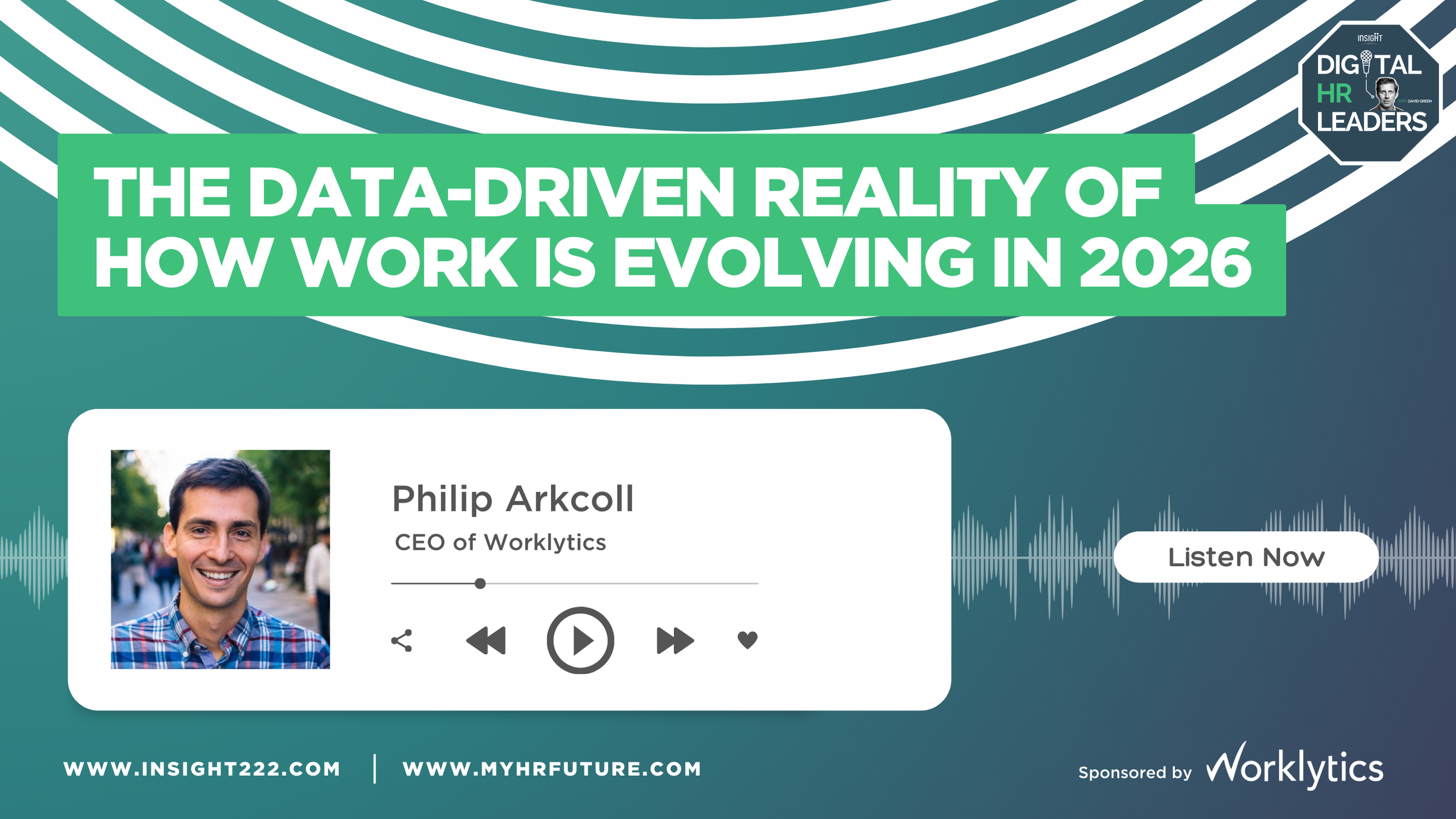
Episode 258: The Data-Driven Reality of How Work Is Evolving in 2026 (with Philip Arkcoll)
AI was supposed to make work more efficient. So why are people busier than ever?
As organisations move into 2026, many leaders are realising that while technology has changed quickly, the fundamentals of how work gets done haven’t kept up. Activity is increasing, output is accelerating in places - yet coordination, focus, and decision-making often feel harder than before.
So what’s actually going on?
In this episode of the Digital HR Leaders podcast, David Green is joined by Philip Arkcoll, Founder and CEO of Worklytics, to unpack this very question.
Join this dynamic duo, as they discuss:
What the data reveals around where organisations were getting stuck in 2025, and how the way we work is changing in 2026
What collaboration and activity data reveals that traditional HR metrics often miss
Why decision-making, not output, is becoming the primary bottleneck in AI-enabled organisations
How increasing spans of control are reshaping the role, and load, of managers
The emerging divide between teams and individuals who are benefiting from AI and those who aren’t
What HR and people analytics leaders can do to measure, diagnose, and redesign how work actually happens
This episode is sponsored by Worklytics.
How productive is your organisation, really? Worklytics makes it clear — with privacy-first insights from everyday work data. See how meeting volume, manager effectiveness, collaboration health, and AI adoption are impacting your team’s focus, efficiency, and outcomes — so you can make smarter decisions, faster.
No surveys. No assumptions. Just clear insight into work. Right now, Worklytics is offering podcast listeners a free 30-day trial of their productivity analytics dashboard.
Learn more at worklytics.co/productivity .
Link to resources:
● 5 Ways Work Will Change in 2026
● People Analytics Trends 2025-2026: Navigating AI & People Analytics From Ambition to Action
This episode of the Digital HR Leaders podcast is brought to you by Worklytics.
[0:00:09] David Green: Change is hard, and right now it's showing up less as a single disruption and more as a steady accumulation of friction. AI tools are multiplying faster than they're being integrated; meetings are getting easier to create and harder to escape; content is exploding while clarity feels scarcer; and even as automation accelerates part of work, decisions, alignment, and trust remain stubbornly human constraints. None of this is entirely new. We've been wrestling with productivity, collaboration overload and decision bottlenecks for years. But in 2026, those pressures are converging. Experimentation with AI is giving way to questions of integration, measurement and real value. And the gap is widening between companies that redesign how work actually happens and those that simply add more tools to already overloaded systems. That's what today's episode of the podcast is all about, which is why I'm absolutely delighted to welcome back to the show, Philip Arckoll, Founder and CEO at Worklytics.
What Worklytics focuses on is understanding how work actually happens inside organisations, how teams collaborate, how time is spent, how decisions move, or don't, through the organisation, and what the data really tells us about productivity, efficiency, and employee experience. And as Phil shares, one of the surprises from the past year is that while AI has accelerated work in many ways, it hasn't necessarily simplified it. So, today we explore what the data shows is really getting in the way of productivity, and what leaders should be paying attention to as AI adoption moves from experimentation to expectation. With that, let's get into the conversation.
Phil, welcome back to the Digital HR Leaders podcast. Can you believe it's nearly three years since you were last on the show? For those listening that don't know you, please can you share your journey and introduce us to Worklytics. I believe you recently celebrated your ten-year anniversary.
[0:02:20] Philip Arckoll: Yeah, that's right. Yeah, great to be here, David. Thanks for having us again. Good to chat again. Yeah, so it is our 10th anniversary. Worklytics is a workplace insights platform. We help organisations use internal corporate data to understand how their teams work and collaborate. And our goal is really to identify opportunity for improvement, where are the potential bottlenecks, how can they improve productivity, efficiency, how they collaborate, and in general, what employee experience is like through work. And over the past ten years, we've obviously seen an immense amount of change. I think we started initially focused on helping organisations navigate agile and digital transformations, which seems like an old issue that people have long forgotten, I think, who've been in this space, or brings back old memories.
Then obviously, we went through the pandemic. We helped a lot of organisations navigate the transition and all of the turmoil, move to work from home and all that change that that brought about. I think that drove a move to greater distributed and hybrid work, which I think a lot of organisations are still dealing with today, the implications of some of that, to productivity, efficiency, how organisations communicate, and how managers deal with their teams. We saw a focus on productivity over the past couple of years, efficiency, the end of zero-interest-rate times, and so a sort of pivot in many organisations. And now, obviously, the introduction of generative AI and artificial intelligence, which has been a huge change to ways of work, particularly in the last year. And so, we see ourselves as helping organisations understand the impact of that change through data, ensure that their web forces, their procedures, their process, their structure is updated in order to handle these changes, take advantage of some of these new technologies, drive productivity, improve employee experience, and the like.
[0:04:24] David Green: Yeah, and I mean I know Worklytics reasonably well, Phil. And what you really do is you help organisations understand how teams collaborate, I guess, within the organisation, which isn't something that many HR technology solutions do, from my understanding.
[0:04:45] Philip Arckoll: Yeah, that's right. I think a lot of HR technology solutions are pretty focused on data about skills or job requisites or general employee wellbeing and the like, pretty different data sets. We're very focused on behavioural data. What does work activity look like? What is the typical workday for an employee look like? What tools are they using? How are they getting work done across the organisation? What does cross-functional, cross-team collaboration look like? What does collaboration look like when it happens across multiple time zones, etc? We're really looking at work as it happens across all these tools, but at the aggregate level across organisations to be able to see, in real time, the impact of all these changes and help organisations adapt.
[0:05:32] David Green: So, looking back at 2025 and based on obviously the data you're collecting, I guess, as well, what did you find to be the most surprising thing organisations have learned about how work really happens?
[0:05:46] Philip Arckoll: Yeah, good question. So, obviously, 2025 is a year of a lot of change in organisations. I think that's probably understating things. It was the first year we really saw generative AI and agents being rolled out at scale across organisations, and we're starting to deal with the implications around that. I think there's a lot of uncertainty, a lot of fear of missing out. We talk to executives who hear from peers or competitors or from their board that they're seeing organisations and their teams improving productivity 30%, 40%, 50%. And then, they go and talk to their own organisations and they see a pretty different story, maybe some successes, but a lot of challenges, barriers. It's a big change and organisations are struggling to adapt to that change.
I would say probably the biggest surprise, from a data perspective, is the more things change, the more they seem to have stayed the same. The same issues that had previously dogged productivity and efficiency and getting things done in organisations are also slowing down the rollout of AI and generative AI tools in general. So, we see change management has always been the challenge and it continues to be one across organisations; leadership and management around these issues; things like meeting effectiveness. We've been talking about meeting effectiveness for ten years. We saw the time in meetings rise during the pandemic, with the introduction of tools like Zoom and Teams at scale. I think we saw time in meetings go up from ten hours for the median employee to 11 or 12.
Then surprisingly, with the introduction of AI, we sort of expected maybe it would go down, there's more efficiency, but time means is going up again; we've seen it go up another half hour to an hour across many organisations, when employees now spending two to three days in Zoom and Teams meetings per week across their organisation. So, these are some of the same challenges we've always dealt with. But AI and the introduction of generative AI is making them more extreme, more content, the pace of work has really picked up. And so, these issues have become bigger blockers, and bigger challenges. And then, I'd say decision-making has become more important than ever across organisations. AI allows people to get a lot more done, more content, more things are being generated, more meetings are happening. Decisions are still the bottleneck, the quality control, what do we put out there? What do we deliver to customers? And that is a very human-led process that we need to figure out how we adapt that and speed that up, and we saw a lot of organisations struggle to add in 2025.
[0:08:26] David Green: That's really good. And for listeners, I definitely recommend, after you've listened to this episode, do check out Phil's article, Five Ways Work Will Change in 2026, which you can get via Phil's LinkedIn, and also directly from the Worklytics site. We'll talk about topics from that article throughout our conversation today. But I'm going to zoom in a little bit on the meetings piece, because I know, as you said, this is something you've been studying in detail at Worklytics, how meeting trends and patterns and activities have evolved both before, during, and after the pandemic, and now through AI. And one of the things in that article that really resonated with me was that, "Well, we'll just invite people to meetings because AI will take the minutes anyway", but you're basically still getting people's time, so that's an hour. And then as you said, AI allows you to create content quicker and easier than maybe you have in the past. So, suddenly, maybe someone would have put together, I don't know, an eight-slide deck to go through at the meeting, but now they've put through a 40-slide deck and they've actually sent it to you beforehand and expect you to comment on it and talk about it during it.
So, in some respects, AI is creating challenges around meetings, around collaboration, around burnout. It's requiring people to do more. And of course, the idea is it hopefully allows people to be more productive, more efficient. I don't know if you can just talk to that as a kind of general trend a little bit, Phil, and maybe a couple of insights that maybe you shared in the article or maybe outside the article as well.
[0:09:59] Philip Arckoll: Yeah, sure, yeah. I think that's spot-on and a challenge that organisations are going to really continue to face this year and probably for a few years to come. As you rightfully said, we're seeing particularly key connectors, people who are project managers, very involved in a lot of work, they're able to be more productive and produce more work than they have ever before. They can get through bureaucracy faster, fill out more forms, write more specifications, create more content, build bigger decks at twice the speed. There's no limit to how much you can create now. Your time is no longer as much of a bottleneck when it comes to producing content, producing more work, producing more data and more insight.
But ultimately, in order to move things forward, in order to do something about the data, the content, the work, the specifications, people need to make quality control decisions. They need to understand, is what is being produced the right thing? Is it good enough to share with the rest of the organisation? Is it good enough to share with our customers? And then, they need to make decisions. They need to make decisions about moving forward on initiatives, about which direction to take. And those are still very human-led processes, "AI is producing this deck, but I have to look through it in detail. I now have to look through 40 slides and present that to the rest of the organisation". Then, we have to create, I think, ultimately a lot more meetings in order to pull more people in.
We're very used to leaning on meetings as the way to make decisions by consensus. We see in organisations a lot of very lengthy decision-making processes, where maybe it takes 10, 20, or more meetings to make a significant decision. People invite their manager, their manager's manager, the other side of the decision, the other team or function, they do the same thing as well. You quickly end up with 10, 15 people inside of the meeting. Key stakeholders potentially said they could make it, but then end up being busy, and so they don't join the meeting. There's this sort of ongoing cycle that a lot of organisations that are very meeting-led and rely on meetings for decisions are facing, and AI is putting way more pressure on that than ever. And as a result, it's really become the bottleneck in seeing the advantages and the efficiency from these new generative AI technologies. And I think we're going to have to deal with that underlying issue, which has been an issue for a long time, in order to really see the benefits of some of these new techs.
[0:12:43] David Green: This episode is sponsored by Worklytics. How productive is your organisation, really? Worklytics makes it clear with privacy-first insights from everyday work data. See how meeting volume, manager effectiveness, collaboration health, and AI adoption are impacting your team's focus, efficiency, and outcomes, so you can make smarter decisions faster. No surveys, no assumptions, just clear insight into work. Right now, Worklytics is offering podcast listeners a free 30-day trial of their Productivity Analytics dashboard. Learn more at worklytics.co/productivity.
So, let's look forward now. What pressures, and we talked about some of them already, what pressures do you see will be shaping most organisational decisions in 2026? And I guess we're going to get into a bit of detail around productivity and efficiency here.
[0:14:02] Philip Arckoll: Yeah, so I think 2026, we're still in a cycle of efficiency and productivity. So, we're seeing in a lot of organisations headcount remaining flat, or even declining. And so, from leadership, from investors, from the board, and downward, organisations are being asked to do more with fewer resources than ever before. And organisations are feeling that pressure from competitors, they're seeing competitors do the same thing. And so, there's a real sense that that needs to be the focus for now. And so, I think we're going to be dealing with a lot of the issues that have dogged us for a long time, that make our teams inefficient, that make it harder for us to get things done.
I've talked about things like time in meetings blowing up, I think we're going to come to a head on that, and we're going to have to figure out, how do we deal with this going forward? People need that individual time to be able to focus and get things done. We're going to have to figure out a way to do fewer meetings, more effective meetings. We're going to have to re-look at how we make decisions in organisations, figure out ways to make them more asynchronously rather than being driven through these enormous meetings that take multiple cycles in order to close.
I think the other thing that we're going to see in 2026 is questions around return on investment on the rollout of generative AI tools. So, 2025 was a period of experimentation. People tried lots of different tools. They threw everything against the wall to see what would stick. And in many cases, they're spending hundreds of thousands, if not millions of dollars or pounds or euros rolling out these technologies across their organisations. They're hearing a lot about productivity improvements elsewhere. And I think that question is going to come to bear this year. Are we seeing productivity improvements from these tools? Where are we seeing those productivity improvements? Where can we double-down? But also, what should be cut? What should we stop doing? What isn't working? What tools and techniques aren't working across the organisation? And so, sort of a consolidation.
I find it fascinating that we still what we're seeing today in a lot of organisations that we that we work with, as many as 50, 60, 70, 80 different AI tools being rolled out across different functions. The marketing team rolls out five or six tools; the sales team rolls out five or six tools; the engineering team, the legal team, IT rolls out its own platforms. A lot of the tools do the same thing, or there's a lot of crossover. Some of them aren't being used at all. And so, I think we kind of have to figure out what is and isn't working and double-down on the things that are. And there's going to be pressure on proving that ROI this year.
[0:16:47] David Green: On the meeting point again, Phil, in the article, you're actually a bit provocative. You talk about budgeting meetings like money a little bit. So, I don't know if you want to talk through that idea a little bit more. I liked that. I think that will appeal to many of our listeners.
[0:17:04] Philip Arckoll: Yeah, sure. I think, as I said, we're seeing more time in meetings today than we ever have before, the pace of work is increasing, I think people are really starting to burn out on this issue. And so, you're starting to see organisations take more extreme measures. And that is starting, for example, in a lot of startups, smaller and more agile companies, they're doing things like net meeting resets, where they delete all recurring meetings across all calendars and all of the organisation. We saw Shopify do that a year or so ago, pretty drastic measures. And I think we're going to see that happen across the enterprise, across a wide range of organisations, more drastic measures to figure out how do we really slow this down and perhaps take a step back and buy people time that they need to do individual focus work, the quality control, the strategy, the decision-making the thinking that they need to do outside of the group setting, outside of meetings, in order to get things done. And so, we've seen a lot of these pretty creative ideas across a range of organisations.
The budgeting is one example, where you're only allowed to attend a certain amount of meetings per week. And once you've hit that budget, you can't attend anymore. You're only allowed to create so many, you can't create anymore. So, sort of creative ideas that stick in people's heads to try to, at scale, roll that out across an organisation. I think the challenge with meetings is that when you're a small team, you can do a little bit to talk to other people and sort of come up with some sort of consensus to cut down on the time of meetings. But when you're a large organisation, hundreds, thousands, tens of thousands of people, it's hard to control, it's hard to understand what's really creating all of this content, these meetings, that has its own momentum. And they grow and grow, and there's no really real easy way to get visibility into everything that's happening, to make clear decisions and then to implement policies across an organisation that start to pull this back.
[0:19:21] David Green: So, too many meetings, too many tools, change management probably not prioritised enough. What are some of the other things that are slowing down productivity and inefficiency, in practice, based on what you're seeing with the data, obviously, that you're analysing and collecting?
[0:19:40] Philip Arckoll: Yeah. So, I would say, following on from time in meetings is inability to find individual time for focus. And this is something we've harped on for years. If you're a knowledge worker, you're a software developer, you're a creative writer, even if you're a manager and you need time to think, to strategize, to make decisions on your own, your days have become too hectic to do that. There's too much context switching. You're being pulled from one meeting to the next, they're completely different topics, they're different functions, different departments. You're pulled in 100 directions, and that makes it very difficult to think and to focus and get things done. And I think that's a major drain on productivity.
The other thing that we've seen that is from the pandemic and the move to greater distributed work is challenges with collaboration across, in particular, cross-time-zone teams. So, we're seeing more than ever, teams that are working on a single subject, on a single topic, trying to deliver something, they're spread across the globe. They might have part of the team in San Francisco, part in New York, part in Dublin, and some in Pune in India, and they are all working on the same thing. A lot of the decisions that they need to make require information from each of those different parties. And so, we've spent a lot of time helping organisations understand the implications of that cross-time-zone collaboration. What it tends to do is it slows down decision-making processes, in particular in organisations that are very synchronous, they're very meeting-driven. They have to wait for that one-hour overlap to put the meeting in, nobody can make it the first day, they have to find another time to do it, it gets pushed out two weeks, that slows everything down, means you're not getting rapid feedback on the work that you're doing, you're unable to make quick decisions and move things forward.
We're seeing that be a major challenge in organisations. And in particular, with the push to efficiency, we're seeing a lot of teams moving offshore, for example. That's exacerbating that issue as well. And this is, I think, a major challenge that organisations are going to need to deal with. How do they move to more asynchronous ways of collaborating in these teams so that people don't all have to be online at the same time? How do they agree on collaborative hours so they have enough overlap with people across different time zones? Maybe one team works a little later, one works a little earlier, and instead of only having one hour of overlap, they have two or three in order to chat over Teams and get things done.
Then, I think ultimately, how do they think about what types of work are best suited to this sort of distributed team? Heavily coupled work, project work is often not well suited to it. They may need to think about restructuring those teams, putting those across fewer time zones, but less coupled work, work that can be done more asynchronously perhaps is better suited to that distribution.
[0:22:46] David Green: What does all this mean for managers? I mean, again, how have you seen the role of the manager has changed as organisations try to move faster? I'm just guessing it's even more pressure on the shoulders of managers.
[0:23:00] Philip Arckoll: Yeah, I think that's right. I think managers are under more pressure than they have ever been before really. Hybrid and distributed work makes life more challenging for managers. You're no longer in the same office as many of the people that report to you, so you're not able to walk over and just have a quick chat and glean whether they're focused on the right things and talking to the right people. You have to do that in a distributed fashion over Teams, over digital. It's very disjointed. You see each other face-to-face maybe two or three times a year. So, hybrid management has put a lot of pressure on managers. The move towards efficiency is also putting more pressure. We're seeing a lot of organisations de-layering and increasing manager spans from five or six people per manager to eight-plus people. Now, we're seeing ten reports per manager, even 15 reports per manager in some organisations. That just means way more work on managers' shoulders. They need to find time to connect one-on-one to each of those ten people to understand what they're doing, to have those career discussions, to develop them, make sure that there's wellbeing there as well. And I think that that's even more challenge.
Then, unsurprisingly, I think AI, generative AI, has driven even more pressure on managers, because a generative AI successful rollout requires a lot of change management, a lot of strategy, thinking through what isn't working, how do we integrate AI into the right places, into the right workflows? And that falls on the shoulders of managers, often within organisations that they're the sort of key catalyst there. If they're not driving that change, I think it often fails. And then, the point we mentioned before, which is AI generates more content, the pace of work is increasing, and often managers are the quality control, they are the gatekeepers on a lot of those workflows. They're deciding whether we move forward or not, and they need to make decisions at a faster rate, they need to review at a faster rate, they need to provide feedback at a faster rate. And so, we are going to see managers burn out at a rate faster than they ever have before. Organisations really need to think about what they're doing to support their managers, to help them scale, to deal with these challenges, or I think they're really going to struggle.
[0:25:24] David Green: And it's interesting, you talk about team sizes increasing, and span of control increasing for managers, which kind of flies in the face of research, which depending on the type of team and where your team are located and how experienced they are, the optimal team size, from research I've seen, is somewhere between six and ten, depending on all those different factors. And then suddenly, if you're having to manage 15, more even, then that becomes incredibly difficult, particularly if those people are even more and more so being more so distributed as well. It's a real challenge, isn't it? And as you said, not only is it more people, those people are able to produce more work because of AI tools, so suddenly it's a multiple, exponential effect even.
[0:26:06] Philip Arckoll: Yeah, I think it was seen as an attempt to gain efficiency, to get more done with fewer people, which it has obviously helped in that direction. I think it was also seen as a potential solution to the decision-making challenge. A lot of organisations were facing, as I said, managers upon managers upon managers in meetings, all of these layers of management required to pass through information in order for decisions to be made; and so, cutting those layers down to decrease the just mere number of people that decisions need to need to go through. But we've seen in our data, time and time again, that when you increase span over around seven reports per manager, things like one-on-one time per week or per month go down. So, those managers just don't have enough time to check in with their reports. Direct feedback on documents, on work, on code, on whatever people are doing, drops down, manager workday length increases substantially. We see over around eight or nine reports, managers are working 10, 11, 12-hour days often in order to cope with that additional work. And like we've said, generative AI just puts more pressure on all of that, there's more to review, there's more work happening, there's more going on at a faster pace.
[0:27:26] David Green: I want to take a short break from this episode to introduce the Insight222 People Analytics Program, designed for senior leaders to connect, grow, and lead in the evolving world of people analytics. The programme brings together top HR professionals with extensive experience from global companies, offering a unique platform to expand your influence, gain invaluable industry insight and tackle real-world business challenges. As a member, you'll gain access to over 40 in-person and virtual events a year, advisory sessions with seasoned practitioners, as well as insights, ideas and learning to stay up-to-date with best practices and new thinking. Every connection made brings new possibilities to elevate your impact and drive meaningful change. To learn more, head over to insight222.com/program and join our group of global leaders.
So, we've recently published our Insight222 People Analytics Trends Report for '25-'26, and we've found that there's a real gap, and I think probably it compares with what you've seen as well, a real gap between intent and readiness when it comes to AI adoption. So, just a couple of stats here. 72% of organisations, and we had over 350 companies participate, say AI is a strategic priority for HR, but only 37% have a defined HR AI strategy, and then just 42% have integrated AI into their analytics workflows. From what you're seeing, why is there that gap and why does it continue to persist?
[0:29:15] Philip Arckoll: Yeah, I think probably the biggest issue we see, and we're helping a lot of organisations navigate this change and understand through data, how these AI tools are being used and integrated into their organisations, I think the biggest mistake we see organisations make is focusing on the technology. It's very tempting to do because it's so exciting, there's all these new AI tools coming out every week today, and new capabilities inside the core models. It is a very fascinating time from a technology perspective, and I think a lot of organisations end up being quite focused on, "Let's try these different tools, let's really focus on getting the coolest tool, the coolest, latest tool rolled out as quickly as possible". There's obviously something to that, there's something to experimenting.
But ultimately, success of any of these tools requires change management. And change management is notoriously very hard. How are you thinking about, when these tools are rolled out, how you're integrating them into your workflows? What is your strategy and leadership model around the rollout of these tools? Do people have the right skills and capabilities to use the tools effectively or not? And then, do you have a good measurement strategy to implement continuous improvement? Do you know very quickly, from a data perspective, what is and isn't working? How can you double-down on the things that are working really well, spread those more widely across the organisation, and drop the things that aren't working as well, or pivot them to different ideas? And so, that lack of more comprehensive change management strategy around these AI tools means that a lot of AI rollout programs are struggling to deliver the results that organisations are expecting. And we're seeing that time and time again through a wide variety of different studies.
[0:31:10] David Green: Yeah, and as you said, just thinking about this as a technology change, technology transformation, is the wrong way. It's a people transformation and it's actually a transformation of how we work, frankly. And arguably, without getting on the hype train too much, it's probably going to be one of the biggest changes to how we work that certainly you and me will have seen in our careers, if not the biggest change to work. So, as you said, the change element, this cannot be underestimated. So, maybe from some of the companies, because I know you work with some of the more progressive companies and maybe companies that have maybe more successfully adopted AI into their workflows, what are some of the things that they're doing maybe differently from other organisations that you're seeing?
[0:31:57] Philip Arckoll: Yeah, I think it's some of what I already just said, which is effective team management, so really thinking about what their strategies are from top-down to roll these tools out successfully. I think integration into workflow is really important, not just rolling out a tool and hoping people will go to some separate portal or some separate UI somewhere, remember to do that from time to time to use a tool, that it's integrated into the workflows they already use, it's well integrated, they've really thought that through end to end. And then, I think a key component of that is a mindset of continuous improvement. Whenever there's a new tech, you're not going to get it right first time. It's going to take a lot of iteration in order to ensure that it's well embedded, ensure that people have the right skills, that they have proficiency in using these tools, that they're actually helping or not. And that's very difficult to do when you're flying blind, when you don't have good data on how these tools are being used, what's being used and how, where the success stories are, where you're getting improvement. It's very hard to implement continuous improvement to track results to aim towards goals within your organisation.
That starts with an effective measurement strategy and effective employee listening strategy. And some of the best teams are becoming very effective at doing that. But they've always done that, in many cases, well across other different spheres, and they're applying that here as well. And that information is allowing them to implement these cycles of continuous improvement and gradually see the gains from the rollout of these tools.
[0:33:45] David Green: And probably connected to that, Phil, do you think, and again, are you seeing, that some leaders, CEOs, other senior leaders within an organisation are maybe overestimating how AI-ready their organisations really are? And if that's the case, what's HR's role in helping manage expectations, perhaps?
[0:34:07] Philip Arckoll: Yeah, I think 100% that they potentially are overestimating. I mean, and that stems from just a lack of visibility. So, as I mentioned before, it's not uncommon for us to see upwards of 60 to 100 different AI tools being rolled out across organisations. And that's being, I think, very fair. This is a time of experimentation, we're trying lots of different things to see what sticks and what works. But there's no data or listening strategy across all of that. And so, leaders are relying on a lot of anecdote about what is and isn't working. Perhaps they hear one or two success stories. They're hearing from their peers and other organisations, from their competitors, from their board, that AI is great, that it's working really well, that it's driving all of this change. But they don't really have a single place that they can go to get a sense for, are we really using this across the board? Are all our functions taking advantage? Are we behind other organisations or are we ahead? How do we benchmark whether we're falling behind, or not, the general space? Where are the success stories? How do we double-down on those? Where are things not working as well?
I think obviously, HR are, in many cases, experts in understanding how humans are adapting to these changes in implementing employee listening programs that effectively survey, that interview, that collect data on how the organisation is adapting. And there's really an opportunity, I think, for people analytics in particular here to play a very strategic role in helping organisations understand where the success stories are, where the failures are, take advantage of where things are going well, pivot where things aren't going as well at the executive and leadership level. But it requires stepping up, having a clear data strategy, a clear employee listening strategy, and really focusing on this initiative and change.
[0:36:11] David Green: And I guess from the employee listening strategy, it's combining maybe the traditional data that we collect from surveys with some of the collaboration data that companies like yours are able to help organisations collect and analyse. And sometimes when you put those two things together, people talking about they're feeling a bit burnt out, etc, and then you've got data that shows that they're attending three times more meetings than they were six months ago, nine months ago, whatever, then you can start to make those connections, can't you?
[0:36:39] Philip Arckoll: Yeah, I really think of it as almost three different data sources. The new one is AI, and the usage of AI in general. So, there is employee listening through surveys and through interviews and focus groups, which is just as important, if not more than it ever has been before, asking, talking to people about what is and isn't working. And then, I think that the new data source is, how are these AI tools being used? What are they being used for? There's a lot of data from all of the different ChatGPT and Cursor and all of these different platforms, but it's sitting all over the place. And getting a sense of how they're being used and whether they're being used successfully, whether users are showing the right level of proficiency, whether people have the right skills, etc, to use those tools I think is a very important source of data. And then, the source of data that we've always focused on is, what does work look like in general? Are people spend time in meetings and collaborating? I think that provides a lot of insight into the impact of these AI tools.
So, we've been doing a lot of comparing your top AI users, what do their workflows look like today? How have they changed? How have they adapted? What does this mean for them? The people who don't use AI at all, what's different about those teams, about those groups? How are their ways of work being impacted by the rest of the organisation? What can you learn from that to help you adapt faster, to copy the places where it's working well to the places that potentially need more support and help, and ensure you bring the whole organisation up to the same level over time?
[0:38:13] David Green: So, on that point, you mentioned about top performers, which I guess can be individuals, can be teams. What are you seeing? Is AI actually widening the gap between some of these top performers and the rest of the organisation? And presumably, one of the things that's driving that divide is the success or not, or otherwise, of whether these people or teams are able to adopt AI successfully, I guess?
[0:38:34] Philip Arckoll: Yeah, 100%. So, we're seeing that these AI tools are a force multiplier on performance. So, the top performers are more likely to try these tools earlier on, they're more likely to become proficient, and it helps them multiply the amount of content they're able to produce, the amount of information they're able to get out into the organisation, the impact that they're having across the organisation in general. We're seeing an explosion and they're, in many cases, sort of pulling away from the org in some senses, or they're the early hyper-adopters of these different platforms. We see it very clearly in looking at sales teams, for example. Sales teams are notoriously more measurable than many other organisations, and the top users of AI within sales organisations, we're seeing them touch customers more often, so they're able to reach out to a broader base of customers; we're seeing the quality and the results from that communication go up; we're seeing more meetings being booked as a result; and we're seeing better results ultimately for those salespeople. And in some cases, that is 30%, 40% more productivity from those top sales reps through the use of AI, relative to those who aren't using AI at all.
I think what's important for organisations to think about is identifying these pockets of success, figuring out what it is about them that's working so well, and how they can replicate that across the rest of the organisation to bring the rest of the organisation along with these successes and implement that more at scale.
[0:40:11] David Green: Are you seeing different patterns as well in how people experience AI depending on their role, for example, individual contributors versus managers and leaders?
[0:40:22] Philip Arckoll: Yeah, so we've been looking a lot at the impact that AI has, particularly looking at heavy users of AI, people that have been early adopters, that are using a lot of tools. And we've seen two interesting archetypes that I think are informative to think about and look at. So, the first is people that are in very collaborative roles. These are your project managers, your managers, your leaders within an organisation. We're seeing them collaborate more than ever. They're getting more done, they're able to cut through bureaucracy faster, generate more forms, generate more specifications, get more done. Their networks are exploding, their workday lengths have increased an hour or more in many cases, and they're running at 150%. So, AI has really been a multiplier on their ability to reach out across the organisation and get a lot of work done.
It begs the question around, what is the quality of all of that content being produced and the impact that it has on those around them? And I think organisations are going to have to think about that and think about how they measure that effectively and prevent sort of negative cases there. And it also begs questions about burnout. Are those people ultimately on a track to burning out, and how do they reach a better, better balance?
The other archetype we're seeing is the individual contributor. These are people that don't need to collaborate as much in order to do their work. A great example to think about is somebody new joining an organisation. Today, they can rely on AI to answer a lot of the questions that previously they would have had to ask their peer, ask their manager, ask other people. And so, what we're seeing is instead of going to the team to get answers, to skill up, to figure out what to do to get that institutional knowledge, they're going to AIs and we're seeing fewer Teams messages, fewer Slack messages, fewer emails, fewer meetings, their networks are shrinking and getting smaller. And it's a really interesting story about efficiency and access to institutional organisational knowledge, which I think is the positive component of that. But it obviously brings about concerns with isolation, integration into organisations, collaborative cohesion and wellbeing of these employees in the long term. And we'll have to think about how these archetypes develop, how organisations can best support each of these different cases.
[0:42:54] David Green: Yeah, and I know that's one of the things that you do at Worklytics, is that impact on networks of some of the data you're collecting. I've just published a collection of my favourite articles and resources from 2025. And one of yours is in there actually, because I think you got there first before anyone actually, in terms of understanding what the impact of agents, positive and negative, could be on organisational networks. Obviously, we'll put the link in the show notes, Phil, but I don't know if you want to talk to that a little bit and how that's evolved maybe since you published that article a few months ago?
[0:43:32] Philip Arckoll: Yeah. So, I think organisations are still wrapping their heads around how to really integrate them effectively. And I think it's honestly one space that at least the enterprise level has moved more slowly than I had originally anticipated. What we had originally in that article, what we had seen the early cases of, was AI agents joining the network as if they are employees. And so, there are nodes within the network, they're another collaborator within that network, people are reaching out to them and that communication is passing on to others. Maybe they're reaching out to you over Teams or Slack to chat to you and broker some of these conversations, to pass information over. And really, the trend that we're expecting and we're starting to see early signs of, but I think perhaps moving slower than I had anticipated, is instead of managers managing teams of people, every person is going to manage a team of agents. And they're going to have four or five of these different agents that are working on their behalf, that are doing different things, reaching out to other teams, helping them gather the information that they need, fast-track decisions, and the like.
We're seeing early signs of that in particular pockets within organisations, but not broadly. And the success pockets are, I think, obviously software engineering, there's a lot of use of agents there, and people seeing really fundamentally different impacts on productivity with really significant increases in results there. I think sales and customer success is another example where agents have really been a force multiplier for those teams. They're able to reach out to far more people, far more customers, manage that at scale, and are really thinking about how they use these agents in order to multiply their effectiveness and productivity across the organisation. But we haven't seen that spread to the general knowledge worker role. There aren't these sorts of sets of agents yet that every knowledge worker is using five of. But I think we'll start to see more of that in 2026 as organisations wrap their heads around this new technology.
[0:45:44] David Green: I guess most managers and organisations are just getting used to generative AI without managing agents as well. It's interesting, we had an episode that came out four weeks before this one actually, with Sandra Durth from McKinsey, and we were talking about, what are the skills as a manager to be good at managing agents? And actually, her opinion was, and what they're seeing with some of the companies that they're working with, if you're a good manager at managing people, then a lot of those skills are actually the same skills you need to manage agents well as well. So, it's going to be interesting to see how that evolves. And if we're having this conversation in a year, 18 months, it will be interesting what your data is telling us on that as well.
[0:46:25] Philip Arckoll: Yeah, I think that's right. I think one of the key things is just a technology component. There's a trust element. If an agent is acting on your behalf and is out there doing things inside of the organisation, you have to really trust that they're doing what you expect them to do in the right ways across the org. And I think there is a bit of a fear still with hallucinations and those sorts of issues that may not be happening, can you really let that many of these things out there act on your behalf? But technology is quickly catching up, there are fewer and fewer of these types of issues. And ultimately, I think we're going to cross a threshold where people feel very comfortable doing so.
[0:47:03] David Green: A couple more questions, Phil, before we wrap up. For leaders or senior HR professionals or even people analytics leaders that are listening to this episode, what are the most important questions that they should be asking themselves right now?
[0:47:19] Philip Arckoll: Yeah, I think it comes back to some of what I've already talked about, which is successful rollout of these tools requires a change management strategy. And key to a change management strategy is how are you implementing a loop of continuous assessment and improvement. You need to have a listening strategy to understand where you are, you need to be tracking where the success stories are, where the failures are, so you can pivot and double-down, and you need to have a very continuous improvement mindset. We're still in the very early days of these tools. things are changing all the time. We need data to tell us where we are, so we're not flying blind, so we're not leading through intuition, we're making database decisions and we're able to pivot quickly, move in the right direction, take advantage of these things. And so, that key question is, do you have a strategy for continuous improvement and the listening required to do that?
[0:48:17] David Green: Well, Phil, we're going to look forward to the last question, or the one before I ask you how people can find out more about you and Worklytics, this is a question we're asking everyone on this series, and we're in January 2026, so we're going to look forward to 2030 now. Don't worry, we won't hold you to this. What do you foresee to be the role of HR in 2030?
[0:48:38] Philip Arckoll: Yeah, so I think in 2030, we're still going to be dealing with a lot of this change. Change is harder than people, I think, often anticipate it to be. We've seen that time and time again through many waves of change in ways of work and in organisations. I think there's a lot of fear and uncertainty there within the workplace. People don't know whether their jobs will still be the same in a couple of years' time, what will work even be once these tools get very good. And I think there's a key role for HR to play, as it has for many years, to be that human voice through this transition, and ensure that we're getting the outcomes that we all really want and believe in, instead of some of the dystopian outcomes that we don't want that, if we're not careful, we may end up working towards. And that's, how can humans continue to focus on the things that humans are good at, where they can provide value, their intuition, their decision-making? And then, combined with AI, doing the things that humans like to do less, the more repetitive tasks, the more mundane work, and work together in a way that creates a better work environment, a better place to work, better employee experience, but ultimately, leads to more productivity as well.
[0:49:57] David Green: Great. I mean, that's what we want moving forward. Phil, as always, it's been an absolute pleasure to speak with you. And obviously, I look forward to seeing you at events throughout the year. Probably not least, People Analytics World at various locations around the world. Can you share with listeners how they can follow you and all the great work that you're doing at Worklytics, and also learn more about Worklytics as well?
[0:50:22] Philip Arckoll: Yeah, 100%. So, check out our newsletter. You can sign up to that on our website or on LinkedIn. We often share research and content there. You can follow me on LinkedIn as well. I share a lot of that content and research, what we're learning, as we study changes to ways of work. And then, check out our website. It's worklytics.co. You can see information about all the different use cases we focus on and how we help organisations navigate these challenges.
[0:50:50] David Green: Great. And we'll put those links in the show notes, as well as the article I referred to earlier, Five Ways Work Will Change in 2026. Phil, thanks so much for being a guest on the show again. And, yeah, look forward to seeing you in person at some point in the next few months.
[0:51:06] Philip Arckoll: Yeah, thank you, David. Great chatting. I think it's going to be a really exciting year. Looking forward to seeing everything that happens and catching up later.
[0:51:16] David Green: Thanks again to Philip for joining me today for what was an instructive conversation. I hope you enjoyed it as much as I did. To everyone listening, I'd love to hear your reflections. What resonated most with you from this conversation? You can join the discussion on LinkedIn. Just look out for my post about this episode and share your thoughts. I always enjoy hearing what you take away from these conversations. And if you found today's episode valuable, be sure to subscribe, rate, and share it with a colleague or friend. It really helps us keep bringing these kinds of thoughtful, forward-looking conversations to HR leaders and professionals around the world. To stay connected with us at Insight222, follow us on LinkedIn, visit insight222.com, and sign up for our bi-weekly newsletter at myHRfuture.com for the latest research tools and trends shaping the future of HR and people analytics. That's all for now, thank you for tuning in and we'll be back next week with another episode of the Digital HR Leaders podcast. Until then, take care and stay well.