Episode 285: How to Build an AI-Enabled HR Operating Model (with Michael Rochelle)
What if the thing slowing down AI in HR isn't the technology at all, but the way the function is set up to deliver it?
Most HR organisations already have access to AI. The bigger challenge is whether the way HR is structured, governed and measured is ready to turn that technology into sustainable business value.
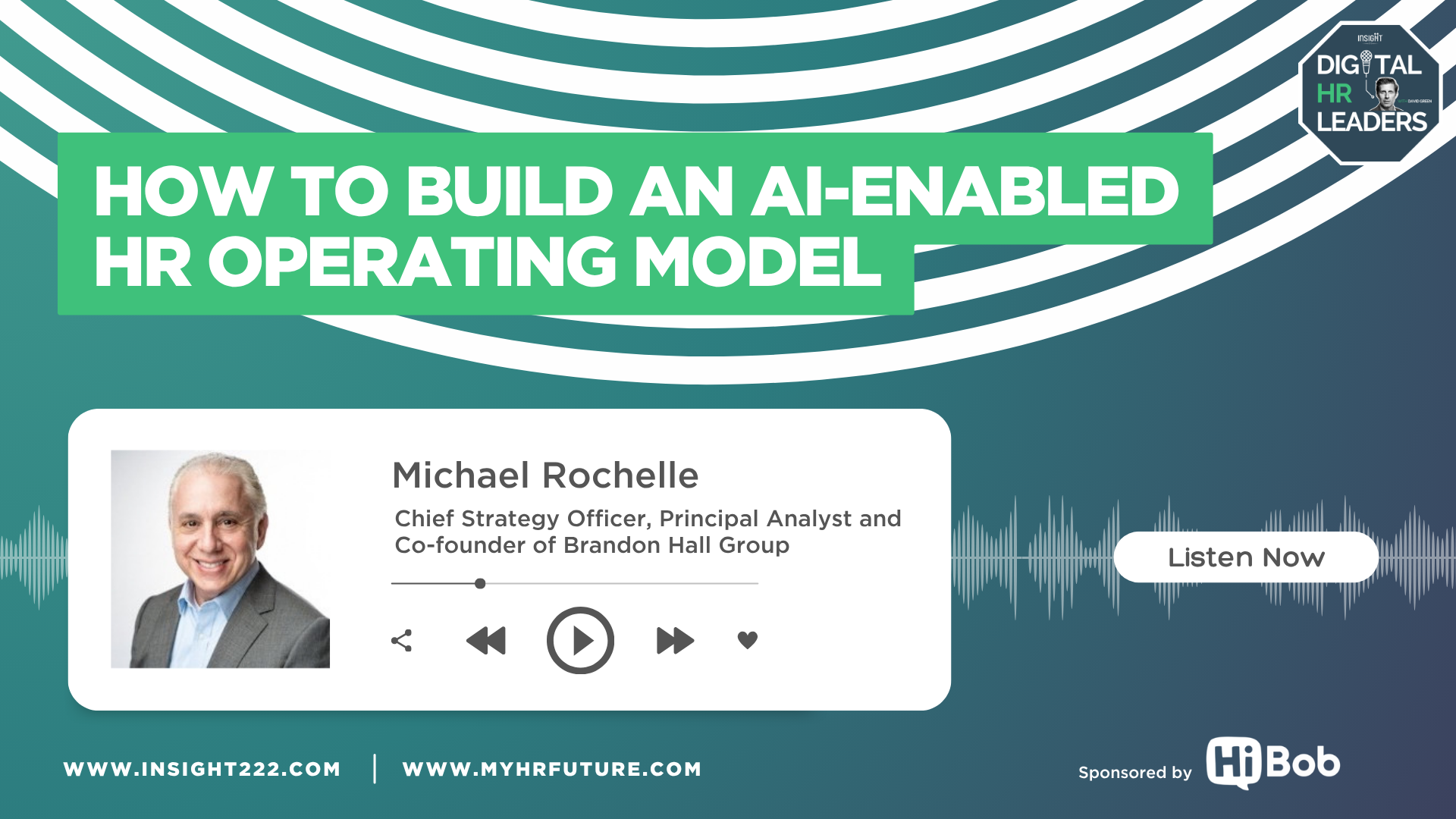
In this episode of the Digital HR Leaders podcast, David Green is joined by Michael Rochelle, Chief Strategy Officer, principal analyst and co-founder of Brandon Hall Group, to explore new research identifying six structural moves for building an AI-enabled HR operating model.
Join them, as they discuss:
Why the operating model can become the constraint on AI transformation, even when the technology is ready
What changes when HR manages recruiting, learning, employee experience and workforce planning as continuously evolving products rather than finite programmes
Why great people and well-designed processes need to come before technology, and the risks of automating processes that already need redesigning
How talent pods, workforce product teams and centres of excellence can combine business proximity with scalable solutions and enterprise standards
Why HR business partners need deeper business acumen and a stronger performance consulting mindset
Why governance works best when it is embedded into design and delivery, helping create the trust required for innovation
Why HR needs to strengthen capabilities in judgement, critical thinking, business acumen and data and analytics as work changes
How leaders can measure business, workforce, system and future impact rather than simply tracking implementation activity
For CHROs and HR leaders rethinking how their function operates, this conversation provides a practical framework for creating an HR model that can continuously adapt, scale and deliver measurable value..
This episode is sponsored by HiBob.
HiBob is the people platform built for the AI era, helping organizations replace fragmented HR systems with a unified foundation for workforce management. That's why Brandon Hall Group says unified workforce platforms are becoming the foundation for organizations looking to scale AI with confidence.
The report also includes a practical business case template with ROI modeling and executive evaluation criteria to help build your transformation strategy.
Download the Brandon Hall Group HCMS Platforms Report
Resources:
The AI-Enabled HR Operating Model - Executive Summary
This episode of the Digital HR Leaders podcast is brought to you by HiBob.
[00:08] David Green: Whenever I share something on LinkedIn about the HR operating model, it tends to generate a lot of engagement, and I don't think that's a coincidence. We're asking HR functions to help lead workforce transformation, embrace AI, and keep pace with businesses that are changing faster than ever, often using structures and ways of working designed for a very different environment. Brandon Hall Group's latest research makes an important point. Most HR organisations already have access to AI. The bigger challenge is whether the operating model is ready to turn that technology into value. Their research finds that organisations making meaningful progress are redesigning how HR operates, before asking AI to solve bigger business challenges.
My guest today is Michael Rochelle, Chief Strategy Officer, Principal Analyst, and Co-Founder of Brandon Hall Group. His new research, the AI-Enabled HR Operating Model, identifies six structural moves that can help HR become more adaptive, integrated, and focused on business outcomes. There's a lot to unpack. We explore what changes when HR moves from running programs to owning workforce products; why some processes should be standardised while others need flexibility; and how business-facing talent pods, product teams, and sensors of excellence can work together without moving HR further away from the business. Michael also has a provocative perspective on the HR business partner. His argument is that business acumen should be the major and HR the minor, helping HR BPs become business partners who represent HR, rather than HR professionals who happen to partner with the business. So, without further ado, let's get the conversation started with an introduction from Michael himself.
Michael, let's start with you. Great to have you on the show, by the way. For anyone listening who doesn't know you or the Brandon Hall Group, can you share a little bit about who you are, who the Brandon Hall Group is, and what you spend your days doing?
[02:18] Michael Rochelle: Great question, but again, thank you for asking me to join. It's a pleasure. My name is Michael Rochelle. I am the Chief Strategy Officer, a Principal Analyst, one of the co-founders of the Brandon Hall Group. And shortly, Brandon Hall Group is the leading analyst firm in the HR space. We work with organisations to help them to understand best practices and next practices for energising and empowering their HR organisations, and that also includes helping them to make technology decisions.
[02:51] David Green: Great. Well, it's an exciting time to be making technology decisions in our space, certainly, and obviously you speak with HR leaders across multiple industries, as well as obviously HR technology firms themselves. What's the question you're hearing most often at the moment, and what does it reveal about where the HR function itself may be struggling a little bit?
[03:15] Michael Rochelle: Well, I think HR organisations have been in a continual struggle from a couple of perspectives. One is they want to make sure that they're considered a strategic asset within their organisation to really be directly connected to driving individual team and organisational performance, and they want that level of impact, level of relevancy, what many people describe as they want that seat at the table. And so, that's a continual struggle for them, and that's been made murkier by the idea that with AI transformation, what role do they play in this space? And as you've probably seen, David, in many examples, AI has now moved from a technology tool to fundamentally rethinking the way we approach work, and it's considered in many organisations another workforce in and of itself. And so, these are the things that HR is grappling with, knowing that they consider themselves the human element of business, being directly in charge of and care for the workforce themselves, and so, "How does AI play, and how do I feel about it? How comfortable am I with it? Do we have the right governance? Can we protect our employees? Can we be transparent and accountable in how it's used?
So, it's a challenging time, but at the same time, it's a time for great opportunity for HR, in that if they can embrace this new transition, this transformational piece, that this might be finally the avenue to being able to get that seat at the table.
[04:51] David Green: Yeah, it's interesting, isn't it? Because obviously, probably like me, you'll speak to CHROs in certain organisations, that this is very much an opportunity that they're grasping with both hands, and that they're being asked to lead workforce transformation for the organisation by the CEO, because as you said, it's that combination of human and AI, and they're able to do that. They've maybe got either the capabilities, the confidence in their own function to be able to do that, or the relationships within the business to be able to do that. And then, on the other side, you've got other HR leaders that are probably getting left behind a little bit by this transformation. I don't know if you could talk to that and to see, from a CHRO perspective perhaps, what are the skills, the capabilities, the gumption, maybe, if that's the word I could use, that the CHROs that are actually getting this opportunity have versus those that aren't?
[05:52] Michael Rochelle: Well, I think it's actually a time where humans are more important than ever, actually, because the one thing that they're able to exercise in this new world of AI is judgment. The factors of being able to reflect on judgment, being able to exercise our brains in terms of empathy, the human element, is more important than ever. So, now you have this technological wonder called AI, but it's arriving on the scene not having that. We've all experienced AI, and we used to think man's best friend was the dog. Now it's AI. It can be the greatest pleaser, make you feel wonderful, it's always willing to apologise, "Oops". So, we need that judgment. We need to be able to exert our brains to say, does this feel right? Does this meet our cultural implications? Do I really agree with the outcome?
The other piece to it is we have to give it the right inputs. So, I think more so than ever, humans now have to rely on critical thinking. They have to think about like, "Okay, AI is just an amplifier. It doesn't invent things, although if you let it, it will". But it's really about the idea that whatever I give it, it's going to drive and determine the quality of the outcome. So, if I really want to be in a position to get the most out of it, I have to think about what I put into it. So, I think this is a time where we have to think about AI in terms of, where are humans on the loop; where are they in the loop, and where are they out of the loop? But we never have to step away from empathy, judgment, cultural fit, that gut understanding of what AI is telling us or driving towards. We ultimately hold the reins in that decision-making.
[07:44] David Green: Now, interesting, when I share materials on LinkedIn, one of the things that really seems to grasp attention is anything to do with the HR operating model. Now, we have to be careful in HR that we don't just look inwardly, we need to look outwardly as well. But it must be said, if HR is going to operate differently in the new world, then it probably needs to look at how we operate things. And you've just published some really insightful research at Brandon Hall Group, on an AI-Enabled HR Operating Model, and you've kindly allowed us to share the executive summary of that in the show notes, so listeners that want to dig in a little bit more there. Your research argues that organisations often try to introduce AI into HR operating models that are designed for a different era, which, I mean let's be honest, we've always done that, not just in HR and other functions as well. What are the clearest signs though that the operating model rather than the technology is the real constraint?
[08:40] Michael Rochelle: It's a great question, and the best way to reflect on that is we have to move away from the linearity program initiative, point A to point B approach to HR. We have to begin to understand now it's more of an organic process. There's twists and turns along the way. The business is constantly pivoting, in a VUCA environment. I know that's an overused term, but I think it's applicable. And so, HR can't be linear. It can't have, "We start here, we end here, you get the deliverable. It follows just a very sequential approach". We have to be more agile, greater degree of flexibility, adaptivity. We have to be able to pivot on a moment's notice, rework, repurpose. So, what AI does is give us that enabling function, I think. It allows humans to be able to say, "I'm not going to be going through whiplash through this process. I'm not on the tail end of all of this hanging on; that I can use AI to help level the playing field and bring all of these elements to the table in a scalable fashion". I think that's the real opportunity that AI brings, is to give that level of flexibility, adaptivity, agility, scalability to HR. So, that's why we call it an AI-enabled HR operating model rather than AI-replacing HR.
[10:08] David Green: Transformation is continuous now, isn't it? And that's very different maybe now than it was a few years ago. And as you said, that requires that adaptivity, that agility, that flexibility that maybe HR hasn't always been known for.
[10:23] Michael Rochelle: It kind of harkens back to when we used to talk about everything in terms of change. Transformation is just, to me, another gear of change, if you think about it. Transformation, evolution, to me it just exemplifies the idea that change has to be a core competency with an organisation. And not all change is good. There's layoffs, reductions in workforce, companies get sold, people dissolve different aspects of their business. It just seems we're in a constant flux and change. And you add all of the global socioeconomic conditions that are going on, and it just creates for that volatility and uncertainty that we talk about. Pulling that all together, transformation sometimes is in the eyes of the beholder. You can have some parts of the organisation that say, "This is very transformative". HR may not see it as transformative or even evolutionary. In some ways, they might say, "This is fraught with risk or a potential step back with our employee value proposition", or what have you.
So, I think what we have to do is kind of dial it back to what's the foundational thing that we have to embrace as an organisation. HR has to be the change agent. It has to be the advocate for change, has to help both the organisation and its workforce embrace change; be the catalyst, be the driver, be the coach, be the mentor in that environment, so that change management does become a core competency of an organisation, so HR is not looked at rigid. Because if HR is looked at as a rigid environment, rigid function, that's going to be a direct reflection of business stakeholders, that the workforce must also be rigid and inflexible. So, that's what we need to work on, and I don't think that's changed for 10 years.
[12:15] David Green: And actually, in the paper, one of the big central shifts that you kind of outline, I've got it to my right here, "Six operating model moves". And one of those is HR moving from effectively running HR programs to actually being a product organisation. What does that mean? So, for listeners that are maybe either in that journey at the moment or know they need to go into that journey at the moment, what changes when processes like recruiting, like learning, like workforce planning or employee experience is treated as a product with long-term accountability?
[12:53] Michael Rochelle: Probably the best way to describe it is to think about in our everyday lives what a product means to us. Like, if you ask a customer what a product is or a service, first thing that will come to mind is hopefully, "It's a reflection of what I need. Somewhere along the line, I was able to give input, be able to help shape it in some way or another, or people just like me being able to shape it", like the Simon Sinek approach, right? So, there's some kind of condition where I can provide input, I can help to shape it, help to make it be what it is and continue to provide new information, new insights that lead to maybe version changes or maybe an update or a brand new approach to doing things. So, that constant input.
The second dimension of a product is that it's been evidence-based. You know, we haven't just created something in a vacuum, we've gone out and tried to collect other sources of information. When you think about developing a product, one of the first things that people talk about is, "We've got to build a marketing requirements document or we have to build a minimally viable product piece". It's to justify that there is a need and that what we're thinking about developing uniquely meets that need and be a competitive differentiator, and such. And also too, the fact that it's iterative. So, we launch products, but we want to be in a to receive feedback and maybe change the product or address over time, or as conditions change in the world, the product becomes outdated or needs a facelift, or what have you. So, it's all these behavioural pieces that make it feel more like a living breathing process than it is, "I've sat, I've come up with something that needs to happen. I've built in stone, locked in exactly what we're going to deliver. And it's just a question of rolling it out sequentially and then waiting for the ultimate lag measure of we've completed it or people have completed it, mission accomplished", that's the outcome.
So, that's the fundamental change is that we have to get HR to begin to think about employees as their customers and clients, we have to think about business stakeholders as being part of that group as well. Begin to think about, "We are a product-service-oriented organisation, so we have to have a product development process rather than a program or initiative process.
[15:29] David Green: This episode of the Digital HR Leaders podcast is sponsored by HiBob. Has your organisation outgrown its HR stack? AI is about to make that expensive. The latest Brandon Hall Group report explains why fragmented HR systems are becoming a liability, and why unified workforce platforms are emerging as the foundation for the AI era. Discover how leading organisations are connecting HR, finance and operations to improve execution, reduce complexity, and scale with confidence. Download the report at hibob.com/davidgreen2026, or visit HiBob at HR Tech Booth 1927 or UNLEASH World at Booth 101. HiBob, HCM for people-proud companies.
Now, in the field that we work in principally at Insight222, it's a lot around people analytics. We've seen people analytics teams over the last two or three years bringing in people that have product management experience, I think product owners for certain areas, for the products that they've developed for the business and for HR and for the workforce as well. For people that have been in that space, product ownership might sound simple, but it does change things like decision rights around funding, around accountability. You've talked about treating employees as customers, which isn't the case in many organisations. Who should own a workforce product and what should that person be accountable for beyond implementation? I suppose, as you said, part of that is continually improving the product, I guess?
[17:29] Michael Rochelle: Well, I think going on a field trip with the HR department down the hallway to the marketing and product development group is probably a good idea. But the idea is you're going to have a product manager, an owner of the product, but they're going to have a team. That team is going to be a cross-functional group of experts that can really represent a 360-degree view of what the product needs to think and act like and what problem it's trying to solve. So, we need to think about this; I need a product owner and I need a product team. Then, the other piece to that, and a go-to-market strategy for any organisation, is someone's got to sell it and implement it. And so, this internal product development team, product ownership group, resides within HR with borrowing people from other parts of the group. The respective HR business partners that have been embedded in the business become your executors, like a go-to-market strategy. They're out there communicating it, setting the change agenda, what the benefit is, helping people implement it, really selling them on the idea that this is really going to work and uniquely addresses needs; and then, be a source of feedback from that group, that customer group, as to did it land or not, and giving that back to the product development team to say, "Hey, we got close, but we didn't get in". And so, this is the feedback that we're getting.
So, It kind of extends through a marketing and sales approach, a go-to-market piece, where we have to have all the elements. What's the underlying emphasis with this? Not to sound overly salesy or marketing with the HR approach, but employees have to see the value of change. One of the things that's an intrinsic motivator for someone is the fact that what's in it for me, what's in it for the organisation, that's not the way I currently roll, it's going to take me some time to catch on. For us to think that again, it's just a program initiative that's a one-way street, it isn't anymore. Having that behaviour approach and building in those loops, that's what it's all about. So, what's the third leg of the stool, so to speak, is we've got the HR business partners, we've got the talent pod, product owners, and teams. The third leg of the stool is the centres of excellence. Where do we meet to make this happen? One of the things that's different with HR is it's not an exclusive meeting. It's not HR meeting with the workforce. It's really a place where people congregate for centres, like this is where business stakeholders can weigh in, HR weighs in, employees weigh in. There's advocacy, there's understanding, validation, working through things, collaborative, social, sharing best practices. You can't do this in a direct one-over-one. You have to create that centre of excellence, where it's that hub, where we meet to really work this out. Those are the three elements that really make for a better operating model.
[20:29] David Green: Yeah, that's really helpful. And listening to you again there, I was remembering, and it's actually quite a long time ago now, Mark Levy, when he was Head of, I think they even called it Employee Experience at Airbnb. He talked about designing products 'with' employees rather than 'for' employees. I guess that's another key element of that product mindset is, as you said, the people that you're designing this product for are your customers. They might be leaders, they might be managers, might be senior executives, etc, and to do that, you need to put yourself in their shoes sometimes to think about what they actually need and how they're going to consume that product and the benefits they're going to get from it. As you said, people won't use something unless they see the benefit of it to them, to their teams, to the organisation itself. So, it's a slightly different mindset maybe than what we're used to in HR, isn't it?
[21:32] Michael Rochelle: It really is. I think if I had to boil it down to a two-word transition, HR is moving from being an enabler to a catalyst. That's really tantamount to the whole scenario, is HR usually rolls in as like, "I'm here to enable something". The business came up with this; I was told that I need to deliver this; if you don't like it, go take it up with the business stakeholders. There wasn't a lot of attachment to the process. Not that HR didn't want to, but it was just put into that position of part of corporate services, finance, legal, accounting, HR, those things that just need to go right, those things that just need to enable part of that whole G&A function. But now, there's the opportunity for HR to break out and be a catalyst, can actually be part of the process that makes things happen on behalf of the business, no different than manufacturing, producing product. If it shuts down, immediate business impact; marketing and sales can't sell products and get them delivered properly, immediate impact; finance doesn't get it right.
What's happened up until now is when HR doesn't get it right, it's usually synonymous with risk only, just lack of compliance. We're going to get sued; something bad's going to happen. It's much more than that. We have to be able to say if HR doesn't do what it needs to, if it doesn't catalyse, then we don't get workforce transformation. we don't improve talent readiness, mobility, and agility. What's the outcome of that? We are at a competitive disadvantage in the marketplace. We don't have the right people doing the right things, the right way, in the right place, right timing. Therefore, we're going to lose in the market. So, HR has the opportunity to be a catalyst in that regard and be able to show the direct connection to the business, which to me is very exciting, and I think AI is the way to be able to be that accelerator doing that.
[23:36] David Green: I was just about to say, that sounds a much more exciting opportunity than being an enabler. The second operating model move that you've got within the paper is about work is standardised and designed. As you said, the paper places that process standardisation before scaling AI. How should HR leaders decide which processes need to be standardised, why should they be standardised, and which should retain some flexibility for the different employees, roles, or maybe even business units?
[24:14] Michael Rochelle: It's interesting. Staying away from a program initiative or processing of itself, let's just think about it in terms of actions within the organisation. The most people-intensive interactions are the ones that need to remain the most flexible. So, the difference might be exercising payroll and benefits needs to be a fairly standardised process, because offering any kind of level of variability could create compliance risk, could create a problem automatically. That's pretty standardised; people want to be paid properly and they want their benefits administrated properly. We're not talking about benefit flexibility, we're just talking about getting the process right, as you pointed out.
Now, let's look at the process of employee engagement and creating employee value proposition or improving the employee experience, or even having an effective management performance review process. Now, you're talking about you need it to be the opposite of that. You don't want to standardise that. You want to have that be a flexible, agile, behavioural approach, where you have room to watch how employees change their ebbs and flows to conditions of how work impacts them. Quite frankly, the conditions of wellness and well-being, financial, physical, emotional, mental, all of these considerations, what's happening outside of work, all of these dynamics, we have to leave room for how that motivates people, how that makes people feel like they belong. Well, that is not a standardised process. That is everyday waking up and saying, "Do I really have the right listening in place? Am I able to identify the right signals that trigger the right actions to create outcomes that are going to achieve where we are today and where we need to be tomorrow? What are the red, yellow, and green flags that are being waved? That to me has to be very dynamic. Now, it doesn't mean we're introducing bias or favouritism or creating all this fragmentation, but you have to have the ability to be able to read the room on an ongoing basis. Anything that's employee intensive like that, then you got to have flexibility.
[26:35] David Green: What happens when organisations automate an existing HR process without first questioning whether the process itself still makes sense? Because, how often do we do that? We buy some fancy technology, and then we try and fit the technology with our processes, which maybe need updating. I don't know if you've got any examples or any horror stories that you can share around that?
[26:58] Michael Rochelle: Yes!
[27:01] David Green: Or that you're allowed to share.
[27:02] Michael Rochelle: Allowed to, right? I think anybody in the audience is going to be like, "Holy cow, I can probably think of four of them myself!" But let's put it in the right approach. Hackett said this a long time ago, that, "People, process, and technology has to move at the same rate of change and transformation". Best way to think about it is great people build amazing processes that are then scaled by technology. That's the approach. If you're skipping any of that, if you're just saying, "I'm going to bring in technology as the mea culpa for bad process, or I'm going to skip over having great people and just build a process in a vacuum, not ask anyone, not get the right people on it, and then throw it into a technology platform, or skip the first two and just say we need more tech", all of that is going to lead to a bad result. So, it's not a perfect way of looking at it, but it does allow people to say, "Okay, I need great people to build great processes", and then technology scales it. Particularly in the world of AI, AI is about computational pieces, like doing big churning things that we can't do in our brain. You don't get that process right, which includes the right information, then all AI or any platform is just going to amplify across the organisation at the speed of light how bad you are at something. It's basically just like grabbing a megaphone and just announcing to the world, "We built this really suboptimal performance review process. We've stuck it into technology and using AI, and we're just broadcasting how bad we are".
Using that as a visual, we have to get it right. Put technology where it belongs. It's the last decision. We've got to lock the other things down, and then technology becomes the great scaler.
[28:55] David Green: I want to take a short break from this episode to introduce the Insight222 People Analytics Program, designed for senior leaders to connect, grow, and lead in the evolving world of people analytics. The programme brings together top HR professionals with extensive experience from global companies, offering a unique platform to expand your influence, gain invaluable industry insight and tackle real-world business challenges. As a member, you'll gain access to over 40 in-person and virtual events a year, advisory sessions with seasoned practitioners, as well as insights, ideas and learning to stay up-to-date with best practices and new thinking. Every connection made brings new possibilities to elevate your impact and drive meaningful change. To learn more, head over to insight222.com/program and join our group of global leaders.
Again, moving on to, you introduced this a little bit earlier, Michael, so the proposed structure that you've got within the paper combines business-facing talent pods, as you described them, workforce product teams, and specialist centres of excellence. Maybe you can give a little bit of an outline of each of those groups. And then, how do these groups work together without creating additional layers of complexity or moving, heaven forbid, HR further away from the business?
[30:38] Michael Rochelle: Great question. So, it first starts with engagement and alignment on the problem itself. I'm a big believer in the fact that to get this right, you have to exercise design thinking. You have to get everybody in a room and say, "We've identified a challenge or an opportunity that impacts our workforce. And because it impacts our workforce, it has a direct impact on our business outcome. So, let's sit down and go after it". And what we oftentimes do within HR is we're like born problem-solvers. So, it gets put in front of us, and we immediately begin to say, "How do we solve it, how do we solve it, how do we solve it?" which leads to immediately going down that road of program initiative, "We're going to do this, we're going to do this, we're going to do this. That's going to solve the problem, or that's going to allow us to seize the opportunity". In a new world order where AI can, at the speed of light, create the computation source so we can play it out in the conference room on our laptop, we should slow our roll and begin to use more design thinking and say, "Okay, the challenge is in front of us, the opportunity. Let's ask all the right questions to help understand all the elements of that opportunity or challenge. What's the connective tissue? What are the layers? What is the texture? Let's make sure we really understand all the dimensions of it".
When we have it all kind of laid out as to how big and how deep this opportunity or challenge is, only then should we put ideas on the table of potential solutions to that. It's not that rush to judgment anymore. We used to rush because we didn't have technologies and tools that allowed us to really act fast. I mean, think about the typical HR thing. You probably find out about it and you've already lost all your window. Rome is already burning and HR has already been asked to do it. So, they're rushing to the solution naturally because they don't have a lot of time to really vet the problem. So now, we can slow down and say, "AI will help us to accelerate towards solution. Let's take the time and really understand what we're trying to face, make sure we understand it from a 360 point of view". And we all agree, what I like to say, we all agree on what time it is. We're not saying, "It's 3.00. No, I live in Eastern time. No, I live in Europe. No, what do you mean, am, pm?" That lack of alignment engagement on the central issue is what is the biggest problem in trajectory.
I don't know if you play golf, David, but there's this old expression, "The slice never comes back". Once that ball starts slicing, the farther it goes out, the farther it goes to the right. But when you get back to where you were hitting the ball, there's a difference of like maybe a quarter of an inch on the club face. That's our opportunity in design thinking, is to make sure we're perfectly aligned on that club face, so when we swing to solve that challenge or take advantage of the opportunity, we hit a straight shot.
[33:36] David Green: Yeah. And if you've ever seen me play golf, there's plenty of slices and hooks, that's for sure.
[33:44] Michael Rochelle: I love when people say, "I have a controlled slice". I'm like, "Okay, let's see how that plays out!"
[33:50] David Green: And your model, again you alluded to this previously, Michael, and the model also changes the role of the HR business partner, the HR business partner is put upon, shall we say, quite a lot within our field and sometimes unfairly, I think. But what should HR business partners stop doing and where can they create more value in the new structure, because they're absolutely pivotal to it, aren't they?
[34:21] Michael Rochelle: I think we have to think about changing the order of the letters. Instead of being an HR business partner, I think we should change it to they're a business partner for HR. So, we need to begin to think about, "I'm going to major in business acumen and I'm going to minor in HR". We have to shift our thinking. We have to begin to say, "I am there to understand the situation and conditions of business, so I need a greater level of business acumen. I need to think about being more of a performance consultant". I need to think about myself as understanding the business more rather than saying, "I'm here from HR and whatever it is that you're going to throw in front of me, I'm going to reach into my bag of tools and we're going to solve it". So, I think just simply switching the letters and getting people to say, "I'm a business partner first, that's representing HR", just like you could have a business partner of IT or a business partner of finance, rather than the other way around. I'm a big believer in just making fundamental shifts like that to create a paradigm to get people to say, "Oh".
So, why do we think that's important? I think we're going to see continually the current state of HR business partnership, where more and more of those professionals are going to be coming from the business itself. We're already seeing that grow dramatically at the Chief Learning Officer level, CHRO level. I'm in an engineering firm and you meet these top HR executives and they're engineers. They were in the business and now they're learning how to be able to scale what they know to help other people. So, I think that's part of it too. But if I'm coming from an HR background, flipping the letters and putting business acumen, performance understanding, getting embedded, walking around, doing that classic Taylor time-and-motion study approach, of really walking in the footsteps and going side by side, shoulder to shoulder to understand how the business works, will be the best determiner on whether or not you can come up with the right solution.
[36:29] David Green: And actually, I think you just highlighted a role for HR as well to enable more mobility within the organisation between functions, because it's the same thing. Obviously, we do see vertical careers. We probably want to see much more horizontal careers now, people moving between the functions, because the further you go up in the organisation, it stands to reason, doesn't it, if you want to be a CHRO and you spend either part or all of your time outside HR, that's not necessarily a bad thing? It should make you a more rounded HR executive. We run those mobility programs for the organisation, so that's an opportunity in itself.
[37:11] Michael Rochelle: Right. I mean, it's like any other human condition that we operate in is 'getting out there' is the term we always use. Whether we tell our kids that we operate that way as adults, we operate that way as professionals, what's the number one thing that every mentor in your career says? "You've got to get out there". You can't manage this from behind a desk, you can't theorise, you've got to go live it. And when you live it, then you really understand it. And when you really understand it, you can figure out how to make it better or different or both. And so, yes, we have to get out there. The business is happening all around us. They're inviting you. I think with many HR organisations that are doing it, there might have been some hesitancy at first, but once they got out there, they found that they were embraced by the business stakeholders. Like, "Yeah, please come and learn. Go stand on the production line or go on a sales call or sit with our treasury department and see what it's like to put together that information for a quarterly call. Come live it with us". They embrace that idea.
So, I think what we have to do, and again, I'm going to just keep plugging the AI idea, is AI offers a different opportunity in that environment. We used to not want to get out there a lot because you're like, "Okay, if we're all out there doing that, who's going to get whatever it is that has to get done, done?" AI is the new home body. While I'm out there being a human, AI can be in the back-office operation where I can be feeding information into it, and it's now the stay-at-home. Now, AI may go out there and help to collect information, but overall, it creates that stay-at-home. So, we can really be humans and go out and do real human interactions that is going to give us the level of understanding that we can feed back into AI to help us come up with that larger idea.
[39:07] David Green: Very good. And obviously, one of the key elements of us using more AI and using more data and analytics within our HR products and operations is governance. In the paper, you described governance as part of delivery rather than review at the end. What are some of the decisions, the controls, and release gates that really need to be built into the process from the outset? We need to be thinking about governance upfront rather than, as you said, not thinking about it at the end.
[39:41] Michael Rochelle: Yeah, it's an interesting journey, David, that organisations go on with governance as it relates to AI. When you look at their early stages of progression, getting it off the ground, governance is oftentimes recognisable as a lockdown approach. Who's going to get it, under what conditions, what can they do with it? It's all keeping it on the tracks, keeping people on the tracks. It's all of a lockdown kind of control model. But what's really interesting is governance can actually create an opportunity as you move through your progression. As organisations get more comfortable with AI through piloting, trial and error, figuring it all out, we see a change in the progression to governance becoming an enabler. So, a probably a really terrible analogy, but I use it all the time, is in the early stages of AI progression within HR, it's like you keep your dog on a leash. You have this really big yard that's really, really pretty, but the dog's on the leash, or dog's on a run, can't let off constraints. Picture organisations in later stages of progression. They're basically saying, "We've kind of figured it all out. We've really paid attention to everything. Let's create an invisible fence. Let's let our dog run around in the yard. There's boundaries out there. We've created an environment where you can't go past that. But as long as you stay within this yard, dog's fine".
So, that's what we want to do. We want to be able to have the opportunity to say governance creates this framework where all of us can move around in that. We don't have to feel like we're being constrained, or you can only go this far, and then you've got to get permission. Why is that important? The important thing is AI offers the opportunity to go to a whole new level of innovation and creativity. And if you don't have governance as an enabler, you're stifling the level of creativity and innovation that comes from AI. When we look at what AI is doing around the world, we don't reflect on in terms of, "Gee, I wonder what LLM they used to do that?" They're looking at, "Holy cow, now we can do drug discovery with it". They look at the outcome of it. They look at what it allows people at the level of creativity, innovation, that never we could have had before without it. That's what we want to move to.
So, governance has to be an enabler. If it just stays as a clamp down, locked on, keeping AI on a leash, and not allowing it to be able to roam around and do the things it really should do, then you're never going to achieve anything with AI, and quite frankly, your employees aren't going to trust it, your managers aren't going to feel that it has any beneficial outcome. It's going to die on a vine.
[42:36] David Green: Yeah. I mean, transparency and trust has got to be at the centre, hasn't it? It's fundamental. And obviously, we've talked about how the AI operating model obviously has technology and data and analytics at its core, but also talent and culture. So, it's not just about technology and data and everything else; there's the talent and culture element to it. And I'm just wondering, if we look about how companies evolve to an AI-enabled HR operating model, we talked a little bit about HR business partners, but let's look about HR teams generally. What are some of the new capabilities that HR teams need; and how should leaders, CHROs that might be listening, support people whose roles, expertise or professional identity may change significantly? As you said, they've got to sell it, I guess, but they've also got to actually put stuff in place to actually help people make that transition as well, haven't they?
[43:33] Michael Rochelle: I think the greatest opportunity for people within HR is to be able to, again, go back to and fall back into what we're best at, which is judgment, critical thinking, applying business acumen, empathy, cultural understanding, those things that we talked about that are below the waterline that AI can't solve for. AI is above the waterline with all of this wonderful computational and outcome analysis, but it can't get into understanding and perceiving norms, values, principles, the way in which we do things, ethics. It just doesn't feel right. That's exclusively for human brains. And so, what we have to do as CHROs, or any persons in the top position within an HR function, is to help people understand that that's the transition. The transition is actually not away from who you are, but actually moving towards who you are. In fact, there's an argument that can be made that a lot of technology that's been rolled out already has already made people feel like they're not valued, or they're not necessary. You don't need AI to do that. If you go back to the beginning of time, learning management systems, payroll systems, performance, all that was done by humans. And so, this isn't like a precedent being set that humans feel like, "I'm not valued anymore". We've gone through this with every technological innovation within HR.
The reason why this hits so hard is because of its reach and the depth and breadth of its reach. So, it still needs to have that invisible fence, and who's going to create that? So, the opportunity is for an HR professional leader to sit down with their team and say, "This is your opportunity to be more human than ever". Your expertise and experience gets translated from, "I have the expertise and experience to do it", to, "I have the expertise and experience to judge whether AI got it right". And so, you're not having to learn anything new, you're just shifting the outcome. You're moving from tool usage to exercising judgment. So, the person says, "I've been here for 30 years. I'm useless now". That story has been going on. What's the biggest challenge that we always talk about? Twilighting employees and knowledge. This is the opportunity to have lots of people be able to say, "My experience, expertise, tenure, just what I know, is more valuable than ever, because it's going to put me in a position to decide whether or not we got it right or not with AI". And that's the exciting part.
The other part is there's new opportunities. I really believe that HR has to create a core competency in data and analytics. It's been coming, it's not a new thing. I think what AI did was not create the problem, it just put a magnifying glass on something that was already there. HR traditionally has not been 100% evidence-based like in other areas of the business, like manufacturing relies on all sorts of metrics, productions, defectors, very metrics-driven. HR has been very human-driven. But now, we have the opportunity to be able to put those things into place and say we can actually use evidence, data-driven evidence and findings to help us to understand the human condition. It's not a one-over-one. If you fix the production line, defects go down. People are not robots. But it doesn't mean that data and evidence-based pieces that we get from AI can't help us to have a broader, more collective understanding of how we need to relate to humans within the workforce. It just puts us in a better position to understand them. And in some cases, people argue with less bias.
[47:24] David Green: Well, I mean at the end of the day, if we can use data and analytics to help create fairer, better, more humane workplaces and show that that actually has a positive impact on business outcomes, isn't that what most of us get into HR for anyway?
[47:39] Michael Rochelle: That's the whole point, isn't it? You want to work with people and you want to do everything you can to make them feel like they're productive value and they come into a safe environment every day, right, and that their personal and professional aspirations can be achieved. And you want to be there to just watch them grow and do everything you can. AI doesn't rob us of that opportunity. Actually, AI helps us to achieve those things better and faster. But ultimately, whether it gets it right or wrong is really going to come down to the people that are within the organisation that can bring the context to all of that. So, I think, now listen, there's a lot of AI whitewashing going on out there. People are saying the layoffs are being masked by AI, or, "Forget, Michael, what you're saying. I know three people that got laid off and it was directly because AI came in". We're not saying that isn't happening. We're not saying that AI may disrupt the number of people that are in an HR department or might lead to changes or people no longer being there.
But what we have to say is with any technological transformation that we've gone on, that's always happened, there's always been changes. If we go back in time, the number of instructors that we needed in learning got diminished, based on rolling out a learning management system. How many people did we need in payroll? There's always an impact on roles. But I think with AI, we actually have the greatest opportunity to retain people because of that human judgment, critical thinking. In those other cases, those people were doing something that was very task-related, that was an easy replacement with a piece of technology. And so, I look at that as saying, "Let's never do that again. Let's not have people be defined by the tasks that they can perform, rather than the decisions that they can create". And so, there's a lesson here that can be learned so that this technological transformation we're going through, that we'll be on the right side of it as humans.
[49:39] David Green: That's really good, and I think you're absolutely right. I mean, if we look back in history, and history's helpful when you're looking at something new, every major industrial revolution, technology advancement has been disruptive, but it's also been a net creator of jobs. So, let's be optimistic for once and hope that that's the case with this one. So, Michael, this is the last question on the AI-Enabled HR Operating Model paper. And this is quite nice, actually, because we talk about data analytics and measurement. And then, we'll get to the question of the series before we wrap up. So, the paper distinguishes things that we don't always talk about in HR, but I love to hear these things, business impact, workforce impact, system impact, and future impact. Which measures give leaders the clearest evidence that the new operating model is creating value rather than simply delivering more activity?
[50:39] Michael Rochelle: Great question. I think we have to get back to the human condition. If I were actually measuring what the ultimate value is of all of this transformation, I'm going to first look for how are people thinking and acting differently? What impact does it have on behaviour? Because that is the lead indicator to performance. I just don't think it's fair, unless you're using AI to solve something immediately like, "Please build this course for me". Okay, so there's immediate impact. But I think for the most part, if we're talking about transformation with the workforce, AI should be given the opportunity to first show what its impact is on a new way of thinking and acting. Are people behaving differently? Are they embracing change more quickly? Are they reaching time to proficiency faster? If we know that we're on the right trail with behaviour, new ways of thinking, acting, it's sinking in, people feel comfortable with that, because they went through 100 interactions with an AI coaching tool, or they went through simulation. It's just like that old thing, you're lucky if you get to fly the space shuttle once in your lifetime. But those crews have been in that simulator 200, 300, 400 times years practising for that one time, right?
These are the things that we have to consider. Are we putting people in a place where they can model their behaviour, model their thinking, practise in a safe environment, and begin to say, "I feel confident to applying this in my role, based on what AI has been able to help me, what HR has been able to offer". And I automatically will presume that performance will closely follow that. So, I think that's the key, you know, sentiment value, embracement, comfortability, trust, integrity. These are all lead indicators that we're doing it right when we're rolling out AI transformation that's HR-catalysing. If that happens, then I think performance will come. And that is still evidence in and of itself, David. It doesn't mean I'm tapping my fingers on the table as a business stakeholder saying, "Yeah, that's wonderful. Everybody's thinking and acting differently. I don't get any changes until we hit this ultimate goal or performance change". I don't agree with that. We as humans incrementally get better.
So, as we see these shifts in behaviour, this new thinking and acting, this new way of approaching work, because an AI has helped us do that, you're going to get incremental benefits. It may be out in the distance, the full impact, the hundred percentile, but it doesn't mean that we're not constantly improving over time and moving into higher percentiles of proficiency. And I have to say that I think AI is the first time that we can actually say things can happen truly incrementally versus other transformations that we had to wait, we had to tap our fingers, do the nail-biting, "Is this all really going to work?" which is terribly stressful for an organisation in these times. I think AI can show the incremental benefit.
[53:53] David Green: I think you're right. Well, Michael, that leads quite nicely to the question of the series. This is one we're asking every guest in this series. And given the research that you've just published and your knowledge base anyway, I think we're probably going to cover maybe some of the same ground we've already discussed in this, but that's fine because you have an opportunity to summarise and maybe be provocative if you want to be provocative. How should HR redesign work to unlock business value?
[54:26] Michael Rochelle: Great question again. Lots of good questions you ask, David. They're great questions, they make me think. I think fundamentally, if I were sitting with a group of HR leaders, the conversation would go something like this, which is, "Stop thinking about AI as a piece of technology or a tool, and begin to think about it as fundamentally going to change the way we approach work, and that we have two workforces now. We have a human workforce and we have an AI workforce". And that's going to fundamentally change and make us rethink every aspect of what we do in HR, whether it's leadership development, all the way through, every element, because we're dealing with two workforces. So, we're going to wake up in the morning now and say, "Are humans going to do it all by themselves? Is AI going to do it all by itself? Or is there going to be some handshake in between?" That's the fundamental thing that we have to start to think about, that shift. Stop thinking about it as just another technology invention; it's at a grassroots level, it's at a DNA level for us; and grasping that and having the important conversations amongst business leaders, amongst employees, that yes, we now live in a world where AI is here and it's going to rapidly continue its advancement, and we have to rethink everything.
We have to rethink everything. The definition has changed in terms of approaching work. And we have these two groups and it even has impact for equity, inclusion, and belonging. It touches everything because you're dealing now with two spinning plates. And there's overlap, and then there's autonomy between those spinning plates of two workforces. So, I would start there and think about listing out the impacts of that and going as far as you possibly can in terms of understanding the extent of how that makes things different. Just play it all the way out. That's the real design-thinking exercise that needs to take place. And once you do that, then you can really decide over what period of time you're able to digest all of that. Every organisation is going to have a different approach, that prioritisation, time, resource constraints, level of change readiness, but we're all going to follow, everyone is following the same journey, "AI can do anything for everybody". So, we might as well play it out, understand it to its full aspects of an alternative workforce, and then work back to where are we today and how comfortable are we over what period of time.
[57:10] David Green: So, I mean listening to you there, Michael, really is, you know, we talk about with AI, HR needs to transform itself, but it also needs to help transform the workforce. I think there's a third element here, listening to you, it's about transforming work fundamentally.
[57:25] Michael Rochelle: That's right. Work is never going to be the same again. It's fundamentally changed, and what we think work even is, whether it's its value, it's timing, it's intensity, it's complexity, it's difficulty. And ultimately, who's better at it, a machine or a person, or is a little bit of both? So, you're right. I mean, you'd have to rewrite the definition of work, start putting some parenthetical understanding of, you know, "In the world of AI", in the dictionary. So, you're right. And I don't think enough organisations are thinking about it that way. They're not having that retreat, that off-campus, "Let's walk away, let's go think about this", approach; and not to their detriment or saying they're doing something wrong. But the other thing about AI is like somebody turned on a giant firehose November of 2022, that changes on an hourly, daily, weekly basis. I think people are still feeling like they're going a couple of rounds with the heavyweight champion of the world. They're trying to get away from the jabs and the onslaught to try to get their footing, like you know, "Holy cow, AI is all over me". So, this is your opportunity to break from that and say, "Let's forget about the activity and all of this hyper-ness that's being thrown at us about it, and take a step back and think about how it fundamentally changes work at our organisation.
[59:04] David Green: Where should people go to follow you, Michael, your work and Brandon Hall Group's research? And as this episode's coming out at the end of September, maybe let our listeners know where they can find you in the coming weeks as we hit conference season as well?
[59:18] Michael Rochelle: Sure. You can always look us up at brandonhallgroup.com and success@brandonhallgroup. And then, you can also look me up on LinkedIn. I love connecting with people and will be able to share my email and create connections there and follow up with folks. As far as a conference tour is concerned, my next big travel plan is to go to Paris, the UNLEASH. So, I'll be there. That's the big travel plans for events for this coming fall. So, any of you that are going to be there, more than happy to meet up with you and talk about this more. And we also have opportunities to learn more about the HR Operating Model, AI-Enabled Model, and that's on a landing page that we have that you'll find if you connect with Brandon Hall Group's website. So, that's how you can find me. That's where I'm going to be. But I'm always looking to have organic conversations daily like you do, David. So, feel free to reach out to me directly and we can talk more.
[1:00:15] David Green: Great. We'll put everything in the show notes for people. And I will see you in Paris in a couple of weeks at UNLEASH.
[1:00:21] Michael Rochelle: Yeah, that's exciting. We'll get a chance to meet in person and maybe we'll do our own design-thinking exercise.
[1:00:27] David Green: We can, we can do our own design thinking. That'll be great.
[1:00:30] Michael Rochelle: That'll be fun. Thanks for having me.
[1:00:34] David Green: Michael, thank you. That's given me a lot to think about, particularly your point that great people build great processes, and technology then scales them. Get that sequence wrong and AI can simply amplify a process that wasn't working in the first place. As you put it, technology should be the last decision. For me, there are two broader ideas to take away from the conversation. First, becoming AI-enabled requires more than adding technology to the existing HR model. Brandon Hall Group's six moves point towards a more fundamental redesign, clearer ownership of workforce products, AI embedded into the flow of work, new structures, governance built into delivery, and continuous measurement of outcomes. Second, this creates an opportunity for HR to become what Michael describes as a catalyst for the business. That means bringing stronger business acumen, judgment, critical thinking, and data and analytics capability to workforce transformation, while continuing to provide the empathy and cultural understanding that technology cannot replicate.
Turning to our listeners, I'd love to know which of the six moves feels most urgent for your function. Head over to LinkedIn, find my post about this episode, and please let me know in the comments. And if you enjoyed this episode, please share it with a colleague who'd find it useful, and subscribe so you don't miss what's coming next. Michael has also kindly allowed us to share the executive summary of the research in the show notes, so do take a look. One last thing before we go, for those who would like to keep up with what we're working on at Insight222, follow us on LinkedIn or head to insight222.com. You can also sign up for our bi-weekly newsletter to get the latest thinking on HR, people analytics, workforce transformation, and everything shaping our field. Right, that's us for today. Thanks for listening, and we'll be back next week with another episode of the Digital HR Leaders podcast. Until then, take care and stay well.