
Episode 284: How Snowflake Is Using People Analytics to Lead AI Transformation (with Arnnon Geshuri)
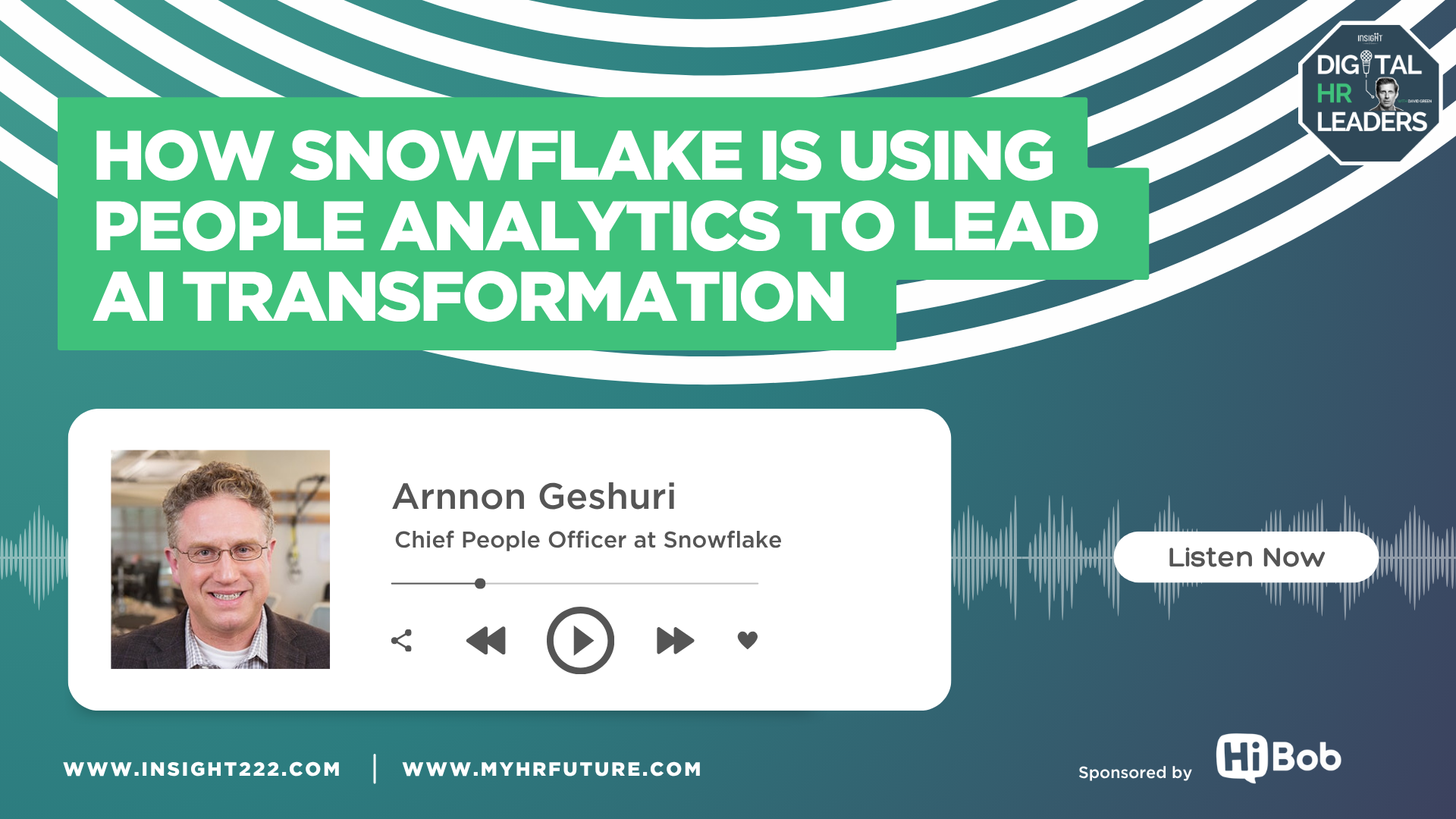
As AI reshapes work, the people function has an opportunity to play a much bigger role in how organisations navigate the transformation. At Snowflake, that starts with trusted data, strong people analytics and a clear view of what technology should automate, where it should augment human capability, and what should remain human.
In this episode, David Green is joined by Arnnon Geshuri, Chief People Officer at Snowflake. Drawing on a career that includes senior roles at Google, Tesla and Teladoc Health, Arnnon explains why data has become a common language between HR and the business, and how Snowflake is putting that philosophy into practice.
In this conversation, David and Arnnon discuss:
Why people analytics gives HR greater credibility and influence with senior business leaders
Snowflake’s model for deciding what to automate, what to augment and what should remain human
How Snowflake’s talent acquisition team is building its own tools, including an application that reduced hours of work on job descriptions to minutes
Why AI is changing jobs, career paths and the skills people will need as work is redesigned
Why trusted data is essential to workforce transformation, and how Snowflake puts interactive organisational insights directly into managers’ hands
How Snowflake’s talent acquisition team achieved a 20% productivity improvement, and why Arnnon focuses on business outcomes rather than tool usage
Why analytics, systems thinking and change management are becoming essential capabilities for current and aspiring Chief People Officers
For HR and people analytics leaders, this conversation provides a practical look at how a data-led people function can help shape work, strengthen decision-making and lead organisational transformation.
This episode is sponsored by HiBob.
HiBob is the people platform built for the AI era, helping organizations replace fragmented HR systems with a unified foundation for workforce management. That's why Brandon Hall Group says unified workforce platforms are becoming the foundation for organizations looking to scale AI with confidence.
The report also includes a practical business case template with ROI modeling and executive evaluation criteria to help build your transformation strategy.
Download the Brandon Hall Group HCMS Platforms Report
Resources:
This episode of the Digital HR Leaders Podcast is brought to you by HiBob.
[0:00:09] David Green: If you've ever taken people data into a leadership meeting and had someone question the numbers before you've even made your point, you'll know how quickly that can derail the conversation. My guest today knows this particularly well. He has spent much of his career in engineering-led companies where data is the common language, and where people leaders need to combine human judgment with analytical rigour to influence business decisions. So, I'm delighted to welcome Arnnon Geshuri, Chief People Officer at Snowflake. Arnnon has had an impressive career with senior HR roles at Google and Tesla, before serving as Chief People Officer at Teladoc Health and now Snowflake. One thing that has been consistent throughout that journey is Arnnon's strongly held belief in building a strong people analytics capability and using data to measure impact, inform decisions, and create a common language with the business.
With Snowflake at the forefront of data and AI, I wanted to understand what transformation actually looks like from inside the people function, and the role HR can play in helping lead it. We explore Snowflake's approach to deciding what to automate, what to augment and what should remain human. We discuss how its talent acquisition team is building its own tools, how managers are using organisational data to make better workforce decisions, and why trusted data is the foundation for all of this. And if you're a current or aspiring Chief People Officer, stay with us towards the end. Arnnon shares three capabilities he believes will become increasingly important for HR leaders: analytics; systems thinking; and change management. So, without further ado, let's get into the conversation.
Arnnon, welcome to the show.
[02:07] Arnnon Geshuri: Well, I'm very glad to be here. Thanks for the invite.
[02:09] David Green: Yeah, we always love talking to Chief People Officers in this series, and I know our listeners particularly enjoy hearing how you're operating in your organisation as well. You've had an impressive career. You've had senior roles and Chief People Officer roles at companies like Google, like Tesla, like Teladoc Health before Snowflake. As part of maybe introducing yourself to listeners, Arnnon, can you share a little bit about maybe some of your key learnings along the journey?
[02:39] Arnnon Geshuri: Sure. You know, along the way, I've gone to companies that have been innovative, have charted a new course in their industry, and really been attracted to those types of companies, because they are experimenting in a whole new world. And I've been to some various organisations along the way in different industries. So, I haven't stuck to the same industry, David. I've tried the people practice just to see how we can create something special within that sector. Some of the common themes along the way that I've learned, because I've worked many times for engineering companies, it's been really important as the people leader to have a common language with all my technical business partners and all the business leaders.
So, I've developed really two things when I start with a company. The first one is very strong people analytics. So, I use data as a common language, so I measure everything. And I think about how the impact of what I do, each programme that I launch, I make sure I know what the before, the after looks like; I make sure I understand the variables that I'm launching so that I can really track the capability of that programme so it lands well; and if it doesn't land well, I can explain why, I know what variables failed and I'm able to iterate on them. So, that's been a really important part to my organisations, is having a strong people analytics function.
The second is all about talent. Every single company I've gone to, it's a growth story. So, I had to build a very strong talent acquisition, very strong recruiting function, really understanding the dynamics of that organisation, and built up strong capabilities to bring in top talent. The one key, also learning, just the last one for you, is it's not a cut-and-paste exercise. Like, If I've done well in a certain other organisation, figured out the secret sauce, it doesn't necessarily transfer over, because cultures are different, leadership is different, the industry is different. The core might be the same, but you have to customise the programmes really to meet the demands of that particular organisation. And I found that some people leaders who just cut and paste don't quite succeed. So, you have to be adaptable, you have to customise, you have to personalise the programmes to meet the needs of that organisation.
[05:07] David Green: Really good. And if only it was so easy that we could just cut and paste, life would be a much easier thing. Obviously, you mentioned people analytics. That's a real passion of mine and the team at Insight222. We work with 120 organisations and their people analytics leaders and their teams. I wonder if you could talk to how people analytics helps you, as a Chief People Officer, to get things done, to add value, but also in your conversations with the CEO and the rest of the leadership team?
[05:41] Arnnon Geshuri: Well, how I think about how, for kind of the context, the people analytics function sits within the people team, but it could sit in the business, it's fine with me. It's just creating a really good analytics capability to analyse everything we do. Now, here's the key. Professional people people, you know, our HR teams, other people team, they come with years of experience and intuition and gut feelings, and they understand the context and a lot of the emotional components to it, which is super-valuable to where we go as a company, right, to create culture and create engagement and connection. The analytics team in the past, I've built it using folks who are not from traditionally HR disciplines. They're statisticians, they're mathematicians, they're economists, they're folks who are actuaries, who could do really great probabilities for me, for my benefits. And because they can see through the noise, they can see through all of the variables to come up with really the core of what's really happening, without bias about what they think is happening. They just let the data tell the story. And so, they see correlations, they see how things are trending in the right direction. So then, if I can couple that capability, that seeing through the noise, and then couple that with a great HR team, a great people team, that has that intuition and experience, you put those two together, then you can create very powerful capabilities for the company.
Now, when I talk to senior leaders, I always make sure, as I mentioned before, I like to measure everything, I like to look at the analytics, I like to see what variables I'm going to try to change. I'm going to launch programmes, I'm going to measure the success of it, the outcomes, what actually happened, look at the insights, use those insights then to inform decisions into the company, let everybody in the company in and build transparency around it. So, I don't hold all the data myself. I say, "Here's what I'm seeing out there. Here's the trends, here's what I'm seeing in the different organisations, here's what the world has in store for us, this is what's happening inside the company". And then, I share the data really openly with the organisation to say, "Here's my interpretation of it. But let's debate, let's talk about the interpretation. The data is the same, the data is clean, it's telling a story. Let's talk about how that is going to impact us and what your maybe alternate perspective is on it". And it usually has great conversations with senior leaders. It helps guide decisions and helps strongly influence the direction of the company.
[08:21] David Green: We're seeing examples of Chief People Officers taking ownership of technology. Tracey Franklin at Moderna is probably the most famous example today, but Jacqui Canney at ServiceNow, Nickle at IBM, and others, as well as their traditional HR responsibilities. Are you finding that's what's happening at Snowflake? Are you sort of getting responsibility for technology, or are you just working much closer with the CTO at Snowflake?
[08:49] Arnnon Geshuri: Well, that's a great question. One contextual component that I think about is with the world of AI and the world of natural language, it has bridged the gap between, you have to be a technologist to be able to run AI, but now you can use natural language, you can vibe code, you can do whatever you need to do to build applications for your organisation. So, the stretch of having to be very technically-inclined is actually much more even across the different disciplines. So, with that in mind, I found that also with AI, the really important component to it is that it is pushing us to be more human, right? It's pushing us to think about what needs to stay human and what needs to be automated. And I think a lot of the decision-making process really sits well within a people function, to understand how you create the workforce, how you preserve humanity within the workforce, how you drive trust with all the new technology. And the best place to do that is within the people function, and the people leader is in the right time in history to be able to lead those type of functions.
[09:58] David Green: Yeah, it's a real opportunity, I guess, and a responsibility for us, as HR leaders, to step up to that opportunity as well.
[10:08] Arnnon Geshuri: It's true. And there's another aspect to this. It's about the human adoption, right, the adoption of AI. And a lot of companies are going through that change management, that ability to think about, "All right, I have all these new tools and we have this data layer and we need to leverage this to make a better company. How do we do that? And how do we sometimes bring people along for that journey?" And again, the people leader and their team is in the right place to help with capturing the hearts and minds of the organisation to help with the change management, to help guide the process, that it's okay, the other side is great. And let's continue to develop the technology, let's do it in a thoughtful way that preserves who you are, but also we're changing the fundamentals of how we work. And again, the people leader is in the right place, the right time to be able to lead that effort.
[11:06] David Green: And I think what you've highlighted there, Arnnon, is something that's a really important thing for people to remember, is that it's easy to think that this is a technology transformation. But this is actually even more of a people transformation than it is a technology transformation. And as you said, who better to help steer the organisation through that change than the Chief People Officer and the people function?
[11:28] Arnnon Geshuri: It's a mindset change, right? You have to think about how you can bring the organisation with you on this journey. And it's such a key element to this. You know, I think about my own people function, and I've been with Snowflake almost two years now. And even with my own people function, we have all these amazing tools in the company, and I had to take people along for the journey. Like, I said, "It's okay. It's okay that we're going to automate a portion of your work, we're going to lift you up to do more meaningful outcomes, more meaningful work on your own". So, I experienced it hands-on, where I brought my own team, over the last two years, into this new paradigm, into this new way of thinking. But it was all about kind of the change management aspects of it, it's all about the mindset change, it's all about this AI propensity. It's like turning AI awareness to AI curiosity to AI proficiency. It's this food chain where you bring people along and start with a few things to convince and get them over that hump. And then, you start working with them to create a better tomorrow.
[12:36] David Green: And it's so important that we lead from the front as people leaders as well, because how can we expect the rest of the people function to come along with us if you, as Chief People Officer, and your direct leadership team aren't actually not only saying it's important to use AI, but actually role-modelling that use yourself?
[12:56] Arnnon Geshuri: Well, I think it's an important point actually, is that it's lead from the front, not only for my own team, but for the company.
[13:01] David Green: Exactly, yeah.
[13:02] Arnnon Geshuri: So, the company leans on me here. It leans on all people leaders to say, "Look, you need to help with this transformation, you need to help with this change, you need to help with this mindset, lifting people up". And yes, it's important to start with my own function to make sure everyone's a believer and everyone's leaning in, and everyone's using the tools and creating some really great applications, and really changing the fundamentals of how they do their daily job to be more meaningful and more impactful for the company. So, yes, you have to prove and model that behaviour, but you also have to be that leader in the company. That's what the expectation is. It's not just me transforming my own team and making sure we go along for the journey, but we talk to everybody in the organisation and help them take those steps forward in all different functions. So, the people leader is so key in this AI era to lead organisations, to change mindset, to change people's perspective of how they do the work, and to really make a better company.
[14:08] David Green: This episode of the Digital HR Leaders podcast is sponsored by HiBob. Has your organisation outgrown its HR stack? AI is about to make that expensive. The latest Brandon Hall Group report explains why fragmented HR systems are becoming a liability, and why unified workforce platforms are emerging as the foundation for the AI era. Discover how leading organisations are connecting HR, finance and operations to improve execution, reduce complexity, and scale with confidence. Download the report at hibob.com/davidgreen2026, or visit HiBob at HR Tech Booth 1927 or UNLEASH World at Booth 101. HiBob, HCM for people-proud companies.
And as people professionals, we have to think beyond that this is just changing our function and maybe using AI in recruiting, or using AI to support performance management. This is about changing the organisation and helping the organisation transform. It's a little bit about what you talked about really, it's about understanding how the workforce and the work going to transform as well. Because obviously, some of that work that's done today and is going to be done by AI, that's going to change how people's jobs are structured, that's going to change tasks. It hopefully is going to create more interesting tasks for people to do as well, rather than some of the more mundane tasks, which is better performed by technology. And that's a great opportunity and a real responsibility for people teams.
[16:00] Arnnon Geshuri: You know, we create a model for what we use at Snowflake, and I advocate this in all my conversations with people, both internal and external to the company, we have this model, and I'll explain it. So, first of all, anything that's repetitive tasks within a person's function, we automate, right? We'll go in and we'll figure out how to make it better through AI, we'll build different apps to increase the capability, but like you said, there's a lot of things will be automated that's tasks. The second thing is augment. So, we go in and we augment the creative. So, I'll give an example. So, let's say in compensation, I've uploaded all of these job surveys, all these salary surveys, and we put it all into this database, and we ask the system to help us with initial insights and look at trends. And it will provide all those trends with the external environment, look at our internal data, and give our data much faster than we could have done by hand. But it's up to us to look at the data and make judgment calls. It's not like we're just asking them to provide guidance to the organisation. We provide the guidance. So, it's augment the creative. You provide the insights, but you still have that next step of personal creativity to understand the data and to be able to customise it for the organisation.
The last is super-important, and it's basically we preserve what needs to be human, we preserve humanity. And that's all about having those conversations with each other about promotion and about how you're doing from a performance perspective, discussing career growth. Being that person who has that connective conversation with somebody has to stay human. And that's where the trust is. If we tell the organisation, "Look, we're going to have a clear line and we're not going to cross it. We're going to automate some repetitive tasks through the insights, we'll augment some creative work. But when it comes to these interpersonal connections, when it comes to explaining your career path in the company, we're going to keep it person to person and make sure humanity is preserved". And that preserves trust. That preserves exactly what people want to hear is that it's not going to go overboard. We're not going to get over our skis in terms of how we use this information. We're going to preserve that personal human element and make sure it does not get diluted.
[18:31] David Green: Let's explore, Arnnon, a little bit more about what this looks like at Snowflake. So, obviously, you've talked about this change that you've been on at Snowflake. What does that mean about organisational design, for example, at Snowflake?
[18:46] Arnnon Geshuri: Well, the whole concept is that we have to look at the architecture, how humans and AI and teams interact, how they connect together. And a lot of times, the capability is a little bit more -- the skillsets are more fungible. So, if you create skillsets, and I'll give you an example. I have my TA team, that's the Talent Acquisition team, and they're building applications. They have an idea in their head on, "I think we can automate this. We can create something really cool". In three days, they've coded it and they've sent it out there and got it into production for themselves, and they've built it. Now, we didn't have to go to any other technical team in the company to get that done. We're able to do it ourselves because we had the skillsets. So, we find that in this new world, skillsets and skill capability are much more transferable across the teams. So, you can rethink the way that teams are structured, because you can do a lot in-house based on your AI capability. And so, the job structure itself might change, might be more universal.
The other thing is that companies do have to think about the job ladder. They do have to think, and the job ladder usually is, let's say, when you are starting with a company, let's say you're a finance analyst, and you start with a company. There's usually this job ladder or job track that gives you, "All right, when you start your first two years, you're going to learn these skillsets. Then, after that, you're going to learn these two skillsets, and you might get promoted". And it gives you this ladder of where you're headed. And if you want to be a CFO one day, here's all the things you have to learn. But in this new world, you're going to have some of these capabilities enhanced by AI. You're going to automate some of the tactical stuff, you're going to augment. So, these people don't come in just to learn basic skillsets, hands-on skillsets, they're also going to learn how to manage agentic workflows, how to manage things that are already automated.
So, the structure of the job itself is rapidly changing. And that's one of the key things that I believe that as a people leader, they're going to have to really understand how the architecture is going to work between the human, the AI and the teams, and how fungible skillsets, how automation, how agentic workflows are all going to feed into this new paradigm to create just a different workforce, just a different way we're going to see growth, see career development. It's all going to be different, but we have to guide how this is going to look, we can't just let it run amok. We have to create some guardrails and help push it in the right direction. So, that's kind of how I see some of that structure taking place.
[21:25] David Green: Really interesting, because I mean, if we think about obviously, there's been a lot in the press about early career roles and some companies supposedly not hiring as many early career. And then you think about, as you say, you then need to think about succession planning, you think about the innovation. And I think what you're saying there Arnnon is, "Actually, let's make early career roles actually more interesting". Let's recognise that some of the staff that we've hired, very intelligent people who've graduated to do quite repetitive, boring work early in career. They don't need to do that repetitive work anymore. They can be doing other things, which are maybe probably more in tune with the skills and knowledge that they've acquired through their studies. But as you said, it does force us to really rethink how we do that. And that's not easy, particularly when the technology is developing so quickly as well.
[22:16] Arnnon Geshuri: Yeah. And one thing, just to grow on what you just said, is so we might take some of the tasks and put in agentic workflows; you still have to train people on those skills. And those skills are important because as you grow in your career, part of your job, part of everyone's job now is going to be much more about judgment calls, much more about looking at the data and see, "Does the data seem right? Does it seem like it's trending in the right direction? Is something missing in the analysis and the insights?" But you have to have some knowledge, some context of your discipline to be able to make those calls. So, yes, I think we'll make the jobs more meaningful, but also to think about how do we train people to learn those fundamentals; how do we train people to understand how the data is supposed to interact; what does great look like; and not just rely on the output of any type of algorithm.
So, I think there's a happy medium here that we're just going to have to just go down the path and figure it out. But that's really where we're headed: more meaningful work, but also train people on the core of the job, so they preserve some of those in-discipline skillsets.
[23:28] David Green: You mentioned, Arnnon, that your TA team have got the skills to design technology and tools themselves. And I understand that you're using a mix of internal and external AI technologies at Snowflake. So, maybe if we just zoom from an HR perspective, because I know our listeners are always interested in kind of the way different companies work, what have you decided to build and what have you opted to buy, and what's your rationale behind that? And I guess you've got that kind of hybrid mix then of external and internal tools that you're using?
[24:03] Arnnon Geshuri: Yeah, I feel a little spoiled here, actually.
[24:06] David Green: Well, I was just about to say, you're customer zero, no doubt, as well, for all the great tools that you've got at Snowflake.
[24:11] Arnnon Geshuri: For sure. And Snowflake, all of our products internally that we build, it's called Snowflake on Snowflake or Snow on Snow. So, we have the platform and we have all the information and the tools to build anything we wish. Like, it is a candy store for anybody on a people team or anywhere in the company, you have everything in there. The only thing we buy externally are maybe some larger applicant tracking systems or a workforce management system, like an HR system, to gather all the data, to have the normal transactions, to put all the data in, from resumés to job transactions. And all of it gets stored, but it gets moved to Snowhouse, gets moved to our Snowflake platform. And from there, we're able to use all of our own tools to enhance, to pull the data, do insights, do analysis on massive amounts of data, that has now just propelled the TA team, propelled the HR folks, propelled our benefits and our compensation team to whole new areas of capability, like never seen before.
So, we use all of our own products. And what I've done is, and I'm just going to stay on the people function for a while, is let's say the recruiting team, the talent acquisition team again. We do a brainstorming session at the beginning of the week. I say, "Okay, what other tools would you like to see out there?" And let me give you an example. Just a few months back, I say, "What's a pain point in your organisation?" And they said, "Well, what takes us a long time to get done are these job descriptions. We write a job description, and then we have to edit it, and then we put it out there. We get the manager to review it, and then we format it, and it goes on to our website, and on and on and on." I say, "You're giving me a headache", right? So, I said, "Okay, what can we do? Let's try to build an app that can actually take these hours of work down to seconds". And so, that's what they did. They built an app that you put in a few keywords, automatically knows the context of the company, it can pull from archive data of different job descriptions used in the past, it can look at external benchmarks. It can look at anything it wants, looks at the language we use internally of how we describe something. And within literally less than a minute, it generates a job description pre-formatted, 99% there. They look at it, it's almost perfect. They show it to the hiring manager. They said, "This is amazing", and we post it.
It's gone from several hours to literally 10 to 15 minutes. It's complete, just doing the entire process. We've already saved years. We've already saved three years already of just person work time just by automating the job description creation. It's insane. And what it did was, this is really cool. It inspired people. People got so excited. They said, "Oh my gosh, this is pretty amazing. What else can we do?" And it just took a few of those initial conversation-starters, those initial projects that proved concept, that it just unleashed this amazing capability within the organisation. And they all realised they can programme anything they want. They can develop any tool using our Snowflake-on-Snowflake capability because, again, you can vibe code, you can use natural language, you're not having to be technical, you just need to know what you want. The biggest key to change management is start with something small, prove concept, get the excitement, get that from the AI propensity, get from people from AI awareness to AI curiosity to AI proficient. That's moving from, "Oh, I'm curious now, what else can it do?" and actually put their hands on the keyboard to start doing something. It is transformational because it's infectious. So, we found that all our teams are one of the biggest users in the company.
[28:00] David Green: I want to take a short break from this episode to introduce the Insight222 People Analytics Program, designed for senior leaders to connect, grow, and lead in the evolving world of people analytics. The programme brings together top HR professionals with extensive experience from global companies, offering a unique platform to expand your influence, gain invaluable industry insight and tackle real-world business challenges. As a member, you'll gain access to over 40 in-person and virtual events a year, advisory sessions with seasoned practitioners, as well as insights, ideas and learning to stay up-to-date with best practices and new thinking. Every connection made brings new possibilities to elevate your impact and drive meaningful change. To learn more, head over to insight222.com/program and join our group of global leaders.
And you mentioned two words actually in your introduction, Arnnon: innovation; experimentation. And I think you've just literally shown that in that example there.
[29:21] Arnnon Geshuri: Yes, for sure. And that's the key. But take a step back again. The whole philosophy about the people function is you have to be just as innovative, just as creative, experiment more than your product team, like, your engineering team. You have to be toe to toe. I mean, you can't be passive in this whole new world. So, every people function that I've had the honour of managing, we've pushed the innovation, we've pushed experimentation, try things, be creative, break things along the way, challenge the status quo, do stuff that is going to make the function better, because ultimately you're going to make the company better, because you're going to build faster products, you're going to build processes that flow much better when they're automated, you're just going to think differently. And so, yes, innovation, experimentation is my number one priority to instil that mindset into the organisation, into my team, so that they can produce and be as innovative as any other team in the company.
[30:18] David Green: And I think what you've just described there, Arnnon, is the fact that you have a people function, but you also have a product function. And you've put the two together, which we've heard for years what the people functions could learn from marketing functions. But I think that, in essence, is use data, experiment, create products that actually deliver value. And that's what we've been told for years that marketing's done, that we need to follow in HR or in people functions, and you've just talked about exactly that.
[30:49] Arnnon Geshuri: Right. And don't be afraid to make mistakes, because you learn from the mistakes, right? That's part of the experimentation. You just play; you play and you build and you try things. And remember we talked about before, is that if you know your starting state and you measure through the process and then you measure the outcome, you know when things aren't working well, you can actually go back into the data and say, "Oh, I understand if I change this variable, this will probably land better, they'll probably have a better outcome". So, as long as you're experimenting thoughtfully and you're breaking things thoughtfully, and use data along the way to measure the before and after and all through the process, you're going to come up with much better capability, you're going to come up with things that make sense. And other people in the organisation in technical functions are going to look and say, "Wow, this was done really well. This was done actually thoughtfully and with data, and you know the outcomes". And it's a common language, and they say, "This is legit. The people function, you're acting and thinking just like a business function, and you're adding value".
[31:51] David Green: Well, you gave a great example there, Arnnon, on the work you've done around job descriptions. Where else are you using AI in your kind of people processes? And where are you avoiding it? You said a little bit about where you were avoiding it, on the stuff where you want to preserve the human. I don't know if you've got any other specific examples that you'd like to share, either where you're using it or where you're not using it?
[32:14] Arnnon Geshuri: Yeah. Well, maybe I'll mention compensation. I alluded to it before, but maybe I'll take it through the whole story. So, from the automation perspective, we'll pull in all the salary and job data all over the world in our history, and we'll put it into our Snowhouse database and have the data ready for so-and-so products to look at it. Then, we augment the creative. So, we pull out the data and we ask questions of the data and start to understand what the data looks like, and it gives us trends. It looks at where are there hot spots in the company, or if we compare certain groups to external benchmarks, is there a gap? It gives us all that analysis and maybe there's a rationale behind it, maybe there's a reason behind some of that. And that's where we start going into the human aspect, where you stop there, you give all the insights, but the human then looks at the data to make a decision, "Yes, well, the reason why this organisation's a little bit off the market data is it's intentional". So, the data doesn't know that, but I know that as a person who understands the company and the dynamics.
Then, the next phase is 100% human. So, now you make decisions on the data based on giving people raises, having people career conversations, doing promotions, looking at hotspots, and you preserve that for that human connection, where managers are managing their people through conversation and connection and having those compensation discussions that are very meaningful, but it has to come from the person. So, this compensation is a really great example of how you start with data and automate, you are creative around the trends, but then you leave the conversations to the manager and to keep it human.
[33:58] David Green: Really good example. Again, you talked earlier about preserving the human and how you're obviously communicating that, bringing that part of the change as well, in order to gain trust. So, if we now think about the organisation more broadly beyond the people function, because the role, I guess, of the people function is to help imbue that employee trust and transparency. Can you talk a little bit to how you're doing that as part of the change and transformation programme?
[34:29] Arnnon Geshuri: Well, there's still some areas that we are making sure that we're optimising in the company, and that is how to be a great manager. Because the number one thing I've learned, if I take another step back, the one thing I've learned is that as companies scale, one of the most important areas is to create a strong management team. And those managers can still be hands-on in their function, but they also know how to manage people and grow people and keep people connected to the company. In this crazy time, even from COVID, if we look back a few years, the biggest thing in our society was people felt lonely, they felt disconnected. They felt like even in companies, people pulled back and they didn't know what to do. It really pushed the manager, "How do I connect with people?" especially in the remote world out there, connect with people in the office and really create that bond, that sense of belonging that's so important.
So, that's preserved. So, we want to train managers to still think about that, train managers to how to have those conversations, how to have even tough conversations when a person's not performing. So, that's not going away, the way that we have to engage with humans, the way that we have to make people feel connected to the company, make people feel a sense of belonging. People connect with companies in different ways. You know, they love their job, they love their manager, they love the work that they do. All that has to be optimised, so that has not changed. Like, we are double-downing on the humanity of our managers as all this technology is really redefining how we do work. But the connection with humans, the connection with each other is not going to change. And we're going to spend more time to amplify that and make that stronger.
[36:19] David Green: I mean, how have you seen the role of managers changing with more AI coming in? Is it changing, in your view, at Snowflake and what's getting harder, what's getting easier? Is anything getting easier? I don't know!
[36:34] Arnnon Geshuri: Yeah, well more than ever, they have to think about how to optimise how work gets done. Managers still, they're accountable to the outcomes of their team, they're accountable to building value for the organisation in delivering to the organisation. Now, all this really great AI technology and all the capability that we're building will optimise how jobs get done so that you can amplify the outcomes. You can measure how things are landing in the organisation much better. So, part of this is managers have to think about, "How do I restructure my jobs within my organisation? How do I own that? How do I optimise how work gets done? How do I think more AI-native?" It's not just adding a few little words to the job description that's going to change things. It's really fundamentally looking at your organisation and restructuring how work is approached when you implement AI, how you build agentic workflows to speed up the process and produce and have better outcomes. So, there's a whole new burden or opportunity, I guess, is a better way to phrase it, on managers to relook at how the organisation is working, to relook at each role, how the interconnection between AI and human needs to work better, so that they amplify not only the humanity, but amplify the outcomes and they're delivering for the organisation.
[38:07] David Green: I mean, workforce planning has always been important, but arguably it's even more important now. And obviously, you've got this really strong backbone of data at Snowflake. You're obviously a strong believer in people analytics. Can you talk a little bit to how that data is supporting your workforce planning efforts as well as you kind of analyse work, restructure work? Do you break it down to the task level, for example? Are you redesigning jobs? I mean, what are some of the things that you're doing in relation to that?
[38:38] Arnnon Geshuri: I will say there's no AI strategy if there's no data strategy. So, first of all, we make sure that it starts with data. So, we built really good data governance, we understand what data should be seen by this group versus this group. And it's super-clean. Like, we make sure our data is great so that you can trust the insights that come from it. I think if you people who have been in my role for many years, we always get knocked for the data being a little bit off and then it ruins our whole argument because they say, "Well, this is not right data, the graphs are off, it doesn't make sense". So, a data-governance strategy and a data-quality strategy is super-important. So, that's really done.
Then, from that, we've built internal insights for the company, for managers to understand organisational design, to understand how they've grown in the past, look at open jobs, look at current population, understand span of control, understand depth of the organisation, like how many layers you have. So, we've built these capabilities that managers have such easy access to it. And then, we put in benchmarks on what good looks like. And we put it there and we say, "This is how your organisation compares to benchmarks, just as an FYI". So, we've brought in data, we brought in external information, we create these away, and it's not just dashboards. I want to be really clear, it's not just dashboards, it's a way of interacting with the data. So, the manager could ask the data, "Oh, I see my span of control, like, when did this happen? Can you give me a little bit of history on this span of control? And why do each of my managers only have three people? I thought they had five people each". And whatever it is, the data can then provide history, provide insights, it can help to look at, "Oh, but if you took your future hires that are coming up, you're actually going to shift this within six months". You actually can interface with the data to make better decisions.
So, what we've done is we've given this accessibility to all managers in the company, we've built clear pathways to get this data. The data is really trustworthy. And now managers, at their fingertips, have the insights, have the information, have the ability to interact with the data to make amazing decisions for the org structure, the org design, what kind of skill sets they need in the future, how they should look at it. But it is more powerful than I've ever had in the past. These aren't static dashboards, these are interactive capabilities that you can actually dive into the data and transform it along with you along that journey.
[41:15] David Green: So, you're basically giving the insights to the people managers in the flow of work and making them actionable, so they can actually use it to make decisions in the flow of work about how they structure their team, etc, etc. But you have to do that. You can't just be sitting in the ivory tower of HR and reliant on people, business partners to be having conversations; you're actually getting it out to people managers?
[41:40] Arnnon Geshuri: Right. And you also make it interesting. I think also a failure point could be that you just send all this data out to the organisation and they just don't use it, right? So, it really is about asking the managers and making sure, encouraging them, "Use the data during your conversations, during your team meetings. Pass down some of the insights that you've put together". So, we try to make sure that they don't only just look at it passively, but they're actioning it. So, we double-check with people, we ask them questions, we train them to use the data if they need to, the opt-in training, but it really is about using it, not just getting it, but using it and making clear actions that you can help improve the organisation.
[42:24] David Green: And that leads quite nicely to my next question, Arnnon. So, it's about measuring adoption, really, of AI, but I think we could extend that to data as well. Are you measuring the organisational take up of people analytics tools, AI tools in your team in HR, but also in the wider organisation? And then ultimately, I guess, it's about outcomes. How are you measuring the value and the outcomes that you're getting from that as well?
[42:51] Arnnon Geshuri: Yeah, it really is an evolution. So, I think if you're just starting out, you're going to lean on maybe dashboards to say, "Hey, how much are certain tools being used in the company? It's more static. Like, are people actually leveraging it?" But, you soon find that that's not good enough, right? You actually need to see outcomes, you need to see value in the company. So, I'm going to use my own organisation as an example. So, the Talent Acquisition team, they were first to jump in and really love the tools. And I got them really excited and talked about the job generator, job description generator, and some other tools. and they're automating so much stuff. So, we found that I didn't have to look at whether they're using the tools; they are. But we found that with the same amount of people, we were 20% more productive, 20%. We hired 20% more people, we talked to 20% more candidates. I mean, it was all this work that we've done.
Actually, the outcome was I didn't have to grow the team much bigger. The team became more efficient in where they were. And instead of asking, "Hey, can I have ten more recruiters?" Instead, they said, "I actually built some really great agentic workflows that I can optimise what I'm doing". And each person is just so excited about just being better and doing more meaningful work. Some of the stuff gets automated, they can spend more time with candidates to have that interaction, that ability to connect with candidates, and have the cultural conversations to make sure it's the right person for the company. So, it changed. And they found that they, in aggregate, were 20% more productive. So, we know that this actually works.
So, other teams are experiencing the same thing, where they're looking at overall outcomes. They've gone from dashboards to overall outcomes and saw that they're producing faster, the amount of code is going faster, the quality of the code, you know, all this stuff just gets better and better. And so, the outcomes and the value of the company have increased.
[44:48] David Green: That's really good. And we do see it often, don't we, that TA teams in people functions are the pioneers when it comes to technology and their appetite to take it up. If we look at the rest of the people function, Arnnon, obviously we've talked about it all the way through the episode really, this is a really interesting time to work in the people function. We've got an opportunity and a responsibility to help drive the organisation forward. What are you seeing in terms of, I mean, for example, what are the skills that you're looking to build in your people function, either by, you talked about in people analytics, you traditionally hired people who haven't worked in people functions. But what are the skills that you're bringing in, maybe from outside, but what are the skills that you're looking to build in your people function as well?
[45:42] Arnnon Geshuri: An important thing is I feel every person in the people function needs to have a really good analytical underpinning. So, not just bringing in analytics and relying on them, but everybody should have systems thinking, should understand how the data should work, be able to ask the data questions. I mean, it's really important to, again, move from AI-curious to AI-proficient, that they could ask the data questions and start to produce better results. So, I ask people, like, "You need to build your skillsets, you need to be comfortable with data, you need to have an understanding of how analytics works, how decisions are made, system thinking". So, all of these components are really important and I instil this in all of my team. Because that will lend itself really well to any type of agentic workflows or AI interface, is they're asking the right questions. They're thinking about what the outcomes need to be and they're guiding the data and guiding the system to get there. Without that, they're just kind of lost and it's just not quite right. That's what I look for in new candidates, and that's what I try to build in my current workforce.
[46:52] David Green: If you had a group of current and aspiring Chief People Officers that aren't quite there at the moment, what's the one, two, or maybe even three things that you challenge them on to help them become more relevant?
[47:05] Arnnon Geshuri: So, I think we talked about it, but I'll summarise some of the things that I think are most important. The first one is definitely the analytical capability, right? People who are aspiring, don't be afraid of data, don't be afraid of looking at a chart, looking at trend lines, and asking questions. Like, if you don't know, it's okay. Because remember, as I mentioned, in all the companies I worked for with a highly technical function, the common language was data and analytics. And so, for an HR person who might have shied away from that early in their career, I would definitely lean in, because that is the common conversation, the common language that you would have for technical functions. So, definitely analytics.
The second is basically systems thinking. So, if you think about, this deals with pattern recognition and looking through the throughput of how a certain event is going to impact upstream and downstream, really thinking about the whole picture. I find that the most successful people leaders and folks that are moving to that role can think about things holistically, can really think about if we launch this product, it's not just going to be in isolation, how is it going to impact? Like, how is it going to land with the organisation? Is it going to be culturally aligned? Will it have an adverse impact? Those that can think about that more holistically are more successful, because they avoid the mistakes, or they think through the mistakes that they should have thought about, right? They think through them and they avoid some of the bigger ones.
So, I think the last one is really about change management. So, we talked about that how key change management, the human condition is with the AI coming in and changing the hearts and minds and the mindset of people, it's understanding the fundamentals of change management. How do you go from, "Here's a whole new idea, a whole new platform, a whole new technology"? What are the steps that it takes to get people to feel comfortable adopting this? Like, what are the steps that are going to be the journey for that product to land in the organisation? But the whole change management, the whole idea about the psychology of it is really important, because the one thing that AI is doing now, again, it's automating a lot of things, it does create a little bit of angst with some people. And organisations rely on the people team to pre-think about that and to make sure that adoption is done more smoothly, and to think about the whole upstream and downstream impact of it. But that's a really big component, too, especially with an AI agentic workforce; change management is really key.
[49:51] David Green: Arnnon, we've got to the last question, which is the question we're asking everyone on this series of the podcast. You've talked a little bit to it. So, again, it might give you another opportunity to summarise, but maybe add something else as well. How should HR, how should people functions help the organisation by redesigning work to unlock business value?
[50:14] Arnnon Geshuri: So, it is about understanding the fundamentals of the job ladder. What we're looking at is, how we work is fundamentally going to change. How each job is structured, how the architecture of the human and AI and teams, how they interconnect is fundamentally going to change. So, to unlock is to kind of think about how you can bring all this agentic workflow into the lives of everyone in the company, how to convince people to think more about being AI-native, AI-first, and the change management component of it, where you're helping people adopt, helping people think through how this can better their own job, making their own job more meaningful. And all of that will unlock this great potential, because we talked about how we amplified outcomes, even my own team, 20% more productive on the TA team. You'll see that as soon as you get this whole thing working together, you'll see all these pockets of amazing work being done, of amplifying, of unlocking the potential of people. But it really is guiding them through this process and making sure it's adopted and landed well.
[51:30] David Green: Really good, and as you said right back at the start, that organisational context as well is so important; obviously meeting your organisation a little bit where they are, but not being too scared to try and pull them forward a little bit as well. Arnnon, thank you so much. It's been a really, really fascinating conversation. Loved hearing about some of the great examples of the work that you and your team are doing at Snowflake. I think that 20% productivity increase from your TA team will definitely inspire many of our listeners. How can listeners connect with you and find out more about Snowflake?
[52:08] Arnnon Geshuri: Yeah, definitely, I'm on LinkedIn, that's my main interface, I love to interact with people there. So, please look me up and send me an invite. And then, snowflake.com, please take a look. We have lots of insights about what we're doing and a lot of the projects that are underway. And we even have classes people can take and sign up for. So, there's lots of great things out there. But please lean in and we'd love to hear from you.
[52:34] David Green: And I'm sure you mentioned that you're growing, I'm sure you've inspired many listeners to maybe look at your Situations Vacant page as well. So, you might get a bit of an uptick in applications!
[52:47] Arnnon Geshuri: That sounds good. I'll welcome all of them and I appreciate it.
[52:50] David Green: Arnnon, thank you very much for being a guest on the Digital HR Leaders podcast.
[52:54] Arnnon Geshuri: It's been my pleasure and thank you.
[52:57] David Green: Arnnon, thank you. I really enjoyed that conversation and the practical examples of how you and the team at Snowflake are using data and AI to reshape the people function and help the wider organisation transform. There are two ideas I'd encourage listeners to take away. First, data and people analytics are becoming even more important as the nature of work changes. Arnnon's point that there is no AI strategy if there's no data strategy really stood out, and resonates with our work at Insight222. Trusted data enables managers to move beyond static dashboards and interact with workforce insights to make better decisions about organisation design, skills, and workforce planning. Second, this transformation creates a significant opportunity for HR leadership. People leaders can help organisations determine what to automate, where technology can augment human capability, and where human judgment, connection, and trust need to be preserved. Doing that well requires HR itself to build stronger analytical capability, systems thinking, and change management expertise.
I'd love to hear where your people function sits on the journey Arnnon described, from AI awareness to curiosity to proficiency. Come and find my post about this episode on LinkedIn and let me know. If you enjoyed this episode, please share it with a colleague who would find it useful, and subscribe to the Digital HR Leaders podcast so you don't miss what's coming next. One last thing before we go. For those who would like to keep up with what we're working on at Insight222, follow us on LinkedIn, or head to insight222.com. You can also sign up for our bi-weekly newsletter to get the latest thinking on HR, people analytics, workforce transformation, and everything shaping our field. Right, that's us for today. Thanks for listening, and we'll be back next week with another episode of the Digital HR Leaders podcast. Until then, take care and stay well.