
Bonus Episode: How Bank of America and Cornerstone Are Building an AI-Ready Workforce (with Mike Wynn and Himanshu Palsule)
Your organisation has committed to an AI strategy. But what does that commitment mean for the people who have to work differently because of it?
AI adoption is moving into a more demanding phase. The challenge for HR and learning leaders is translating technology investment into new capabilities, different ways of working and measurable business outcomes.
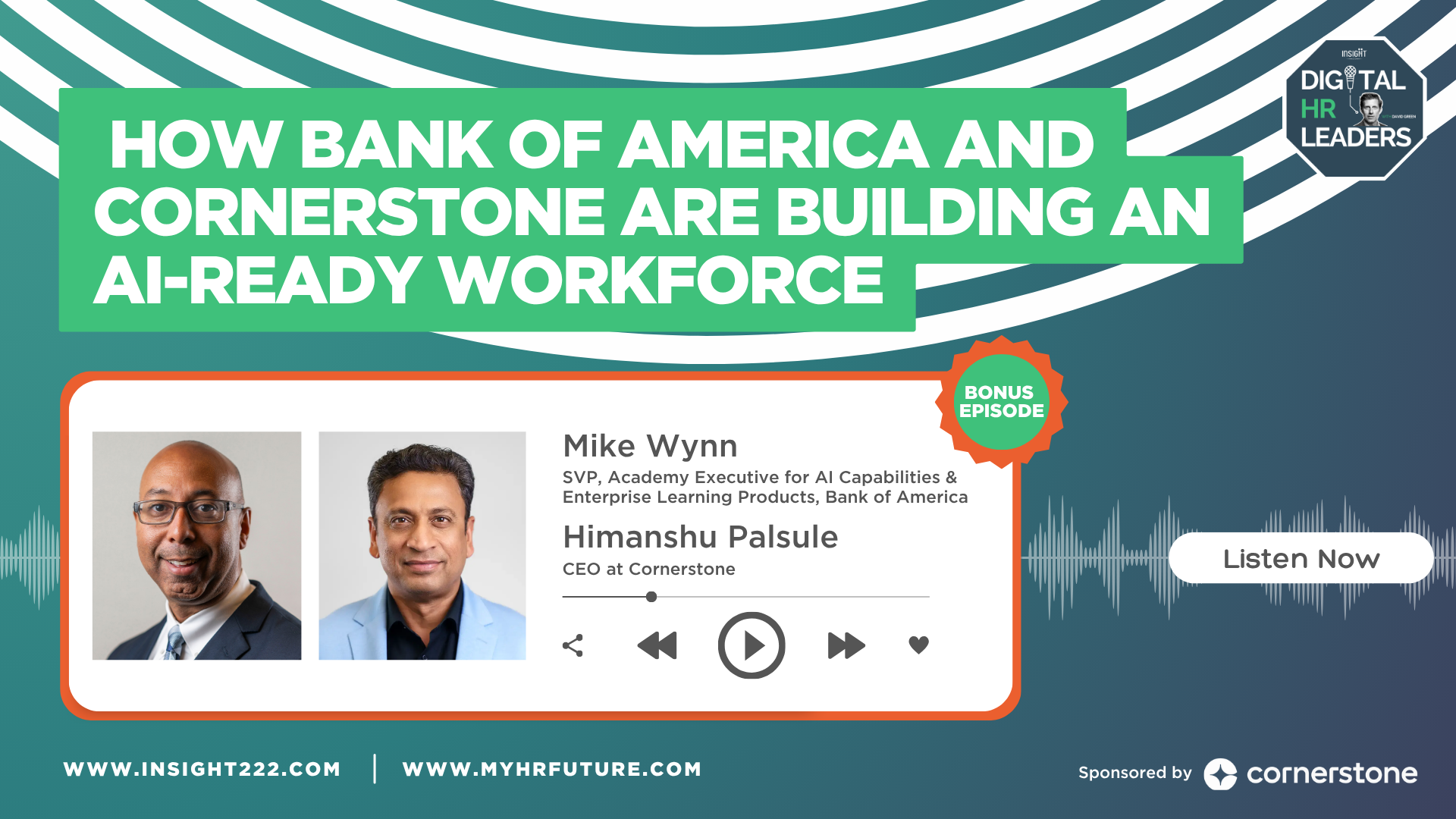
In this special episode of the Digital HR Leaders podcast, David Green is joined by Mike Wynn, SVP, Academy Executive for AI Capabilities & Enterprise Learning Products at Bank of America, and Himanshu Palsule, CEO of Cornerstone. Together, they explore what it takes to build an AI-ready workforce, combining the practical experience of capability building at scale with a broader perspective on workforce intelligence, skills and work redesign.
Join them as they explore:
How Bank of America is building AI confidence and capability across every career stage, from self-paced learning to collaborative, experiential workshops
Why every AI capability the bank teaches is anchored to human skills such as judgement, critical thinking and strategic thinking
Why organisations need to connect AI strategy with workforce strategy by understanding how work, tasks and skills are changing
How workforce intelligence can help organisations connect signals about people and work with outcomes such as productivity, mobility and workforce transformation
Why learning increasingly needs to happen in the flow of work, as technology makes development more continuous and contextual
Why course completions and attendance are insufficient measures of success, and why leaders should instead look for changes in behaviour, work and business outcomes
What HR and learning leaders should prioritise when ambitious AI plans have yet to translate into a clear people strategy
For CHROs, CLOs and workforce leaders, this conversation offers a practical roadmap for moving beyond AI experimentation and building the workforce capability needed to turn ambition into business value.
This episode is sponsored by Cornerstone.
Industries, organisations and workforces are all changing at once, and most people leaders are trying to respond with fragmented data and processes that move too slowly to keep up.
Cornerstone brings together the insights leaders need, the learning and skills that move people forward, and AI agents that turn intelligence into action, helping organisations build a workforce that’s ready for what’s next.
Explore Cornerstone Workforce AI™ and the wider platform, here.
And if you are building the case internally, Cornerstone's CHRO Mandate eBook on workforce readiness is a useful place to start: CHRO Mandate eBook
Find out more about Cornerstone here.
Resources:
This episode of the Digital HR Leaders podcast is brought to you by Cornerstone.
[00:09] David Green: For the last few years, much of the conversation around AI has focused on the technology, what it can do, where to deploy it, and how quickly people are adopting it. But the conversation is changing. For organisations making significant investments in AI, the challenge now is translating that investment into new capabilities, different ways of working, and measurable business value. And that takes us directly to the workforce, because deploying technology can happen relatively quickly. Building the skills and confidence for people to work differently with it takes longer. As Mike explains in our conversation, meaningful adoption is about helping people understand how their existing capabilities can be amplified and how work itself can change.
So, for this special episode, I'm joined by two guests looking at that challenge from different but highly complementary perspectives. Himanshu Palsule is CEO of Cornerstone, which helps more than 7,000 organisations across 186 countries use workforce intelligence to develop critical skills, surface hidden talent, and build workforce readiness for continuous transformation; and Mike Wynn leads the Academy for AI Capabilities and Enterprise Learning at Bank of America, where he has spent the last 22 years, and is now helping build AI capability across every career stage. What I particularly enjoyed about this conversation is how the two perspectives come together. Mike takes us inside Bank of America's approach to building an ecosystem for AI learning at scale, including why every AI capability they teach is deliberately anchored to a human skill, and why experiential and collaborative learning have proved so important. Himanshu widens the lens to workforce transformation. We explore why AI strategy and workforce strategy need to come together, how workforce intelligence can help organisations understand how jobs, tasks, and skills are changing, and why the real evidence of successful learning is whether the work itself changes. And we close with practical advice for HR and learning leaders tasked with translating ambitious AI plans into meaningful workforce change. We've got a lot to cover, so without further ado, let's get into the conversation.
Mike, Himanshu, welcome to the Digital HR Leaders podcast. Before we get started, could each of you give listeners a quick introduction to your role and the perspective that you're going to bring to today's conversation? Mike, let's start with you.
[02:42] Michael Wynn: Absolutely. Thanks for having me. I'm the Executive for the Academy for our AI Capabilities and Enterprise Learning products. And quite frankly, what that means is it's my job to help people learn across the organisation. And so, from a context aspect, I'm going to talk about how we're doing that at scale with our teammates.
[03:02] David Green: Great, and you've got a big job at the moment, I imagine, like anyone who's heading up AI capability building in any large organisation at the moment. And Himanshu, please introduce yourself to listeners as well.
[03:12] Himanshu Palsule: Yeah, hello, David. I'm Himanshu Palsule. I'm the CEO of Cornerstone. We've been in this learning journey for the last 25, 26 years, working across businesses globally in building platforms, such as with Bank of America that Mike and his team use. And the thing that caught my attention is this whole topic around beyond the AI hype, and what does it mean to our people. And that essentially is the ethos of the new Cornerstone and something that I'm really looking forward to discussing today.
[03:50] David Green: That's great. It's great to have you on the show, Himanshu. And I know from going to an event hosted by you and the team at Cornerstone in London a few months ago, just before your Connect there, there's some exciting things happening and looking forward to sharing that with some of our listeners in this episode. So, Mike, let's come to you. Bank of America has made AI a strategic priority across the company. What does that ambition mean for the workforce and for your role leading AI capabilities and enterprise learning products?
[04:22] Michael Wynn: That's a loaded question for sure, because when I think about the word 'ambition' in particular, for us, it has been less about the technology itself. And really, as I think about my role, it's about helping to prepare the workforce, so that they can think differently and ultimately work differently because of what's possible. And when I think about what I have to be able to accomplish in order for that to happen, it comes down to less about teaching features and capabilities of software. We're really in the business of actually building confidence and capability with our teammates across every single career stage. So, think new hires that just start with our company, or folks that have actually been here for 20-plus years. My job isn't to help them understand how do you access a tool, as much as it's helping them understand how do I work differently? How am I supercharged? How are the skills that I currently have now amplified because this technology is available? That's the shift from just awareness of a tool to actual capability. And that's when we talk about ambition, what my team focuses on, because it's about getting that right. This isn't about AI as a buzzword or a headline. This is about the responsibility that we all carry on my team, which is unlocking the power of our people.
[05:50] David Green: Yeah. I mean, as you said, it's not a technology transformation, it's a people transformation at the end of the day. And then certainly, from the research out there and the organisations that seem to be pushing ahead with this, they view it as a people transformation. And we know that's a big thing. And as you said there, and we'll talk about this during the conversation, it's about working differently, it's about redesigning work a little bit as well. And hopefully, it's about taking some of the more mundane tasks away with technology; and as you said, helping amplify the skills that people have got as well, to help them get more fulfilment from work as well, which is really important. And obviously, when an organisation like Bank of America makes an investment on the scale that you're doing, like, many organisations at the moment, there's a danger sometimes that the technology can move faster than the workforce. So, how are you translating the kind of strategy and the ambition of Bank of America into a practical workforce and learning strategy, Mike?
[06:54] Michael Wynn: You're definitely right. I mean, when you think about speed, deploying a technology can technically happen relatively quickly. And when you think about all the applications and evolution of technology that has happened over the years, we have deployed technologies all the time. This one definitely feels a little bit different, because we want to make sure that this is a capability that we're helping people understand what it takes to not just use a tool, but to actually use the skills that they have to make themselves better. Because what we want is for them to be able to trust themselves and not lose that skill that they currently have. And so, for us, this wasn't about building a particular program or a training resource, hosting a couple of calls, and then calling it a day. For us, this was about making sure that we did this correctly. And that involved really creating an ecosystem with a couple of different paths associated with it. Because again, we needed to make sure that we did this right.
So, one of those paths was to actually allow for teammates to be able to learn at their own pace, which means we needed to have the right resources and modalities available for them to be able to access. And so, we created those resources, intentionally making sure that there's varied resources and not just a couple here and there, but there actually had to be a really robust library of content that they could access so that they could learn at their own pace. We also wanted to make sure that we allowed for them to learn socially. And what I mean by that is when I think about learning in general, people learn better in community. And so, we wanted to make sure that there were forums and are forums available for our teammates to be able to communicate and talk with each other, learn from one another, because again, it's how we typically learn best when we're actually learning with our teammates and our peers.
Then, of course, from a traditional learning perspective, we wanted to put together structured pathways, and so we did that. We wanted to make sure that we actually had the ability for people to learn foundationally the beginnings of what AI is, how it works, all the way through advanced levels. So, it was a matter of making sure that within that ecosystem, we had all of those different flavours for them to be able to access. And then, lastly, the thing that I think I'm most proud of is allowing for them to be able to practise. And that's where experiential learning kind of comes into play. And we were very intentional with creating workshops and sessions, where it was less about a facilitator talking and more about people solving problems together. Because the one thing you will hear me continuously mention is how important human skills are in this equation. And we wanted them to self-realise that the skills that they actually have are the most valuable, which we're talking about strategic thinking and communicating and critical thinking, all of those things that our teammates actually put into practice every day. Now, being able to couple that with AI capabilities truly takes what they can do to the next level.
So, again, all of that to say it was about putting that ecosystem together that worked cohesively, to make sure that this wasn't just an event as much as it's the way that we want our people to learn.
[10:30] David Green: And listening to that, Mike, it might seem a bit counterintuitive to some that we're talking about AI here, we're talking about technology, but actually it amplifies those human skills that you've just talked about, like critical thinking, doesn't it?
[10:44] Michael Wynn: You're absolutely right. When we're talking about capabilities and we're talking about what AI adoption really means, it all comes down to our ability to take what we do best, which is to be human, to take our human skills and absolutely use those things. Because the reality is, AI isn't a decision-maker, we are. And it's important for all of our teammates to understand, and that's why we wanted to build that ecosystem that they actually have those skills today. And so, for us, with every AI skill or capability we teach, we actually anchor it to some type of human skill that it actually depends on. That's where it really comes together for people, because what we didn't want was for people to get lost in technology. And it very easily can be done when you think about the complexity of AI and all the things it can do and things of that nature. We wanted people to understand how judgment, strategic thinking, and all of those human skills are actually the things that are going to amplify what they do. AI is simply helping it along and accelerating things, but they are the decision-makers always.
[12:01] David Green: Thanks, Mike. And, Himanshu, this might be a good point to bring you in here. Obviously, at Cornerstone, as CEO there, you have a broader view across a number of organisations that you're working with that are going through similar transformations, as Mike has just articulated about Bank of America. Again, if we strip away the hype, what distinguishes the companies that are genuinely preparing their workforce for AI from those that are maybe still primarily experimenting?
[12:31] Himanshu Palsule: Yeah, it's probably the most important question for organisations that they should be asking themselves today. Look, I look at 2023 and 2024 as years of AI experimentation and AI fascination, and parts of 2026 as well, where a lot of energy is expended on answering questions such as, "What's the real power of AI? What's the cost of AI? Who's going to win this battle? What's the risk and opportunity with this technology?" And understandably, CIOs and CEOs have been very concerned about the risk, as well as excited about the opportunity. Now it's time to start worrying about the adoption and success of AI within your own companies. Different customers move at different velocities. People like Mike, who I've always looked at as a learning innovator, I mean, Mike, you have this fascinating innovation lab of Bank of America that I've had the benefit of visiting. And they have already started asking that question, "What is the role of the human in all of this?" While AI will be great at detecting patterns, reducing complexity, eliminating redundancy, what the humans need to step up at this point is the actual usage, adoption, as Mike said, judgment, making exceptions, and making decisions.
So, those companies who are now asking that question, "What does AI make possible for my people that wasn't possible before?" are the ones that are starting to make steady progress. Those are the ones looking at the work being done, the tasks that need to be completed, and creating a human and digital strategy next to each other. When we came up with our new positioning around 'Humans to the power of AI', we deliberately chose that because we said what people need to start worrying about is how does AI become a catalyst to help the people? And as a result, what is your workforce strategy? So, I think this is the time where people leaders, and business leaders need to start asking themselves that very germane question.
[14:56] David Green: Everything is in constant reinvention, your industry, your organisation, your workforce. As business needs change, your workforce must adapt in real time. But fragmented data and slow processes make it hard to know what's changing, and act quickly enough to get your people ready for it. Cornerstone is the intelligence platform for workforce readiness, with the workforce insights leaders want, the learning and skills people need, and AI agents that make action easy. Cornerstone: the intelligence to know, the wisdom to act. Learn more at csod.com/humanai.
And, Himanshu, so staying with you, and I know this is something you've been looking at at Cornerstone, and obviously I was privileged to see the workforce intelligence tool that you've launched recently, are organisations, in your view, paying enough attention to how jobs and skills are changing, rather than focusing primarily on the technology adoption? And where do you see the biggest gap between AI strategy and workforce strategy?
[16:26] Himanshu Palsule: That's a great question. I would say more and more businesses are now being forced to pay attention, because the strategy that looked great from the top down, where you sort of had these training academies, you had these training programs, you had workforce strategies, etc, it all starts to fall apart when you look at the type of work that is getting completed by people, the type of knowledge that people are garnering by themselves. The very ubiquitousness of AI means I can just be as successful learning AI on my own, enhancing my skills by myself, rather than having these as corporate mandates. So, I think that inflection point has been reached by the majority, if not all the companies. I mean, certainly there are some sectors that are more exposed to this and vulnerable to this and others that are more protected from here. But I think the largest gap between workforce strategy and AI strategy is in its baseline definition, in how do these come together? Companies are spending a lot of time, energy, and money. I mean, this whole token business around how do you force employees to start adopting AI; very few of them are looking at fundamentally, how is work going to change with AI? What is the unit of work and how is it going to get defined? And when you really break it down into tasks and skills, what is that amplification that needs to happen?
Then, we have to also meet with companies that aren't worrying about it as much and partner with them and help them in this journey. Because as a CHRO, it can get pretty lonely in this world of AI. You get big mandates on what needs to happen; you don't necessarily get all the tools and the budgets and the know-how. And we see Cornerstone's role, wherever possible, in being that bridge between an AI strategy and a workforce strategy.
[18:25] David Green: There's an argument you can't really have an AI strategy as an organisation if you don't have a workforce strategy alongside it. And I just wonder if you just wanted to say a few words, or maybe your kind of bigger view around that importance of workforce intelligence to support AI and workforce strategy?
[18:42] Himanshu Palsule: So, what we did with this is we sort of stepped back and asked ourselves the question, what is the role of Cornerstone in this journey? Are we just a vendor? Are we a tool provider? Are we an advisor? Are we a service consultant? And what we realised is that the market is so frothy right now in the very definition that we can at least start baselining the problem, and then helping companies and allowing them to find solutions to it. We came up with this idea, and we call it DWTS, Domain, Work, Task, and Skills. And we came up with this idea that what technology now allows you to do is differentiate between these. I'll give you an example. Let's take a job of a project manager, and a project manager, let's say, at an aerospace company, and a project manager at an insurance company. Job descriptions are just too vague. They say the same thing, they talk about the same general ideas. So, what we've started breaking down, and we can talk a little bit more about the solution, is first identify the domain that this person is in. Understand what is involved in this domain. And then you go from D to W then as a result, what is the work being done at the domain? The aeronautical project engineer probably needs to be very grounded in groundbreaking technology with avionics, while the insurance company's project manager needs to understand the complexity of insurance filings and fraud detection and things like that. And then, you come to the most difficult part of this, and that's the task; what is the actual task that needs to be completed? While skills is all over the news and work is all over the news, and these are easy concepts to explain, where the real magic happens is in the task that needs to be completed.
So, with that, when we came up with the workforce intelligence product, Cornerstone Workforce AI, the very fundamental was the companies that can bring that context, which is a very important word, in the DWTS framework can enable their customers greater success. And that's sort of that ethos that we are going ahead with.
[21:06] David Green: That's really helpful, Himanshu, thanks for explaining that. I think that's a good point to turn to you, Mike, to get into the practicalities of what that means at Bank of America. So, once organisations have clarity on the tasks that people need to do and the capabilities they need to fulfil those tasks, the challenge perhaps becomes building those at scale, particularly in such a large organisation as Bank of America. How are you helping employees develop their AI capabilities, but also strengthening their human skills and the capabilities they need to fulfil those tasks in this new environment?
[21:46] Michael Wynn: Yeah, it goes back to what I was mentioning earlier, with our approach with teaching what this means to use AI in the flow of work, because teaching features and capabilities is somewhat easy. But teaching and making sure that we're using the things that we're good at, such as those human skills, is where we need to make sure we continuously do. And this is one of those situations where it's been really great to actually talk to our teammates as this evolution has occurred, because here's what I will tell you. As I talk to people across our enterprise, every single employee I talk to is generally excited about this. And to be honest with you, when you think about training and traditional training in general, sometimes people aren't always excited about training. And I think what AI has actually brought to the picture is it actually has brought some of that energy where people truly want to know more, they want to learn, they want to understand. Because at the heart of anything and everything is the fact that our teammates want to do the very best that they can do at whatever their job is.
So, now, what they want to understand is how this technology can help them continue to do that. And we've got some of the most brilliant people working across our teams that are servicing our clients, that are doing things operationally behind the scenes. And what we've made sure throughout this entire transition is that we have helped them understand how to be comfortable leveraging their skills with these capabilities. And once you get them past the fact that you don't need to be an AI expert to actually be good at using AI, you just have to know how to leverage the technology to amplify what you do. And that's why we focused a lot of time on helping them understand what it means to use this technology in the flow of that work. Because it comes down to all the things that we've been mentioning throughout this conversation, how do I make sure that I am using my judgment as I'm using this technology, I'm using my critical thinking as I'm leveraging this technology? All of that remains at the core, at the centre of everything. And when I think about previous transformations, oftentimes it was a system upgrade or a systems change. You teach them the button clicks, but fundamentally the work was the same.
With this transition, it is very, very different, because this is less about just the capability as much as it's about how we're going to take what we do and amplify it. And so, that creates excitement and people asking questions, how? What can I read more of? And again, as a learning professional, I want people to learn. And so, the fact that we've got people with so much energy asking for more and more training, you couldn't ask for something better.
[24:55] David Green: What are the lessons from previous transformations that you believe still apply to this one? And what's different, perhaps?
[25:03] Michael Wynn: I think the biggest thing was being able to define what adoption truly means. And I think that oftentimes, especially with technological releases, it's about just getting someone to use something. And I think the biggest difference when it comes to this particular transformation is that we didn't want people just to use AI because it's here. We wanted them to use AI and understand how it actually is helping them and benefiting them. And that's what's been super-exciting for me, because now we get to truly see the light bulbs go off in people's heads as we're going through the workshops and all of the different modalities that we're providing them from a training perspective, because it's less about what can this tool do, and more about, how are my capabilities better now? Where can I spend the most time, where before I was spending time doing administrative tasks, repetitive tasks, which now I don't need to do as much of that anymore; I can actually spend time on the moments that matter? And that is super-impactful to our associates, because they all care, as I mentioned, about doing a great job, whether or not that's serving our clients or doing the things behind the scenes that ultimately serve our clients.
So, for me, what's great about this is people are learning how to work differently, but it's allowing for them to spend time where it truly matters, because at the end of the day, my job is to make sure that our teammates understand how to work to take care of our clients. And this transformation is allowing for that to happen, which is why people are bought into this, because this isn't just a technology, it's not just an application. It's helping us get our jobs done. And that's powerful, because once you help people understand that, then they want to learn. And that's what makes this so different. Because as I mentioned before, you almost kind of had to force people to learn certain things, because oftentimes they don't understand the why behind it. This one is different because they understand that using this actually makes them better. So, it really isn't a hard sell to a learner.
[27:29] David Green: I want to take a short break from this episode to introduce the Insight222 People Analytics Program, designed for senior leaders to connect, grow, and lead in the evolving world of people analytics. The programme brings together top HR professionals with extensive experience from global companies, offering a unique platform to expand your influence, gain invaluable industry insight and tackle real-world business challenges. As a member, you'll gain access to over 40 in-person and virtual events a year, advisory sessions with seasoned practitioners, as well as insights, ideas and learning to stay up-to-date with best practices and new thinking. Every connection made brings new possibilities to elevate your impact and drive meaningful change. To learn more, head over to insight222.com/program and join our group of global leaders.
And Mike, just following up, obviously I appreciate the transformation is still going on and will be for a number of years, because the technology keeps getting faster and better and it seems like it will do for the foreseeable future. But was there a moment in this transformation when you feel that things really started to click and you had greater clarity about the path forward, and what changed as a result for you and the learners effectively?
[29:09] Michael Wynn: For me, one of the things that really was an aha moment is when we started doing some of the experiential training, specifically the workshops to help our teammates understand what it means to truly prompt and communicate with AI. And I say that that was an aha moment because it was very different for me to be able to kind of step back and watch them collectively and collaboratively learn versus just feeding them information and telling them, "Hey, this is what you can do, and this is what a great prompt looks like". It was truly about presenting them with true business tasks and true business challenges, and then watching them strategically think how they would solve for that problem, and focusing less on the technology itself, but truly thinking through what it takes to solve this, and then taking that and understanding how AI helps them do that. And when you kind of step back and allow for that type of collaborative learning to happen, that again, as a learning professional, it's the most rewarding thing ever. Because one of the reasons why I do what I do is because I want to see people learn, I want to see that light bulb go off in their heads. And once I started to see them learn faster collaboratively and then go through that process and then teach others, that, to me, helped me understand how we needed to continue to teach and scale this. Because this is less about just information sharing, it's less about job aids and quick reference guides and videos. Although we have all of those things, it was more about helping them learn together.
Again, when I think about the past and other types of transformations, we didn't always do that. And all those transformations didn't necessarily warrant that type of attention. But this one most certainly did. And the success that we've seen from our people learning socially, collaboratively, is some of the most amazing learning that I've ever had the experience to see.
[31:29] David Green: What have you learned then about not just building those skills and capabilities, but also building that confidence to work differently?
[31:39] Michael Wynn: Change and evolution takes time. And it's one of those things that you can't expect for someone to fundamentally change the way they work from one day to the next. It takes time, it takes confidence, it takes skill-building. And that's what's critically important as a part of this transformation, is you actually have to make sure that it's consistent and that you're following through. Because again, in the past, you could launch something, deploy it, and then move on to the next thing. This is one of those situations where we're going to continuously evolve. The technology is evolving. So, at the same time, as a learning organisation, we're going to make sure that our resources, our capabilities, and our ability to make sure that people have all of the learning that they need to have is evolving right alongside with the technology, because my expectation is learning never stops. And so, as AI continues to evolve, we're going to continue focusing in on the skills that we know our people need to be better at. And as I mentioned throughout, those are all the human skills. They know that they are the decision-makers. So, we're going to continuously focus on helping them understand how they strengthen those skills alongside this technology so that they can be the best version of an associate that they can be.
That's how I do my job, and every single day, there is something new and there's somebody that needs to learn, whether that's a new hire or somebody who is with us for a long time. I've got to make sure that our teams are continuously working to make sure that they know that they are a part of how we do business and we're going to grow them as much as they want to grow.
[33:29] David Green: Yeah, thanks, Mike. Himanshu, probably like me, you've been sitting there listening about how impressive the journey is at Bank of America and the successes that they're having there, thanks to the work that Mike and his team are doing. What are you seeing elsewhere that reinforces or perhaps challenges Mike's experience? And what do you think organisations are maybe still getting wrong about the human side of AI transformation?
[33:54] Himanshu Palsule: Yeah, so I want your audience to envision this, is step back and think about while CHROs and people leaders are in the practice of taking care of people, at the end of the day it's about the business. It's about productivity, efficiency, growth, profitability, and things like that. So, step back for a second and think about where is work actually done in your company, and what systems capture that work. And there's a massive chasm between the two. And then we capture work in these sometimes archaic systems. We call them system of record. This is where the employee master sits. This is all about the employee when they were hired, when they were promoted, and everything that they did there. We have systems of engagement, how they engage, and these are quite modern and quite well done. And that engagement could be email, it could be Slack, it could be many of these places. The system of experiences, web, mobile, portals, etc.
But then, the whole idea of system of work, I say it's the in-between documents. It's that hard-to-find PDF that somebody wrote that had some critical information on it. It was a conversation that happened in Teams or Slack, a Slack channel that wasn't captured, so on and so forth. So, technology today, when you look at AI, look at it as the greatest enabler for you to capture work, where work is being done, to assess the efficacy of an employee. So, again, imagine this, and whether you use our product or any other product, we now have a people graph. So, whether you have 100 employees or 100,000 employees, you come to work, you open up your screen, and you have a people graph, and it shows all your people there. And then, you go and hover over any one of them or right-click on them, you get what we call a people passport or a skills passport. Now this isn't just static information about, you know, "When was Mike Wynn hired and what's his title and how long he's been with Bank of America". This is about the work that he did last night. This is about what he said on Slack, what code he checked into GitHub, what opportunities were put into a CRM. And that captures and that makes their skillset very, very dynamic.
It then starts to capture sentiment, you know, "Was he very positive? Was his tone getting negative? Is there a concern? Is there a burnout risk? Do we have a salesperson who hasn't got back to a customer in two months and is sitting on critical accounts?" So, now the outcomes can be defined. So, think about you've got signals coming in from the left, you've got the people graph in the middle, and then you have these outcomes on the right. That together is workforce intelligence. So, the beauty, what I want the audience to understand is what AI is now enabling you, is to discover the sources of work, build out this people graph, and then define what your outcomes are. And the outcome could be you want to improve engagement levels, you want to reduce attrition, you want to increase profitability. You now have the ability to do that because of technology, and that's the real promise of AI.
[37:16] David Green: Yeah, thanks for sharing that, Himanshu. And again, you've talked about workforce readiness becoming a continuous challenge, and we heard from Mike about the importance of continuous learning, as roles, skills, and tasks evolve. How is Cornerstone helping organisations understand how work is changing, identify the capabilities they will need, and then translate that intelligence into learning, development, and workforce decisions?
[37:42] Himanshu Palsule: Yeah, so just as I mentioned, the ability now for us to go and capture work where work is being done, the ability for us to go across systems, regardless of what your HR system is, your CRM system is, your ERP system is, your various work systems, your collaboration systems, and largely fuelled by this planet-size ambition that AI brings, we have the ability to tether those signals and build out this people graph. And once we get the people graph right, it's all about determining the outcomes. And what's been fascinating is, as we work across now dozens and dozens of customers with this new idea, they all have a very different way in which they want us to pursue it. An outcome for one company could be a reduction in force, but for the other company could be a massive investment project, a new centre of excellence they want to start, a new gig that they want to launch, a new academy or cohort they want to create. And now, once you have this new vocabulary of a people graph, the outcomes are limitless on what you can generate.
We believe we are in the start of something very fascinating. What is fundamentally different is we firstly have the humility to understand that we sit inside a stack that is only going to grow. We don't expect customers to sort of be jettisoning all their systems for all the hype that AI says is, "Hey, we can just come and vibe code everything away", or sort of the words around, you know, "What's the future of SaaS?" Everything is actually quite secure. However, how information is extracted and how decisions are made are very different. As you all know, and Mike, would love your thoughts on this, you know, everyone learns and everyone is going to learn forever. No job, task, project, skill, peace, war, has ever been done without learning something new. How we learn has fundamentally changed. I mean, I grew up in a time where you had to be forced to go into these two-, three-week training sessions, and you learned everything there, and then you had the rest of your life to apply it. And then, it evolved into learning just in time and learning in the flow of work.
But in this new agentic world, it's even more exciting. Not only can you now sort of highlight a PDF, right-click it, and say, "Put a learning program to me". Agents should now surface learning where learning needs to happen. If you're on an oil rig and there is a fire, you don't need to know the properties of sulphur dioxide or remember what you were taught two years ago in a lab on what you need to do. You need systems helping you put that fire out. You need to be informed about it in situ. So, people talk about the blast radius of AI and how every company is being impacted by AI. Sure, Mike, you'll agree, learning is ground zero for that. Fundamentally, the reason you go to a ChatGPT or a Claude is to learn something new. So, if we can harness that, if we can work across all the different vendors and partners that are out there, and we can harmonise this and create outcomes, I think we'll all be in a better world in the future, and we actually would have taken humans to the power of AI, as what we've been promising our customers.
[41:11] David Green: Mike, let's give you an opportunity to react to that, particularly on the evolution of learning.
[41:18] Michael Wynn: I couldn't agree more. When we think about traditional learning, the one missing element of traditional learning is the fact that it's very static and it's about reading and then answering assessment questions, and things of that nature. And for us in the academy in particular, for Bank of America, that was never something that we wanted to make sure was only the part of our learning experience. Their ability to actually have access to information is a critical component of learning. And when you think about how we, as human beings, like to learn, especially today with the evolution of technology, we like to learn quickly. We need information at our fingertips. We will go onto the internet and search for information so that we can get that quick answer. And so, when I think about AI and how that is transforming things, our teammates now have the ability to get information quickly. And that is a critical component that we didn't necessarily have several years ago. And while we've been using AI for years and years, especially with our clients, now our teammates have the ability to get access to information much quicker, which helps them learn.
So, as Himanshu mentioned, this is all a part of learning. And we want people to understand how it all comes together, because this is where adoption is about confidence. And when you think about adoption and learning skills, this is about, can I do this ultimately, and am I comfortable doing this? That is a critical component of this. So, there's no question that the access to information that AI allows for us to do now is most certainly changing the way that we're able to teach and train our teams, along with those human skills that I mentioned.
[43:15] David Green: So, this leads nicely to measurement. I mean, one of the dangers of measuring the effectiveness of learning is we can focus on activity rather than readiness. We look at courses completed, tools accessed, people trained. What evidence should a CHRO, a CLO or frankly a business leader, be looking for to know that workforce capability is improving and translating into better business outcomes? Himanshu, I'll come to you first, and then, Mike, I'll get your view on that as well.
[43:44] Himanshu Palsule: I think this has strengthened their seat at the table, because now the question they need to ask their leadership and their board is, what are the outcomes that you're really looking at from your people? What is it? Is it productivity, is it efficiency, is it knowledge, is it empowerment? And then, being able to show them that you now actually have a way to measure success based on their outcome. If you're trying, you're going back to the example I said, we've been hiring 1,000 people, we've been firing 1,000 people, but now internal mobility is real. I was able to sort of transform 600 of them because I knew more about them. I knew their skills, their soft skills, their ambition, and all of that. And so, heads of businesses, general manager, managing directors, what are the outcomes that you're seeking out of your people? And now, I'm in a position where I can help you meet those outcomes rather than be relegated to back-office tasks, which was about measurement and, like you said, how many training courses were completed, as Mike said, very static ways in which things were reported.
So, I just think that technology and a lot of work that we are doing now enables you to measure success of training and learning, based upon the outcomes that they drove for the company, which trust me, for any board or any CEO is way more valuable and germane than any other metaphors.
[45:16] David Green: And Mike, just turning to you on that particular point as well around measurement.
[45:20] Michael Wynn: I talk about this all the time, and quite frankly, it's not even just about AI in particular. It really kind of comes down to success of training and what success truly means, because as Himanshu mentioned, metrics, completion, attendance, that tells you that someone completed something, it tells you that somebody attended something, but it doesn't truly tell you what has changed. And at the end of the day, it really isn't complicated. What you're looking for is whether or not behaviours have changed ultimately. Again, that's where it's not just about AI when you look at the training landscape. This is about whether or not our leaders are starting to see their teams ask better questions, not just get quick answers. It's whether or not we're seeing these repetitive manual administrative tasks being done now by AI so that our people can actually reinvest their time into judgment heavy work, into strategy, into coaching, into taking care of our clients and building relationships. It's about whether or not our people are teaching each other, because when the capability truly takes hold, you're going to start seeing that teaching and coaching start to spread sideways and not just up and down.
So, if the story that you're telling about your training journey begins with, "X amount of people completed this training or attended this session", you're just telling us completion and attendance. The real evidence is whether or not the work itself has actually changed.
[46:58] David Green: Very good. Right, we're going to get to the last question and we're going to actually provide advice to maybe those listening, so other HR or learning leaders that are listening, and I'll start with you, Mike, so you can offer the practitioner perspective on it. So, for our listeners, HR professionals, HR leaders, learning leaders whose organisation has maybe just announced or is close to announcing ambitious AI plans but hasn't yet translated them into people strategy, what is the first thing that you advise for them to get right or to prioritise?
[47:28] Michael Wynn: For me, I think everyone needs to define what success truly looks like for them, because you can't go into this type of transformation just telling your people to use AI, because I don't know how successful you're going to be doing that. It has to actually start with teaching them how they should use AI and what type of environment you're creating for them to be able to do so. Do they have the permission to not only have access to the information and training materials, but do they have the ability to practise? Do they have the ability to ask questions without judgment, that safe space? Most AI rollouts fail because it's not about the technology underperforming, but it's because organisations tend to skip right to deployment and assume that the capabilities will just follow by themselves. And capability, in my opinion, most certainly follows intention. So, for me, I would say get very clear on where your people are starting from, what habits you're actually asking them to change. And then, based on that, set the scene, set the stage for what that training ecosystem needs to look like, because it shouldn't look like any other training rollout that you've done before. You have to be very intentional to make sure that you are creating the safe space for learners to be able to practise and to be able to actually ask questions collaboratively, socially, so that they're all learning together. This is a different transformation. So, you should be creating something very different than you have in the past.
[49:13] Himanshu Palsule: Well said, Mike. Be bold and ask the organisation a simple question, "What is the outcome that you're looking for from your people, all the functional leaders? What is the change that you're looking for now versus the world pre-AI? And then, how do you define success for your people?" And try to garner that information. And then again, be bold in trusting that technology will now allow you to get answers in a very simple conversational way than you ever had the ability to before. So, a great time to start testing the real genesis of what you mean by strategic workforce transformation. And then, let's hold everybody, let's hold the whole community accountable for what is it that we want our people to do. What is it? Where are the jobs that are actually going to get enhanced or replaced, and where are the jobs that actually are going to become more critical? And build out that baseline, because that's what's going to determine the success of your workforce.
[50:14] David Green: Mike, Himanshu, thanks for such a fascinating conversation. Mike, thanks for sharing the story at Bank of America, and Himanshu, for what Cornerstone is doing with clients. I've seen the people graph, it's highly impressive. Before we finish, can you let listeners know where to follow your work, what's coming up, anything coming up from Bank of America or Cornerstone that you particularly encourage listeners to explore? Mike, let's start with you.
[50:40] Michael Wynn: Well, I'd love for listeners to connect with me on LinkedIn. I constantly engage with people all across the world on my LinkedIn about anything and everything AI. And so, anytime there's something I want to share, strategy-related, there will be times where I actually share that on LinkedIn. And we actually have some great conversations. So, I would definitely encourage anyone to reach out to me on LinkedIn and let's connect.
[51:02] David Green: Thanks, Mike. And now, Himanshu, can you share with listeners how people can follow you as well?
[51:07] Himanshu Palsule: I'm active on LinkedIn. Please reach out, Himanshu Palsule. This is a community, we are in this together. I want to hear from all of you, I want to work with all of you. You can email me at hpalsule@csod. Check us out at Cornerstone on what we are doing. And then, we have this multi-city tour, we actually have 15 cities. There's a big event coming up in Chicago, it's on our website. Join us for that. And every opportunity that we get to interact with you is going to be time well spent. Thank you, everyone.
[51:39] David Green: And as I said, thanks so much to both of you for sharing this brilliant conversation with our listeners today. I look forward to seeing you both, maybe in person at a conference near you soon. Thanks very much.
[51:53] Michael Wynn: David, thanks so much for having us. This was truly a pleasure.
[51:56] Himanshu Palsule: Important conversation at an important time. David, thank you for hosting it.
[52:02] David Green: That brings us to the end of this special episode of the Digital HR Leaders podcast. Himanshu, Mike, thank you both. Two different perspectives on the same challenge. And I thought the way you built on other's knowledge and experience made this particularly valuable. There are two ideas I'd encourage listeners to take away. First, AI adoption is ultimately about confidence and capability. As Mike explained, organisations need to create opportunities for people to practise, experiment and learn together, while strengthening the human skills such as judgment, critical thinking and strategic thinking that become even more important when working with AI. Second, workforce readiness needs to be connected to business outcomes. Himanshu's perspective on workforce intelligence highlights the opportunity to understand work at the level of domains, work, tasks, and skills, and then use that context to make better decisions about learning, mobility, and workforce transformation. And as both Himanshu and Mike emphasised, course completions and attendance tell us very little about impact. The real evidence is whether behaviours, work, and outcomes have changed.
I'd love to know what stood out to you most from this conversation. Head over to LinkedIn, find my post about the episode, and let me know in the comments. And if you enjoyed this episode, please share it with a colleague who would find it useful, and subscribe to the Digital HR Leaders podcast so you don't miss what's coming next. One last thing before we go. For those who would like to keep up with what we're working on at Insight222, follow us on LinkedIn, or head to insight222.com You can also sign up for our bi-weekly newsletter to get the latest thinking on HR, people analytics, workforce transformation, and everything shaping our field. Right, that's us for today. Thanks for listening, and we'll be back next week with another episode of the Digital HR Leaders podcast. Until then, take care and stay well.