Episode 278: From HR Silos to One Connected People System (with Tony Truong)
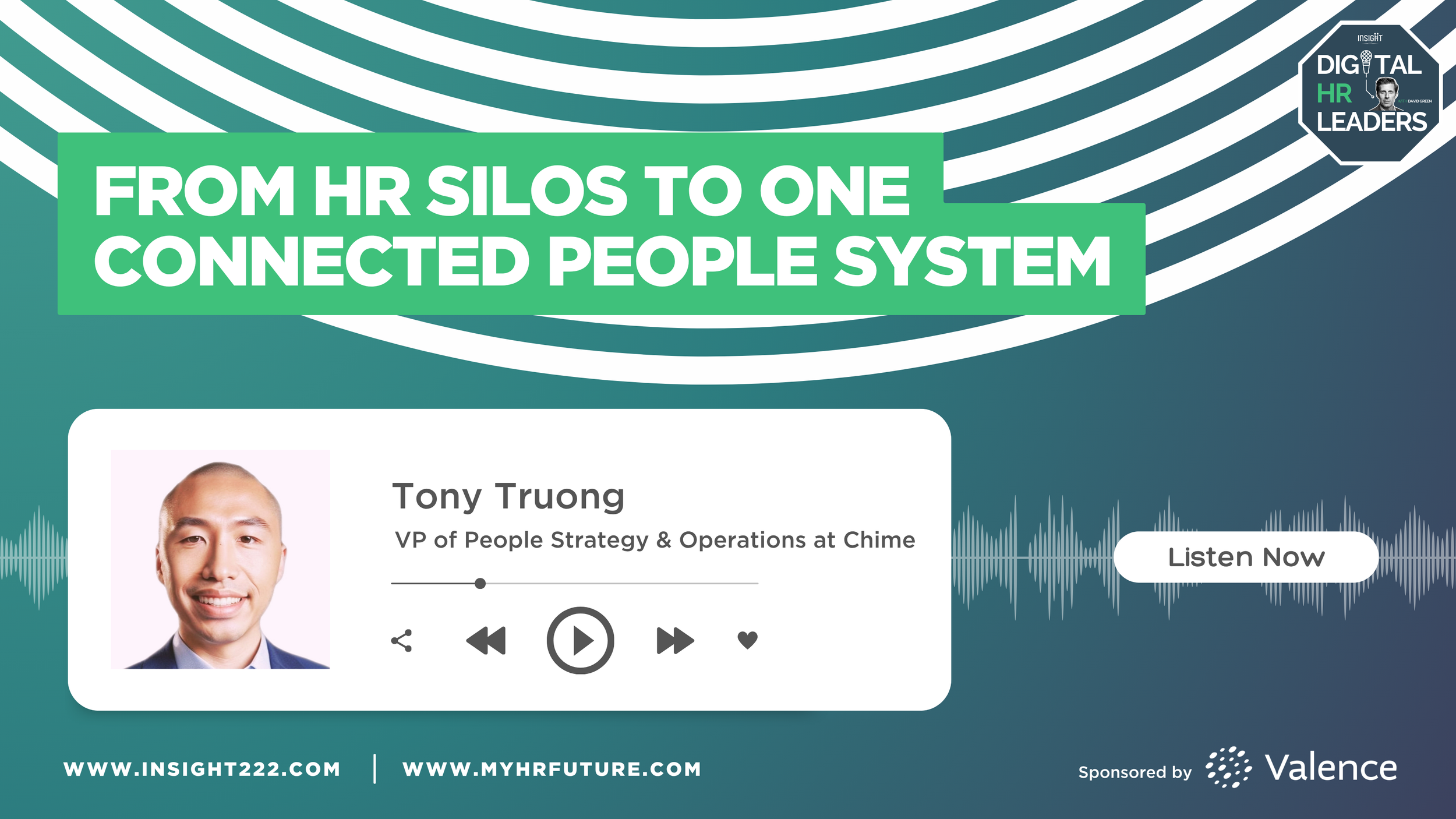
Is your HR function organised the way employees actually experience it, or just the way it's always been done?
In this episode of the Digital HR Leaders podcast, David Green is joined by Tony Truong, VP of People Strategy, Operations, Technology and Analytics at Chime, to unpack why most HR functions are still organised in silos, by specialty, while employees experience work as a series of moments: getting hired, being onboarded, going for a promotion. Tony has spent the last two years closing that gap, rebuilding Chime's people function from the ground up as the company has scaled into a public company.
In this episode, David and Tony discuss:
Why the real limitation holding HR back is fragmentation, not ambition
What it's taken to rebuild a people function from the ground up at a newly public company
How AI has reshaped recruiting at Chime, cutting a process that used to take days down to hours
Tony's three-stage framework for thinking about AI's role in the business: assistance, automation, and orchestration
What it actually looks like to move people analytics from the periphery of HR to the centre of how a business makes decisions
This episode is sponsored by Valence.
Nadia, Valence's AI coaching platform, connects talent strategy to the work employees are actually doing — offering coaching from the frontline to the boardroom, and surfacing organisational insights that weren't visible before.
As the most widely deployed coach in the Fortune 500, Nadia is already helping global leaders like Nestlé, Delta, CVS, and Kraft Heinz transform talent at scale.
Learn more at valence.co/insight222
Additional resources:
Deloitte Global Human Capital Trends 2026 Report
This episode of the Digital HR Leaders Podcast is brought to you by Valence.
[0:00:09] David Green: What I find interesting about how many HR functions are structured is that they are still organised the way they've always been, in silos by speciality. But employees don't experience work that way at all. They experience moments, getting hired, being onboarded, and going for a promotion. But my guest today is a strong believer that this gap is a real limitation holding HR back, and he's spent the last two years rebuilding a people function to close it. I'm joined today by Tony Truong, VP of People Strategy, Operations, Technology and Analytics at Chime.
Tony has spent around 15 years in people analytics, and what I find interesting about where he is today is how much broader his remit has become. It's not just people analytics anymore, it's the operating model, the technology and the strategy all sitting under one roof, which is exactly the kind of shift some of you listening will recognise that is happening in your own organisations. In our conversation, Tony and I will talk about what it's taken to rebuild Chime's people function from the ground up, as the company has scaled into a public company. He walks me through how AI has reshaped recruiting at Chime specifically, taking a process that used to run for three days down to hours, and he shares a framework I think you'll want to steal, the three ways he's thinking about AI's role in the business: assistance, automation, and orchestration. If you've ever wondered what it actually looks like to move people analytics from the periphery to the centre of how a business makes decisions, then you'll enjoy this episode. So, without further ado, let's get into it.
Tony, welcome to the show. Can we start the conversation by learning a little bit you? What was the journey that led you into the world of people's strategy and analytics and HR technology? I know, I think, you've been certainly in the people's analytics field for around 15 years.
[0:02:08] Tony Truong: Yeah, my career has always sat in the intersection of people, business, data, and systems. I started in people analytics, helping leaders move from intuition to evidence. But over time, I realised that analytics alone wasn't enough. You can have great insights, but the operating model, technology, and decision-making forums aren't strong. Those insights don't translate into action. So, that pulled me into the broader people strategy ops and HR technology space, really owning the supply chain of people analytics. And today at Chime, my role brings those pieces together. And all that helps our people function, scale and support the business more effectively.
[0:02:47] David Green: Well, I think we first met, I think it was at a conference over a decade ago. I think it was when you were at Docusign and from memory, and you might have to correct me here, I think you were doing some really interesting things in terms of understanding the operational efficiency of recruiters in Docusign. So, I think you were scaling at the time. What's your perception of how the field's changed over the last 15 years? We've definitely changed; analytics has definitely changed, hasn't it?
[0:03:14] Tony Truong: Yeah, absolutely, yeah. The first time I met you, David, was in London. I think it was the People Analytics World.
[0:03:20] David Green: That's right. Well done. Well remembered.
[0:03:22] Tony Truong: Yeah, so can't believe it was ten years ago. Such a long time. I think, back then, people analytics was still proving its value. A lot of the work was really just descriptive, right, like what is headcount, attrition, engagement and reporting. And I think the bar is much higher now. Leaders want to tie insights to decision-making, where to invest, where to simplify, where talent risks exist, and how workforce choices impact the business performance. I think the field is much more connected now to HR technology and AI. It's no longer just about dashboards, it's about embedding intelligence of how work is done through agents, orchestration, assistance, automation. That seems to be the topic across all HR teams today.
[0:04:09] David Green: So, let's talk a bit about what you're doing at Chime, Tony. What's taking up most of your attention in your role right now?
[0:04:17] Tony Truong: Yeah, I mean, we went public last June. So, we operate much differently now as a public company. So, my focus is helping our people functions scale for its next chapter as a public company. I joined two years ago alongside our Chief People Officer, Sarah Wagener. And the opportunity was to rethink both the people strategy and the operating model from the ground up. That includes workforce planning, service delivery, people technology, AI, and analytics. The common thread is building a more integrated people function, one that helps the business make better decisions, supports employees more effectively, and creates leverage for more of the people team, so that folks can get back to doing what matters most, which is serving our members and delivering value for our members at Chime.
[0:05:06] David Green: And for those listening that don't know about Chime, can you tell us a little bit about Chime?
[0:05:10] Tony Truong: Yeah, we're a fintech company and we provide the lowest, if not the free, banking services that are around chequing, savings, early wage access, rewards. And we serve the two-thirds of Americans that really live paycheque to paycheque, so highly mission driven. We're really about just helping people gain financial progress so that they're able to live their best lives here in America.
[0:05:40] David Green: You mentioned that you came in with Sarah a couple of years ago with a remit to really look at the whole operating model in HR as well, and you talked about bringing in workforce planning and AI as well. Obviously, you've worked at a number of organisations, Tony, both large organisations, like Nike, and then other organisations that were scaling, like Docusign as well. When you look at how most HR or people functions are set up today, where do you think the model starts to show its limitations? And I'm thinking really in the context of AI in particular, and also actually generating business impact.
[0:06:23] Tony Truong: Yeah, I think most HR functions are still organised in silos and in specialty areas. Like, you have your HR business partners, recruiting, operations, rewards, talent management. And I think that all makes sense internally, but employees and managers do not experience HR that way. They experience moments like hiring, onboarding, performance, job changes, and career growth. So, I think the limitation is actually the fragmentation of HR and processes, systems, data, and accountability are often spread across too many teams. So, that slows decisions, creates friction, and makes it harder for HR to operate as one connected system. So, I think now, HR actually needs to think about themselves as a system, as an intelligence layer, and thinking about what we deliver as more product centric to the organisation.
[0:07:18] David Green: Yeah. And what have you found successful in terms of setting up the people operating model at Chime? How are you set up?
[0:07:30] Tony Truong: Yeah, operating more like a product and operating system is what's really been helping us. And that means starting with the experience we want for employees, managers, our executives, and our HR teams. And that's designing process, data, technology and accountability around it. For example, we focus on clear service tiers, AI-enabled employee support, better workforce planning rhythms, and analytics that show up in real business conversations and not just through dashboards and reports. The biggest lesson is that transformation doesn't come from adding more tools, it comes from redesigning how work gets done.
[0:08:08] David Green: Yeah, and again, are you able to maybe bring that? You talked about rather than having analytics in dashboards, you talked about giving people analytics and data that actually supports them in the flow of work. Have you got any examples that you're able to talk to and kind of bring to life?
[0:08:26] Tony Truong: Yeah. In our recruiting process, we had to rethink how we were going to deliver and scale hiring at Chime. And in the previous state, it was around very manual processes around writing job descriptions, writing interview plans, and the onus was on hiring managers to develop all of that. And we actually wanted to flip that model and be more, I'll say, service-oriented to managers and to candidates, where HR and recruiting actually should develop those intelligence, and do it in a very fast and automated way. So, we brought on an AI copilot to actually develop a lot of that, again, manual processes around writing job descriptions, the interview plans, the interview questions. And we also implemented technologies to start capturing in the interview itself, through the agent videos that are part of every interview, so that candidates and hiring managers and interview teams can actually just pay attention to the interviews and focus on the quality of the candidate experience. That then gets translated into transcribed notes, so that the scorecard process of how we evaluate candidates gets automated into our ATS. And we know a lot of times that's where the bottleneck is, is after interviews, is capturing all our notes, submitting the scorecard, and then deciding on whether we like the candidate or not, whether we want to move them on, make an offer to them. So, we were able to take days and weeks of a process, now into hours, if not minutes. And that actually improved our speed to hiring and our cost per hire here at Chime.
[0:10:20] David Green: And candidate feedback? I mean, presumably, I know you well enough, Tony, that you're measuring candidate experience and stuff like that. What sort of feedback have you had from candidates around appraisals?
[0:10:35] Tony Truong: Yeah, I think the feedback has been great. Again, I think we've removed the manual and the attention of managers having to write notes so that they could be more focused on the candidate experience. I think the speed of getting back to candidates quickly, because the process is faster, has also improved on the service level. And I think the feedback from the managers is that we're able to move faster and get focused more on the quality. So, that's also been delightful for our customers.
[0:11:05] David Green: What if every employee had a personal coach that connects your talent strategy to the work they're actually doing when they're doing it? Meet Nadia, The AI coaching platform for talent and performance. Nadia offers coaching for everyone in any moment, from the front line to the boardroom, augments the HR programs you already run, and offers deep organisational insights that could never be surfaced before. As the most widely deployed coach in the Fortune 500, global leaders like Nestlé, Delta, CVS, and Kraft Heinz are transforming talent at scale with Nadia. Discover how you can give every employee a coach who knows them, their team, and the company by visiting valence.co/insight222.
At Insight222, in our annual research that we do, our People Analytics Trends research last year, we did a kind of big focus on AI, which probably won't surprise you. And we found that organisations that are leading on AI, they have good people analytics capability, which again probably won't surprise you, but the four drivers that we identified in companies that are creating value with AI, like it sounds like you are at Chime, from an HR perspective, one was just having this clearly defined strategy; second was having technical skills within the broader HR function, it could be people analytics, but it could be the broader HR function; the third was around tested access, for example to recruiters and the whole governance piece behind it; and then, the fourth one was actually integrating some of the technologies that you have so you can deliver a smooth process. I don't know if any of those resonate with you. I mean, it sounds like you and Sarah had a very clearly-defined strategy on how you wanted to redesign how you're delivering people processes and people programmes at Chime. You talked about kind of shifting towards more of a product-oriented model. I mean, I don't know if any of those four resonated with you and you'd like to sort of share some kind of insight from a Chime perspective around them, whether it's around the strategy or if it's around integrating tools, whether it's around the governance space, or around the technical skills that you're maybe looking to bring into HR to support these processes?
[0:13:47] Tony Truong: Yeah, I think it all starts with really understanding the operating model, the function, like how the team should be organised, what capabilities do we need, and how do we want to simplify the structure so that we're able to move with speed and agility? So, there's a traditional model of people, partners, and COEs. What we did a little bit differently is we actually created an enablement layer that was actually horizontal to the function that actually sets this on top, which is more mission control, focus on the analytics, ops, technology, which is the function that I support today; and making sure that that's more the tip of the spear that's connected to the business, so that we're able to be very close to the business strategy and translate that into the workforce plans and then translate that into the HR strategy on what we need to do to deliver on those outcomes. And then, it's about looking at what the ways of workings are within the function. How do teams interact with each other? What sort of operating model framework do we use, like RACI; do we use DRI models? How decisions are being made? And then, how technology and analytics become a step function to accelerate how we are working and how we are making decisions? Because everything we do has a people, process, technology, and data implication. So, that's all intertwined. And that's why having that enablement layer sit on top of our org design and our operating model, at least it's worked for us effectively.
[0:15:28] David Green: Very interesting. And obviously, as we talked about at the start, people analytics has been around for a while now. When I kind of first became aware of it, I think it was probably around 2011, when I moved back to the UK from France, where I'd been outside a kind of HR role. And we were using customer analytics in the company I was working at at the time to kind of provide more value to customers and potentially give them products that enable them to provide more service to their customers as well. And at the time, as you'll remember, it was companies like Google who were kind of pioneering people analytics and sharing what they were doing. Now, we've definitely moved forward, as we said. But in many organisations, and again our research at Insight222 talks to this, we've identified eight characteristics of leading companies in people analytics. So, we had 370-odd companies that participated in the study last year. Only 10% are what we call A teams, those delivering value on a consistent basis. 60% are still D teams, as we call them. They're really glorified reporting functions. And I'm just interested in, they're still quite far removed from the business really, and they're really more serving HR. Why do you think that gap still exists? And based on your experience, maybe what's three things that you would recommend to people listening to this who work in an organisation where their people analytics function is a D team? What would be three things that you would suggest to them to kind of move up the value chain?
[0:17:07] Tony Truong: Yeah, I think it's finding opportunities or places where analytics can be more embedded into the decision-making process. So, really thinking about the forums of how analytics are being raised and where critical discussions are happening. At Chime, my first month there, we actually developed an org health scorecard that was actually at the executive level. Like, what were the key metrics that matter most to us? We defined the questions that executives and leaders should be actually asking us. So, we actually pushed a guide in addition to a scorecard on like, "These are things we should be asking". And then, we defined parameters: what is good; what is needs attention; what is at risk, so that there is a so-what component. We weren't just reporting for reporting sake.
At every time we present the scorecards, there were high signals across all these dimensions around hiring, attrition, talent density, our organisational structure, spans and layers, and then our metrics around hybrid work. So, we also tracked how we're hiring locally versus remote. And those signals are actually really important, because it helps us zoom in on where focus areas are. Because at times, when you're doing a lot of reporting and sharing a lot of data, it can just go into the business rhythm, but it becomes mundane and people don't look at it because you're not raising what matters most to them. And more importantly, what we should be doing about it. So, yeah, my advice is to have it be more embedded into critical forums, like executive committee meetings, as part of staff meetings, as part of leadership quarterly reviews. That embedded workflow with analytics I think is just critical on just getting the visibility and helping drive decisions.
[0:19:05] David Green: I want to take a short break from this episode to introduce the Insight222 People Analytics Program, designed for senior leaders to connect, grow, and lead in the evolving world of people analytics. The programme brings together top HR professionals with extensive experience from global companies, offering a unique platform to expand your influence, gain invaluable industry insight and tackle real-world business challenges. As a member, you'll gain access to over 40 in-person and virtual events a year, advisory sessions with seasoned practitioners, as well as insights, ideas and learning to stay up-to-date with best practices and new thinking. Every connection made brings new possibilities to elevate your impact and drive meaningful change. To learn more, head over to insight222.com/program and join our group of global leaders.
So, when you start to close that gap, and let's say you're becoming a B team where you're delivering value on an inconsistent basis, but at least delivering value, or an A team, delivering value on a consistent basis, what is it that needs to change? Is it the capability within the function itself? Is it the structure or the way the business engages with HR, or maybe the way HR engages with the business, or a bit of all of that? What's worked for you at Chime, but in the past as well?
[0:20:47] Tony Truong: Yeah, I think you have to start with the decisions. Before changing the structure, adding more capability, you need to be clear on what decisions you're trying to improve. Are we trying to make better decisions around workforce planning, around hiring, our retention strategy, how to make managers more effective? I think once that's clear, you design the right data, technology, operating rhythm, and the roles around those decisions. So, the capability and structure matters, but it should always follow a decision model. And those are the ultimate outputs that you're trying to get.
[0:21:23] David Green: You mentioned, at Chime, you've got people strategy, technology, operations, and analytics, and you talked about having those together helps you and your team have much more impact and obviously ultimately create value for the organisation and its employees and its customers. And a lot of these areas have traditionally been quite separate within HR. You've probably worked in organisations where they are separate. And I know you've typically, over the last few roles you've had, you've had some of these areas grouped together. Are we moving towards a model, do you think, where HR, analytics and technology are all part of the same system?
[0:22:04] Tony Truong: Yeah, I think they have to, I think in the age of AI now, those are the main components that drive the orchestration that you need to build an intelligence layer for the HR function. Historically, operations ran the process, technology, maintained the systems and analytics reported any outcome. And I think that model is too slow now. The future model has to be more integrated, where the process should create clean data, technology should guide and automate the workflow, and analytics and insights should surface much more quickly, and AI should orchestrate all of that. That's the nirvana or the dream state I think most HR teams are aspiring to today. And employees and managers need a connected experience, not just a fragmented HR internal org chart.
[0:22:55] David Green: When you look at how your own people, whether they may be in HR, are actually using AI, what are you finding?
[0:23:02] Tony Truong: Yeah, adoption is definitely growing. Some employees are using AI every day to draft, summarise, analyse research code, and reduce their manual work. Others are still learning where it fits in their role. I think there's still more adoption that needs to be made. I think the biggest lessons that AI adoption is not just a tool rollout, it needs to be a behavioural change and it needs to be tied to how work needs to get redesigned. And people need access to tools, but they also need examples. Like, they need training, manager reinforcement, have space to do experimentation, and they need clear guidance. So, there's a path where everyone's kind of choosing their own journey on how to do things, but there's also a path where I think companies, managers, and leaders could do a better job with developing more structure of how to use AI and how to learn how to use the different use cases of best practices of AI.
[0:24:04] David Green: And how are you approaching it at Chime, into the people function at Chime? Are you driving, accelerating AI adoption and expertise within the organisation? I'd love to hear about how you're doing it from an enterprise perspective, but also how you're thinking about the people function itself. And maybe with the second one, in the people function, what additional capabilities that you're either hiring for or building within the function as well?
[0:24:31] Tony Truong: Yeah, as a company, we're really focused on AI, I think both on the product side, how can it help create new features for us that really add value to our members; and then, on the enterprise operation side, it's really helping us remove friction, move faster, and we look at it across sort of two dimensions. One is, how can it help drive the orchestrations of processes across systems and across multiplayer processes, where you need to embed and create synthetic workflows, where you're working at cross-functioning with teams, whether it's IT with HR, or with finance and the people team, there is a sort of multiplayer orchestration component. The other vector is around individual productivity, so giving the tools to the hands of employees, so that they're able to do a lot of things locally on their computer to remove friction, move faster. And then, we embed it into our culture as well. We have an AI, we call it like 'showcase and recognition program', where we are spotlighting how AI is being used across the company. We have an AI Champions Award that we give out quarterly to really highlight that we care a lot about this. We want to recognise all the progress that we're making as a company. And we're just making this just part of everyday sort of living now, that we want AI to be more and more part of our lives.
[0:26:06] David Green: And that's so important, isn't it? As you said, it's not just a tool, it's changing the way we work, and you have to embed it within the culture so people have that permission to experiment a little bit, learn, probably fail sometimes, but ultimately trying to go up the adoption curve and gaining proficiency, and impacting themselves, having a positive impact on themselves, but also having a positive impact on the organisation as well. And it sounds like your leaders are leading from the front on this a little bit as well, and role-modelling that, which again we find is something that helps employees invest time themselves in developing these skills.
[0:26:52] Tony Truong: Yeah, I think what's unique about Chime is that we've positioned AI as an accelerator for people. It's not taking away jobs, it's actually making people move faster. And we try to make it fun as much as possible, so that sort of breaks down the barrier around, you know, "Is there consequences if I don't use it?" We're really trying to make it fun, experimental, a catalyst for people to move faster, to reduce a lot of the low-value work, so they can bring to surface all the high-value capabilities and impact that they can do in their everyday job. But yeah, we do expect roles and jobs to evolve with that, just like how we innovated with calculators, then with Excel. Now it's going to be AI. So, that's the journey that we're on right now.
[0:27:46] David Green: And in terms of work redesign, I appreciate maybe in the early stages of this at the moment, is that something that you're involved in? I presume it's going to be a core part of your role moving forward.
[0:27:57] Tony Truong: Yeah, absolutely. The technology is evolving and moving quickly, and we're trying to keep pace with it. And one of the biggest things is looking at all of our workflows, and not just traditionally you'll do some incremental improvements on systems, making some tweaks here and there, but now with AI, you've got to reimagine how the work is done completely, and look at what is the ratio between people involvement versus AI; what can you get out of technology? And what we're really optimising for in our strategy with AI is around three dimensions: assistance, automation, and orchestration. How can AI work with you through assistance? How can it work for you doing tasks? And how can it work without you, just doing things asynchronously so that you don't have to do it at all.
[0:28:53] David Green: So, that workforce planning element to your role that you were talking about earlier becomes work planning as well, I guess. So, it's going to be so important, isn't it? I mean, the great example that you gave earlier in the conversation, Tony, around how you're using AI in recruiting, then clearly that's changing the role of the recruiter. Things that traditionally recruiters did themselves is now being done by AI. So, you're redesigning the role of the recruiter within Chime.
[0:29:23] Tony Truong: Yeah, absolutely. I think AI transformation, workflow transformation is symbiotic to workforce planning right now. They are working hand-in-hand as far as looking at ultimately what capabilities we need to deliver the outcomes we need. And the capabilities, you know, it used to be buy, build, borrow, and now it's like bot/AI now, which is taking more of a bigger picture in thinking about the capabilities landscape of workforce planning.
[0:29:52] David Green: And I wish I could remember off the top of my head, but I know from looking at the recent Deloitte Global Human Capital Trends Report, they had three more Bs. So, as long as it has a B, it can be in workforce planning, I think. But yeah, so there's seven Bs, I think. I'll put a link in the show notes so people can find out for themselves. Obviously, the more we use AI for not just people processes, but also processes within the business as well, the stakes obviously get higher. How are you thinking about putting the right guardrails in place without slowing everything down? And maybe, in addition to that, what's the role of the people function at Chime?
[0:30:32] Tony Truong: Yeah, I think the key is governance, right, and what sort of governance should you have with AI. And we work very closely with our legal team, our AI governance team that we have here. And we definitely want to drive innovation and not slow innovation down. So, not every AI use case needs to go through the same level of review. Like, a low-risk productivity use case is different from something that could influence hiring, pay, performance, or promotion. So, we focus on clear principles, we look at data protection, human accountability, and practical guidance for employees using AI. So, again, the goal is not to slow innovation, it's actually to move quickly and drive innovations faster. And it's to create enough trust so that people can move fast, safely.
[0:31:21] David Green: And it sounds like again, from what you were saying earlier, you're using it as part of the culture, as I said, to help people be more effective. So, that openness, that transparency, certainly I'm guessing really helps to get employees on board, get employees using these tools, but also to feel comfortable with it as well.
[0:31:39] Tony Truong: Yeah, absolutely. It's embedded into our onboarding. We have a lot of training guides, we have a lot of artifacts of where we can point people to on how to use tools, we create a lot of custom GPTs so there's libraries out there. We've already stood up, again, some custom GPTs where folks don't have to rethink or redo a lot of the custom work they want to do with AI.
[0:32:07] David Green: Very good. I tell you, we're sort of winding down now the conversation. We've got two more questions. The first is the question of the series. So, this is the question we're asking all the guests in this series of the podcast. How does HR, or the people function, how does HR connect culture to measurable performance?
[0:32:26] Tony Truong: Yeah, HR connects culture to performance by translating values into behaviours, systems, and outcomes. Culture cannot just be words on a wall, it has to show up in how we hire, how we manage, how we reward, how we promote folks, and how we develop folks. For example, if a company values high performance, you should see it in how we drive clarity around our goals; you should see it around manager effectiveness, how we differentiate with performance, how we look at our talent density, are we keeping our top performers, are we exiting our bottom performers or graduating them to performing in role? So, HR's role is to make those behaviours invisible. We should be able to measure them and report on them and we should connect them to business outcomes.
[0:33:15] David Green: Very good. And again, just as an add-on to that maybe, Tony, you mentioned that obviously you're looking at AI across a number of different processes, people processes at Chime. Are you looking at it around performance management and stuff like that? And if you are, are you able to kind of share maybe some of your thinking around that as well?
[0:33:37] Tony Truong: Yeah. Well, one, we want to make the process around giving feedback and writing feedback more simple. I think everyone dreads the performance cycle where they have to go into a system, they have to figure out who's going to give them feedback, who to get feedback from. So, what we did in the early days of using AI was to actually create a custom GPT where folks can dump a lot of their knowledge and their understanding of how they interact with certain people and they will actually generate the feedback for them. I think now, we actually want to take a step further and look at AI orchestration, where we can use a feedback agent. So, if you are going into a prompt-based module, you can say, "Hey, I need to get feedback from X", or, "I need to give feedback from X". It can recommend who are the people that you should be getting feedback from or get feedback to, based on sort of the organisational network analysis that we have around connections, who you work with frequently. And then, it can dig into the corpus of information. What have you worked on, what did you work with those people on? What are the projects? And it can actually spin up some of the least initial outputs of what the performance or the interaction was like with those individuals. And then it could push through into the system. And again, this is where the human element needs to be in. You review it, you make some tweaks and then you submit it.
So, we're hoping again to remove friction and move a lot faster with the process, but to provide the intelligence in a much faster and smoother way than just people, again, looking into their notes, looking through their notebooks around their interactions with folks.
[0:35:29] David Green: Really good, because that's almost like helping them, coach them, to perform, well, to perform better, but coaching to help their personal development as well.
[0:35:42] Tony Truong: Absolutely.
[0:35:43] David Green: Well, Tony, it's been a really fascinating conversation, you're obviously doing some great work at Chime at the moment, and I'm sure most of the people listening to this will take something away and think about how they can maybe do something a little bit differently in their roles as well within their organisations. Where can people find out more about you, connect with you, and learn more about Chime as well?
[0:36:07] Tony Truong: Yeah, LinkedIn is the best place to find me. I share my thoughts there on people strategy, HR transformation, people analytics, all things HR. So, yeah, you can find me there and you can learn more about Chime through my LinkedIn page as well. I work there. So, you can click on the link, learn more about the company.
[0:36:24] David Green: Fantastic. Tony, thanks so much for being a guest on the show.
[0:36:28] Tony Truong: Thank you, David.
[0:36:30] David Green: A huge thank you to Tony for joining me today. I think anyone wrestling with how to structure their people function will get a lot from this conversation. I'm curious, for those of you listening, what resonated with you from this episode? Head over to LinkedIn, find my post about this episode and let me know in the comments. I read every single one, and the conversations that happen there invariably build on the one we had on the show. And if you think a colleague or friend would get something out of this episode, please do share it with them. It really helps us bring more of these conversations to HR professionals across the world. And one last thing before we go, for those who would like to keep up with what we're working on at Insight222, follow us on LinkedIn or head to insight222.com. You can also sign up for our bi-weekly newsletter at myHRfuture.com to get the latest thinking on HR, people analytics and everything shaping our field.
Right, that's us for the day. Thanks for listening, and we'll be back next week with another episode of the Digital HR Leaders podcast. Until then, take care and stay well.