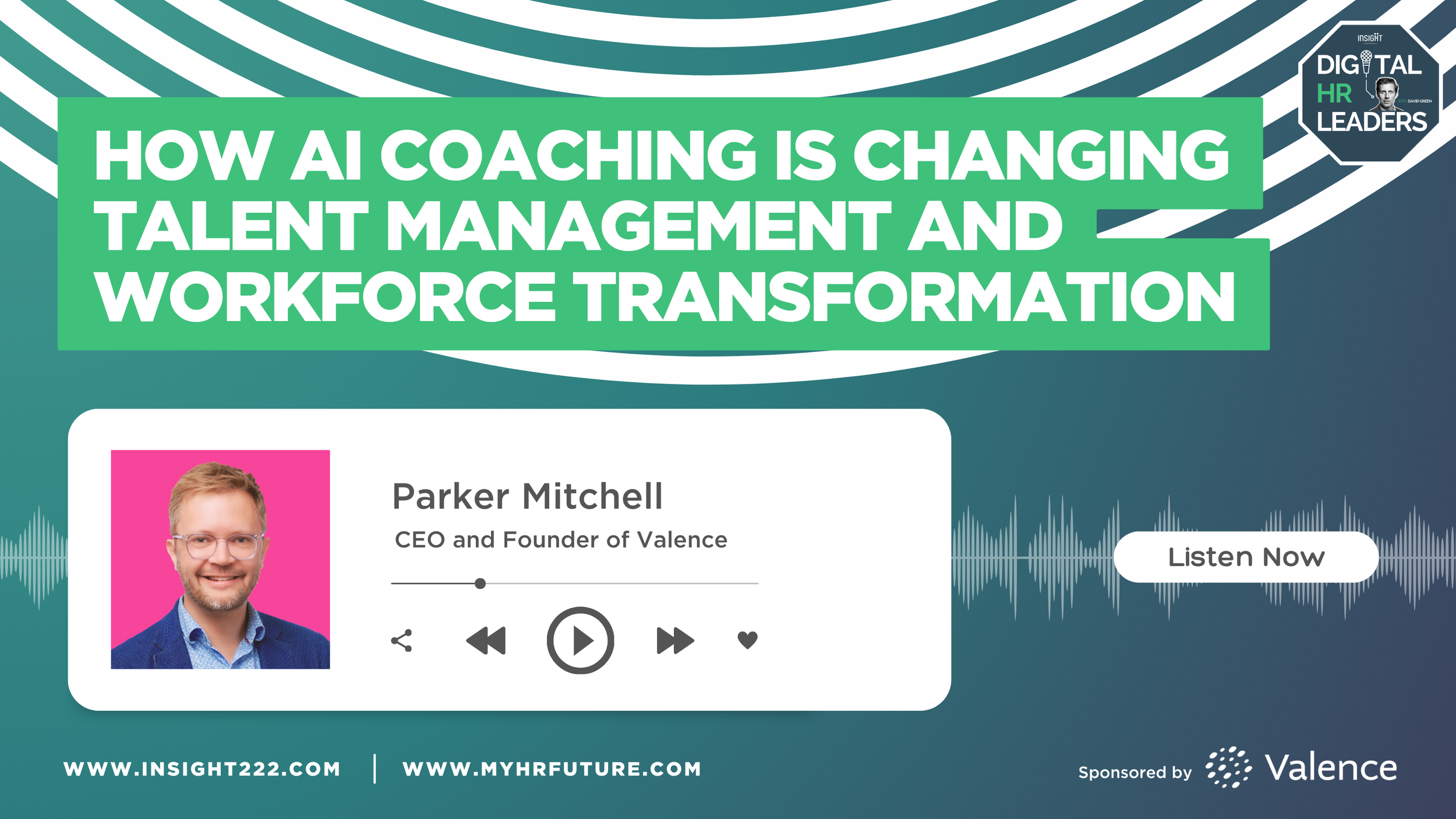
Episode 277: How AI Coaching is Changing Talent Management and Workforce Transformation (with Parker Mitchell)
How do you tell the difference between AI that's genuinely transforming HR and AI that's just a slide in a vendor deck?
In this episode of the Digital HR Leaders podcast, David Green is joined by Parker Mitchell, Founder and CEO of Valence, the team behind the AI coaching platform Nadia, to discuss what it really takes for HR to prove value in an increasingly crowded AI market.
Join them, as they discuss:
How to separate genuine AI capability from marketing claims in an increasingly crowded market
Why AI budgets are increasingly coming from the C-suite rather than HR, and what that means for how HR shows up in these conversations
What CHROs should be asking before choosing between an AI-native provider and a legacy platform with bolted-on AI features
How the best people analytics teams are proving ROI from AI coaching, beyond adoption metrics
What it looks like to make performance management continuous rather than a once or twice-a-year process
Why frontline and operational workers need a different approach to AI coaching than knowledge workers
Valence's recent partnership with Microsoft and what it signals about where AI coaching is heading
This episode is sponsored by Valence.
Nadia, Valence's AI coaching platform, connects talent strategy to the work employees are actually doing — offering coaching from the frontline to the boardroom, and surfacing organisational insights that weren't visible before.
As the most widely deployed coach in the Fortune 500, Nadia is already helping global leaders like Nestlé, Delta, CVS, and Kraft Heinz transform talent at scale.
Learn more at valence.co/insight222
This episode of the Digital HR Leaders Podcast is brought to you by Valence.
[0:00:08] David Green: One theme I keep hearing from HR leaders is that the AI conversation has moved very quickly from curiosity to accountability. A year ago, many organisations were asking how individuals could use AI to work faster or save time. Now, as Parker Mitchell puts it in our conversation, the question has shifted from how AI can help me to how AI can help we. That shift matters. So, how do CHROs separate genuine capability from marketing language? How do they prove value beyond adoption metrics? And how do they ensure AI coaching improves both business performance and the employee experience?
That is exactly why I'm delighted to welcome back Parker Mitchell to the podcast. Parker is the Founder and CEO of Valence, the team behind Nadia, one of the earliest and most widely deployed AI coaching platforms in the Fortune 500. In today's conversation, Parker and I explore what it takes to build a business case for AI coaching, how leading organisations are connecting coaching to outcomes such as manager effectiveness, frontline and knowledge worker performance and talent mobility, and why people analytics teams have a critical role to play in measuring what really changes. And Parker shares the latest on Valence's partnership with Microsoft and what it signals about where AI coaching is heading next. So, if you're trying to cut through the noise, prove value, and help your organisation move from AI adoption to workforce transformation, this conversation should give you plenty to think about. So, let's get started.
Parker, welcome back to the Digital HR Leaders podcast. It's been about seven months since we last spoke on the show, which in this fast-moving market probably feels like about seven years. What's been happening with you and Valence since we last talked? And maybe, for those that are listening that maybe didn't listen the first time and maybe don't know you, Valence or Nadia, can you also outline a little bit about what you do, what Valence does, and how you help customers?
[0:02:16] Parker Mitchell: Terrific. Well, I thought maybe I would start with a change in the overall market. Because as you've said, in one year, or actually, we've been seven months and it probably feels like seven years, and one of the expressions that I use is that the half-life of what feels sort of the dominant theme of the day in the AI era, that half-life is just getting shorter and shorter. And so, I think the era, I'll go back one year, the era that we were in then was people were saying, "How can I use AI for me?" in many cases. So, it was in early days of exploration, people were trying it in their personal life. They might have some access to a large language model at work and they were just experimenting with it. And they would come up with, "Here's an anecdote here and an anecdote there". And I'll talk a little bit about what Nadia was in that era, and then what's changed for today.
So, in early days 2023, we began investing heavily in AI. We went out and found some of the world's best scientists, a Turing fellow, someone who'd been exploring how do you build conversational knowledge assistance. So, conversation is going to be the dominant way of interacting, at least back then, this is what we were thinking of, interacting with an agent; how do we help that agent be as helpful as possible to you? And so, there was a real focus on, how do we go get the best practices of coaching? How do we help an agent not just spit off an answer that might or might not be right, but ask you questions, help you reflect, but also help you solve the issue that you have? So, the dominant question I would get from a CHRO a year ago was, "Would people even speak to an AI coach?" And that's been answered unequivocally. People in their personal life and in their work life, they're more comfortable. They tell us, not just us, they tell surveys, the data shows, that they're more comfortable talking to an AI coach, which is absolutely non-judgmental, than a human.
So, Valence had the most powerful, the most comprehensive, and the most widely deployed AI coach in the Fortune 500. So, you could pick the industry, pick the country. We would have a company with 50,000 or 100,000 or 400,000 employees, and they'd be rolling the coach out to their leaders, to their managers, eventually to all their employees, and coming back with the best NPS scores they'd seen for an HR tech technology. People were talking about sort of a new type of support they'd never had before. So, that was wonderful. And as we started out saying, the era changes so rapidly. And I think we've gone from, "How can AI help me?" CHROs asking, "How can AI help we? How can it help the collective of us to change how we interact together, to change how we define the success in a particular role or particular function, not even just a role, but in the function and the goal we're trying to do?" And so, they're asking higher level questions about how AI is going to transform work and how AI is going to help people, help their workforce in that transformation.
[0:05:39] David Green: I know that you've recently announced a collaboration with Microsoft as a personal intelligence layer. Do you want to share that a little bit more with our listeners who haven't already heard this exciting news?
[0:05:49] Parker Mitchell: So, this is something, I think, that is really exciting. And it has to do with sort of the vision for what a firm would look like and how an AI coach like Nadia fits into that. And so, I'm actually doing this call from San Francisco, and I guess it was three weeks ago, I was in San Francisco as well for the Microsoft Build Conference. And Satya went up on stage. And the premise, the fundamental theme of the Build Conference was this idea of a frontier intelligence ecosystem. And both as sort of an objective viewer of how I think the trends are going, but also as the builder and the CEO and the Founder of Valence building Nadia, I think it's a really exciting trend. And the reason why I'm excited about it is because I think this intelligence layer, ultimately what companies are trying to do at scale is they're trying to understand signal from all the parts of the business, what's working or not, whether it's in how they're manufacturing or what their supply chains are like or what their customers are buying or how their customers are using their products. They're trying to understand all that, they're trying to make decisions or judgments on what are the best practices they can begin to apply to how to solve an issue that might be, or identify signal that's coming up, and then they're trying to have that best practice be disseminated to all parts of the business. And the challenge with scale is how hard it is to do that. And much of how businesses are built is to pass that information back and forth.
So, with AI that can understand language, that's the key here. We've had that in a numerical way. If you had a very, very numerical business, you could understand all the data points from a numbers perspective. I mean, you are a leader in people analytics. You could understand the data side of people analytics, but it missed the qualitative side. And now, we're going to be able to have that same revolution on the numerical side, on the language side. And so, what that's going to mean is you can rethink how businesses combine the human intelligence and the judgment and the incredible nuance that we bring, with some of this huge ability to understand signal at scale. And so, I think intelligence, I would bet you that when we do this podcast a year from now, this concept of intelligence is going to be one of the defining concepts that everyone's talking about, and I think we're just in the early stages of that.
So, Microsoft talked about this frontier intelligence ecosystem. And so, I was excited because I think intelligence is going to be the theme that matters. Satya is talking about this idea of frontier firms that adopt AI, not just in, "How can I use it myself?" but, "How can I rethink how my company is built and structured?" And the exciting thing that Microsoft's always had is they want to build an ecosystem. And the definition of an ecosystem for them is where all the parties, the customers and the partners, get more value from the ecosystem than the company, the platform play. And so, I think Microsoft is really saying, "We want to be able to plug in different types of intelligence into this intelligence ecosystem layer". And the exciting thing for us is that Nadia can be two parts of that intelligence. Nadia can deeply know who you are and give you utter control over any pieces of information you want to share into that layer. So, it's entirely about you, privacy first, you first; you get fine-grained control over everything.
But also, and we can talk about this, we've invested a lot, since we last chatted, in this collaborative intelligence layer, so how can AI not just help you, but how can AI help you be the best human version of yourself and collaborate in new and powerful ways with your human colleagues? And that collaborative intelligence, a lot of our customers are loving the insights, like the leaders, the users we have at our customers are loving this. And I think that fits very well into the Microsoft layer. So, it's a long-winded way of saying, I think the vision's exciting, I think how Nadia fits in is exciting. And then, there's a whole set of product integrations that we're building out with folks on the Microsoft team, that's going to allow us to close the loop on a lot of what a great coach does. And so, that's really exciting as well.
[0:10:15] David Green: Yeah, and I think as you said, Parker, really exciting, because clearly it can help individuals. We talked about last time how it democratises coaching, getting it down to potentially everyone in the organisation having a coach support them in their work and make them more productive, make them more engaged, all those sorts of outcomes that we spoke about last time. But again, as you said, at that collaborative layer, understanding how you work better with people, with teams, with other teams within the organisation. And I guess, I mean even at the aggregate level, as again you said then, and as we talked about last time, the trust element is so important with this data in particular. But at the aggregate level, this could really help companies in terms of making the workplace fairer, better, more humane, but also around driving outcomes for the business as well. So, really exciting. And I think we will be talking about that throughout the remainder of the conversation.
[0:11:15] Parker Mitchell: And I just want to add, I love that dual mandate, those two pillars. Like, how do we make work better, fairer, more humane? How do we help humans be the best version of themselves? That's crucial. And companies are saying, how do we also drive performance, and where can we intersect with those? And I think, if you think about traditional coaching, it's probably not actually been able to drive performance. There's a lot of studies that purport to, but at the end of the day, I think a lot of people are saying if you're really focused on performance, there's got to be higher accountability, feedback loops, things like that. But it's important to help people be the best versions of themselves. But I think AI coaching is, I don't want to say it's like a magical wand, but I think it will be able to do both. And I think that's what's really exciting, because it can be win-win for the employee and the employer. There's not a lot of AI solutions out there that are win-win for both, and that's one of the things that our customers are loving.
[0:12:17] David Green: What if every employee had a personal coach that connects your talent strategy to the work they're actually doing when they're doing it? Meet Nadia, The AI coaching platform for talent and performance. Nadia offers coaching for everyone in any moment, from the front line to the boardroom, augments the HR programs you already run, and offers deep organisational insights that could never be surfaced before. As the most widely deployed coach in the Fortune 500, global leaders like Nestlé, Delta, CVS, and Kraft Heinz are transforming talent at scale with Nadia. Discover how you can give every employee a coach who knows them, their team, and the company by visiting valence.co/insight222.
So, you mentioned the Microsoft Build event, Parker, and I've been at a few industry events recently, I'm sure you've probably been to even more than me. And the AI noise at the moment is pretty intense, as you said, and I love how you framed it. We've kind of moved from AI for me, to AI for we, and I really like that. And every technology vendor out there is claiming some version of AI, this AI, that. Obviously, you're a technology firm I class as AI-first, you talked to how you built that in early, after the launch of ChatGPT; and a pioneer in the rapidly emerging category of AI coaching. What guidance would you give to listeners, and most of the listeners to this are practitioners and HR leaders themselves, what guidance would you give to them in terms of how they can tell the difference between what's real and what's just a slide or a slogan that you might hear either on stage or at a booth at one of these events?
[0:14:23] Parker Mitchell: It's honestly a question a lot of CHROs will pose to me. And I'll just tell a quick funny story. I was at the CHRO Association. It's formerly known as the HRPA. I think it's the single largest gathering of Fortune 500 CHROs, happens in March every year. And I had the CHRO of a major pharmaceutical company come up to me and literally ask me that question. And she said, "It is very hard for my team to separate", I don't know if she used the term 'signal from the noise', but to separate, "what's real from what's just hand-waving marketing. And our team is considering Nadia, and we're considering other options by other vendors. How would you help us make that decision?" And my answer to her, because we're at this gathering, turned out I said, "Look, anything I say is going to sound self-serving, I acknowledge that. But the CHRO of a major 300,000-person tech company is right there; ask her about her experience. The CHRO of one of the most valuable-by-market-cap pharma companies is right there; ask him about that. The CHRO of a 400,000-person logistics company is seated at that table over there; ask him about that. And I say that because I think your peers are the place you should turn to, to ask them thorough questions about how did you evaluate different options? What did you consider? What did your team say?" Because different teams are going to want different things.
Some people on teams are AI-first and they're excited to rethink from first principles. And I think, let's be honest, some people probably feel threatened by AI and might want to keep the old way of doing it and might not want to rethink. Maybe you don't need an employee engagement survey in two years as much as you did before; you'll find other ways of gathering that data. But if you own the employee engagement survey or if you own different elements of a budget line item, you might not want to give them up. So, ask how the team's evaluating, ask what conclusion they came to, ask what their experience has been. But you, as a CHRO, I think that the challenge is you have to own elements of this, you can't necessarily delegate it. You have to talk to your fellow CHROs and get in the details of it so that you can guide your team. So, number one, I'd say talk to your peers.
Then, number two is, it's worth the investment to put two or three options head to head, especially if you're thinking, "Why don't I just go with my default vendor? I'm being told that they will have this, being told it's on the roadmap". Just really stress-test it with actual use cases and trust your managers. They are the ones. You have an opportunity to put incredible tools in their hands that they will pull out of your hands. You've never really had that before. Very few HR tech deployments have generated more pull and you running out of licences. You have a chance to do that, so make sure you test things, rather than just going with the default option. You might be pushed in that direction by your default vendor.
[0:17:40] David Green: And I guess the other thing I think is, and again, this will help you then evaluate between maybe the two or three shortlisted firms that you come to, what are the use cases that you're trying to get to? What's the business challenges that you're trying to connect to, the business outcomes you're trying to connect to? And actually, as you said, talk to peers that have maybe had similar use cases, and what were the strengths and weaknesses of any particular technology? And, as you said, stress-test the shortlisted companies to actually talk about how they would solve those use cases for you. Because ultimately, some of them are going to be very similar between different organisations, of course, but that might not be the case for each individual organisation. So, do your homework. And as you said, as a CHRO, you've got to get involved. Even if you've got a team that's supporting you on that and doing a lot of the day-to-day work, you've got to be involved within it yourself.
[0:18:35] Parker Mitchell: The other thing I think that's unique is that in prior technology eras, you were buying a solution for a particular problem. If you were doing talent acquisition, steps in talent acquisition, there could be very good solutions for that, and their job was to be excellent at that particular solution. And the technology, if you did an RFP process and it took 18 months, honestly, the snapshot of the technology you might have seen at the demo at the beginning of the 18 months would probably be pretty similar to the one that you would implement. Now, if you take 18 months to go from evaluating a vendor to deploying something, hopefully the solution, if you pick the right vendor, the solution 18 months later is going to be way more powerful than the solution you first saw. And so, understanding the arc, what specifically are the new features that have been introduced? How have people reacted to that? How have new use cases been able to be unlocked, especially in the sort of first-principle thinking of like, how can you rethink a talent process or how can you rethink things? How can a particular partner, technology vendor, how can they help you unlock those things? Or are they solving a particular use case? I think that arc is so important to understand because, frankly, some companies are like this and some companies are like this in the use cases, and it really matters the upside that you might get 24 months from now. And that's a CHRO decision.
[0:20:02] David Green: Yeah, it's really important, and I think that's a great point. And that's why the CHRO needs to be involved, because I guess one of the things that they need to do using their influence is to get their procurement teams to maybe move things forward a bit quicker than maybe traditionally procurement teams have done when buying technology; and need to be a bit more agile as well. Because as you said, the right vendor at that point in time might not be the right vendor six months, 12 months, 18 months, 24 months, and I guess that's even more the case now.
[0:21:31] Parker Mitchell: There's much more fluidity. Before, there were defined boundaries. Now with AI, you can solve adjacent problems in a faster and more powerful way. And so, that's why it requires some strategic oversight and not three different people in three different sub-functions each trying to solve it on their own.
[0:20:51] David Green: One of the things that I've seen as well, and I've noticed this talking to CEOs at firms like yours, Parker, is that traditional budget in HR for HR technology, like things in the traditional silos, maybe an ATS or an LMS or something like that, it's much more difficult to get budget for that at the moment, is what I'm hearing from the vendor community, but also from practitioners themselves. Whereas with some of the AI related budget, particularly when it's sponsored by the CEO or another senior person in the C-suite, HR CHROs are going to be got more access to budget. They're not all good CHROs, of course, but some CHROs. Does that tally with what you're seeing? And what are your thoughts on this in terms of how HR and how CHROs need to show up in those conversations with their C-suite partners?
[0:21:43] Parker Mitchell: If I think about the challenges that a CEO is articulating with regards to their workforce, I would say about half of our deployments, once they start to get to the level of scale, they are presented by the CHRO to the CEO and to the C-suite, and I'm fortunate enough to be invited into a few of those conversations to share more. I've personally onboarded CEOs of Fortune 250 companies to Nadia, so I'm willing to give them that personal experience. And I'd say about a quarter overall are being elevated to the board level. So, it's a board-level strategic AI bet. And for all those companies, the CEO is saying, "I know that the work that my people are doing is going to be utterly transformed. If I talk to any random person in my company, whether they're a pilot on a plane, whether they're a product manager, whether they're in supply chain, whether they're a night manager at a store or at a property of a hotel, their job will be different in some ways. And I need to bring my workforce along". So, I think their big thing is this idea of change management and supporting people. That's sort of part one.
Then, part two is, AI adoption is the wrong term, and I don't think anyone's quite landed on it. But it's AI fluency, it's how are people almost reinventing parts of their operating system to incorporate or be AI-first. And so, they are saying, "Can Nadia help my workforce make this transformation?" And they're saying, "Is Nadia going to help the people in my company to think about how to use AI differently in their functions overall?" And the evidence is clear on both those. I can spend some time on some of the data that we've had our research teams working on. But if you can solve those kind of transformation or performance issues, their upside, honestly, it's way harder to measure ROI. It's easy to measure ROI if you're saying, "I used to have 500 people in a call centre, now I only need 300 people in a call centre", that's a very clear ROI. But ROI to capture upside is a little fuzzier. But number one, you have to sort of build that case.
Then, for pretty well every deployment where someone is going to, say, seven figures and above, they've often run 200,000, 300,000, 400,000 pilot with maybe 10% or 15% of their managers. And these are big companies again, you know, they're fortune 100s. They're saying, "I wanna deploy to all my managers or all my workforce". We almost always can be budget-neutral. We can find line items where someone's saying, "People aren't using this technology. These programs maybe aren't needed. Maybe we can reallocate some people who were dedicated to these areas". We can almost always be budget neutral, and I think that's a crucial thing. Because HR is in an era the way, honestly, every function is, which is, "Can you do more with less? How are you going to use AI to do more with less?" That's the day-to-day, week-to-week mission of many leaders, and HR is not exempt from that.
[0:25:02] David Green: I want to take a short break from this episode to introduce the Insight222 People Analytics Program, designed for senior leaders to connect, grow, and lead in the evolving world of people analytics. The programme brings together top HR professionals with extensive experience from global companies, offering a unique platform to expand your influence, gain invaluable industry insight and tackle real-world business challenges. As a member, you'll gain access to over 40 in-person and virtual events a year, advisory sessions with seasoned practitioners, as well as insights, ideas and learning to stay up-to-date with best practices and new thinking. Every connection made brings new possibilities to elevate your impact and drive meaningful change. To learn more, head over to insight222.com/program and join our group of global leaders.
Let's expand a little bit more on that, Parker, because I really resonate. I was smiling. It's almost like you know what's coming next. But obviously, I have the privilege of speaking to a lot of HR leaders on the podcast here, but also through the work we do at Insight222 when it's not public. So, obviously, we won't refer to any conversations. And I've seen, and it's a bit like you were saying, that the shift has been from me to we. I think we've also seen a shift from that primary focus on AI adoption to, and I actually like the term you use there, AI fluency and AI first. And then obviously, the business impact and value that can be generated through AI. When companies come to you wanting to prove ROI, and you just talked about how difficult that can be to do as well, what does it actually look like in practice? I mean, you started alluding to some of the other business outcomes. That you can look at. I guess you can look at, okay, let's look at AI fluency, let's look at workflows, let's look at maybe some of the other metrics that I guess Nadia can help create around engagement, I guess, is one; performance ratings, I guess, is another; and stuff like that.
I'd love to hear a bit more about that because obviously, I get if you're working with CEOs and you're working with boards, I imagine that's a fairly frequent question that you get.
[0:27:30] Parker Mitchell: So, we talked about that cost neutrality. So, I think that's a key thing. I think if you can come in at cost neutral, you get a lot of leeway to say, "Okay, here's the upside business case, here's how we're going to measure it". But we're just we're shifting dollars around, we're shifting them into more effective ways to reach more people at a higher scale with a higher degree of personalisation. So, that's kind of the foundational piece. When it comes to measuring the productivity improvements, I want to talk about two different workforces. I want to talk about frontline workforces, hourly workers primarily; and then, I want to talk about salaried workers and knowledge workers, and those, we've learned, are quite different from the points of view of what they're asked to do, and then the impact that you can measure.
Frontline workforces, they are so tightly managed. They have KPIs and operational metrics and the people running those businesses know to a T what are the dials, and if it's a case of retail, there's a cluster of 20 or 30 stores that are similar, they're ranked against them. There's performance metrics if you're a transportation industry. And it's funny because I flew here to San Francisco, and there's probably five or six companies on that journey whose people are coached by Nadia. So, it's a strange world where I'm watching what they're doing and wondering, "How could Nadia help in this moment or how could Nadia help in that moment?" And there's a lot of specific standard operating procedures, there's a lot of information that you need to be able to bake into Nadia. So, again, it's way beyond just a coach. It's understanding all the issues, but then surfacing them proactively. And so, if you look at something like -- I'll come up to share two quick examples.
One, we were looking at a retail coffee shop chain, I think it's one of the two or three largest in the world, and they were giving Nadia to their store managers, to a subset of them, during the holiday season, which is their busiest season. And it's all about increasing NPS scores despite busyness; it's handling a lot of extra shifts and then people dropping from shifts, so shift management; it's upselling, so how do you upsell by 5% instead of 3%? These are small differences, but they make a big difference to the bottom line. And they measured their data. Nadia unequivocally increased store performance, increased employee NPS and customer NPS. And that was more than enough justifications to roll Nadia out to the leaders, store manager, their entire store network. So, that's a very concrete example.
Another one, global transportation company. They were looking at particular behaviours that they knew drove business outcomes. They did a very rigorous pilot over the course of three or four months, showcased again people analytics, your bailiwick, when they have a good people analytics team and they can run those experiments, and they see the changes in the indicators that they know matter. Again, that was more than enough to say, "Okay, we're going to roll Nadia out to our entire manager base." So, they have those kinds of precise metrics for those frontline hourly workforces in particular. I am utterly confident that if someone says, "Here are the three or four things that matter to me", we will customise Nadia, we will help her understand what those best practices are. And as she begins to show up and help you, she'll be able to weave those best practices in. And so, it's like taking all the knowledge of your top-performing people, condensing it and distilling it, but making it available in not just a, you know, ask-me, but a proactive form that's alongside you to every manager. And it just raises the floor for everyone and gives the people who are really aspirational, it raises their ceiling as well. So, that's sort of on the operational side.
Knowledge work, as we know, way harder to measure productivity. Are you a more productive podcast host than you were six months ago? I think it's hard to put your finger exactly on that. But for knowledge workers, there's a lot of measuring of self-employee engagement, manager effectiveness scores on surveys, and elements like that. We've had one company that early on, again, they did really good measurements. Their managers, using Nadia, went up by an average of one quartile, so that the average score, if you were third quartile, you'd go up to second, second, you go up to first, and that was measured by their manager effectiveness score. So, that's a big leap there. A really interesting recent finding with another one of the companies, we're publishing this research in a couple of weeks, is the connection to high performers. And so, high performers both naturally begin to use Nadia more, and also Nadia power users are more likely to become high performers. And so, there is a self-selection mechanism of like, if you provide the right tools, the people with the right mindsets will begin to use it. But that's often what you see in adoption curves, is you often see the people who have those higher aspirations who are saying, "Hey, I want to be the best manager possible", adopting the most powerful tools. And then, you see the rest of the company adopting them in similar ways and similar benefits. And so, there's really powerful early indicators. I think it's 38% or something of the power users were more likely to get promoted or be in the highest performance band.
So, there's a lot of clear evidence, and we're launching a research initiative, partly to discuss the future of work and partly to confirm how Nadia use is tied to real performance benefits, because CEOs and CFOs need to know that.
[0:33:23] David Green: So, two things. Firstly, I think that research, you're working with Prasad Sethi, one of your advisors on that, and obviously most of our listeners will know that Prasad led the people analytics function at Google for 14 years. I can't think of many better people to be working on a research study than with Prasad. I don't know if you want to say some words to that, Parker.
[0:33:41] Parker Mitchell: Well, he's also the author or drove the research behind two of the studies that I cited the most in the early days as Valence was getting going, which was around Project Aristotle and Project Oxygen, which were about the effectiveness of the manager and the importance of the team. And this idea of the team, how people come together and collaborate, is a bigger driver of performance than individual capabilities on it. And the Amy Edmondsons of the world intuitively knew this and were articulating it. But sceptics needed Google's rigorous analytics. And they came to it with a sceptical perspective and changed their mind, which I think is actually the hallmark of good research, is the data changes your mind. And so, I thought those were great studies, because they were grounded in that collaboration actually really matters. The role of the manager matters and the role of the team in collaboration matters, and the role of the manager is to help the team collaborate. So, that was the foundations of Valence. It was how do you help people collaborate in the pre-AI era?
So, this idea now of how do you collaborate now and how do you measure the impact of that collaboration, that's one of the reasons why he's fascinated by this. And he's been an advisor for us for multiple years now on different themes. But he and I talk about, where is work going? How will that intelligence, if that's infused across the whole business, how will that redefine what the role of a manager is? How will that redefine spans of control? How will that redefine how you organise your people to try to drive better business outcomes? So, we'll be talking about and doing research on elements of that. We'll also be asking how do CHROs look at a collection, sort of an ecosystem of AI for augmentation, AI for people to collaborate with the AI to come up with a better answer than they would without it? So, not AI to automate things away, but what's your augmentative AI strategy and how are you looking across a range of different -- I think everyone agrees it's not one, it's an ecosystem of it. So, that's the second layer.
Then, the third Layer is how do we tie Nadia deployments and use cases to clear business outcomes, to be able to drive more evidence so that CHROs, who intuitively might know this from their deployments, can bring up a really bulletproof business case, ROI case to a CFO who might be sceptical? So, those are the three pillars and couldn't be more excited. I mean, Prasad is one of the people I just look forward to the most. Whenever we talk, it feels like fireworks are going off of all these different ideas. He's a wonderful thought partner; I'm very lucky to be working with him.
[0:36:23] David Green: That's really good. And yeah, I mean Oxygen and Aristotle, those projects, those seminal projects in the field, have really helped I think inspire lots of people to get into the people analytics field back in the 2010s when Google published those. That leads nicely to people analytics. So, Prasad actually was a guest on the show about 16, 17 months ago. We were having a conversation around how AI potentially could change the role of people analytics. And one of the things he said really struck me was that people analytics leaders are arguably the best-positioned people in HR to support the CHRO with the AI strategy, the AI transformation, not just within HR, but for the organisation as well. And I'd love to learn a little bit more, Parker, from you on how you see people analytics teams connecting with what Nadia is doing to the outcomes that the business really cares about.
[0:37:22] Parker Mitchell: Talked about it a little bit of sort of how they're, at least in the lens that we're bringing, the Nadia lens, trying to understand how Nadia deployments tie into the factors that they have identified that affect performance. It could be reduced unwanted attrition of your high performers, it could be a more diverse set of high performers. So, a lot of people analytics teams have driven that. But I want to, maybe to be a little bit provocative, challenge the premise that you had there which is the people analytics leader is best positioned by virtue of the work that they do. And what we have found is it doesn't actually -- the past that you bring to the role that you have is not actually what matters, it is how you are oriented towards the future. So, you could have a people analytics person that is like, "I am data only. I need rigorous scientific proof before I do anything. I am not going to take action until 95th percentile certainty". That people analytics person is going to be left behind, I am sorry to say. We do not have time to prove something. By the time you've done your study and said, like, "AI of type X is adopted in this way and has this impact", the AI has gotten ten times better because you took too long to do it. So, I think it's this combination of openness to the future, curiosity, genuine curiosity about how the technology might be used, not have a particular point of view in a path that you're trying to prove; and first principle thinking of saying, "We've had these sets of ways of doing things in place, but these things are in place to solve a bigger problem. What is that bigger problem? And if I understand that problem, how would I work back with a new technology at my fingertips and think about that?"
So, I think it is that the attitude and the lens that people Are bringing. And it doesn't matter to me if they came out of TA or talent management or leadership development or people analytics. I think that framing for the future is by far the biggest predictor of the right partner for a CHRO to think things through.
[0:39:35] David Green: One of the areas that I am seeing people analytics teams working on at the moment is trying to understand things like AI adoption within the organisation and AI fluency and, you know, what people are really taking to it and trying to understand why. And I think one of the areas that I've spoken with a few companies now is leaders, the important role of leaders. Now, I mean it's not just with AI, it's with most things. We've done it with research, we've done it around building data literacy and HR as well. The role of the leader is really important. It's not just about saying you need to be data literate or you need to use AI and you need to think about doing things a little bit differently and look at workflows, etc, they need to role-model it themselves. And actually, some of the skills, so role-modelling, so there's a little bit of a technical kind of know-how that leaders need to build. But there's also the other skills that you need to have, the human skills. So, it's empathy, courage, etc. And I'm just thinking, I know I've spoken to a few of these companies, and some of them are using Nadia to actually help leaders to do that.
So, number one, with the technical stuff and with the human skills, it's that ability for them to be able to experiment in a safe space without having to do it in front of other people necessarily at first, not just for the technical side, but also for the human side as well, "I've got a meeting with my team", etc, "this is what I'm on", and doing the role playing. I mean, are you seeing, I presume you are, but I'd love to hear if you've got any examples as well; are you seeing customers using Nadia for those sorts of use cases? And if you've got any use cases you can share, fantastic.
[0:41:25] Parker Mitchell: Absolutely. I think the rule of the leader is they are the linchpins in adoption across the organisation. And I think one of the things that people are seeing, they're recognising, is that there's sort of official AI use and there's shadow AI use. And sometimes, I even ask a CHRO and they say, "Well, I think people could just use one of my existing AI systems for it". And I think everyone knows that you don't say everything that's on your mind into your company's systems, whatever it is. And so, I say, "Well, you've got 50,000 employees. How many of them do you think had a challenging problem at work, they didn't feel comfortable talking about it in an official system, because they didn't trust the privacy, and do you think might have just used their personal cloud or GPT account? They might not even pay $20 a month for it. And so, this is data that's going into the models across 50,000 people. Do you think anyone last week revealed a key piece of information about your company?" And they sort of say, "Statistically, yeah, there are probably a few people that did". And so, one, I think you just have to recognise that that safe space that you talked about is crucial, because it absorbs the frustrations and the uncertainties. And all the things that you go to a human coach to talk about because you feel safe, you need to make sure your AI coach has that first and foremost as a sort of a design principle.
On the Adoption side of things, I think it is less the technical and more the ability to experiment and then the willingness to share the failures of those experiments. And so, when people say, "How could I help drive adoption across my company?" I say, if the top people share -- I had this magical use case that everyone looks at and goes, "Well, I could never do that. But I spent three hours struggling with this because I really think it should unlock this problem that I have. I couldn't make it work. I'm going to try again next week for another problem, but this week's problem, I couldn't crack it". That's the biggest encouragement that people have to try different things and share where theirs did or didn't work. So, I think it's like sharing the zigzag of the experimentation, not just people talk about like it's a jagged saw. Talk about the valleys, not just the peaks of the efforts that you're doing. So, I think that's a really important thing.
Then, with Nadia, Nadia is this incredible combination of sort of access to like, you can ask it anything; but also, Nadia is developing a point of view, and that point of view is how to help you. And that point of view can include company principles, so, "Can I encourage you to share this experiment?" So, you could see an email that might come from Nadia saying, "Hey, David, we just experimented with this key idea together. Your company is really wanting to get some examples of X out there. Would this be an interesting thing for you to share yourself?" You get to choose to do it or not, so everything is private with you, but she's nudging you in the directions that are going to be collectively helpful. And that idea from the me to the we has that sort of, Nadia can nudge people collectively there. So, those are some small examples. But I think that really important distinction is an AI coach is no longer an entity that you go to, at least Nadia is. I think actually, many AI coaches that purport to be are. We talk about 2025 is a year you went to AI, 2026 is a year AI is coming to you.
So, Nadia is looking at your calendar. Again, if you give access to a calendar, she knows bits of information about your colleagues, she knows about the goals that you've talked to her about, she might know about the development goals that you've set at the beginning of the year. And she might look at your calendar and say, "David, you've got a huge meeting coming up for the presentation of the major project you've been working on. One, how prepared are you? How can I help you prepare? Do you want to role-play anything? Are you worried about it?" She can also say, "Hey, I actually have pieces of information about some of the people in the room who have revealed they've chosen to share these collaboration profiles. So, I know that three of them are very big picture-thinkers and are going to want to hear the vision. But six of them are very detail-oriented and they're going to want to hear how specifically you've chosen to implement that. So, given those differences, I can help you identify how you want to present this to these people versus these people". So, you're getting custom guidance based on the people in the room. And then, she can also say, "Now, your key person that you've been counting on, you've had growing friction with them. Is now the chance to sit down with them and say, 'Hey, I need to talk about this. It seems like we're on different pages. Here's how we might resolve it'". She can give you a couple of key starting points, work with you on that. So, it's such a different concept from, "I want to go work and develop my leadership skills", to a partner that's trying to help you with the most pressing issue, on a week-by-week basis, that you have coming up. So, I just want to draw that because that's the use case that people just say, "Oh my gosh, I want to offer this to 30,000 managers right now".
[0:46:37] David Green: Yeah, and I'm not surprised. And I guess the great thing for you and the team is you're in a fairly nascent space still, AI coaching, and you're probably learning things all the time about what customers use Nadia for.
[0:46:51] Parker Mitchell: Every day, every week.
[0:46:52] David Green: And where, and again, talk to this, I don't know if you do, but where you get aggregate data on how people are using it, obviously anonymised, you can't ascribe it to any individual, that really helped you around product development.
[0:47:06] Parker Mitchell: And incredibly powerful insights for the CHRO, the Head of Talent, the Head of People Analytics to see that the company has a goal to be more agile and a goal to really experiment and celebrate failure. In days, Nadia, we can look anonymously over tens of thousands of conversations and say, "Where are the pockets of people doing that? Where are they not doing that? Have they misunderstood or misheard the mission?" and then, give you a chance to readjust the goals and the messages and the strategy that you're trying to articulate to a huge workforce. You get real-time updates on that. It's so powerful if you're trying to lead a company, or even a function within a company.
[0:47:46] David Green: At the start, Parker, in your introduction really, you talked about talent management and how we've traditionally operated in silos and processes haven't changed massively, not since I've been, well, certainly over the last 15 years or so. And we talked about how Nadia isn't something that you can use in a silo, it's something you can use across that whole kind of life cycle. If you take that whole talent management and performance cycle, and then as you talked about, rather than making it annual, or two or three points a year, and you use Nadia, what changes for a manager? What changes for the employee? And again, if you can share any examples of companies that have done that and what they found, that would be fantastic.
[0:48:33] Parker Mitchell: So, there are a few companies that have been at the forefront of adopting this, and I think it's interesting. I mean, they are customers, but they're really partners. And to your point about discovery, it's like we are co-creating, we're trying to bring to life the vision that they have about how they believe talent management should work. We're doing that with the first dozen or so customers. And then, those will become principles that are sort of baked into the product that will be able to scale more. So, I think it's early on, it's about a partnership more than sort of a customer relationship. And many of them are saying, "Most of my talent management, it's like fire and forget. I set up a series of goals and I probably couldn't even tell you three months later what the goals were, whether or not they're still relevant, and how we're tracking on it". So, the key thing is Nadia is going to take those and weave them into how you're doing on them, but also the goals that your team members have that they might have shared with you.
So, the way that I talk about it is we all, as leaders, have these series of things that we know are always important, never urgent. But Nadia is trying to pay attention to those for you. And at the end of the month, she might say, "David, you had a goal of inviting these types of podcast guests on and having these slightly different types of conversations. Now, I've looked through your calendar. It doesn't look like you've set up the meetings that you would need to have to do that. You might have done this already, I might be completely wrong, but if you don't feel like you've made progress on it, what can we do to make February better than January?" So, she's paying attention to what you want to do, paying attention to what you are doing, highlighting if there's anything missing, and then highlighting how she can help you with that. And that accountability sort of gap, I don't know if that's quite the right word, but closing some of that accountability and paying attention to those things and making it easier for you. So, whether that's your goals, the development conversations you have with someone, how do you create opportunities for a high performer, there's so many of those use cases that our customers have of something as a manager like, "Oh, I really should do this". Managers have unclosed loops of four, five, six, "Oh, I really should do X". Nadia will close half of those for you without it feeling like it's any lift on your side.
[0:50:53] David Green: So, let's just say you've got a CHRO that's listened to this and they think, "Okay, I need to do this. I want to do it properly". And if they came to you tomorrow and said, "Parker, I've listened to you on the show with David. I want to do this properly", what would you advise they do? Where should they start before implementing an AI coach like Nadia?
[0:51:15] Parker Mitchell: Well, so if they're looking specifically at Nadia, we would start with saying, "What are the top two or three challenges that you have?" Like, we would co-design the first phase with them. So, it would be unique to them, it's not a generalised solution, it's not just everyone gets the same thing. We would say, "What are the top two or three challenges you have? How can we work with the moments, the talent moments that you have, or the challenges that your CEO has articulated to you?" So, we would co-design that. And we would co-design the instance of Nadia that they would get and how the various dials are set, and we would work very, very closely with them with the deployment and how to promote it and how to integrate it into their programs and how to communicate it. So, it's a very hands-on initial stage, because AI is noisy. People don't know what's this, what's that, how does it work? So, our team would work alongside their team to design that. They would look at that and say, "Okay, does this match to my priorities?" and then they could begin to move quickly. I'd probably ask them to put a little pressure on procurement to move faster, to the point that we had before, because I think it's urgent to get this in people's hands. But that's what that co-design first phase would look like, so that the first instance they have of Nadia solves one of the most pressing challenges they have. Once they've demonstrated that, then they'll add more use cases on.
[0:52:37] David Green: Yeah, it makes a lot of sense. Now, this is the question of the series, Parker, and you've touched on this anyway, and I know it's a topic that you're passionate about. How can HR "own", own being in inverted commas, workforce transformation in the AI era?
[0:52:57] Parker Mitchell: I think it is one of the most important questions, and I think there's two answers to that. And so, my one answer is for you to own something new. I mean you talk to CHROs, heads of functions, how many of them say, "Oh, it's Friday at 11.00 am, I've run out of things to do. What shall I do for the final half day of the week?" I don't think any of your listeners are sort of wondering how to fill the hours. I do think that people have to say, "What am I going to put aside? What is a priority that feels like it might be a fire, that feels like it might be urgent, but I'm going to set this aside because I need to clear out the time to focus on this?" And I would say blocks of time, meaning people live by their calendars, you need to put immovable blocks in your calendar. It sounds simple, but actually, to own something, you have to delegate or let something else go, part one.
Part two is, I think it is real familiarity with the work. If you want to bring AI into the work, you have to spend time with the people who are running operations. You have to deeply understand what it's like to manage a store, manage a supply chain, run engineering, whatever it is, and you have to start to say, okay, there's specific functional leadership that's needed, and there's general leadership that's needed. And the merger of those two is how work's going to change. And you can bring this general leadership principle, but you need to understand how to plug into the functional. If you're running a sales team, it's going to be different than if you're running a logistics team. And so, spending time on that, spending time to understand the colleagues. So, I'd say create an informal working group, two to three experts in the business, you, maybe one person who's like a fast technology prototype, and just prototype things. It's just the ability to prototype is so fast these days. Don't talk about ideas, don't do studies, don't come up with too highfalutin-sounding ideas. Go, "Hey, here's a concrete example of something we might do. Here's another concrete example, here's a third concrete example". People are going to respond so well to those smaller concrete examples, and those are the building blocks that you're going to get to as you think further in the future.
[0:55:19] David Green: Great, well what a fantastic way to end. I've really enjoyed the conversation, Parker. Where can people follow you and find out more about Valence and Nadia?
[0:55:29] Parker Mitchell: Valence.co, you can learn everything about Nadia and hear some of the use cases and the stories and all the specific metrics we've got there. And then, I'm at parkermitchell at LinkedIn, and I think there'll probably be a link at the bottom that people will be able to click on. Look forward to asking me questions, send me provocations. I'm delighted to talk to anyone about this topic, it's near and dear to my heart.
[0:55:54] David Green: Well, great, thanks, Parker. I'm really looking forward to see how the research that you're doing with Prasad pans out as well. Look forward to when you release that to the general public.
[0:56:03] Parker Mitchell: David, I always enjoy our conversations, and I look forward to the next one and see which predictions we got right.
[0:56:12] Parker Mitchell: Thank you so much to Parker. That was such a fascinating conversation and the shift, how AI can help me to how AI can help we, really resonated with me. For those of you listening, if anything we discussed today got you thinking, I'd love to hear from you. Head over to LinkedIn, find my post about this episode, and let me know in the comments. I read every single one and invariably, the conversations that happen there really build on the conversations that we have on the show. And if you think a colleague or friend would get something out of this episode, please do share it with them. It really does help us bring more of these conversations to HR professionals across the world. And one last thing before we go, for those who would like to keep up with what we're working on at Insight222, follow us on LinkedIn, or head to insight222.com. You can also sign up for our bi-weekly newsletter at myHRfuture.com to get the latest thinking on HR, people analytics and everything shaping our field.
Right, that's us for the day. Thanks for listening. And we'll be back next week with another episode of the Digital HR Leaders podcast. Until then, take care and stay well.