
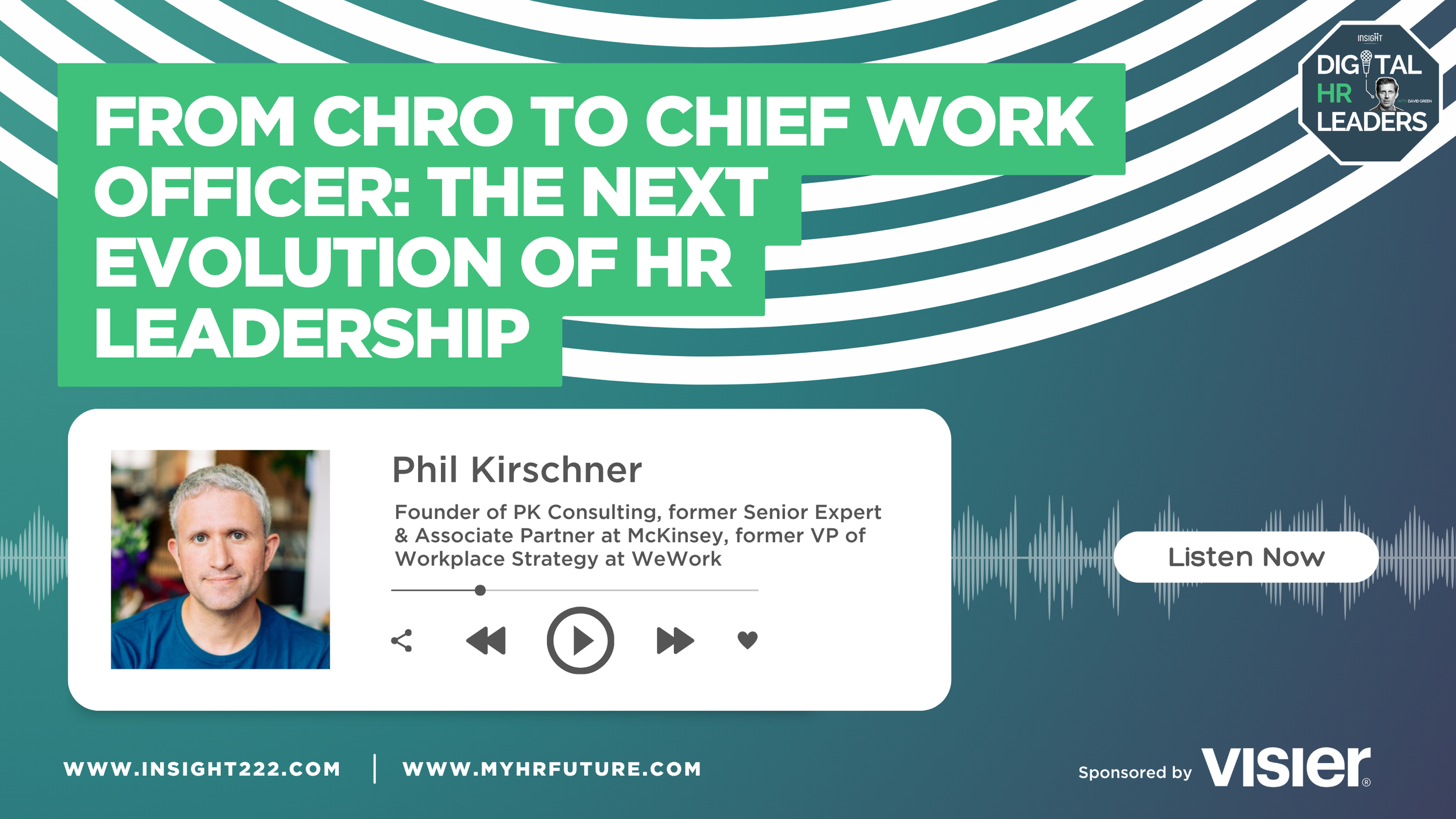
Episode 266: From CHRO to Chief Work Officer: The Next Evolution of HR Leadership (with Phil Kirshner)
Are organisations overlooking one of the most important drivers of employee experience and performance?
For many, the workplace is still treated as a fixed asset - something to manage for cost and capacity, rather than something to actively design around how work actually happens.
In this episode of the Digital HR Leaders podcast, host David Green is joined by Phil Kirschner, Workforce Experience Consultant and author of the famous newsletter, The Workline, to explore why workplace strategy continues to sit outside of core HR and people analytics conversations - and why that needs to change.
Drawing on his experience across Credit Suisse, JLL, WeWork, and McKinsey, Phil shares a more practical view of what organisations are missing - from the lack of basic workplace data, to the assumptions that still shape many workplace decisions today.
So, hit play to learn more about:
Why workplace strategy is still disconnected from workforce strategy
The key data points organisations should be tracking
How leading organisations are starting to think differently about the purpose of the office
What the “Chief Work Officer” role looks like in practice
Why AI is increasing - not reducing - the importance of workplace and experience design
This episode is sponsored by Visier.
Visier Workforce AI is your GPS for workforce decisions. Spot attrition risk, uncover pay gaps, measure leadership impact, and track skills shortages before they slow growth. Then act. Align talent to real business outcomes.
Across industries, HR and business leaders are using Visier Workforce AI to navigate the biggest workforce shifts of our time. Move from knowing to doing, faster.
See it in action at visier.com
Also, make sure to read to explore Visier’s latest research on strategic workforce planning in the AI era.
Resources:
This episode of the Digital HR Leaders podcast is brought to you by Visier.
[0:00:08] David Green: If you examine how most organisations are approaching the future of work, there's invariably a huge amount of focus on skills, AI, and new ways of working. But when it comes to where work happens, the workplace, it's often treated as a fait accompli, rather than something that needs to be intentionally designed. And yet, the physical workplace plays a much bigger role than we sometimes acknowledge. Because whether people choose to come together, how they collaborate when they do, and even how they experience work day-to-day is shaped, in part, by the environment around them. So, what happens when we start looking at the workplace as something that actively influences employee experience and performance outcomes? And what role should HR and people analytics play in determining how the place of work is designed?
To explore this, I'm delighted to welcome Phil Kirschner, who has worked as a senior workplace experience strategist at companies including McKinsey, JLL, and WeWork. Phil is also the creator of the fantastic blog, The Work Line, and I'm delighted to welcome him to the show to explore why and how the workplace has become something of an invisible variable in how organisations design work. We'll discuss what HR and people analytics teams might be missing when they overlook where work gets done, how leading organisations are starting to take a more intentional approach to the role of place, and we discuss Phil's concept of the Chief Work Officer, what it really means in practice, and why the rise of AI makes the design of work, space, and experience more important than ever. This is a topic we haven't really explored in depth thus far on the podcast, so I'm delighted to dig in. So, let's get the conversation started with an introduction to Phil and his background.
Phil, to kick off our conversation, please can you walk listeners through your journey that shaped how you think about work today?
[0:02:06] Phil Kirschner: Thanks, good, happy to. So, I started my career in information security. My background is actually in technology, studied computer science and everything. So, I think for the first couple of years doing that at a bank, it really taught me a lot about how organisations are structured technically, the architectures that are in play, and the many things that individual users will do to maybe self-medicate when rules don't let them do what they want to do, not that they should do that, but plenty of, "Oh, I can't access this and that website on my corporate computer, so I'm just going to use my phone", exercising a little bit of personal autonomy, saw a lot of that. Then, I made my way into expense management, so the finance organisation, same bank, working for a mentor and a friend. Looked after consulting and external services spend. So, that taught me a lot about who pays for what, how big companies do accounting really, and how the policies around various budgets and different types of expenses, and the way they are accounted for, lead to all sorts of weird incentives and behaviours, again that pop up in places that maybe are not always so expected.
Then, I fell, quite by accident, into the arena that changed my life from that point, which was into a budding pilot programme for changing how the bank worked physically in the office, a pilot group largely pulled together people with no real corporate experience or corporate real estate experience, born out of that expense management function, which is critical that we were not in corporate real estate when we started this, but building what became a very large global programme called Smart Working, where everybody had unassigned seats, a very simplified version. As it pertains to the post-COVID world, no changing at all what anyone was doing when they were not around. So, this was not a remote work programme, it was very much, "You're not all here all the time. When you're not here, I don't care why. But when you are here, we are using our space very ineffectively, inefficiently. The experience is also bad. Maybe we can solve all those things at once if you're willing to trade your assigned seat for much better space and change management and technology, and ways of thinking about your job". So, I did that as a practitioner.
I then left to do that on the consulting side at JLL, so helping others go up that kind of a mountain. Then built and led the workplace strategy and experience function at WeWork, which in addition to really strengthening my backbone on the role of community and activation and hospitality in the built environment, and why we like hotels and restaurants and co-working sites usually much, much more than we like our offices, but also the impact of treating space truly as a product, with everybody, top to bottom, working on the same team. And then, went from there, after COVID, to McKinsey, where I sat between their real estate and people practices, kind of the McKinsey version of workplace strategy, helping clients wrestle with the big question of 'now what' because of COVID, both in how they show up physically or how real estate companies deliver real estate as a product in their services, but increasingly getting much closer to the CHRO and HR population on what they did or didn't know about place before COVID, and how they are or aren't talking about place now many years later. So, technical at heart, but have been in or very, very close to IT, finance and HR as both the practitioner and the consultant.
[0:05:37] David Green: Yeah. And today, we're going to be talking a lot about workplace, why HR and people analytics professionals should care about workplace. And we're going to be talking about how you potentially bring workplace, people and technology together. And we're going to talk about a concept that you have, I've heard others talk about, the Chief Work Officer as well. So, I'm really looking forward to the conversation, Phil. Let's start. You've had quite a journey, and I know that latterly, you've been touching more on the people space as well. So, I'd love to hear, and given the last ten years, we've seen quite a lot of change happen, haven't we, not just in your career obviously, but in the world of work as well and how companies are using workspaces, given what happened during the pandemic as well; I'd love to hear, Phil, what's a belief that you've held about work maybe ten years ago, that your experience has completely dismantled?
[0:06:31] Phil Kirschner: I really thought about that question in advance. I used to think many more people, on a percentage basis, were as curious about why certain things are the way they are, or why we behave the way we do, spatially, technically, sort of policy and behaviourally, and have come to realise, I think, in talking to more and more leaders these days, that's actually not the case. I think it is a core futures-forward skill, particularly with overcoming the trials and tribulations of dealing with AI; but just straight curiosity, because I've had clients throughout that trajectory of career who initially would say, "Oh, we do it this way because…" And at least on the practitioner side, when I was part of, you know, I'm like, "I'm on the same team as you, we all work for the same person". If I can come up with a compelling argument as to why it might not be the way you think, because I've been sitting here and looking from the outside with no bias whatsoever, maybe I could get them over that cliff, be like, "Huh!"
But as a consultant, that's a really difficult thing to overcome in almost any situation or discipline. And when people are moving really quickly, and when your time is expensive, hanging around to let you ask deeper probing questions is unusual in all but the most, I'd say, customer-centric cases. So, definitely not for employees, usually.
[0:07:57] David Green: When people talk about modernising work, they usually mean people and technology. But more often than not, place of work or workplace gets left out. Why has the place of work almost become the invisible variable, if you want, especially when hybrid or flexible working is still such a live issue?
[0:08:17] Phil Kirschner: Yeah, I appreciate that you view it as a live issue. I know it's a live issue and we're certainly not done with it. But I think a lot of leaders are very, very burnt out from the initial, "Oh no, what do we do?" moment. And it's just one of those things where if the person or people closest to the top have made their decision and they are mentally exhausted or just trying to move on, it is not something that can be challenged or further entertained at the levels below that. I have lots of real estate leader friends who have all said variations on a theme of, "My CEO, never thought about real estate really once before COVID, it was just a thing we went to, we went to our office to do the stuff. But they renovated their bathroom at home that one time". And so, now that they were asked, they are certain that they know the impact of the place and how much it has an influence on the outcomes for the people or the company, or they just don't care. Then, there's the fact that the real estate industry itself, which includes the homes you and I are in right now, is big and there's a lot of money in real estate as an asset. They have a vested interest in making sure that we love our buildings. And the post-COVID moment was really scary in terms of real estate as a cliff and thinking back to the global financial crisis. I think that put a lot from the outside view of, "We've got to get back and look at my big, shiny box of beautiful space", which is important. And the best buildings are winning.
But I think for a lot of people, it just remains this sort of invisible variable, because we treat it as sort of a static asset instead of a tool, something that could be more variable and dynamic. But when you say, "Fail fast or iterate" and, "Test and learn", to most real estate professionals, the smoke will come out of their ear immediately. So, it's easier for them too to be like, "No, no, we got this right. See you in ten years".
[0:10:32] David Green: And it's interesting, isn't it, Phil, because if we think about most of the people listening to this podcast or this episode probably work in HR, in recruitment, in people analytics, but they work under that umbrella of HR. And if we think about some of the biggest challenges that are usually facing an HR professional, it's, "How do we attract the right people into the organisation? How do we retain them?" The workplace can play a huge role in that, can't it?
[0:10:59] Phil Kirschner: Yeah, 100%. We don't like to go to bad restaurants twice. I'd say most offices are more like bad restaurants than not. And most people on the whole don't have the opportunity to work for the ultra-elite companies that are building campuses and cities and spending oodles and oodles of money for amazing, amazing places. Even if you are told you have to be there, they are objectively great. But most people work in not that great places. And I think, not to make this about generations per se, but the younger you are and the readier your access to people's opinions about anything, whether it's your sweater or where you lived or who you work for, the tolerance for not great places is just going to go to nothing. And your average young talent, they come roaring out of university, having worked in literally dozens of different places over the course of a given month. So, to come into an organisation with a not great environment being told, "Sit here", just runs counter to the way that most young talent thinks. And that is not new.
[0:12:13] David Green: This episode of the Digital HR Leaders podcast is sponsored by Visier. When top talent leaves and skills gaps appear, how do you find your way? Visier Workforce AI is your GPS for workforce decisions. Spot attrition risk, uncover pay gaps, measure leadership impact, and track skills shortages before they slow growth, then act. Align talent to real business outcomes. Across industries, HR and business leaders are using Visier Workforce AI to navigate the biggest workforce shifts of our time. Move from knowing to doing faster. See it in action at visier.com/demo.
And then, the other factor, before we sort of dig into the people or HR side of it, again, if we look at workplaces, obviously it probably hasn't gone unnoticed from anyone listening to this podcast that we're going through a huge technology revolution at the moment with AI, and the way people work is changing, the way people collaborate is changing as well. You could argue that this was sped up during the pandemic, where we proved that we could work remotely as well. And I'm interested, I know extensively some of the stuff that you published at McKinsey, Phil. What are you seeing around things or some of the dynamics around workplace design as well that you're seeing, which are driving collaboration and innovation in the workplace; but also, helping organisations attract and retain top talent as well?
[0:14:11] Phil Kirschner: Well, yeah, keeping the answer physical, the problem is most of our offices weren't great for most people doing most of their work most of the time before COVID. And the entire workplace strategy industry exists in part because most companies don't ask their people what they think about their place. That's pre-COVID problem. Many companies, even to this day, going from very nice pre-COVID space to very nice post-COVID space with gobs of money, big fancy companies, I will either see myself or hear from peers in architecture firms that they're asking the employees, "What do you think about the place where you happen to be right now?" And it is the very first time that they've ever been asked that question, even today.
Unfortunately, trying to make a box of space that accounts for most of the people doing most of their work most of the time, you will never get an A-plus on all of those things all of the time. It's just impossible. You're always making trade-offs. So, I think the environments today that are the most interesting, the most impactful, most beneficial for the company, and light, therefore magnetic by the user, like, "I choose to go there", are the ones that have narrowed their band of purpose, what they're there for. And that guiding principle has cascaded through where we choose to put it, what we made it look like, how people are supposed to behave when they go there, and what is happening around them when they go there, which could just be free lemonade, anything. And those companies that make those decisions are usually the ones who, at least as the first brush from the executive level, don't believe that everybody has to go into a box that is controlled by the company most of the time just because. That doesn't mean that they don't have strong opinions about certain groups and certain circumstances, but the starting point is that there should be a reason.
So, those spaces, by having an a narrow purpose, saying, "Look, this is an executive briefing centre, or this is our innovation hub, or this is our talent attraction and retention zone", could be more successful, because they're trying to do a smaller band of things and are not necessarily in boxes of spaces that those companies own or built over long periods of time, and are more likely to be consumed from the market, whether that's coworking or whatever you want to call it, someone going, "Look, I have a very narrow need, I found a place that is going to meet that need. If my need changes, or it's not perfect, I will iterate, but I don't want to be stuck for ten years into something I tried to get 50 things perfect, and they never will be". So, that, yeah, that's where I see the most success. But it is constitutionally difficult, especially if that first starting point is, "The boss says I want you here almost all the time just because". It cuts off the whole leg of exploration around those other options.
[0:17:18] David Green: What are some of the things that companies that do it well do to understand design before they do it, but also how they evolve design as well through the life of that building that they've got, which, let's be honest, can be for decades?
[0:17:34] Phil Kirschner: Yeah. I mean, step one is opening the aperture. Just even inherent to your question, there is a bias, right? How are we using, or what do we think about the box of space that I was told I have to come to, and even possibly, or for most people in the box, I'm told to sit here next to that person and that thing over there. And this is like, I don't have a lot of agency in the decision up to the point where you're now asking what do I think. It is much more interesting were you to, with all the money in the world and all the resources, if you could effectively follow teams around with someone with a clipboard, giving them all the money and all the choice and saying, "Go forth and do whatever you want", and then see what they do, to then ask why instead of, "How effective do you think the cubicle that you're sitting in is". And there are moments of that for us in corporate land, when we take business trips, for example, right?
Like, if I'm going to fly to London for my company, and I get that act approved, just there's a certain amount of money that is assumed that I will spend to fly there, to stay there, within reason, hotel policies, like, "Go have a trip to go see a client"; once it gets approved, within that envelope, even with policies, I have a pretty high degree of autonomy. I may have a per diem, what I can spend to woo my client, but no one's telling me what restaurant to take them to. No one's telling me, do I meet them at their place? Do they come to my place? No one's telling me, do I blow it out for lunch and then grab a quick bite later? Do I take a taxi or a train? There's a lot of fluidity and we're making choices. And I wish when we came back from trips like that, if our real estate teams had the sort of mindset as a maybe Chief Places Officer, as a step up to something we'll talk about later, to ask why. Like, "Why did you make those choices? What was it about that experience? Did you have an event at a hotel for a client or for a team? Why there? Was it good? What was good about it?" And to have the employee think, and here's really the key, even if I told them, "Tell me in every little detail, why did you go to that hotel? What was it about their business centre?" and I'm furiously taking notes; if they then ask me, "Great, are you going to do that for our office back here in New York where you're home?" I might say, "Yes, when our release expires in five years, I will think about that".
So, then we're like, we don't see the feedback fast enough that you want to give it, which is one of the main reasons that a lot of real estate teams, I think, historically haven't asked because they know you don't like the desk, you know you don't like the desk, but they also know. But they'd rather not have it on paper, because they can't fix it without being given money out of cycle in a way that is prohibitively expensive and takes a lot of time.
[0:20:28] David Green: So, if a people analytics team or maybe a CHRO wanting to work with their people analytics team, wanting to take place or workplace more seriously tomorrow, how would you advise they go about this? Maybe what are the first three data points that you'd want them to try and capture?
[0:20:45] Phil Kirschner: Yeah. So, my own experience that we probably talked about in the past, like when I first came across a people analytics team in a workplace capacity for me, I discovered that despite all of the amazing things that they could do, they could not identify anything for an individual employee lower than the city level about their sort of space. Do they sit in an office? Do they sit at a desk? New space, old space? So, answer one, check what is the smallest scope that you can identify about someone as a demographic that is spatial? Like, is it a building? Is it a floor? Is it a seat? And then, really they're like, are they a remote worker or not? The company may know that, but I often find that even that simple variable, like, "Bill is a remote worker", isn't stored in Workday or you pick your HRIS system. It's somewhere else, or it's just not viewed as an HR variable, so that's the baseline. Then, the moderate level would be very, very basic behavioural. Do I walk into buildings? Which buildings? How often? Just the front door? No fancy, does he like the second chair from the left in the meeting room? But just, how often do I go somewhere? And this, critically, shouldn't be about attendance taking. It should just be, what am I doing?
Then, the slightly more advanced version would be anything more detailed than the door like, do you move around, especially if you're unassigned? Do you book lots of different desks? Are you in different rooms in different buildings? Do you travel? And then, the most advanced, ultimately, would be the customer-oriented satisfaction. A WeWork or Industrious, as a co-working company, will often sample people who do certain things, like book a meeting room, just like a hotel would do. "Oh, you booked room A? How'd that go for you?" It might be that you hated the wallpaper, it might also be that the technology wasn't working, but they will ask because there's this assertion that, "It's my product, I will do something about it". So, that answers that. But even just level zero, am I remote or not? To what kind of space am I assigned? How big? That's one that is rarely, if ever, one-click accessible to the people analytics team.
[0:23:15] David Green: I want to take a short break from this episode to introduce the Insight222 People Analytics Program, designed for senior leaders to connect, grow, and lead in the evolving world of people analytics. The programme brings together top HR professionals with extensive experience from global companies, offering a unique platform to expand your influence, gain invaluable industry insight and tackle real-world business challenges. As a member, you'll gain access to over 40 in-person and virtual events a year, advisory sessions with seasoned practitioners, as well as insights, ideas and learning to stay up-to-date with best practices and new thinking. Every connection made brings new possibilities to elevate your impact and drive meaningful change. To learn more, head over to insight222.com/program and join our group of global leaders.
In several articles on your excellent blog, The Work Line, Phil, you've written about what you call, and I've heard others use it as well, but the Chief of Work, the Chief of Work Officer, which is a phrase actually I've heard from other people I highly respect in this field, Diane Gherson, the former CHRO at IBM, Brian Elliott, who I know you know well, Phil.
[0:24:46] Phil Kirschner: Sure, but you may have gotten it from me!
[0:24:48] David Green: I think he did credit you on that, actually. And both of them have been guests on this show, so no bias on my part there. But if we strip away about the title a little bit, what does the Chief of Work role, in your imagination, what does it actually entail?
[0:25:09] Phil Kirschner: Yeah, I usually simplify it ultimately down to either first the kind of Human Chief Operating Officer, or even more simple, Head of What it Feels Like to Work Here, that which maybe once was employee experience. But employee experience usually would never have crossed into either the physical environment or with an eye on technology, the choices that leaders and teams and departments make that affect workflows and how we communicate with each other and how hard it is to get something done, generally. So, I think they were just sort of like, Head of What it Feels Like to Work Here, as a title. And when I wrote my first article in response to Tracey Franklin's role at Moderna, combining HR and it, I dug out Chief of Work, only because I had seen it 12 years prior, interestingly enough, from CBRE, the real estate services firm, in a big report written in 2014 about 2030. And the only reason I had seen it was because I was in it. There was a case study about Credit Suisse and the programme I helped build. But there was a page about what a Chief of Work should be, very similar to the definition I carry, like holistic, IT, HR, real estate, all of us.
I've kind of jumped back on the bandwagon because there is now more and more invocation of Chief Work Officer, which is a totally fine version of the same thing. But almost always, at least that I see, when someone now says, Chief Work Officer, what they mean is kind of CHRO 2.0 or 3.0, or whatever version we're at, or CHRO plus AI is a thing now, but place is never mentioned ever. So, that is one of my rallying cries around this.
[0:27:13] David Green: Yeah. And if you think about it, if you're going to put technology under the CHRO, presumably because it's tools or products that employees use, then why wouldn't you put workplace under the CHRO or Chief Work Officer? Because surely, the workplace is a product as well, isn't it? It's part of the employee. It's an important part of employee experience.
[0:27:35] Phil Kirschner: It is a very important part, it should be managed as a product. That is, by the way, an important maybe differentiation. The people who make the technology products that we use the most, I mentioned like a Workday or even ServiceNow, let's say, their product is a product. They use product-oriented language, product management techniques, how to think about user feedback. The real estate industry, as it pertains to offices, for most of us, they fund and finance and build a big old block of concrete and steel. And they get it to a condition whereby someone could move in. And then, a lot of companies move in and have to make a product themselves, with the help of architects and engineers and everybody else. So, even if you were thinking product orientation for workplace, by and large, other than the kind of co-working industry, which is growing and I love, it's hard to find a building that is offered as a product. So, you have to sort of do it yourself, which makes it feel very different than the others.
[0:28:40] David Green: So, Phil, if you had to diagnose the root cause of why HR, IT or technology and real estate are invariably misaligned, what would it be?
[0:28:53] Phil Kirschner: Well, that's one. I mean, on the real estate side, just the truth about the external reality in the industry relative to the other two. They too, they often report to different people, all three. And real estate in particular, and this I don't think is appreciated enough by leaders, and I certainly learned well at McKinsey, recruiting is always in HR. It does not randomly show up reporting to the general counsel or the COO; it reports to the head of HR. Same thing with people who are on the help desk in IT don't randomly report to the general counsel. The core real estate function is at its simplest, let's say, a third of the time in finance, a third of the time in HR, a third of the time in some other group, COO, CAO, CIO, general counsel, it happens. And they're called different things. And even the ones within finance, I did a straw poll at a conference a couple months ago of an audience, again of real estate people, and even within finance, some were direct to CFO, some go through procurement, some go through like accounting or treasury, they're buried all over the place, depending on the nature of the beast. So, just on that, we think of it as a three-legged-stool problem. But one of the legs is like chopped half off, and doesn't have a consistent executive focus.
So, there is no such thing as like a C-suite-level conference that takes place, where corporate real estate is predictably on the agenda. You go to Unleash, Transform, the big people conferences, yeah, CHROs, they're talking about everything having to do with HR, excluding place. Gartner, right, like ServiceNow, these mega IT conferences, Microsoft, place will not come up. So, the real estate folks will go to real estate conferences and talk to each other.
[0:30:52] David Green: We're going to go to the area where, I think, you seem to think where it should be paired with, which is with HR. So, say HR took full ownership of the place of work. What has to change about HR's operating model to make it work?
[0:31:08] Phil Kirschner: Well, one, I think they have to be able to disagree with the boss, or at least like -- and again, I wrote an article a couple months back called Three Levers to Mitigate the Mandate for HR, after being in a workshop filled with CHRO-minus-one types who were like, "I can't, I'm stuck with it. So, I have to work around it instead of being able to say the thing I actually think". And that is very difficult and Brian talked about this for sure, those sort of trust issues with leadership and vulnerability. That has a huge role. So, I wish that they could, like compensation or anything else, be able to go, "I'm the expert, we've looked at this, this is what people think. So, if we want to have them have a better experience, or be able to get the people that we want where we want them, this is what we must do".
Two, I think they've got to lead from the front on mobility, and sort of exploration of space and testing and learning. I am also a big believer that in the long run, the idea of having assigned space is preposterous and will hold us back from the level of resiliency that we need as organisations. Trying new tools, test and learn, like, "Oh, I built a better prompt than you had for AI", blah, blah, blah. We're moving at the speed of light, except I'm stuck right here. And HR is one of those teams, I know from experience, historically goes, "No, no, we have to be over here in our little bubble. No, you couldn't possibly". And of course, there are legitimate privacy and regulatory concerns, but they're not usually a group that will operate like, "Yeah, I move all over. We experiment all the time in the name of the experience we want you to have".
Then there's the financials, like HR does not currently command the kind of capital budget and accounting treatment nuances that come with managing real estate. Same thing with IT, right, just that is new, so you can't then try to keep it separate. And for the HR orgs that have brought it under their wing, you cannot have this HR-IT dynamic that I mentioned earlier, where like, "Our stuff's not the same". "No, no, we are all the same now". And yeah, that's the big one. And I think maybe this is leading towards, is the real answer that HR is the end-all be-all chief; like, is HR the Chief of Work, or does it have to be something else entirely? And we can go that way if you want, but the jury is still out on that point.
[0:33:52] David Green: Let's hold that one there, go to that one next. Where have you seen it work well where HR is responsible for place of work? You mentioned that some of the technology companies are a good example, and you've highlighted a few examples in some of your articles recently. I think Dropbox was one I think you put in there. And what is it about those examples which is kind of the good practice that others could potentially learn from?
[0:34:19] Phil Kirschner: Yeah, so I mentioned Dropbox, and I can't remember if Brian did too, but any of the companies, regardless of who's responsible for it, any of the companies with that what I call virtual or remote first, but not placeless posture. So, you don't have to come in, but we do still maintain places that we control and designed ourselves for much narrower-band purposes. Atlassian is another one, Synchrony Financial is one. They tend to have better outcomes for those places because of that first decision at the executive level, no matter what happens after that. Then, so you mentioned people and places. That was happening a little bit before COVID, where real estate was going into HR, and the CHRO appropriately pivoted with their title. Probably the most visible example of those is Sharon Doherty from Lloyds Bank in your neck of the woods. She's, like, on the circuit. They've had really progressive work done in their own offices in particular because of their human-centred exploration of space, I think, under her leadership.
There are Chief People and Places Officers at Okta, Intuit. There used to be one in Deutsche Bank, but I think they changed it. UBS, so was Credit Suisse, now UBS, like where I used to work. They don't call -- I think it's just Head of Human Resources, Stefan Seiler, but he has real estate under, and a very interesting organisational structure. Yeah, so that's really -- oh, and then maybe the largest financial services example, Tanuj Kapilashrami from Standard Chartered Bank, one of the largest banks to go, "We are flex first, period, the end". So, that enabled them to both reimagine their corporate real estate footprint, but begin moving past corporate real estate. But people ask me, like, "What happens when you move past flex and hybrid?" I say, "You write a book called The Skills-Powered Organisation", which is the next big topic, right? You're not thinking about hybrid anymore. So, those are some big examples. Adobe also, yeah, there's a few that have elements of it within HR, and the title change is significant to start.
Oh, with one example. Sorry, I just interviewed last week, Arvind KC from Roblox, who is the Chief People and Systems Officer for Roblox. So, he comes from an engineering background, is responsible for HR, and also real estate, and also IT. And I'm going to write about that experience, specifically because of how unique it is.
[0:36:53] David Green: I know Microsoft did some research, which you've probably seen. This is going back probably about 18 months now, and they were trying to understand, when do our people need to be together? What are the moments that matter when they need to be together? And they identify, when you're starting a new role, that could be an internal move; when you're kicking off a project; and for social cohesion, so deliberately bring people together. Now, that's what they found with their data. Doesn't mean it'd be the same --
[0:37:18] Phil Kirschner: Yeah, and McKinsey did similar with an overlapping personality there, with Katy George, who had been the CHO of McKinsey while I was there and is now at Microsoft. Yes. And just the really critical thing you just said there, many organisations have thought about or studied the moments that matter in my week, month, year trajectory. At McKinsey, for us, it was project to project. And let's say a 12-week project, sure, there are a couple of moments where it really, really, really, really helps, either internally or with a client. Others, do it if you can. But if someone's home, it's fine. But being together does not always mean in that exact block of steel that we're renting right now. I have discovered, in this post-COVID world, there are people who live closer to me in my home than the place we would otherwise meet. So, we end up having coffee or doing something around here. So, we want to get together, we will prioritise getting together. That doesn't mean it has to be in the most logical or first-opinion place to do that.
[0:38:24] David Green: You mentioned, you kind of threw away a remark, "Should it be HR?" Well, I'd love to hear your thoughts, because obviously this is something you've been living for a number of years, and you've obviously been as a practitioner when you were at Credit Suisse, as a consultant at McKinsey, and now as an independent as well. Is there one place it should go or is the answer going to be something like, "It depends, David"?
[0:38:47] Phil Kirschner: Yeah, look, I think in my first article I said, if you were trying to build a forward-leaning, Chief Work Officer, Chief of Work, or just 'what the heck does it be like to work here' function, and you had to put it somewhere just to start, my inclination would say HR is the best of those answers. But really, I don't care, as long as someone senior enough was on the hook and looking after them. But it's really about who would you put in those groups. And for a large organisation, I think about somewhere in your real estate group hopefully, you still have what I think of as a workplace strategist, and probably spatially-oriented change management people. It's another good example of silos, by the way, and somebody recently told me that they were talking to the change management team in their own organisation in HR, while they were a change manager in the real estate group in the HR function. And the traditional communications-oriented change management people effectively told her, "You are not us. We are not the same animal". You are.
But anyway, so within real estate, workplace, and change, and if you have a really progressive, design-oriented person internally, I want to grab them. I want to go to HR, and I want to get whoever thinks about not just, "Oh, we rolled out Windows 10", or whatever it is, but who thinks about collaboration tools and what's on my phone and how am I supposed to use it? What are the best practices? Some people around Gen AI in particular, but just that top layer, not the infrastructure rollout, the one who is more human-centred about the choices that we're making, I want to grab them. And then, I'm going to go to HR traditionally and say, "I'd love employee listening, like whoever runs your engagement survey, maybe somebody in benefits design. I just want that. All of you come with me, put you in a bucket somewhere, give you a hotshot data scientist or two, who genuinely does not care which leg of that stool is the reason that somebody likes something or doesn't, or it's going well or not, and let you go after problems, parts of the journey.
You see this in companies, even JPMorgan, very publicly, would put a whole squad around onboarding as a product. I don't think it actually included real estate, come to think of it. But a group like that could say, "Right, for this sprint, we're going to look at onboarding", or, "For this sprint, we're going to look at meetings, like, why are our meetings terrible?" And come at it in a human-centred, ideally funded with at least enough money, if they discover the problem happens to be spatial or an HR policy, that they could just go, "Here's a little bit of money. We'll fund the fix. But we were able to come to the decision about what the problem is in an unbiased way that is not informed by whichever master we're serving". So, if you think of Chief of Work as the like, 'how does it feel to work here', or human COO, maybe a small group like that ultimately needs to sit off to the side.
Because look, it snowed here big-time yesterday. God bless the facilities teams everywhere for offices that were bustling around to get snow removal and make sure temperatures were right. That's real work. The lights cannot go out in the office. Same thing for HR. We need to get paid. People have to be able to get hired and get onboarded. And IT, my computer shouldn't just shut off. Those are real disciplines with real experts and increasing complexity. Just like with HR, you don't want the best people-listening teams to be totally overshadowed by the fact that it's comp season, and all their HR VPs get sucked into a black hole for weeks. I was just like, "I can't hear that amazing thing you just learned about our whatever cohort of people", right? So, I think the long-term answer, it should be out of all three of those silos somewhere. Does it demand a C-suite role? Maybe. But it's probably none of the three today to do it really well.
[0:43:17] David Green: I know, Phil, another area you've done a lot of research in and work around is this whole hybrid. I think we should probably call it flexible working perhaps now. Probably, thankfully, we're seeing fewer questions and comments around how many days in the office, although there are still some. What are the right questions, though, that leaders should be asking around this topic?
[0:43:38] Phil Kirschner: Yeah, all things equal, I would say, what is the clear and authentic, meaning in your language and not jargon-filled, purpose for why your company has any relationship with the built environment at all, stores, branches, factories, but also offices? And then, down to specific offices, like what is that thing good for? As a follow-on to that, if we were to hold a performance review with our London office, not holding the people accountable, holding the building accountable, how would we know if the building was doing the thing it's supposed to be doing for us? Then, which just really means you have to have done purpose. And if the reason that your London office is not accelerating offer acceptance the way it's supposed to, it probably has nothing to do with the colour of the chairs. Lots of other reasons.
Then it asks, how much is legacy entitlement and space-assignment culture preventing teams and individuals from being as fluid and opportunistic around where the wind is blowing for business? Sharing shouldn't be viewed as a cost burden. It should be viewed as, "Oh, I can reorganise teams on a snap and have people just go, 'Great, I should be over there now. See you in a minute'. Like, here's where the energy is". And they're encouraging people to do that a little bit more, taking trips, but not necessarily business trips. Locally, go sit with another team, go to another building, go to another place, you might learn something. Or maybe stay home or go have coffee with a neighbour that works for us, so that you ultimately can accelerate the test-and-learn culture within real estate that has been, unfortunately, as I've seen in my own research, decimated. It was bad before COVID, it is worse now.
[0:45:32] David Green: In your opinion, why does AI raise the importance of place and employee experience design more than ever?
[0:45:40] Phil Kirschner: Yeah, one, and I think Brian got into this a bit, if the office is going to be more, or the office should be more human-centric, because the rote work we used to go there for, just mashing on our keys, presumably for many jobs, AI starts to augment, if not displace. So, we should be going to do very human-oriented things, which is going to make us lean even harder into the hospitality and community and activation choice that we want, because that's how we behave in our human lives when we go to shows and restaurants and sporting events. And then, of all the things that I hear AI is going to make better for all of us, space tends to be absent, even in the biggest AI conferences. And I remember doing a presentation last year at some point through Rebecca Hinds, who was at Asana, now at Glean, about AI, and I think my title was something like, "AI is going to make hybrids suck less". We forget this, right? The reason hybrid is hard is because we used to have a fair degree of predictability in our day. Like, I always sat in this desk, and you and I always had our weekly meeting in conference room A. Now, none of that is true. People are in different places, and we can't handle all that cognitive load. Where should I be? When should I be there? How should I get there?
But if you fast-forward a couple of years, it is not out of the question that my personal little agent will say, "Hey, you and David were supposed to do this conversation virtually. Did you know he is going to be in New York next week? Would you like me to move the meeting, book you a podcast studio somewhere in New York, call you a Waymo that's going to come pick you up so that you can do the call that's before then?" It prevents you from moving. That happens to me a lot, right? I would come see you because you just told me you're in town. But I have one call I had right before, I'd have to travel 30 minutes. But autonomous vehicles are basically moving meeting rooms, if you've never been in one. So, yeah, AI will take all of that complexity out, choosing the places just like we ask it to help book vacation. Like, "Help me with my path through my own city today". And as long as we are willing to trust the process and take the nudge, I think it will unlock both immensely productive and experiential, but human-centric ways of working much more than mashing on keys used to be in the office.
[0:48:17] David Green: Phil, you mentioned trust. You've just teed up the question of the series. This is the penultimate question of this episode, and this is a question we're asking everyone in this series. So, again, you might want to answer this coming from that kind of workplace perspective, but how can HR move fast with AI without losing trust, fairness, and governance?
[0:48:41] Phil Kirschner: Leading by example, being willing to fail in the open, admitting vulnerability, and showing that the people who are failing along the way don't get fired, and instead are applauded for having tried something that didn't work, and sharing those, those lessons learned, just being vulnerable.
[0:49:01] David Green: Yeah, perfect. Psychological safety, the permission to fail.
[0:49:05] Phil Kirschner: Yeah, we need more, this is a terrible word, but sometimes it's terrible not to use for real, but it's not psychological safety, like I feel safe. It's sort of psychological safety, like I want to be able to point to things where like, "That's stupid. It didn't work". That has to be okay, which is a new level of trust within an organisation that we need, I think.
[0:49:26] David Green: I mean, how many things didn't work before the wheel was invented? I imagine a few. Probably some square ones, certainly if you look at the Flintstones anyway. Phil, it's been an absolute pleasure to speak with you and I look forward to seeing you at some point this year at a conference, probably Unleash maybe in March in Vegas. Can you share with listeners how they can follow you, learn more about The Work Line, for example, and all the other great work that you're doing for the field?
[0:49:54] Phil Kirschner: Yes, the easy one, and I'm so pleased that I've just relaunched my newsletter website, which is walktheworkline.com, hopefully easy to remember. So, that has the archive of everything I've written over the past year, plus the ways that I consult and speak with clients. I'm also very active on LinkedIn. I'm a top voice there, like Brian and others you've had on the show. So, very responsive if you find me on LinkedIn. And yeah, really excited to continue this conversation. It is so, so important and I'm so excited about like, what is possible when we connect the sort of workforce intelligence strategy and the spatial element that can't be ignored.
[0:50:31] David Green: Well, I'm looking forward to seeing workforce and workplace intelligence come closer together. And I think the sum will be greater than parts, as they say.
[0:50:42] Phil Kirschner: From your lips, as they say.
[0:50:44] David Green: That doesn't mean it's true, though. Phil, as ever, an absolute pleasure to speak with you and look forward to seeing you soon.
[0:50:51] Phil Kirschner: Definitely. Take care, thank you so much.
[0:50:54] David Green: Thank you again, Phil, for joining me today and bringing to life the concept of the Chief Work Officer. For those of you listening, I'm curious, what stood out for you the most from today's episode? I'd love to hear your thoughts. So, please head over to LinkedIn, find my post about this episode, and let me know what resonated with you. I always read the comments and love learning about the different perspectives across the field. And if this conversation got you thinking, please subscribe to the podcast and share it with a colleague or friend who might benefit from hearing it too. It really does help us bring more of these conversations to HR professionals across the world.
For those who would like to stay in the loop with what we're working on at Insight222, follow us on LinkedIn or head to insight222.com. You can also sign up for our bi-weekly newsletter at myHRfuture.com to get the latest thinking on HR, people analytics, and everything shaping our field. Right, that's it for the day. Thanks for listening and we'll be back next week with another episode of the Digital HR Leaders podcast. Until then, take care and stay well.