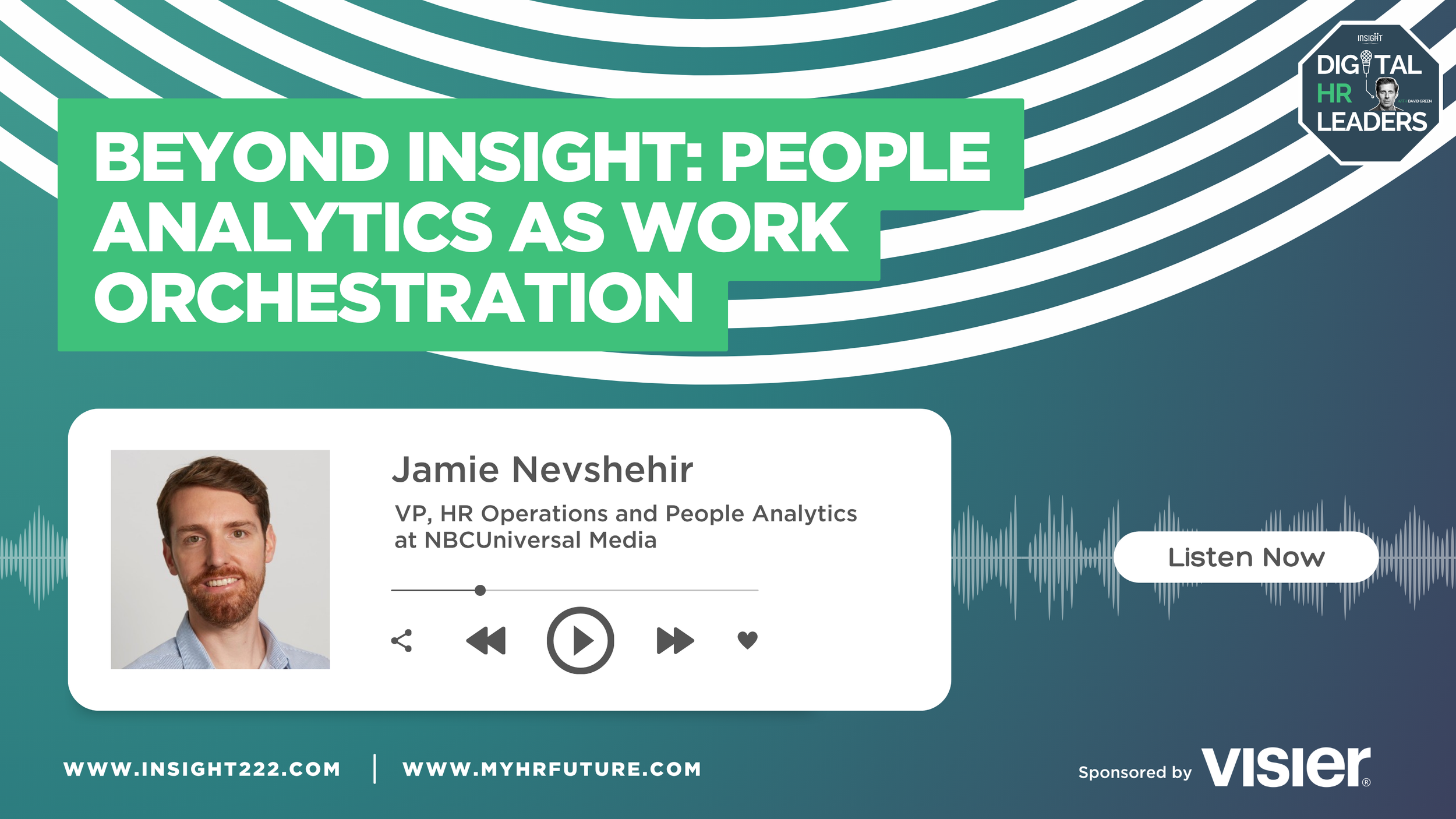
Episode 267: Beyond Insight: People Analytics as Work Orchestration (with Jamie Nevshehir)
What does the next evolution of people analytics actually look like?
As AI reshapes how organisations operate, people analytics is increasingly being drawn into more consultative, business-facing work - helping leaders think through decisions, guide adoption, and play a more active role in how work actually gets done.
In this episode of the Digital HR Leaders podcast, host David Green is joined by Jamie Nevshehir, VP of HR Operations and People Analytics at NBCUniversal, to explore what that looks like in practice.
So, hit play to learn more about:
How to build a people analytics function from scratch and establish credibility early
Why strong data foundations still matter more than advanced analytics
How to introduce a more consultative, business-facing approach
The role of people analytics in guiding and governing AI adoption
Why dashboards are no longer enough on their own
How the function is evolving toward influencing decisions
This episode is sponsored by Visier.
Visier Workforce AI is your GPS for workforce decisions. Spot attrition risk, uncover pay gaps, measure leadership impact, and track skills shortages before they slow growth. Then act. Align talent to real business outcomes.
Across industries, HR and business leaders are using Visier Workforce AI to navigate the biggest workforce shifts of our time. Move from knowing to doing, faster.
See it in action at visier.com
Also, make sure to read to explore Visier’s latest research on strategic workforce planning in the AI era.
This episode of the Digital HR Leaders podcast is brought to you by Visier.
[0:00:08] David Green: If you work in people analytics, you'll know the function has come a long way. We have moved from reporting and dashboards to generating insight. But what our latest research at Insight222 shows is that this is no longer enough. The leading teams are not just producing insight, they are shaping decisions, influencing strategy, and driving measurable business outcomes. In other words, people analytics is evolving beyond insight; it is becoming a core capability for orchestrating how work gets done. This shift is being accelerated by AI. AI does not replace people analytics, it amplifies it, but it also increases the stakes. It increases the demand for better data, stronger judgment, and much closer alignment to business priorities. As a result, the role of people analytics is becoming far more consultative. The best teams are not waiting for questions, they are framing problems, guiding leaders, and helping the organisation navigate complex decisions about productivity, skills, and how work is designed. That is exactly what we are going to explore in today's episode.
I am joined by Jamie Nevshehir, VP of HR Operations and People Analytics at NBCUniversal. Jamie has been on this journey firsthand since setting up the function at NBCUniversal in 2019, from building the foundations of the function to evolving it into a more integrated business-facing capability. Together, Jamie and I discuss what it takes to move beyond reporting, how to build credibility with the business, and how people analytics can play a central role in guiding AI adoption and shaping the future of work. So, with that, let's get started with a brief introduction from Jamie.
As a member of the Insight222 People Analytics Program, we've known each other for several years. I think it's probably seven years now. And for those that are also part of the program that are listening, you will likely have seeing Jamie speak at one of our events. For those listeners who may not be familiar with your work, could you please share a little bit about yourself and your background, what your role at NBCUniversal entails, and perhaps the journey that brought you to where you are today?
[0:02:24] Jamie Nevshehir: Yeah, thank you, David, for inviting me on to this podcast. Like you said, I've known you for a few years. I think it's about six years now, through Insight222 and other things. But yeah, it's lovely to be on the podcast, so thank you very much. As you said, I'm VP of HR Operations and People Analytics at NBCUniversal. So, I've got two hats. So, one of them is looking after HR operations, which is our systems and processes outside the US for NBCUniversal; and the other part is leading people analytics globally. So, how did that journey start and where have I come from?
So, I'd probably say inspiration and being in the analytics world came from my dad. I started at KPMG in finance and that really gave me the analytical mindset. And then, I was lucky enough to shift into an HR role there and started in their service centre before moving into consulting, and then joined NBCUniversal about nearly ten years ago it will be, I think, next month. So, yeah, it really kind of helped shape things here. So, when I started, it was just HR operations I was looking after. But I went to the CHRO, I said, "Look, we're only really doing reporting. We really do need to bring it up and start to look at how do we become a bit more data-driven around our decision-making". And I said, "Look, can I set up a people analytics function?" She said, "Off you go". So, I was very lucky to get that opportunity and very thankful for doing that. And so, since about 2019, we've been building out the team and trying to look at how we could shift things. Again, we're a creative company, we're not a tech company. Data and technology is not at the core. It's creative thinking and building out content, whether that's TV, news, sports and films, as well as our parks and what we do there in Universal Studios, Hollywood, Orlando, Japan, etc.
So, I started off the journey just bringing in the lead of reporting, because I thought we needed to have a strong foundation, we needed to understand our data. And she had actually been here at NBCUniversal a long time, and had really got to know the data. So, it was just myself and her pretty much in 2019, and then the pandemic hit. And like a lot of organisations, that really accelerated our journey, and it really put us in the forefront, where we were helping to make sure that people were safe, people could come back into the office where they needed to, we needed to keep the lights on with our news broadcasts, and other things. So, it was really important that we could bring the people data together with facilities, with our crisis management groups, with some of the contact tracing that we were doing. So, again, all of that was a real big starting point. And we've evolved since then to really build a strong foundation, to build a core, to actually understand what is, how do we build consistent data? How do we harmonise our data? How do we have standard definitions? How do we have reliable reporting? All of those things are crucial. And I didn't want to jump into all the fancy shiny stuff from the start. I wanted to make sure that we really did have a strong foundation, and that's what we spent the first two, three years building out. And then we moved into the standard things like dashboards and other things.
Where we are today, I've really built two pillars in the team, as we call them that. Again, we're not a huge team. We're a team of ten across London and the US, being LA, New York, and Orlando, and we have two key facets. So, we have a team that is purely focused on reporting, which is data, BI, data governance, and our products. So, I call that the Data and Systems Team. And then, we have a People Analytics Consulting team, which is kind of the newer part of the team over the last two years. And in that team, we have critical thinking, understanding of data science, and then we also have the analytics, the consulting side of how do we partner with the businesses? How do we tell stories? How do we bring those businesses through into a different mindset, where they can start to think about how they use data and how they can make decisions with data? So, again, yeah, kind of a journey over the last sort of six or so years. But, but I'm really pleased where we've got to. And I'm really grateful for all the support, especially from leadership, that's brought us to where we are now.
[0:06:26] David Green: It's a great story. And obviously, we've had the pleasure of seeing that on various stages, when you've presented to fellow companies that are part of the Insight222 People Analytics Program. It's quite interesting. I just wrote a few notes down there, Jamie. So, obviously, starting in finance at KPMG, moving across to HR and then into consulting. It's a nice little combination there because obviously, if you're going to be successful in people analytics, either having that background in finance or working closely with your finance counterparts is really important. I don't know if you've found that background has helped you in people analytics?
[0:07:07] Jamie Nevshehir: Definitely. I think there's still a journey we've got to make here around how we partner more with finance, especially in terms of workforce planning. We're on that journey, and have been for the last couple of years, of how we start to look at how do we understand the positions, understand the cost of those, and then look at how do we start to plan for the future. So, again, that's very much driven through finance at the moment at NBCUniversal, it's the workforce planning through FP&A. But I'm trying to bring in the more strategic thinking. And some of the businesses are doing this. But I think there's no consistent way that we're doing this. And again, we're on a journey to look at how do we become more skills led in the way that we do things. And that's going to come with future platforms that we're moving to in terms of SAP Employee Central and SuccessFactors, other modules that we're going to bring on board over the next kind of two, three years. So, I think, yeah, we'll slowly shift into the more strategic workforce planning side of things, and that will mean we'll really have to come in lockstep with finance. But we're doing a whole load of work around how we try and make sure we've got our definitions correct. We're never going to get the same in terms of our headcount versus FTE, but we've got to make sure that we've got a similar understanding of what those things are.
[0:08:15] David Green: Yeah. And then, the other piece I wrote down, there's two other things I wrote down, one was around that entrepreneurial piece really. You went to your boss and said, "I think we need to build a people analytics function", and you were given the permission to do that, and that's fantastic. Over the last six, seven years, you've built that function out. As a founder people analytics leader as well, which we see a few of those across the industry, I mean what helped you? What are some of the things that you think, if you look back and think, "That really helped me build a success"? And then maybe again, it's always good to look back, what are a couple of things you might have done differently?
[0:08:53] Jamie Nevshehir: Yeah, I think that's a great question. And again, I think a lot of people that I've spoken to have had very different journeys. But for me, I think some of the things that really helped us were just getting that value at the start, helping to kind of explain what we do. I think everyone sees people analytics, to start with, as reporting and dashboards. That is the bread and butter. That is some of the things that, yeah, your core facets that you have as a people analytics function. But I think for us, some of the early things, again, the pandemic, as I said, was kind of a big catalyst, some of the things that really helped us as well were, we tried to get a use case or tried to have a project that really showcased the value that we had, and this was financial value. The pandemic gave us that opportunity.
One of the things we did was we used Viva Insights, or at the time was called Workforce Analytics, a Microsoft product. And we started to look at what was happening to the work week, what was happening to the way that people were working, whether they're working late, whether they're working long days, etc, by looking at their kind of their Outlook, looking at their Teams, looking at their emails, and when they were sending things. And what we could do is we could build a picture of how much of an expanded work week people were having because they were working at home, they weren't in the office, they weren't commuting, it was very stationary. And they were juggling a lot of other things.
The second thing I think that really helped was we wanted to partner with the HR leaders across the company and show what we could do. And one of the things we thought that really would showcase that, and we happened to be at the right time of the year, was talent reviews. So, as part of the talent reviews, those HR leaders would bring together a pack of information that would look at succession, high potentials, all those kind of things you would do as a part of a talent report. But we also wanted to complement that with data that showed some of the trends or some of the data points that they may not have shown their leaders and their businesses and the CEO at the same time. So, they all had to present through to the CEO at some point in that talent review process. So, what we did is we worked on a pack for each of those senior HR leaders that showed specific things that were relevant to that business, whether that was attrition, whether that was changing the demographics of their workforce, or other things they may not have really focused in on that we could see maybe are some highlights that were very different to other parts of the business. And we created those packs and we talked them through those packs and they understood them and they could see the kind of key story within those packs.
Then we asked them to think about how they would present that story themselves. Because again, we were pulling the data for them. It was their data, it was their story. So, we just had to work through coaching, mentoring to do that. And that was an amazing pivot from actually, "Well, you guys have done reports for us in the past", to actually, "You guys have partnered with us to think through some really key things that are going on in our business". And that really helped raise our profile.
[0:11:47] David Green: This episode of the Digital HR Leaders podcast is sponsored by Visier. When top talent leaves and skills gaps appear, how do you find your way? Visier Workforce AI is your GPS for workforce decisions. Spot attrition risk, uncover pay gaps, measure leadership impact, and track skills shortages before they slow growth, then act. Align talent to real business outcomes. Across industries, HR and business leaders are using Visier Workforce AI to navigate the biggest workforce shifts of our time. Move from knowing to doing faster. See it in action at visier.com/demo.
You mentioned earlier, obviously, in the last couple of years, you've built a consultative layer into the team as well. What prompted this shift and what outcomes were you looking to achieve by building it; or maybe, what outcomes that you're able to share have you already achieved by building it?
[0:13:05] Jamie Nevshehir: Yeah, so I think I wanted to shift again, as we'd started to move to work more with business HR teams and some of the leadership as well, I wanted to make sure that we had a strong group within the team that could do that on a more consistent basis. And that's where we wanted to build out that consulting arm, is having that group that can really start to partner properly with different business leaders and HR teams. And I wanted to think about the expertise in this group. So, we are really lucky that we can use our IT function from an engineering perspective. So, we utilise them for all of the data lake build, the engineering build around how we build out our models. And then, they also supported us all the way through from our BI to build out our suite of dashboards, which we call People Insights. And so, they've helped us in that journey. But what we wanted to have is something is some data science experience in our team, that we could really spin up some quick analysis, we can look at doing statistical, whether all that's building out a new model. And we weren't just beholden on using engineering teams to do that, and we could be a bit more agile.
Then, I wanted to bring in a different framing. So, one of the things that we were lucky to do is, the head of the people analytics consulting side of my team came from an audit background, an internal audit background, which is a really unique skillset. It wasn't something that I was initially looking for. But as I started to look at more of these types of roles and what people were doing, it just seemed to be a really nice fit, because they have that real critical thinking, the compliance angle, that rigour in terms of what you do in internal audit. And then, you're also trying to really dig into risk, compliance and, and governance of data and other things. And in terms of the second part of what we've been able to do, and how that kind of team has spun up certain things, we've definitely gone off and partnered more with businesses. We're not anywhere near where we'd like to be. I think in the next year or two years, we'll be much deeper into working with the business HR leaders and HR teams. But what we have managed to do is look at how, especially in the age of AI, look at how we could automate where we could do things. So, that team, because of the data science experience, can help code, can help do things a lot quicker than we had been able to do.
One of the examples is, we moved to a four-day in-office week from January, and we wanted to move the accountability from HR, which it was previously when we were in a four-day week, to being leaders and managers owning that, because they are the ones that are managing their teams, they're the ones who are looking at how they work within the office. And so, we've built out a process and an automation and a script, and my team had helped to design, build, and think through all that. And it's highly complex with the different organisational parts, the organisational structure, the different types of leaders that we've got, and then making sure that we had common, consistent, accurate data from a badging perspective and then from the HR perspective, blending all that together and then pushing it out through a set of emails. We wanted to look at where could we land this so that it was in the flow of what people were doing, especially those leaders. Again, it went to all our senior leaders across the company. And we wanted to make sure that they got an email and a report. They weren't really going to go into a dashboard to look at all the data. We wanted to make sure it's front and centre, so sending it as an email so that comes in on the first week of the month. And it has a report that's purely for their organisation with all of the conditional formatting and other things that we built into it. That was really important.
So, that's what they've done, and that's one of the big use cases that we've been able to work on recently, as well as supporting, we've just spun off Versant as part of our kind of linear networks and brands. And as part of that, there was a whole load of relocations. We were moving people from different offices, and we wanted to look at how we could support those individuals as they moved into new offices and their commute times were changing, etc. We wanted to understand what the impact was across that redistributed, restructured workforce. And so, my team were fundamentally helping to do that analysis around what's the impact on commute times, etc.
[0:17:14] David Green: I think that the buzzword of the moment is 'disruption', whether that's geopolitical, technological, or workforce shifts. How is it shaping the work that your team is being asked to do? And does it change how you position people analytics internally? You talked about risk. What's the new people risk maybe created by disruption and AI, not just attrition obviously, but decision and overload risk?
[0:17:40] Jamie Nevshehir: Yeah. I think this is a great question, David. It's huge. We probably could spend two, three podcasts, and four or five hours talking about it. But I think, yeah, there's so much that's on the shoulders of HR and CEOs. I think you've seen CEOs are kind of looking at their roles, and a lot of them have kind of decided to retire early and other things. I think that's because of the pressures that have come through, especially in the last year or two, and the pace of things and the pace of change. And I think AI is just a massive change in the way that we're going to have change in society, change in the world. It's similar to what happened in the Industrial Revolution. And in the 1800s, again, I hope we don't have a Luddite movement like they had then as a result of this.
[0:18:29] David Green: I think we possibly already have.
[0:18:31] Jamie Nevshehir: We may have done, yeah. But I think we're at that inflection point in our evolution as human beings. And I think AI it's going to change the way we do things, yes, it definitely will. But I think we've got to be conscious. We've got to be really understanding what that means for us as individuals, and then as an organisation. And I think there's so much hype, it's very hard to dig through that and to find what are the things that really resonate with individuals, with leaders in businesses, and specifically, CHROs, and how our role as HR, as people analytics, is going to evolve and what's that going to mean. So, I think from my perspective, it is going to change things. But I think we've got to be a little bit cautious about how fast we do things, and especially how we have a good strong foundation around governing what we do with AI and how we think about it. Again, for our industry, it could be hugely impactful and sensitive.
But I think we've got to look at, and I think in some of your other podcasts that you've had Hebba was talking about it recently, was how do we look at the skills? How do we look at the roles and the tasks? How do we break that down? And I think that's fundamental to how do we do things in the future, and how we think about, what are those roles? Again, we're not going to replace lots and lots of roles. I think there will be some augmentation, and there will be some automation. But overall, I think some of those roles will change. And I think there's also a disconnect at the moment between educational institutions and the workplace. So, I think we, again, as people analytics professionals, we're there to help guide around what are those real valuable use cases that we can use AI for in the workplace, and what are those things that are just wasting energy, wasting time, and not fundamentally the right things to do. And that could be from an ethical perspective as well. I think I've heard lots of crazy use cases of how we could do things. And then, part of my role as my team is to start to as a filter for that and act as a funnel.
I'm really glad I've had, over the last few months, some of those business partners coming to me and saying, "We're thinking about doing this. We're trying to experiment with this". And again, my reaction isn't just to throw that out of the water saying, "Why are you doing this? Why are you plugging all this data that is quite sensitive into these tools?" It's just to say, "Stop, let's think about this. Let's think about where there's wider enterprise projects going on. And then, how do they relate to exactly what you're trying to do, or how could you feed into those?" So, I think that's where my role in my team, and I can see with other people analytics teams becoming more, is where there is that kind of funnel for some of these projects and some of these enterprise-wide initiatives, especially when it comes down to people. And a lot of the use cases in organisations are around people. When we look at TA, talent acquisition, and what recruitment are doing, a lot of that is impacted by this. And some of those really fruitful use cases are coming through from that TA side.
[0:21:32] David Green: I want to take a short break from this episode to introduce the Insight222 People Analytics Program, designed for senior leaders to connect, grow, and lead in the evolving world of people analytics. The programme brings together top HR professionals with extensive experience from global companies, offering a unique platform to expand your influence, gain invaluable industry insight and tackle real-world business challenges. As a member, you'll gain access to over 40 in-person and virtual events a year, advisory sessions with seasoned practitioners, as well as insights, ideas and learning to stay up-to-date with best practices and new thinking. Every connection made brings new possibilities to elevate your impact and drive meaningful change. To learn more, head over to insight222.com/program and join our group of global leaders.
With AI coupled with that, how are the types of skills that you look for in your team, or do you think maybe will pan out over the next 12 to 18 months, how's that change and how is AI starting to influence what good looks like in a people analytics team, but possibly your people analytics team?
[0:23:01] Jamie Nevshehir: Yeah, I think we've still got to have business acumen. I think we've still got to have an understanding of what is human. I think those are core facets that we should have in people analytics teams and other teams as well. As we go through this, we've got to make sure that as we're looking at AI, we're looking at how it could change the way we do things in the businesses, we've got to make sure that we have that clear grounding. And if we make any decisions, it shouldn't be that AI is making that decision. It should be that the human has that ultimate, the buck stops with the human, in everything that we do with AI. Again, we've seen it recently. It has dire consequences from a military perspective, it has dire consequences from a healthcare perspective. But again, we're thinking about our workforce and our employees. These are people, these are human beings as well, and we have to make sure that we make the right decisions, and we don't just rely on the AI to make that decision for us. And that's really key.
Having a key part to play in that with leadership, with HR as a function, I think that's where the HR function as a future is there to really make sure that we ground in the human, as we become kind of a more symbiosis between machine, AI, human in the future. And again, we've seen lots of sci-fi films. I think we've made the sci-fi films. I think there's a lot of stuff that is coming true. But I think we've got to be looking at some of those things to heed on some of the challenges that came up in those stories and make sure that we don't fall foul of some of those big pitfalls.
[0:24:38] David Green: You mentioned AI adoption and obviously you mentioned your team are getting involved in that, and that's something we're seeing with a lot of people analytics functions at the moment. There's a big difference between knowing who has a licence and understanding the value people are getting from these. Maybe you could spend a little bit more time, Jamie, if that's okay, to just talk about how you're approaching that measurement challenge at NBCUniversal?
[0:25:01] Jamie Nevshehir: Yeah, I don't think we're there just yet. I think, again, we're going on that skills journey.
[0:25:08] David Green: I don't think many people are there yet, to be honest with you, Jamie.
[0:25:11] Jamie Nevshehir: I think it's a very hard nut to crack, I think, to understand what those tasks are that people are doing. Again, yeah, you can look at job descriptions, you can look at other things. I think we've got to orchestrate a lot of data together from what other apps may have. You may have Slack, for example, that gives some insight of what people are doing in their day-to-day; you may have GitHub that kind of understands what those coders are doing, how they're doing things. There's multiple different ways that you can get an understanding. If you've got time shooting systems, you'll understand some of those tasks that people are doing. But again, that's kind of the data you can collect. But I think we've got to have qualitative grounding in this, we've got to know what people are doing. And I think it's up to managers to really understand what their people are doing day-to-day versus what they expected them to do. So, I think, how do we tie this into performance management in terms of that expectation setting versus what people are doing? And then, as we're shifting and automating more, then we've got to help managers to make sure that they can set those expectations in a different way. And I think that's going to be a really hard thing for some managers to really grapple with, is how do you really set those expectations in a very different world, that those individuals may not have grown up with or have their careers focused on?
I think we've got to be careful we don't push AI strongly because we feel we've got FOMO or there's things that other organisations are doing, we should be doing that too. We should be really grounding what we think we want to do as an organisation and how we should do it, and do it in a considered way. Otherwise, yeah, you're going to kind of push people into something and they're not going to want to adopt it, they're going to be worried about it. And I think there is that paradox at the moment between uncertainty of jobs and things in the future versus excitement about how it could change the way that people do things or change thinking, especially in research and development and in the pharmaceutical industries, and other things like that. There's huge potential there, but we've got to be really careful of that.
So, I think, yeah, for us and what we're doing, I think we're taking things slowly, we're taking things cautiously, and we're trying to look at how do we think about adoption, but also how do we think about training. So, one of the things that the business has done is some really thoughtful training around how we want to bring people's awareness up of what is AI. AI is a huge subject, it's not just Gen AI, and what does that mean? And then, how do we then think about the Gen AI tools and agents and other things that are being thought through? How do we want people to think about that? And some of that is being driven through Microsoft and what Microsoft Copilot pushes out and around the learning there. We've also just pushed out a whole load of licences across the organisation for LinkedIn Learning. So, I think there's a lot within there that people can tap into as self-driven learning. So, I think we've got to look at how do we make sure we bring everyone up to a level of understanding, at the same time as we're starting to put agents and put some of these bots and other tools into the into the business. And how do we put it in at the right places where people are working in the flow of their work?
One of the examples actually that I could give that we've just done, and one of my team members has thought through this and did it on his own, is we use Business Warehouse, which is our reporting tool for HR to go in and pull down the line-by-line reporting. And we have BusinessObjects on top of that, which is the interface that they can do that with. That is not a user-friendly tool, that is a clunky tool. And we've always had challenges with people knowing how to use it and what to do in terms to get to their end output for the report they need. And what my team's done is, one of the individuals has gone off and looked at how we could build a web extension within BusinessObjects. And so, he's also thought about how to do that in a fun and creative way. So, he went off and spoke to the DreamWorks team to see if we could use Kung Fu Panda as a design. So, he's created what we call the Training Hall, which is a web extension app that brings up Po from Kung Fu Panda. And Po goes around your screen, guiding you where you need to go based on what type of report you're trying to generate, or where you are in BusinessObjects and what you want from BW.
Then, he's also now working on, and we're about to launch it in a month or so's time, is what we call Ask Po. And that is a specific agent that is very restricted to only Business Warehouse, BusinessObjects questions; and we've built that. Instead of allowing it to go and look at all of our knowledge guides, we've actually brought those knowledge guides into a semantic data set so that it really constricts what that agent can answer. So, if you try to ask it questions about workforce data, it won't go into that, it won't dive into the data that you're pulling from BW, but it will help to answer questions of, "How do I find this filter to select in the report I'm trying to build?" it will guide you to that.
So, I think that's a really nice use case of how you've contained something, it's helping to fulfil a purpose. And it was one of my team going off and building this on his own as a kind of experiment, as something to play with. And so, I'd love to see more of this. And I think that's what's happening in organisations. But it's just how do we become aware of all these things, where people have some great ideas, and they've gone off and done things; but making sure that there's people aware of what they're doing, so that it doesn't break any of the legal compliance risk elements within the company.
[0:31:01] David Green: What do you feel the people and cultural factors are that tend to get in the way of employee AI adoption, perhaps?
[0:31:09] Jamie Nevshehir: Yeah, I think it's this fear, is definitely one. I think, as I was saying, it's that paradox of people being fearful of it and people being excited about it. And I think that's there. I think there's an expectation mismatch sometimes between leadership, what they want and what they're trying to drive for, and actually where the workforce is in terms of their thinking. And then, I think also there's a lack of transparency. So, this often happens where, again, you're asked to try these tools out, you're asked to kind of go and build things or experiment and play around with stuff, but I think there's not enough actual transparency about how people have done to try these tools, or what they've done, especially in leadership. I think some really great examples that I've read about in different white papers and other things is where those leaders actually show the prompts that they've done and how they've tried to get that prompt to work, or what they did that really gave them a good outcome and what didn't. That's just a small example of something, but it has such a big effect, that it shows that they're having the same challenges as others in the workforce around, "I don't know how to prompt this outcome I'm trying to get to correctly". And then, it brings a collective understanding and help to those individuals as well. If we become more transparent about what we're trying to do and how we're trying to do it, then it will make a massive change.
I think it's all this around resilience as well, and that's a huge element of what's impacting culture, is how do we have all these disruptions that we were just talking about earlier, and that we can ensure that the workforce isn't going to be burnt out. And we risk doing that with what we're doing, where AI is going, and what it's driving in the workforce, that we're going to be pushing people to the limit. And I think we need to be careful of that. It's that, yeah, having leadership and having CEOs and other people to show that actually, "We're on a journey with you, it's not about us pushing that down to you and you've got to change all these things within your jobs, you've got to think about all this stuff". No, we've got to do that in a way that's considered right from the top all the way down. It's not just you guys beneath us are the ones that have got to do it.
[0:33:28] David Green: What's the one thing, and it might be more than one thing, that you believe AI will fundamentally change about how people analytics functions operate over the next three to five years? And don't worry, I won't come back to you in three to five years and mark you on it.
[0:33:44] Jamie Nevshehir: Yeah, no, I'd love to come back if you want! But yeah, I think others have said this as well, I think in the past, we've been a dashboarding function. For me, I just think that's on the way out. I think people will want to go through a Gen AI interface rather than going into a dashboard in the future, go through an agent. So, I think we've got to shift the way we build our products. So, there's a product mindset, and how do we think about our function. We've got to be more product-led, we've got to be more product-oriented, product mindset in the way that we operate as people analytics, but in a different way. So, I think that's for us.
It's also for some of the vendors and products to think about how they want to do that. Again, we use Snowflake as our kind of data lake, and Snowflake has Cortex and other things. So, we're looking at how do we use that. So, I think that's a change for people analytics. And then, I think in the future it's how do we still ensure that what we do, whether that's through HR or it's other people-related projects and activities in the business that may be related to AI, how do we make sure that that's grounded still in the human element of it? And that's where it's really key, I think, for people analytics teams to have that behavioural science in there, to have an understanding of what it is that we do and why do we do things in the way that we do it, so that as we start to roll out agents, as we start to change things in the workforce, as we start to take people through that massive change journey, that we really be able to understand it. And then, how can we use data to tweak all the little knobs that we're having to manage in our cockpit of what people analytics and what HR has in their toolset? And we've got to look at how do we balance all of that. So, I think people analytics has a real key role in that.
I'd probably say thirdly is that governance piece I've talked about, how do we ensure that things are done in a just way and in an ethical way, and we remove bias from the things that really could take us down that route, and we try and make sure that we can mitigate for that as much as possible, especially because we are data custodians. We are the data wranglers a lot of the time, and we've got to look at how we use data sensibly.
[0:35:55] David Green: As someone that's built and led a function for seven years, and that I'm sure we've got many current and maybe aspiring people analytics leaders who are listening to this episode, with a nod to our research -- and apologies, listeners, for another plug for it -- but we have a leading companies model and we were able to map all the companies that complete the survey against a model, ABCD teams. D teams are predominantly reporting functions. 60% of people analytics teams are still in there, and that's not really moved for the last two years. So, what would your advice be to leaders in those functions, or aspiring leaders in those functions, on how to shift the functions' positioning and move towards a more strategic forward-looking work? For instance, if you could give one piece of advice, where should they invest first? Is it data quality, is it product thinking, is it consultative partnering, is it something else?
[0:36:45] Jamie Nevshehir: I think from my experience, I think, yeah, it's a big question. The grounding probably goes back to when we started this podcast and the piece around foundations, making sure that you've got that trust, making sure you've got that transparency and consistency, the strong data definitions. I think if you don't start with some of those, you're going to come to some sticky conversations along the way. So, I think that's really key. Don't try and jump into the really fancy, more deep analytics predictive models if you really haven't got that strong grounding. So, that's definitely one of the things I would say, that we definitely tried to do. And it really has helped us.
Then, I think it's about trying to change that mindset. And again, one of the things we've done is tried to build data literacy. And how do you do that? There's no easy one way to do this. Every organisation is going to have a different way that they will have to tackle this. But we have run some programs and some workshops as well as having our CHRO, who came from compensation, and she was leading reward, her mindset is very much around data. So, that has really helped, because she's helped to make sure that the HR leadership teams and others are thinking about using data in the decisions that they make. So, having that and then making sure that you're just going out and talking to business HR leaders. Don't be the ivory tower, don't be that just spin-up analysis because you can see something in it or you're trying to find something in the data. Go out and understand what their strategy is for their business, what it is that they're working on as priorities with their leaders, and how can you then answer some of the questions with them. And it may be that you don't have the data.
I think we found a lot that, yeah, we've had those conversations and they really want to have this data that we just can't collect at the moment. And a lot of the time, it's things like a survey, where you're going to understand the sentiment and the insight from that, that they really want. But that's not to say we can't do it. So, we've got to go and make sure that when you have those conversations, you don't just throw things out, and you understand what you want, what they really want, what are those questions, how you help frame the questions. Because a lot of the time, people analytics teams are really there to help some of those business HR teams or even leaders to reframe the question, rather than it being, "I just want to understand my attrition", or, "I just want to understand how many promotions I've had". "Well, why?" And you keep asking the why and you keep going through the why journey. Then, you're going to get to that really defined use case, that really defined project.
So, it's having that grounding, having those skills, having that ability within people analytics as a function is going to really help you start to ramp up through into doing something that's really value-add, having projects that are really outcomes focused. And then, you can measure those interventions that are made. So, I think some of the things we've done in the past is, when we've gone out to deliver some stories and some analysis, we then want to follow up on what interventions have they done on the back of that. Either that's because it's based on the engagement survey, and there's some things that are done on the back of that, or other things. So, it's just making sure you follow up and you can take a baseline checkpoint when you start to bring that analysis to them, and then you can take that follow-up action to start to re-measure where they are based on that baseline you've done. So, it's just those simple little things that you can do that already help make the difference.
[0:40:11] David Green: Jamie, we've got to the last question. So, this is the question we're asking everyone in this series of the podcast. So, we've touched on some of these topics already, but please feel free to maybe summarise a little bit on some of them. How can HR move fast with AI without losing trust, fairness and governance?
[0:40:29] Jamie Nevshehir: I love this question, David. And I know it's the last question, but I really like it. There's one word in that question that I find I get a little bit nervous about, and I've kind of talked about it earlier, is the word 'fast', and AI. I think those two things, we need to be really careful about. But I think as I was saying earlier, AI needs to be purposeful, I think it needs to be considered and grounded in trust, ethics, and having those safeguards. And then, most important is it needs to be the decision is made by a human. I think we need to have all of that as our positioning when we go into these things. And I think it starts with the work, not the tech. I think we don't want to just throw the product out there and then hope for the best; we want to really make sure that it's grounded in what people are doing and how this solution is going to help with their jobs. And we don't want to just throw out a new shiny solution just for the purpose of it. So, I think we've got to be deliberate.
I think some of the things I'm saying about what we've done with that Ask Po and the Training Hall, where it was actually, we were trying to solve that issue of people not being able to navigate quite a clunky tool, so we want to be able to help them to do that. And that's where that helps solve that use case. I think that some of the stuff that we've done in terms of automation that I was talking about earlier, where we were doing in-office attendance and trying to make sure that leaders have what they need to be able to make decisions on how they think about the workforce, and they're coming back into the office. And then, one of the things that I haven't talked about is, we're on the journey of building an HR bot. We have a bot that's called THRibarian with the H and the R capitalised. Again, not maybe the best name for it, but it fits what we need. And they've rolled that out, which is bringing together all of our knowledge content, so policies, knowledge, guides, practice, and how the HR can then tap into that to be able to get answers much quicker than having to sift through policies to find out what that element is that they're trying to dig into. Then, on the back of that, we're trying to create an employee agent, employee bot that can then help solve benefits, payroll questions, etc. So, I think this is a journey lots of organisations are going. So, we're trying to do that.
But I think how do we deploy those fast, I think we need to be considered. We need to make sure that we have the agent not hallucinating. That's a key one. I think most people are trying to do that. But it's really how do we make sure, and that's where people analytics and my team comes in, that data grounding. Again, some of it's not just data as in numbers, some of it is data as in knowledge documents, and how do we build out the semantics so that when the answer comes back to those individuals, when we're using especially Gen AI, that it's contextualised, it's understanding what their role is, it's understanding where they sit within the business, and it's not just giving them something that's very generic; it's giving them something that's really grounded in what they do and where they are in the business? And I think that if we can get all of that right, then I think, yeah, we're going to be thriving, we're going to be able to work in a much better way. But we've got to have all of that element. I know you said about trust, of fairness and the governance piece. But we've got to have that all at front and centre of what we're doing so that we do things in the right way, and we don't just break people or break parts of the organisation because of this.
So, yeah, I think the word 'fast' is still the piece that makes me worry. But otherwise, I think we should be really considered in how we do this. And I think there's a lot of practical application for what we do. And then, people analytics is really at the key of how we measure that as we start to roll things out, and as we start to change things.
[0:44:07] David Green: Very good. Maybe the question should be, how can HR move forward with AI?
[0:44:12] Jamie Nevshehir: Maybe that's it, yeah! But it'd be interesting to hear what others say as you go through that.
[0:44:17] David Green: It will be. So, thank you, Jamie, it's a really thoughtful answer. And I agree, actually, and probably right to pull up on the 'fast' bit. So, Jamie, huge thank you for being on the show and sharing your journey with us here, with listeners of the Digital HR Leaders podcast. It's always great to speak to such a thoughtful and accomplished leader. How can people stay in touch with you and find out more about your work?
[0:44:45] Jamie Nevshehir: Yeah, thank you. And, yeah, been amazing to come on the podcast. So, thank you again, David. It's been like sitting in your living room just having a chat with you, which is great. So, yeah, how can people find out where I am? I think, yeah, as everyone else probably says, it's LinkedIn. You can log in and find my profile at LinkedIn. Or if you are a member of Insight222, which I know a lot of your listeners are, then yeah, I'd love to chat to you at any of the events, webinars, etc. And I know that there is a big network, some of which I know, and an ever-growing network of people analytics professionals that I'd love to chat to. So, please reach out.
[0:45:18] David Green: Great. Well, certainly our European leaders, many of them will be in London for the peer meeting hosted by Capgemini on June 4th and 5th. So, I hope to see you there, Jamie. And maybe those of you that have listened to this that maybe haven't had a chat with Jamie, please do. And obviously, if anyone is interested in finding out more about the Insight222 People Analytics Program, please get in touch with me, David Green. You can do that on LinkedIn or at david.green@insight222.com, as you gave me that opportunity to make a plug there, Jamie. Thank you very much. And I look forward to speaking to you again soon. Take care.
[0:45:53] Jamie Nevshehir: Yeah, thank you. It's been an absolute pleasure. So, thank you, David.
[0:45:57] David Green: Thank you again, Jamie, for joining me today and sharing the hugely impressive journey of people analytics at NBCUniversal. For those of you listening, I'm curious, what stood out for you the most from today's episode? I'd love to hear your thoughts. So, please head over to LinkedIn, find my post about this episode, and let me know what resonated with you. I always read the comments and love learning about the different perspectives in the field. And if this conversation got you thinking, please subscribe to the podcast and share it with a colleague or friend who might benefit from hearing it too. It really does help us bring more of these conversations to HR professionals across the world. For those who would like to stay in the loop with what we're working on at Insight222, follow us on LinkedIn or head to insight222.com. You can also sign up for our bi-weekly newsletter at myHRfuture.com, to get the latest thinking on HR, people analytics, and the future of work. Right, that's all for this episode. Thanks for listening and we'll be back next week with another episode of the Digital HR Leaders podcast. Until then, take care and stay well.