Episode 274: Work Intelligence Playbook for CHROs in the AI Era (with Mikaël Wornoo)
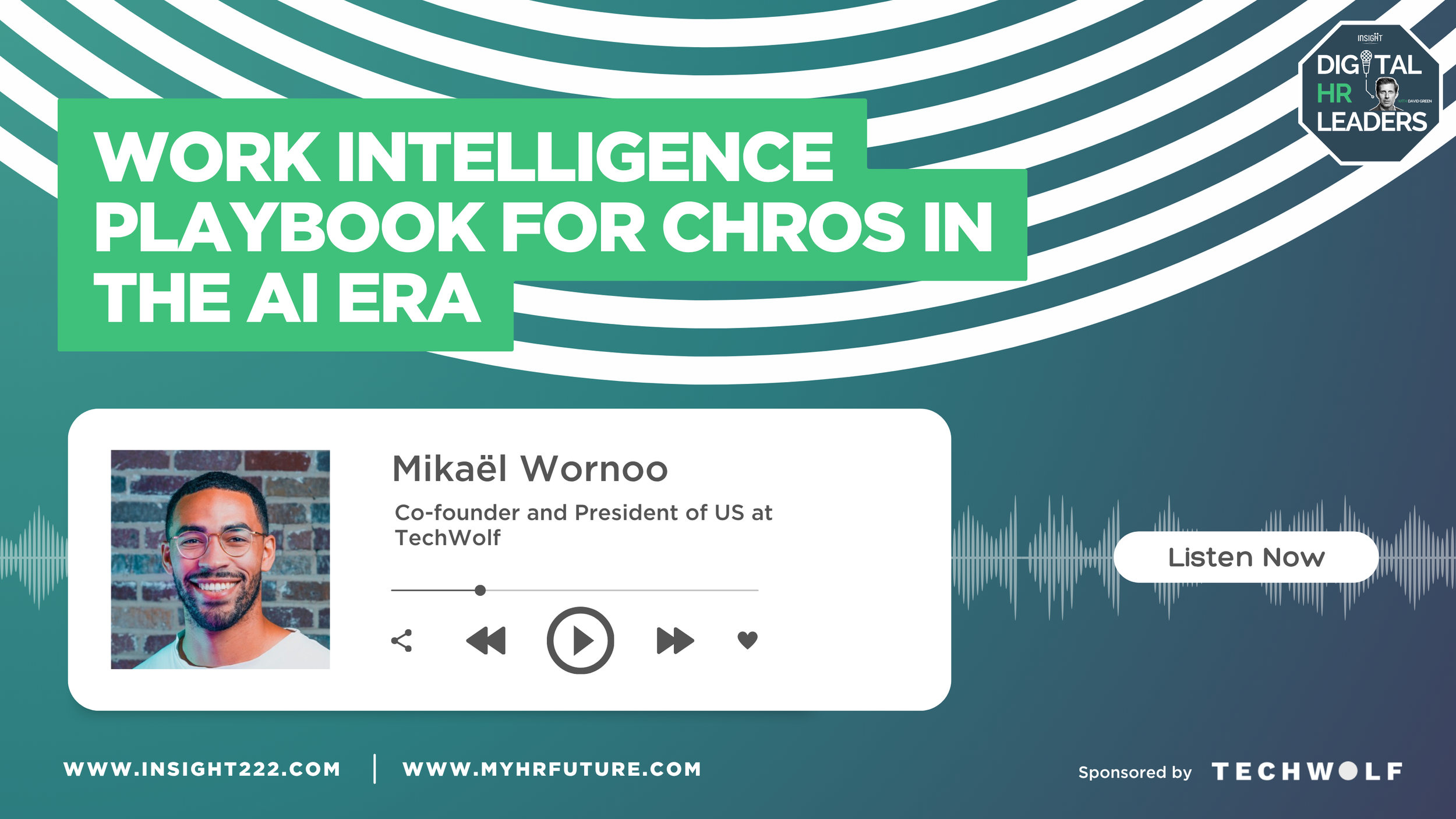
How do the world's most forward-thinking organisations use skills intelligence, market intelligence and work intelligence together to stay ahead?
In this episode of the Digital HR Leaders podcast, host David Green is joined by Mik Wornoo, co-founder and President of US at TechWolf, to explore how organisations are using three signals together to build a strategic workforce planning strategy that can keep pace with AI, and what that looks like in practice.
In this conversation, David and Mik discuss:
What skills intelligence, work intelligence and market intelligence each bring to strategic workforce planning, and why all three matter
What work intelligence actually means in practice, and how decomposing work into tasks is changing how organisations understand the impact of AI on their workforce
How AI is actively reshaping roles right now, and what that means for strategic workforce planning, job architecture and redeployment
Real-world case studies from organisations using all three signals to make smarter workforce decisions and align their people strategy with their AI strategy
What it actually looks like to get started, and why the barrier to entry is lower than most HR leaders think
This episode is sponsored by TechWolf.
The world of work is being rewritten faster than HR systems can keep up. Skills age in months. Roles get redesigned quarter by quarter. CHROs have quietly become AI transformation leads, and the data they need to lead it doesn't exist in any HR system.
That's why the world's most forward-looking enterprises such as HSBC, AMD, T-Mobile, GSK, ServiceNow, Pfizer, have built on TechWolf.
As the data layer for the AI era of work, TechWolf gives enterprises the skills, they need to move faster and lead with confidence. Skills Intelligence, Work Intelligence, and Market Intelligence, in one layer. Visit techwolf.ai.
Resources:
TechWolf podcast
This episode of the Digital HR Leaders Podcast is brought to you by TechWolf.
[0:00:09] David Green: I was in Ghent, Belgium, a few weeks ago, at TechWolf's AI Day, and I have to say it really had me thinking about what is possible when you look at your workforce through three lenses: the skills your people have; how their work is changing under AI; and where the labour market is heading. My guest today is helping to make that a practical reality for some of the world's biggest organisations. As such, I'm delighted to welcome back to the show Mikaël, or Mik, Wornoo, Co-Founder and President of US at TechWolf, who will be walking us through how organisations are combining these three signals and data sets together to get ahead of what AI is doing to work. And Mik's got some really compelling real-world examples to share with listeners to bring that to life too. I'll keep it there. But if you're looking to supercharge your skills journey, this episode is one you'll want to listen to, save, and return to later. With that, let's get the conversation started.
Mik, welcome back to another year of the TechWolf Digital HR Leaders podcast sponsorship. We're always grateful to you and your colleagues for partnering with us. And it's always a pleasure to speak with you. And what I love about having you on the show, Mik, two things. Number one, every time we speak, everything's really changed since the previous time we spoke. But also, in my view, TechWolf always seems to be three steps ahead of the skills and workforce planning game. So, tell me, tell our listeners, what's been happening with you and TechWolf this past year?
[0:01:48] Mikaël Wornoo: All right. Hello, David. Good to be back. I think this is the fifth time we probably speak or the sixth time.
[0:01:52] David Green: I think it is, yeah.
[0:01:54] Mikaël Wornoo: And good to see you again. And yes, a lot of things have changed. I mean, last year, AI took us by storm, it took the industry by storm, it took the workforce by storm. I think it presented a lot of opportunities for us. Around the beginning of 2025, a lot of our customers started asking us, "Hey, TechWolf, can you help us understand the impact of AI on the workforce? We know you've been dabbling in the task space, we know you use tasks for skills inference and you have a bunch of models there. Can you help us figure out how to assess the impact of AI on the workforce?" That was the core use case going into 2025, and honestly, now really, really accelerating.
What was very different was essentially that TechWolf had been in business for, I think, by then seven years, and we had some learnings from the skill space. We knew that just giving the data set and then saying, "Okay, let's go to the next customer", wouldn't really work. So, we launched an early adopter programme that said we're going to give you very high-quality data on your work and your workforce, so we're going to decompose your work into atomic units, tasks. We're going to assess the impact of AI on those tasks. We're going to use the best frameworks available, the Stanford Human Agency Scale and smarter frameworks. But we're also going to help you figure out how to use that for workforce planning. And so, in the early adopter programme, we've been working shoulder to shoulder with our customers to essentially figure out how do we go from data to insight to action, but more specifically, how do we do AI transformation in a responsible way?
I'd say with most of our customers, they have a pretty profound understanding of the fact that AI is going to change society as a whole, that companies, Fortune 500 blue-chip companies, are in many ways going to set the example for the rest of the world. So, on one hand, we've been trying to figure out what's truly the impact of AI on the workforce, and how do we guide the workforce through this transformation? It is a people transformation. You can just see in the data that work is changing both on a task level and on a job level. So, it's very clear that the workforce is going to look different. It's also very clear that you will need less people to do the same amount of work. And many of our organisations are taking that as an opportunity to deliver more value to their customers or to reinvent the way they work. And so, we've been working with our customers shoulder to shoulder there with some incredible results.
[0:04:23] David Green: That's really impressive. I actually had the privilege of being at your AI day in Ghent at the start of May, and I was part of the skills workshop that you were running with some of your customers and potential customers as well. And actually, quite interestingly, we had GSK, Tanya from GSK was there, and we were interviewing Zaka from GSK, who's going to be on the episode after this one actually, Mik, so it's a nice link there. And actually, there was quite a lot of conversation around the TechWolf agent that I think you launched last year as a pilot, which I think a number of customers have been using in pilot, and the feedback was really good. I don't know if you want to share a little bit more about the TechWolf agent with listeners?
[0:05:06] Mikaël Wornoo: Yes. And again, this very much came from an observation in our customer base. We have about 50 customers now, all really large organisations. Some of them have a people analytics team, most of them don't. And so, in many engagements, we are seen as the data provider for work in workforce. But there was always a problem in going from data to insights to action. In a few cases, for example at GSK, you have an amazing people analytics team at ServiceNow. At a few other organisations, you have amazing people analytics teams. But these people are in very, very, very high demand. So, you get them on your project for a couple of weeks, maybe a couple of months, and then they have to move on. The board is asking questions, leadership is asking questions, and so that was one thing we saw across our customer base. It was very hard for our customers to build a skills intelligence, a talent intelligence, a workforce planning capability that lasted and could stand on its own feet.
At the same time, we also saw this massive development in agentic capabilities, where probably around December of this year, which saw Opus 4.5 or 4.6 it became really possible to do longer-running tasks with agents. And so, if you looked at the capabilities, it was very clear that the traditional or the typical coding agent, like ChatGPT or Anthropic, or a few others, they could do Python, they could do data analysis, they had exceptional data engineering skills. You could teach them about TechWolf and the TechWolf API and how TechWolf does its data engineering and data modelling and data storytelling. And you could also teach it about HR. So, we've essentially built a virtual people analytics consultant or a virtual workforce planning analyst, and essentially made that a way to consume the TechWolf data. So, it's very similar to ChatGPT or very similar to the interface of ChatGPT, where you can just ask a question and you'll get a response. So, for example, "What skills gap do I have?" That usually would take weeks to answer, maybe a couple of days once TechWolf was implemented. Now, that gets answered in minutes.
What is very important though is that we also wanted to stay true to our partner-first philosophy. So, instead of trying to own the agentic layer, trying to own the front door, we've again said we're going to make sure that partnering and being the smart agent in the back end or the intelligence in the back end is what we prioritise. So, the agent is available in Copilot, the agent is available through the other agents, because we see that in most enterprises, there will be a front door for the employees, there will be a front door that essentially coordinates all the AI traffic. And so, what we've built is essentially a very easy way for a customer to go into Copilot, ask a question around workforce planning, ask a question around AI transformation, and then get a response from the TechWolf agent without having to implement another agent.
[0:08:12] David Green: Very good. And certainly, what I heard from talking to customers in Ghent was how it was really, really helping them. So, great work to you and the team on that.
[0:08:23] Mikaël Wornoo: It's amazing to see, especially the cycle times. There's a couple of things that we realised that we're now going to double-down on. So, we've been scraping labour market data for about a decade now. We have 2 billion job post gains. I'd say 95% of customers asked us, "Hey, TechWolf, can we do competitive benchmarking? Can we know what XYZ companies are hiring? Can we know what emerging roles or emerging skills are taking place in a certain industry?" All of those questions essentially took some professional services time. Now, you can just answer it, or you can ask the question and you get an answer in a couple of minutes. So, the perceived value of working with TechWolf, working with a skills intelligence vendor, has gone up massively, simply because the implementation time is now a couple of days instead of a couple of weeks, a couple of months. So, that's been really fun just seeing our customers be able to tell the story much more quickly and in turn, get much more executive support.
[0:09:23] David Green: How's your role changed? I think you moved to the US a couple of years ago now, aren't you, and to kind of lead the setting up of the business in the US? But you've been doing quite a lot of different things since then.
[0:09:35] Mikaël Wornoo: Yes, you've heard something through the grapevine. Yeah. So, I'd say at this point, my role changes every three months. We have a really big team, so I'm very fortunate that I get to pick my battles a little bit. Around last year, and around the same period that we launched the early adopter programme, I also realised that as TechWolf, we needed to go a little bit deeper and get a little bit closer to our customers. I started reading about forward-deployed engineers, which are all the hype now, and there was something very intriguing about that. At the same time, I also had the realisation that we started TechWolf as three engineers in university. We always worked very closely with customers, and you can get a pretty good understanding of the problems that you're trying to solve by just working very closely with customers. But there was always a gap, because I felt like I never worked in an HR function. Especially for this problem, it seemed like an incredible skill gap I had.
So, I messaged a few of the CHROs I knew and asked them, "Hey, can I work for you as a Fractional Head of AI or Workforce Transformation or as a Forward-Deployed Founder?" We're going to do a bigger release around this very soon. But one CHRO in insurance took me up on the offer. And essentially, for almost a year now, we've been partnering and really getting into the weeds of AI transformation, not just as a vendor relationship, but really, again, shoulder to shoulder. I go to their leadership team meetings, I spend time with their team. I flew to Argentina. I made a bunch of decks myself. It was incredibly rewarding to just do the work myself, but it was also incredibly eye-opening to see how big the gap between data, insight, action actually is. Because ultimately, and I'd say maybe as a more fundamental driver, I felt very strongly about the fact that AI transformation is not just something you solve as a tech vendor, it's a societal problem. And so, I feel like I had to transcend the vendor relationship a little bit and just go on site, figure out with customers how to solve this problem.
The learnings have been massive on both sides, really figuring out what does it take to redesign a function? How do you get business from the buy-in? How do you tell the story to the CEO? How do you tell the story to board members? How do you tell the story to the rest of the executive leadership team? And me being there and partnering so closely with that team, obviously also supported by the broader TechWolf team, it just created a new type of partnership, but incredible support and awareness in the organisation. And I feel like we're setting a blueprint on how to responsibly do an AI transformation. Because, I think, you can take the financial lens, you can take the techno-optimist lens and say, "Oh, AI will create more jobs than it destroys, it's all going to be okay". But the reality is, there are a lot of layoffs happening, the reality is the productivity gains are real. And so, balancing the investor and shareholder demands with humanity and doing what's right, or at least guiding your workforce is incredibly difficult, and I wanted to be very close to the action.
[0:12:36] David Green: That's fascinating. And I think what a great way to learn as well and really get into the weeds. And how has that changed how you see the world of skills intelligence?
[0:12:48] Mikaël Wornoo: So, this is so fascinating. In a way, the skills work is downstream of a lot of the task intelligence, work intelligence, AI impact assessment work, but ever more relevant. What needs to happen today? Reskilling, workforce planning, buy versus build, buy versus bought. You're doing large-scale organisational transformation. I think the most, in a way, funny example is job architectures. Nobody likes doing job architectures. It's expensive, it takes a long time. Now, almost all of our customers are telling us, "We need to revamp our job architecture because we're redesigning work. The work is changing in such a way that we will need to do job architecture". We're launching something there too, we can double-click on that later. But to go back to skills, a lot of the things that we've been preaching around skills-based workforce planning, around using skills to redeploy talent, skills to understand skill gaps is ever more relevant, but very much downstream of some of the work that we're doing on the AI side.
[0:13:56] David Green: This episode of the Digital HR Leaders podcast is sponsored by TechWolf. The world of work is being rewritten faster than HR systems can keep up. Skills age in months, roles get redesigned quarter by quarter, CHROs have quietly become AI transformation leads, and the data they need to lead it doesn't exist in any HR system. That's why the world's most forward-looking enterprises have built on TechWolf. TechWolf is the data layer for the AI era of work. It connects three data sets that have never lived together, the skills your workforce has, how their work is changing under AI, and where the labour market is heading. Skills intelligence, work intelligence, and market intelligence in one layer. HSBC, AMD, T-Mobile, GSK, ServiceNow, Pfizer, and many more rely on TechWolf to deliver measurable impact, including cutting time to a unified skills foundation from 18 months to three, servicing 800-plus deployable internal candidates in under 30 days, and unlocking more than $8 million in projected L&D savings at one global biopharma. If skills, work, and labour market data is what's standing between your enterprise and its AI transformation, talk to TechWolf, the data layer for the AI era of work. Visit techwolf.AI.
You've got, I think, a three-signal framework that you've got: skills intelligence; market intelligence; and work intelligence. And I'd love to deep dive a little bit on the work intelligence piece, which you highlighted earlier, as I think there's still probably some confusion in the market. This is another way of saying skills. But I know the nuance here is that, as you said, it's actually more around the tasks that people actually do at work, so the tasks that typically make up a job, and what happens to those tasks when AI starts to change how work gets done. Talk to us more about how you're seeing some of your customers gather and use that work intelligence.
[0:16:18] Mikaël Wornoo: Yes. And so, this also happened somewhere last year where all of a sudden, there was a debate between tasks and skills or, "Should we do tasks or should we do skills?" I think you should do both. They are two incredibly valuable data points to understand your work and your workforce. I'd say what we're seeing right now in practice is that to understand work, task and the task lens is a little bit more useful; to understand your workforce, skills is a little bit more useful. But what we do today is saying, "Let's give you both data points to understand your work, so your jobs, and your workforce, your employees, your resources".
[0:16:54] David Green: And I guess the market intelligence is the external side, what's happening in the marketplace, because you need to understand that as well?
[0:17:00] Mikaël Wornoo: Exactly. So, the way we're helping our customers right now, the way we're positioning TechWolf, is as a data layer to help you make better workforce decisions. Field intelligence helps you look inwards, work intelligence helps you look forward, and market intelligence helps you look upward. Three lenses to look at the workforce, all equally relevant. I don't think it's an 'or' conversation, it's an 'and' conversation. And in practice, that's also what we're seeing. Specifically on the work intelligence side, our customers are very much at different maturity levels. I'd say the first step is really understanding the impact of AI beyond the high level, "Oh, we have 20% productivity gains here, here and here", really understanding on a role level what is changing and what does that mean for the workforce. In a way, it's a combination of a workforce planning exercise and a work redesign exercise. The workforce planning component is trying to model and forecast, given the existing workload we have today, how will work change and how many people will we need to do the same work if we implement AI. That's step one, where you deconstruct work into tasks, you try and figure out what the impact of AI will be. That's a theoretical ceiling, in a way, like this is what we could do. You factor in what the organisation has already done, and then you factor in how quickly you can implement AI. And so, a lot of this work goes from theoretical to practical by taking in some organisational data points. And that's really on the strategic workforce planning side, where you're really trying to understand, "How is my workforce going to change?"
On the work redesign side, it's really trying to understand how our roles are evolving and changing. So, customer service is a good example. What we're seeing in the market, what we're seeing with customers, is that the customer service role is bifurcating into probably three different roles. So, one is the human specialist, the senior customer success or customer service person that really handles the escalations. If AI does a lot of the triaging, the easier requests, then the harder requests go to the human specialist or the more senior customer service person. Then, there's the AI augmented customer service agent, simply somebody that needs to learn to work within the tools. And then, there's the automation operator. Obviously, these job titles will change, but it's a role that we're actually seeing in startups, in bigger companies across every function, somebody that is essentially going to implement AI in a way like a very decentralised way of doing IT or tech. It's essentially a tech person embedded within the function or within the group that is trying to figure out how do I automate. So, that's the work redesign component, modelling how work is changing. So, we're helping customers with both. One is really understanding how work is going to change; two is then figuring out what that means for specific jobs.
Bringing it all together is then how do we redeploy and reskill people to those new roles, and how do we, for example, use natural attrition or performance management or retirements or hiring freezes to get to that target straight, which is maybe from 700 people to 500 people over time? And so, with one of our customers, we found that natural attrition was very high in customer service, over 20%. And so, by simply saying, "Hey, we're going to backfill a little less over three years", we can get to our productivity target without any reductions in force. And so, that is incredibly rewarding. No layoffs, I think that that's a very noble cause to work towards. But we're also helping our customers redesign work into, I think, more meaningful work. That's, say, the TL;DR.
[0:20:44] David Green: I'm curious, how have you seen customers using this to their advantage? Have you got any case studies that you can share with us?
[0:20:52] Mikaël Wornoo: Yes, I think the example that I just presented with, ServiceNow at their Conference K26, was a combination of all three signals. So, they're moving towards an AI native go-to-market organisation. Within that organisation, forward-deployed engineers are really important. The problem is a lot of organisations are now hiring forward-deployed engineers. It's the hot new role that is in short supply. So, customers and ServiceNow are trying to figure out how do we maximally redeploy and reskill people into that role? So, step one was figuring out how is the forward-deployed engineering role defined. And the forward-deployed engineering role is essentially a technical account management role combined with a little bit of engineering, combined with a little bit of customer service skills. You go on site, you implement the solution, but you're also savvy enough, customer-oriented enough to hold the conversation with your customers. So, you're a little bit of both, a very rare breed of person, somebody that is both technical and commercial.
Palantir pioneered this model, and now a lot of organisations are adopting this model. So, we have to understand what that role looks like, what are the skills that are needed in that role, what are the tasks, what are the different archetypes of roles within the forward-deployed engineering role? There are seven different archetypes. We help them understand those different archetypes. And then, we use skills data to help them figure out who we can redeploy internally. They have their talent signatures, so they're combining behavioural data, performance data, obviously the assessments that they do internally, to essentially go from a thousand possible candidates to a couple of hundred. But these are people that are now actively being reskilled and redeployed with massive cost savings, both on the recruitment side, but also very specifically on the ramping side. These are people that don't have to be onboarded, they know ServiceNow, and they can be deployed really, really quickly.
With a couple of customers, we've been able to avoid a layoff using the framework that I just described. And with other customers, it's really trying to figure out how do we drive AI adoption? How are we making sure that this task data and this understanding of how work is changing ultimately goes to the employee for them to get very actionable feedback on how to use AI?
[0:23:06] David Green: I want to take a short break from this episode to introduce the Insight222 People Analytics Program, designed for senior leaders to connect, grow, and lead in the evolving world of people analytics. The programme brings together top HR professionals with extensive experience from global companies, offering a unique platform to expand your influence, gain invaluable industry insight and tackle real-world business challenges. As a member, you'll gain access to over 40 in-person and virtual events a year, advisory sessions with seasoned practitioners, as well as insights, ideas and learning to stay up-to-date with best practices and new thinking. Every connection made brings new possibilities to elevate your impact and drive meaningful change. To learn more, head over to insight222.com/program and join our group of global leaders.
That's really good. And then, the next layer of that is obviously, as you said, and as I know, and some listeners know, with TechWolf, TechWolf's not a platform, as you said, it's the data layer that allows organisations to maybe get some better return on investment from some of the technologies that they've already invested in. So, where does this intelligence actually live then on a day-to-day basis?
[0:24:40] Mikaël Wornoo: Yes, same as before, really, really big focus on partnering. So, we're servicing it into employee work, so that's ServiceNow's agent layer. We're getting it available in Jule and in Sana, and we're getting it available in Copilot. The idea is still the same. We don't want to own the agentic layer, we want to make it very easy for our customers to consume the insights that TechWolf brings. There's plenty of amazing agents. The agent-to-agent protocol is something that maybe is interesting to double-click on. It's essentially a way for agents to communicate. So, let's say you have ChatGPT. You ask ChatGPT a complex question, so, "Hey, can you design me a workforce client for my customer service function?" ChatGPT could answer that by itself using the data it has, or via the agent-to-agent protocol, it can look in its own catalogue and say, "Hey, maybe I have other agents that can give me a better answer to this". In this case, that will be the TechWolf agent. And the TechWolf agent does the calculation and then feeds it back to ChatGPT.
So, in a way, it's a manager-employee type of setup. The managing agent, or the manager in this case, is the agent of choice that the customer has. And the TechWolf agent just does the calculation and feeds all of the information, the visuals, back down to the customer. And we're pretty confident that that is going to be the paradigm. If you look at Claude Cowork, if you look at Codex, these platforms are building essentially front doors to work. We don't want to compete with that at all, but we want to make it very easy to consume the insights that we provide.
[0:26:17] David Green: So, I mean, we can see why TechWolf is growing as a company providing that task intelligence, work intelligence as you're calling it, as well. And obviously, we mentioned earlier, Mik, you've been in the US now for a couple of years. And I know, because we work with many of the companies that you're working with at TechWolf, that you're really expanding into the US as well. And in that North America market, I'd love to hear though, given your heritage as a European company, and you are a European-headquartered tech company, which is great to hear in this day and age, do you believe that companies in North America come at this problem differently to their counterparts in Europe?
[0:27:02] Mikaël Wornoo: The North American society is structured very differently to the European society. That's something I had to learn. All of us, we consume the same media, we're all raised in a way by Hollywood, and we have this idea that the West is this uniform area or at least uniform culture, especially with COVID and the digitisation. It's very easy to trick yourself into thinking that the cultural differences are not that big and profound as they are, or centralised into the things that we hear in the media, so, "Healthcare is very different", or, "Education is very different". But being here and living here, you just see that society is structured very differently.
In Europe, the government takes care of you in many ways. There's a lot of regulation in food, there's a lot of regulation in chemicals. In many ways, Europe is a very safe place. And I think it translates into how businesses are built up and it translates in how some of the innovation is adopted. In the US, everything is more competitive, business is much more competitive. Organisations are adopting AI because of this competitive landscape. And so, because of that competitive pressure that is much, much more present in the US. I think also because a lot of the companies are listed, a whole or a big chunk of the world has money invested in the US. There's just a much bigger focus on results. So, that leads to AI being adopted way more quickly. There's also less regulation around workers, and so the equation is very different there. With the European counterparts, I think there's the regulatory shield that is just preventing innovation and AI from seeping in or being adopted at the same pace. Even when I came to the US two years ago, I realised that, wow, this AI train is going so much faster than I anticipated. And I was an AI founder, so it was a big wake up call. And apart from the regulatory shield, there's also the strong employment law and employment protection that also prevents drastic or more drastic moves. And so, yes, as a second- or third-order effect, you see a difference in people's strategies and how organisations are approaching this topic.
The more time I spend here, the more nuanced I think the answer to this question is. I think as a society, we're figuring out this new paradigm. It's very clear that it's going to change society. And I think the different areas in the world will adopt it differently, based on the existing culture.
[0:29:40] David Green: So, this might apply to some of our listeners as well, so when some practitioners hear AI, skills intelligence, workforce intelligence, market intelligence, they may think that this entails a really complex transformation programme, large investment, and significant risk. I know it's not the case because I've spoken to you and your colleagues many times before, but is that exactly what it takes to get started, or is that a bit of a misconception, because I think you've run a number of successful pilots for some of these big organisations first before they've scaled?
[0:30:13] Mikaël Wornoo: I think it's a misconception because in the old world, if you wanted to do any type of data collection in HR, that meant a survey, that meant bothering, in a way, employees, people that are really busy, especially now everybody's working very hard with TechWolf and obviously also a few other providers. We're taking a different approach. We're really modelling the workforce and we're giving HR data to base some of the decisions on or to essentially help them focus their efforts. So, step one is definitely not a big transformation. Step two, once you start redesigning work and redesigning the workforce, you're not doing that all at once. We're seeing that a lot of this work is being aligned to existing technology implementations. So, it's not saying, "Oh, this is the effect of AI on the workforce. Dear business leader, we're going to go and transform your work". No, it's aligned with technology implementations. Those technology implementations are happening.
So, our customers that are most successful right now are essentially trying to figure out what are the company's big AI bets? How do I align my work with that? How can I be proactive with that and go to business leaders and say, "Hey, look, we see that you're investing either a couple of hundred million or a lot of time, energy, resources in ABC AI bets. This is the impact on the workforce related to that bet. We would like to redesign the workforce and the jobs in parallel". And that's a completely different conversation, I'd say one of the most practical and actionable examples of being proactive, being strategic, and being a true partner.
[0:31:47] David Green: Yeah, and for organisations that have got started with you, and actually we've got a fantastic example in next week's episode with Zaka Farhat of GSK; they're 18 months into their skills journey, so we will hear from them. And she talked about a number of things being important, such as leadership alignment, and I think that really talks to what you shared with me previously, Mik, in previous episodes, you know, what's the business challenge? What's the why? Why do you want to do this? But that leadership alignment, that single data layer, which obviously you can help provide; governance around this, such as having a skills committee and stuff; decommissioning, so using an investment in this to actually reduce the amount of investment in other technologies or platforms; and the HR capability build as well. And I thought that was a really good way of sharing that. And hopefully, people listening to this now will be waiting eagerly for next week's episode to find out. But I'd love to hear as well, Mik, some of the other companies that you've maybe got started with, what does it actually look like in the early stages? What do they do first?
[0:32:54] Mikaël Wornoo: So, it depends. Right now, we still have two offerings. So, on the skills intelligence side, I think we've spoken about this many, many times. They pick a pocket of the organisation, usually, it's R&D, technology, sales, a strategic pocket of the organisation to do this work with, and it's aligned with a business problem. I think what is different now is the fact that AI is, in many ways, everybody's business problem. The AI transformation, in some way, shape or form, is affecting the business. On the work intelligence side, it's in many ways a little bit easier, being we're always aligned with the big AI transformation. Step one is assessing the impact of AI on the workforce, which gives you a lay of the land. And then ultimately, that feeds into a buy-or-build decision for very tactical roles, for future roles that they want to hire, or a more strategic conversation with leadership about what is the workforce strategy that we're going to align with the business strategy.
There's probably two types of businesses that are more in a steady state, slow to medium growth, which are historically seeing headcount grow as a proportion of revenue. So, "Maybe we need X% more workforce to have Y% more revenue". And then, you have organisations that are really in high-growth mode, semiconductors, everything that is happening in the AI stack, or any company that contributes to the AI stack. That is, "How can we still keep growing or grow a little bit more quickly, but just deliver more value to our customers?" So, depending on where the customer is, different use cases emerge. But ultimately, for both, it's figuring out how can we redeploy, reskill our people, based on what we know AI is going to do in the workforce? So, it goes to the L&D transformation or the upscaling and rescaling, and it goes to redeployment. Those are probably the two big factors.
Then, the very operational stuff, such as redesigning job architectures. I'd say that's downstream of that, but more and more we find ourselves helping customers across the world. SLB is a good example. We just started working with an Italian pharmaceutical company where we're helping them with their job architecture. So, it's, on one dimension, a very broad range of problems that we're helping to address. On another dimension, it's all related to a big workforce transformation.
[0:35:28] David Green: Very good. So, I mean, I think you gave some clues to the next question here for people listening. I'm sure we've got HR leaders listening to this, thinking this really resonates with what my company needs. I want to move forward on this. Where should they start? What's the first conversation they need to have internally? Presumably, it's with a business leader?
[0:35:52] Mikaël Wornoo: I'd say it's fair to say that an AI initiative is happening, getting a good sense of what the big AI bets of the company are. And then, it's about figuring out how do we align the people's strategy with that. Going back to the workforce planning conversation, workforce planning used to be about really predicting the future. That was very hard. What are the future skills in energy? What are the future skills in oil and gas and technology and 5G? Very hard to do. I'd say workforce planning changed, because essentially now you're modelling a technology adoption. The technology is already here. In many ways, the future is already here. It's just unevenly distributed. So, companies are trying to figure out how quickly can we adopt this technology. And they know the end state somewhat once they adopt that technology. So, workforce planning, in a way, is not about predicting the future anymore, it's just a planning exercise, so workforce planning exercise with some strategy in view. So, I think after having a good sense of what's happening on the business side, it's creating that workforce plan, a strategic workforce plan. We've spoken about the strategic and strategic workforce planning for a very long time. I'd say right now, it very much seems possible and it's very, very true.
[0:37:04] David Green: Very good. I've got a couple more questions. I'm going to do the question of the series, Mik, and then I'm going to ask you about what's next for TechWolf, what your future plans are there as well. So, question of the series. So, we're asking all the guests in this series, which you and the team at TechWolf are kindly sponsoring. It probably talks a little bit to what you've already talked about a little bit, so please feel free to summarise, or obviously add something new as well. Where should HR leaders, where should CHROs start if they want to turn AI into real impact at work?
[0:37:37] Mikaël Wornoo: I'm trying to remember who said it. A CHRO that I was talking to said, "Look, I see my own mandates as having two big pillars. One, it's driving operational efficiency in my function, that's AI in HR. But the broader part of my mandate is really figuring out what AI is going to do for the workforce, and that's an org-wide mandate". She said, in this case, "I have somebody in my team figure out how to implement AI in HR to drive that operational efficiency. I am really focused on making sure that the workforce can navigate this transformation successfully". So, I'd say, depending on the function and the HR team's makeup, those are two good starting points. I'd say understanding the impact of AI on the workforce and on work is a no-regret move. At TechWolf, we like to think about no-regret moves. I'd say figuring out what the impact of AI is, how work is going to change. What it means for all of the talent processes is a no-regret move, because one thing is clear, AI is going to change work for every organisation and it's already happening.
[0:38:44] David Green: Really good. I think you're right. I think in many respects, HR has a unique opportunity here. As you said, it's not just about reinventing the function, it's about helping the organisation be successful as it goes through transformation as well. And I love the example you gave there with that CHRO, "I've got someone operationally looking at HR, I'm looking at the business". Very good. So, Mik, before we wrap up, what's next for TechWolf? What's next, what are the plans moving forward? What are we going to be talking about next time that we speak?
[0:39:19] Mikaël Wornoo: What are we going to be talking about next time? Good question. We're realising that, and this might seem very obvious, but this is really the time to get very close to customers. Our development speed has gone up significantly. We're getting the sense that we can help the customers solve a lot of problems around work and workforce. I'd say that's probably one of the biggest changes we see going forward. Instead of saying just skills or just tasks, we really want to help our customers understand work and workforce, and we want to help them make the best possible decisions for their work and their workforce. And the way we're going to get there is essentially embedding ourselves deeper with the customers, figuring out what problems we can solve. I think job architecture is a very good problem. We had one of our product managers who sat down with partners, with our customers, and said, "Look, tell me all of the challenges you have. We're going to map out the process, we're going to build a solution for you to not automatically generate a job architecture, but at least make the entire process go from a couple of weeks of the variation, even a couple of years, to let's create a draft in a couple of days, and then we can validate with a consulting partner or internally. And so, to compress that entire process that is manual, boring work into something that supports a work reinvention".
So, we're seeing many more of those opportunities to solve either very tactical or more strategic problems. We're also seeing that token spend is becoming part of the workforce cost. I think that's probably one of the biggest trends that we're looking at. I think I recently heard that Salesforce spent 300 million on tokens. I'm not sure if it was in last year or this year. Regardless, probably the biggest non-workforce line item. So, I'd say in the past, we've mostly helped our customers with buy versus build in some sense. I'd say in the future, buy versus build or optimising token budgets, figuring out how we can model that line item in the workforce, is going to be something that we're going to be experiencing with customers. And then, just make it very, very easy for customers to get value. I think that's been the focus this year. I think with AI, we see that we can agentify some of the services. So, things that used to take weeks can now take days. And so, it's just easier for customers to tell the story. The TechWolf agent is a good example. Questions that would take weeks to answer now take minutes. And so, that makes it just so much easier for customers to achieve their goals. So, more of what's been working in that sense.
[0:41:50] David Green: It's been an absolute pleasure. It's always good, as I said at the start, it's always good to catch up and talk to you on the show. Can you share listeners how they can follow you, because I know you do a lot of stuff on LinkedIn as well, and all the great work and how they can find out more about TechWolf as well, and maybe any upcoming events that you're going to be speaking at in the near future?
[0:42:09] Mikaël Wornoo: So, there's the big HR conferences. We have the SAP conference, the Workday conference, HR Tech, and the Gartner conferences. We will all be there. We have a very busy September and October ahead of us. You can follow me on LinkedIn. We also have a podcast, not to compete with your podcast, but I think Julius is doing some amazing work.
[0:42:28] David Green: He is, he is doing some good work.
[0:42:30] Mikaël Wornoo: We want to give our customers the opportunity to share their story. I think Julius has done a phenomenal job at not only elevating some of our customers and their voices, but also just thought leaders in the space. I think that the TechWolf insights are obviously relevant, but I'd say the cool part there is really giving the floor to people who are doing this work in the field and in the trenches. So, definitely check out the TechWolf podcast and follow us on LinkedIn, or go visit the website at techwolf.com.
[0:43:00] David Green: Great. And I'm sure I'll be seeing you at some point at one of those events, or UNLEASH or something else as well, Mik. So, thanks again for being a guest on the show and, yeah, see you soon.
[0:43:14] Mikaël Wornoo: See you soon. Bye-bye.
[0:43:17] David Green: Thank you again to Mik for joining me today. It really was a fascinating conversation, one that I am sure will be an eye-opener for a lot of our listeners. For those of you who are listening, I'm curious, what stood out for you the most from today's episode? Is there anything you would like to add to the skills conversation? Come and find me on LinkedIn and my post about this episode, and let me know your thoughts and perspectives in the comments. I read every single one, and that conversations that happen there invariably build on the one I've had with the guest on the show. And if you think a colleague or friend would get something out of this episode, please do share it with them. It really helps us bring more of these conversations to HR professionals across the world. And one last thing before we go. For those who would like to keep up with what we're doing at Insight222, follow us on LinkedIn, or head to insight222.com. You can also sign up for our bi-weekly newsletter at myHRfuture.com to get the latest thinking on HR, people analytics, AI in HR, and everything shaping our field.
Right, that's us for the day. Thanks for listening, and we'll be back next week with another episode of the Digital HR Leaders podcast. Until then, take care and stay well.