
Episode 287: Why Relationships Matter More as AI Reshapes Work (With Michael Arena & Greg Pryor)
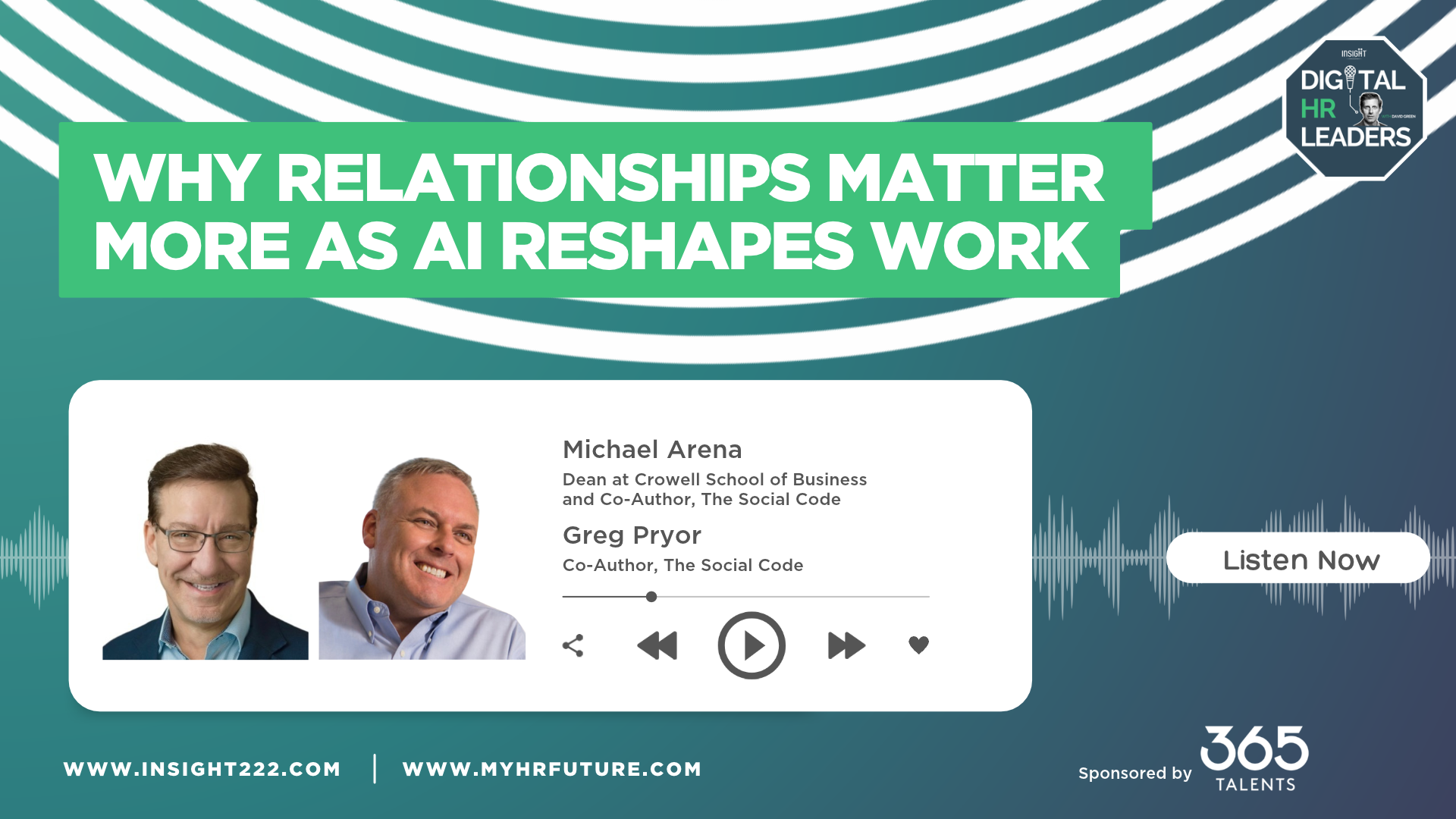
As AI makes knowledge more widely available, are organisations paying enough attention to the relationships that help people put it to work?
In this episode of the Digital HR Leaders podcast, David Green is joined by Michael Arena and Greg Pryor, co-founders of the Connected Commons and co-authors of the forthcoming book, The New Social Code: Five Relational Edges That Outperform Algorithms.
Drawing on decades of organisational network research and experience leading talent in major organisations, Michael and Greg explore how human connections shape performance, career progression and the ability to turn new ideas into action.
Michael is Dean of the Crowell School of Business at Biola University and previously served as Chief Talent Officer at General Motors and VP of Talent at AWS. Greg’s career spans talent leadership and consulting at organisations including Accenture, Workday, Merrill Lynch and Juniper Networks.
Together, they make the case for bringing social capital into talent practices alongside skills and experience, helping people build the relationships they need for the work they do today and the responsibilities they may take on tomorrow.
Join them as they discuss:
· Why relationships become more important as AI makes knowledge easier to access
· The five relational edges: opportunity, trust, attention, insight and influence
· Why bigger networks can undermine performance, and how to balance deep trust with broader connections
· How onboarding can help new joiners build trust and contribute more quickly
· How to recognise collaboration overload and support the people connecting different parts of the organisation
· What networks reveal about future leaders, and practical ways to apply this thinking without sophisticated analytics
This episode is sponsored by 365Talents, a Docebo company.
Every organisation approaches skills in its own way, so 365Talents designs its talent intelligence solutions to adapt to how each business works. HR teams use them to put skills-based strategies into action more quickly and to see the impact across the whole organisation.
Find out more about 365Talents
Building or refining your skills strategy? The 2026 Skills Toolkit brings together 14 free HR templates covering every stage of the journey. It includes a business case built for your CFO, a structured framework for comparing vendors, a strategy you can take to the board, and practical tools for day-to-day HR operations and rollout.
Get free access to the 2026 Skills Toolkit
Resources:
The New Social Code: Five Relational Edges That Outperform Algorithms
The New Social Code Compendium Newsletter
This episode of the Digital HR Leaders Podcast is brought to you by 365Talents.
[00:09] David Green: If you've got children preparing to enter the workforce, you're stepping into a new role, or you're helping others develop their careers, today's conversation has plenty for you. As AI makes knowledge more widely available, how do we turn what we know into meaningful impact? My guests today argue that as AI becomes more prevalent, the relationships we build, the trust we earn, and the people we connect with become even more important. Michael Arena and Greg Pryor are good friends of mine and familiar names to many listeners through their work on organisational networks and social capital. They've brought decades of research and practical experience together in their forthcoming book, The New Social Code: Five Relational Edges that Outperform Algorithms. It offers a thoughtful, practical guide to building the relationships that help people find opportunities, contribute more effectively, and progress in their careers.
In our conversation, we explore why a bigger network can actually hold back performance, why some people build trust in a new role much faster than others, and why the relationships that make us successful today may need to change as our responsibilities grow. We then work through the five relational edges at the heart of the book. For HR leaders, these raise some important questions: are we helping new joiners build connections as deliberately as we help them acquire; how do we protect trusted colleagues from collaboration overload; and, what might we learn about future leaders by looking beyond their skills and experience? Michael and Greg also share some simple ways to put this thinking into practice, and discuss how experimentation can help prepare people for jobs that haven't yet been defined. There's plenty here for people analytics, HR, and talent professionals. So, without further ado, let's get the conversation started.
Michael, Greg, welcome to the Digital HR Leaders podcast. Michael, it's great to have you back on the show once again, I think for the third time, which is fantastic. And Greg, lovely to have you on the show for the first time too. Really looking forward to the discussion. Before we get into the book, maybe could you briefly introduce yourselves, the work you do, and maybe how the two of you came to work together? So, maybe I'll start with you, Michael.
[02:40] Michael Arena: Yeah, yeah, it's awesome to be back. I'll let Greg handle how we connected. Awesome being back. I think last time I was on the show, we were talking about networks and the pandemic and all the outrageous, crazy stuff that was happening back then. I study networks, so I've been doing this for almost two decades. I hate to say that out loud. Started as a visiting scientist in the MIT Media Lab and have been the Chief Talent Officer at General Motors. We spent some time talking about that as well at one point in time, where we were using networks to really drive transformation. And then, I went to AWS where I was the VP of Talent, and also owned an organisational research group that studied networks ad nauseum across and throughout the pandemic. And I've always taught. So, I teach at the University of Pennsylvania. I am now the Dean of a business school here in Southern California. So, that's my background, always studying networks, but have kind of hung my hat in the talent space inside of corporations.
[03:49] David Green: You're a 'pracademic', as I've heard you describe to me before.
[03:52] Michael Arena: I oftentimes describe myself as a pracademic, yes.
[03:56] David Green: I like that. Greg, again, let listeners know about you and your background and how you came to work together with Michael.
[04:04] Greg Pryor: Yeah, well, David, first of all, thank you for the invitation. I would be lying if I hadn't said I've been listening to the podcast for many, many years, a little jealous to see so many of my good friends and colleagues, and listen to you. So, it's a thrill, an absolute thrill to be here on the podcast. Much like Michael, I'm a longtime practitioner in the talent management space, actually second generation, believe it or not. My dad, my sisters all sort of came into the learning space. I had the privilege to lead talent for lots of different organisations, as well as did some consulting. Spent almost ten years at Accenture in their human capital consulting practice. And then, I had what Michael has heard me refer to in the past as my 'Dorothy from Wizard of Oz' moment, where as a human capital practitioner, primarily forever, all of a sudden I landed in Oz and the world went from black and white to beautiful technicolour, and I saw both human capital and social capital in that moment. And since then, I've just turned into a social capital evangelist. And that's been many, many years. And again, I did work at companies like Accenture and Workday, Merrill Lynch, Juniper Networks, a variety of places. I'm not even sure, I'm going to give you this bit of the Michael story that he may not even know; I don't know if he does.
I actually had, before Michael and I met, I was working at Juniper Networks in Silicon Valley. And a person who I didn't know very well said, "There is someone you must meet". She didn't know me well, and she said, "You need to meet Michael Arena at General Motors. You two are like brothers from another mother". And then, many years passed, and all of a sudden I met Michael, and I said to him, "Wow, I was meant to meet you, finally". And so, we've been partners in crime in this world of social capital and really evangelising social capital since that moment, Co-founders of the Connected Commons, with a variety of other amazing colleagues, and we continue to elevate the role of social capital in the world.
[06:09] David Green: So, let's start with the central argument of the new book, The New Social Code: Five Relational Edges that Outperform Algorithms, and we will put some links in the show notes for listeners. You write that as AI makes knowledge and expertise more widely available, our relationships become more important, not less. Greg, why do you believe human networks will become such an important source of advantage?
[06:35] Greg Pryor: You know, gosh, David, I might even suggest that when Michael and I started this work many, many years ago, particularly the book, and Michael said, "There's a book for us to write", and when Michael says something, I generally follow. And this was several years ago. And I don't think either of us could have expected, quite a bit into the writing of the book, the anxiety that people are feeling from an AI perspective. We couldn't have imagined people needing to have a sense of relevance. And when you look at all the data now, in retrospect, it was very clear, we always knew over time that the future of work would rely more on networks. I mean, that has been clear to Michael and I for many, many years, and I'm sure you as well, David. But I don't think we anticipated the type of anxiety. And so, our central premise for the book, it was going into it, but now I think even further confirmed, is that you can't really out-compute the algorithms. We look at the power of AI, we look at the future of work, and our hope is for our children and Michael's students and the many professionals to help really bring relational agency, David, to replace that AI career anxiety. And that evolved and opened as we have come through the book. But that, I would say, is increasingly the central premise.
We very much believe, and we'll talk about this today, that it is our relationships that eventually unlock what the power of AI will bring. That sounds a little counterintuitive, but boy, as we've done this work, as we've talked to people about it, we are more convinced than ever that it's our relational capabilities that unlock the power of this new technology.
[08:19] David Green: Really good. And Michael, let's maybe put that in the context of the work you're doing now, obviously helping teach the next generation. We hear a lot about the impact of AI on early careers, and certainly it does mean that early career roles in many organisations need to be redesigned. And as I said, you spent a lot of time teaching and working with those people at the start of their careers. Are you seeing them approach career-building differently as some of what we have long understood to be the traditional routes into organisations and professions begin to change?
[08:57] Michael Arena: Yeah. I definitely am, and I don't know if they're doing this intuitively, or if this is something they're being instructed to do more and more. But I mean, remember back when we were in university and many of our colleagues and friends were in university many, many years ago, you enjoyed the university experience, you enjoyed being there. And about your junior year, you would start to think about, "Oh no, I've got to go get a job someday. And, oh no, I'd better get an internship because I've got to think about what this thing's like". That's happening literally. I had freshmen come on campus last year, last fall, and three weeks in. They were thinking about, "Hey, I want to be in private equity or I want to be a technologist. And how do I dive in and start to do this hackathon thing with AI into business?" And so, I think mostly students are feeling this significant anxiety themselves already. And I just read this stat the other day that 78% of teens are concerned about whether or not they can make a living for themselves. And I think that anxiety is spilling over into, "I'd better be assertive about this, I'd better get started sooner". I actually think that's a very good thing. Now, I don't want them stressed out, that's a different part of that equation. But the more they can engage in those early experiences, the more they can engage in, maybe it's three internships, and maybe it's building these brandable experiences, and that requires building a network, because the university is not going to do that for them. Career services is already overloaded and under-resourced, just like our great friends from talent management. So, the students are figuring it out on their own.
Greg and I spent a lot of time actually in the book talking about, how do you find opportunity? How do you move outside of the crowded pond, which LinkedIn and Indeed in fact are? And how do you start to network sooner? How do you start to look for opportunity sooner? And where better to do that than when you're in the university. And I would even say, just one last point, professors are also anxious about this. They care for their students, they're anxious about this, so they're helping to fortify and formulate those networks. So, I'm stunned at how many freshmen to sophomores are spending their summer in internships and how many of them are working with business on sprints and real projects, and I'm strongly encouraging that. I've said to every student I talk to, "You should have five brandable experiences", which is another way of saying, "You should have engaged with business professionals at least five different times on real projects before you graduate, because you're not going to get a chance to do that in the uptake of the new modern organisation". So, I think universities are, in fact, adapting some, and I think we're going to see a very different role being played by universities in the next four to five years.
[12:03] David Green: Good opportunity, I think, to maybe bring that conversation inside organisations, Greg. So, in your view, what has changed, and maybe from the research from the book, what has changed about the way work gets done that makes relationships and networks more important to performance? And what are most organisations maybe still getting wrong about how collaboration actually happens and how they actually measure and map it, I guess?
[12:30] Greg Pryor: Yeah, David, maybe I'll start broad and then get really, really pointed and specific. I think, ironically, even as we go into this time where we believe that our relationships, our connections, our capabilities are at a premium increasingly, what we know today through research from all of our good friends is that there is a huge gap today. There's a lot of value left on the table around performance. A survey, or a body of research done not too long ago, suggests that even the best teams are leaving 39% of their capability untapped. Candidly, and I don't think anyone's going to particularly argue with this, is we weren't that great at collaboration going into this next age of work. There was a tremendous amount of value still left on the table. When we move forward with that, what we know is that about 50%, actually, I guess technically 49% of our career success, David, by a fascinating body of research, is not about our capabilities, but our connections. And so, this is very invisible to a lot of people. So, you've got this huge amount of value.
Then you look and you say, "Wow, if half of my success, even before this next world of work, was based on my connections, how am I leveraging that? And then, the third thing I would say, which is to your point around what does the future of work look like, it was actually many years ago, we did a body of research within the Connected Commons that eventually led to a cover story on the Harvard Business Review. But given Michael's good work, given lots of other people's thoughtful work, we looked at the future of work and we said we're likely to see three things: the complexity, the frequency, and the intensity of collaboration in a more machine-driven world, we didn't have all the words to talk about it at that point, but we could see this in the early trends. And so, when we looked at those three factors, we said, "Gosh, we're not really good at it today. It plays an overwhelming part in our success, and yet it's only about to become more important". And our data suggests very specifically that intensity, the frequency, and the complexity of our interaction.
So, with that as the next generation of work, we really felt it was important to sort of unlock what we call The New Social Code. And obviously, we're going to talk a little bit about it, but it is so central. And I'll let Michael, because he can't help himself, because he's got such good data on this, Michael, go ahead, chime in.
[15:01] Michael Arena: Well, thank you, Greg, for that. And then, I think we now live in this AI world, right, so that's all true. And the intensity of work actually has increased, even with AI, in spite of the promise that it's going to save us time. In fact, the power users are 71% more overwhelmed than the people that aren't using it, which is kind of the hidden message beneath the surface. But whenever you think of knowledge becoming commoditised, and this is why universities will change, when you think of knowledge, the bottom being at the average right away, almost instantaneously. In fact, we saw some great research from the Worklytics team last week that you can onboard 35% faster when it comes to the ramp-up of just knowledge. But that's only one dimension. If 49% of your performance, or up to, is predicated on how well you can connect with other people, and you're also trying to absorb the tacit knowledge, which is outside the models from an AI standpoint, how we connect is going to matter more than ever, disproportionately more than ever. I mean, how do you find new strategies? How do you get to the future sooner or faster? How do you look over the horizon? How do you read the room? How do you work across the organisation and create strategic insights?
I mean, these are all the things that we talk about very comprehensively throughout the book, where within the age of AI, how you connect, how you build trust fast, all those things are going to matter immensely more than they did before, because knowledge, which is the way organisations were ordered and organised in the past, becoming commoditised, then relationships have to be optimised. And the way we think about that will be different. And in the early days, like we're seeing, it's both intensity and a little bit of fragmentation, a little bit more localised sort of interactions in the network because of artificial intelligence. So, we've got a long way to go on this, but it's going to matter. And you know that we're the enthusiasts, so we can temper that enthusiasm for your listeners, we'll back it up with data, but it's going to matter disproportionately more over the horizon from now.
[17:24] David Green: This episode is sponsored by 365Talents, a Docebo company. 365Talents takes a flexible, tailored approach to skills and talent management because no two businesses are the same. Their adaptive talent intelligence solutions empower HR teams to move faster, build skills-based strategies, and deliver real impact at scale. Want to learn more? Visit 365Talents.com. And don't forget to explore the complete 2026 Skills Toolkit, 14 HR templates spanning the full skills journey, from the CFO-ready business case, through structured vendor evaluation, board-ready strategy, daily HR ops, and rollout. Head over to the show notes and get your free access today.
You mentioned the magic word, Michael, 'data', so we're going to get into a little bit of that now. We're definitely going to get into the five relational edges that can sort of make up the new social code, but let's talk about the evidence and the data, as you've both done. You've drawn on decades of network research and hundreds of organisational network studies. And we talked about some of those in previous episodes that you've been on, Michael. What did the book, though, what did the data tell you about the relationship between people's networks and their performance? And you mentioned that 49% of work is down to your connections, which is pretty significant, let's be honest about it. And is there anything that surprised you as well when you dug into the data?
[19:15] Michael Arena: Yeah, a number of surprises. That was Hans Wolff's research on a Germany, by the way, the 49%. And that was, of all the variables he included in a three year study, maintaining healthy networks was by far the largest predictor of future success and explained 49% of the variance, and that included things like experience and how much your tenure, and so on. So, the data has always been there. We've probably underappreciated it a bit more inside corporations, which has been the crusade that Greg and I have been on for years. But I think what we get wrong with networks, and this will get into some of the data in the book, is we think of networks as these static entities. So, even Hans Wolff's work, and many other academics, they study it at a snapshot like, "Let's look at a network" because that's the data that you have access to. But the reality is our networks are far more dynamic.
So, one of the critical things, and one of my favourite pieces of research from Ron Burt, is that we've got to start to think about our networks as this dynamic sort of entity. We're constantly moving in and out. And having a large network is actually statistically negative correlation towards having a large network and being a top-20% performer. So, actually, one of the biggest surprises that people refute and push back on, we call this the network paradox, is that, yes, you need a network in order to be successful, but a larger network actually hinders performance. And one of the reasons is that network starts to pull on you, so your network starts to manage you versus you, your network. So, the right number is somewhere probably closer to 12 to 18, a little bit more for executives. And what we found is knowing that there are different networks for different outputs, it's kind of a form-follows-function model. So, throughout the book, I'm tipping forward a little so you can pull me back, I'm getting into the five relational edges, but throughout the book, there are different studies and statistics that we've extracted from hundreds of network studies, including our own, where when you're trying to form trust early, fast movers are able to do that. And we've collected some data on this exemplar in building trust early fast. But then you become saturated by your network, then you become overwhelmed.
So, the bottom line is we first have to think about where we at right now in the network and the life cycle, to put it in HR language, where are we at in the life cycle of our career, what work we're delivering, what work product are we trying to deliver, and then how do we think about optimising that 12 to 18, or slightly more number of people that we're managing on an ongoing regular basis. And we just haven't thought about it that way. We think about work that way all the time, like what phase of work are you in? But we don't think about what phase of network development and maintaining are we in? And that's the nature of the book. The book really, in essence, talks about this concept of a network is a fluid structure and you're constantly moving back between bridging connections, where we find new ideas, and bonding connections, where we build trust and execute. And those that can figure out how to navigate back and forth are going to be far more successful over time, in fact the research says up to 9x more successful than those that stay in a static network.
[23:01] David Green: So, I mean, we'll talk about this, no doubt. But it's long held that you need to be purposeful about building your capabilities at work so you can actually do the work. But listening to you, and I think I know the answer to this, I might be leading the witness, but you need to be just as purposeful about cultivating your network as you do about developing your capabilities, as an individual and as a leader, as an executive, etc?
[23:27] Michael Arena: Yeah, and even more so into the future. If you're not thinking about -- I mean, the short answer to the question, and we'll go deeper into each of these in a bit, is that what got you there won't get you to the next level. And so, just like the knowledge that made you successful early in your career, early in your position, was indispensable in that moment, it's not the same knowledge you need as you take on more projects or more initiatives or broader activities, the same thing is true with your network. And yet, we leave it as this sort of invisible serendipitous -- Greg will tell you, I hate the word, 'serendipity' -- because we leave it to chance, and that's just not true. You can you can manage relationships. You have to do it authentically, and that's really important, we'll talk more about that. But we've got to be far more intentional about how we think about building a network and who we partner with as we're thinking about, frankly, what value, not even putting it in a performance quotient just yet, what value we bring to the people around us. And that's what's going to separate you from those who maybe are outsourced someday and those who continue to provide strategic, novel, distinct value to the people around you.
[24:49] David Green: Good point, I think on that, Michael, to bring Greg in and talk about one of the concepts and ideas that kind of underpin the book, which is social agility. So, this is, again for listeners, the ability to move between deep, trusted relationships and broader connections that expose us to new ideas and opportunities. So, Greg, what does social agility look like in practice? And how, and I'm putting your old hat on here as a Head of Talent, how can organisations actually help people develop it?
[25:20] Greg Pryor: Yeah. So, maybe building on the point that we just made, I would add to your point, we've got these capabilities. But as Michael introduced in his book, probably was a decade ago, right, Michael, Social Adaptive Space, it all matters in context, exactly what we talked about. So, what's the context? So, I'm going to get a little bit outside the organisational realm for a moment, and David, I'm going to bring us back a couple of years ago. If you had arrived, I guess it was two summers ago, fast-forwarded to I guess two summers ago, and you had been around for a while and you had heard the name Post Malone, you would say Post Malone was a rapper. That was his background. But if you arrived two summers ago at the end of that summer, you would have seen he was top of the country charts. And you would have said, "How is that even possible?" In this case, Post Malone wanted to change up his career, open up a new market, if you will, expand. And what he did, and what he did so brilliantly, and I have to do a shoutout that we all, as a people, lost an amazing person in the person of Dolly Parton; what Post Malone did was he leveraged his relationship, he didn't have a deep relationship, but he leveraged his relationship with Dolly Parton, who we all know was a central connector, an energising influencer in the country world. And what he was looking for was a new opportunity. He wanted to expand his markets, if you will, or expand his fan base. He went to the person who had tremendous legitimacy there, who had an incredible reputation. And Dolly Parton served as a broker to give Post Malone the opportunity to get with the best musicians across multiple genres. And that was the discovery for him of looking for a new opportunity.
But then, what he needed to do, David, to your point, was he needed to get heads down. So, he got heads up, he leveraged his relationship with Dolly, he was able to connect with the right people. Then, as Michael just talked about, he needed to build trust. So, we needed to go from a big network to now, "I've got to get in the studio. I've got to build deep trust. We've got to create relationships with these people". And ultimately, that would be an example of going from a bridging network or meeting a broker who can help provide you new opportunities, to then building deep trust so that you can deliver an amazing album in that context. So, I realise we're a bit out of the organisational realm, but this is what we do. We go back and forth exactly between these bridging and bonding relationships in the context of the work we need to do. And that's really the essence of what we talk about in being socially agile or social agility, is to know the context for the work and then to shift those connections and the underlying relationships that are going to activate or unlock those.
[28:07] David Green: How can organisations help people develop that ability of Post Malone or David Bowie; okay, not the musical ability of either, but the ability to actually define those connections and move?
[28:21] Michael Arena: I'll dive in on that one. And by the way, we use all kinds of stories. So, we talk about Billie Eilish and we talk about Pope Leo. And so, we use all kinds of both outside, and then we've done some phenomenal interviews of professionals inside to sort of bring the data to life, which many of your listeners know well; you can have the data, which we do, but if you can't bring it to life, if you can't put it in context, then it's not that useful. And we try to do that the whole way throughout the book. But once you have this lens, like once you see that, I oftentimes joke, we were at the People Analytics World last week, I was actually with a group there and I oftentimes joke, I see the room as nodes and edges, or links and connections. And once you start to see the world that way, as an HR professional, you start to see the rest of the organisation that way. And you start to think, okay, well, like who? It's not about getting the smartest person in the room, because we've all known that really smart person who just gets themselves marginalised, and they just get pushed to the edge. And they may, in fact, be the smartest person on a topic, but they've destroyed or eroded trust to such an extent, or they're so eager to make themselves known as the smartest person that they get marginalised, they get pushed to the edge. And I think it's our role as HR professionals to start to think about this as another dimension of talent management. We look at skills and traits and we look at experiences, but we don't look nearly enough at networks.
So, the five relational edges, real quickly, and I'm putting it in the context of how an HR professional can think about this, is we all know that you've got to onboard people quickly. But we tend to think about that as a knowledge consumption or a ramp-up phase of things. But going back to that smartest person in the room, if you're only absorbing knowledge and you're not becoming pulled into the network at an optimum point of influence, another way of saying if you're not building and more importantly, earning trust, then you're not going to be successful. But once you've gotten pulled into the centre -- and by the way, we'll talk more about this, but that takes a lot longer than most of us believe. We think knowledge consumption is actually the easy part of onboarding someone. Getting them pulled into the network is a human-centric dimension, and it just takes longer for the everyday person. But once you build trust, then what happens is you get overwhelmed. We've already talked about this. You become so managed by your network, so overwhelmed. And our friend Rob Cross calls it collaborative overload. You become so saturated that everybody starts to pull on you, and you ultimately become so overwhelmed that you begin to fail, you can become a fast staller.
So, what we talk about then is attention. Like, how do you build relational attention? How do you limit redundancy, because I'm getting the same information from the network, or I start to think about scaling myself, where rather than having many one-on-ones, I start to have one-on-many meetings. And then, what happens is you start to disconnect, at least on an everyday basis, with a few people so that you could buy back capacity to either go deep heads down, or start thinking more broadly. So, we call that relational attention in the book. So, trust, relational attention, and then we get to insight. And how do you find insight? Well, you've got to go broad for insight, you've got to bridge, and you've got to reach out across the organisation. And if you're overwhelmed and locked into your local group, you can't do that. So, buying back time affords you 10% to 20% of your capacity to be able to reach out more broadly. And that's all about insight. And then ultimately, you've got to influence. Once you've garnered strategic insights that are unique and different and outside of the people that you're working with every single day, what you end up doing is building upward influence and start to get pulled into conversations that are very, very different than the conversations you would otherwise.
Then, the fifth dimension is thinking about opportunity, and that's thinking beyond the organisational boundaries from time to time, tapping into your weak ties, or if you're looking for a job, tapping into your weak ties to find new opportunity. And those are the five relational edges that we go deep into the science and annotate with a lot of stories the whole way through.
[33:06] David Green: That's great. So, I mean, again, the five relational edges for listeners, and we're going to delve into these each now in a bit more depth: opportunity, trust, attention, insights, and influence. And I think, Michael, there you've explained how they kind of weave together. And funnily enough, when you were talking there and you were talking about you get overwhelmed and you get saturated, surely a promise of AI perhaps has helped free you up to focus the time that you need to focus on your network. And maybe we'll talk about that idea as we move forward. So, Greg, let's take the first two together, opportunity and trust. In the book, you introduce fast finders and fast movers. So, maybe you want to explain what you mean by that. But what do they do differently when they enter a new role or organisation? And then again, for an HR leader listening, if we're thinking about our listeners predominantly being in HR, what should that change about how we design onboarding?
[34:05] Greg Pryor: Yeah. So, I'll double-click into the -- as you talked about it, I won't pull the Post Malone story too much further, but as we talked about...
[34:13] David Green: It's more about me than you, Greg, if I don't know Post Malone that well! Showing my age.
[34:17] Greg Pryor: I get it. At least we know the name and we know the crossover story, but the idea of like, again, that open network, the opportunity, I'll mention just very briefly. In the book, we introduced the opportunity edge with the story of Harrison Ford. Many people may not know that Harrison Ford was actually banned from auditioning for the role of Han Solo, which many of the Star Wars lovers, which I know you are, David, now can't even imagine the role of Han Solo not filled by Harrison Ford.
[34:44] David Green: No, I didn't know that.
[34:47] Greg Pryor: But because he was in American Graffiti, the director said, "I don't want anyone who has been in these roles in the past". But he had an aide. The casting agent was so enamoured and could see Harrison Ford in this role that, believe it or not, he had invited him into the rooms where the auditions were happening, not as a person who was auditioning, David, but as a carpenter. Harrison Ford has mad, deep carpentry skills. And so, he was hired to actually build cabinets. George Lucas then was looking for someone to read, he was frustrated that he had different people reading the role of Han Solo. George had known Harrison from American Graffiti and said, "Harrison, why don't you just stand in for a moment?" Harrison was candidly a little bit annoyed and played this pirate instead of the swashbuckling -- played it as sort of a frustrated, like, "Get me out of here. I'm a carpenter reading lines". George Lucas fell in love with the role, and the rest is history, as we mention it.
So, we think especially now, in this world where opportunities, getting upstream, being in the room before the role is cast. Now, back to this idea of social agility, now once we've gotten that role, we need to be very intentional and very authentic about connecting with very specific types of people in the organisation, David. And this was the work that eventually appeared on the cover of the Harvard Business Review. We identified what we call these fast movers. While it takes most people up to three years to build the relationships to be a high performer, it took a small group of people to do that in nine months. And so, these are the fast movers who, to your point, are very intentional about connecting and knowing why they're connecting. So, now, how do we think about that in the context of onboarding? Obviously, in my career and Michael's career, we've looked after these capabilities in the past. What we know is that, I would suggest, about half of the time that we're spending in onboarding should be, yes, around capabilities and context for the organisation; and then, half should intentionally be around connections and having a very specific plan that just says not just, "Go meet with Sally", but, "Why am I encouraging you to go meet with Sally?"
I'll do a shoutout as an example to our friend Chris King. He works at a very large entertainment company, has looked after talent for them. Chris does a brilliant job, especially when bringing people on into a very socially cohesive organisation, of making sure that he helps senior executives understand exactly who and why they should be meeting with people. And he explains to them, "This is an energising influencer. This is a person who will help you spread your ideas". You're building that relationship proactively in order to think about -- because they will be, he can promise, they will be critical in your role in the future -- let's nurture that relationship now before you need it. Michael always reminds me you have to nurture the relationship before you need it. Once you want to trade the social capital, it's too late, you don't have it yet. And so, there are people, and I put Chris King out there as one of them, who have just done such a brilliant job of being intentional and authentic about taking this science and helping people get pulled into the network rather than try to push themselves, which is what the classic coaching has taught us for decades. And it just doesn't work anymore in this network world.
[38:20] David Green: And of course, the network data can help you with that. So, presumably, I don't know, you're a new salesperson coming into an organisation, and it's really important you've got good relationships with product and marketing. There might be one or two people who have those strong relationships that can help you speed that process up. The network data will tell you potentially who those data is, as well as obviously people's intuition, but the data can back it up. I don't know, you're smiling Michael.
[38:46] Greg Pryor: Who's the Dolly of Marketing? To your point, who's the Dolly? You know, can I find the Dolly in marketing? And that person, you could spend your time, as Michael sees, when he sees nodes and edges, right, you could spend a lot of time on the edge and it could be very inefficient. You look at that central connector who's an energising influencer or who people look to, and as you know, David, better than I, there's a relatively small number of those people percentage-wise in organisations. You connect with those people thoughtfully, authentically, that can make all the world of difference in how you get pulled into the network versus trying to push yourself in.
[39:21] Michael Arena: Yeah, and it doesn't always have to be as complex as running a network map, right? There are just simple techniques, and you can leverage the science to really inform moves that you make, and/or as an HR professional, help encourage others to take moves. So, throughout the book, we talk about different tools in place that are backed up by the research. So, one of them is called the friendship paradox. And it's this whole concept of rather than looking at the network map and trying to figure out who's in the centre, which most individuals are never going to have access to, just ask a few friends. So, ask David, like, "Who are three other people I should connect with?" And it turns out that the friendship paradox says that on average, your friends are more centrally connected than you are mathematically. The math actually proves this out. Scott Field actually looked at this, and if you just ask that question to the first four or five people you meet, "Who are three other people I should connect to because I'm working on this thing?" you will find yourself naturally gravitating towards the centre of the network asking the right work-related questions, and then ultimately adding value to get yourself pulled in.
So, we don't want to make this super-complex, the data backs it up, but you don't need to do these elaborate network maps in order to understand how can I be more successful. You just simply need to understand the data to be able to exercise some of these simple moves.
[40:50] David Green: I want to take a short break from this episode to introduce the Insight222 People Analytics Program, designed for senior leaders to connect, grow, and lead in the evolving world of people analytics. The programme brings together top HR professionals with extensive experience from global companies, offering a unique platform to expand your influence, gain invaluable industry insight and tackle real-world business challenges. As a member, you'll gain access to over 40 in-person and virtual events a year, advisory sessions with seasoned practitioners, as well as insights, ideas and learning to stay up-to-date with best practices and new thinking. Every connection made brings new possibilities to elevate your impact and drive meaningful change. To learn more, head over to insight222.com/program and join our group of global leaders.
So, you described the risk of successful people becoming overloaded, and I'm sure many people listening to this will recognise that as well, because everyone turns to the same trusted individuals. How can HR identify those collaboration hotspots before high performers become bottlenecks or burnout? And maybe there's a little bit there about the individuals themselves; what tricks can they do to try and manage that process?
[42:26] Michael Arena: Yeah, I think a lot of it's the individual themselves. And this is what we talked about earlier. First of all, I just want to notice, once we start to use this lens, what happens is we start to see the world this way. And you mentioned some other folks, and we could go on and on to say, "Well, this person does that extraordinarily well". And it's always authentic. I just want to double-click on that word. One of the things, and I'm not going to embarrass you anymore, I promise, but one of the things we know as we engage with other people is if they're manipulating their way in the network, they get invited out. So, I just want to make sure your listeners know that if this isn't authentic, like if you're not doing it in a way that is truly lifting up others, and there's not this, you know, we talk about benevolent trust in the book; if there's not this deep trusting reason that you're doing this, not just to manipulate your way through, but to lift up others around you, the network has this really funny capacity of rejecting you, maybe not the first time, maybe not the second time.
So, I just want to say, I don't want anyone to think that what we're doing is written a book and showing you the data on how to manipulate your way towards success. There is nothing farther from the truth. If you're not doing that authentically and you don't care about those other people that you're connecting with, you actually do more damage by using this this approach. And same thing's true. So, it's easy to be a fast mover, right? A fast mover surges in. Greg shared the research. It takes somewhere between two to three years to become centric in your organisation. Fast movers can do that in a third of the time in as little as nine months. But what happens really, really quickly is these same people that make themselves valuable, others start pulling on them because they build a reputation and in network language, their incoming ties start to multiply. And then, what happens is everyone wants a piece of them, everyone wants them in a meeting, everybody needs to talk to this person and they become fast stallers very quickly, unless they do something different.
In fact, the whole way through the book, just to make sure I pick another professional one, the whole way through the book, we use stories and we talk about Rami Rahim, who ultimately was the CEO of Juniper, and Greg knows his story much better than I do. But the reality is, he was the person that was centric to the network. Everyone went to Rami, everyone wanted to know. They needed a piece of him in order to get their thing unlocked, get their stuff done. So, he was incredibly centric to the organisation. In fact, up to 130 incoming connections and lots of demand, which is completely overwhelming, and was starting to feel some burnout. The HR partners stepped in, and Greg will share more of this story later in this segment or a different one, but the bottom line is, until he unglued himself from the centre of the network, he wasn't able to buy back the capacity to be able to do some more strategic things and had stalled out for a bit of a time.
So, what we see in the book is fast shapers are people that probably 12 to 15 months after becoming central, begin to think about how do they reduce redundancies in their network. So, rather than having 50 people pulling on them, they start to think about, "Okay, who are the people I have to be working with? Who are those eight people that I really need to lock in with that I already know, in order to execute on this thing?" And then, they buy back additional capacity to start thinking about bridging out more broadly. And the people that can do that are constantly repeating that pattern and becoming successful across time. And they don't stall out nearly as quickly as others who get themselves burned out.
[46:15] David Green: So, there, thinking about an HR perspective, think about the listeners, so once they recognise that there will be fast stallers, those people that are able to assimilate quickly, develop their networks, and then get pulled upon, they can effectively help them become fast shapers presumably, by identifying other people that can take some of that burden away from them potentially within the company?
[46:39] Michael Arena: And that's exactly what these fast shapers do. These fast shapers are actually thinking, in a very, very in a disciplined manner, how can I delegate more? How can I pull others in? How can I take the things that others are pulling on me for and start to divvy that out across the network? And they could be an individual contributor, but they're just sharing it with somebody else, their craft with someone else. We call it 'giving away their Legos' in the book. And we've got a whole tool for this. And as an HR VP, one of the very first things I would do if I were working with a senior executive is I would say, "Okay, now that you've really nailed this in your first year-and-a-half, show me your calendar. Let's talk about who you're meeting with. Let's talk about who brings the most strategic value. Let's talk about how are you going to scale yourself with these repetitive meetings?"
The best leader I ever worked with, and I can't mention by name, but a CEO of a very large company, would look at his calendar, along with people on his team, once every quarter and would redefine every single routine to say, "Okay, what do we continue to double-down on, because this is still important? What do we actually start to let go and find other ways to get done? It still needs to be done, but maybe others can do that". That's how we build capacity in the organisation around us. And then, "What are the new things I need to take on?" And the leaders that constantly are revisiting their calendar and their relationships and their connections with that mindset are constantly refreshing their network, so that they could have what we talked about earlier, this social agility to constantly be moving in and out of different types of relationships.
[48:20] David Green: So, Michael, let's stay with you, because we kind of moved from attention to insights. And here, you have the concept of fast spanners. So, these are the people connecting groups that might otherwise remain disconnected. So, I mean, without staying the obvious, why are these people so valuable, and how can organisations identify and support them without simply giving them more work?
[48:44] Michael Arena: Yeah, this is a touchy one. This is one that I think will really matter in the age of AI, where we're talking about tacit knowledge being stored in different pockets of the organisation. And when we're talking about, we humans still design strategy. We humans still have to be able to weave together all the things that our organisation is so great at, and then look at the white space in the market. And fast spanners do that incredibly well. They navigate across the organisation. In the book, we say they fill the voids, le vide in French, in regards to bridging the gaps, structural holes, in Ron Burt's language. And not many people do this. We get really good at the thing, we get really good at our craft or really good within our function. And then, we tend not to bridge out across the organisation nearly as much as we need to. And it's those people that actually have what we describe in the book as a misfit career. And now, I'm going to embarrass you again, because you actually were this, where you did a sales stint, then you did a consulting advisory stint, and then you did this technology stint. And the people that actually navigate across these different domains throughout their career, outside of the quote unquote, "Structured career path", actually they may not go as deep in the experiential stuff as other people, but they go deeper in the network and they forge these relationships across the network and see things and have this wide-based perspective that is invaluable to the future of an organisation.
What that does is it gives them new strategic insight or new novel insight, the recombining ideas from across the organisation. And Ron Burt describes it as they've got three significant advantages. They've got early access to new information; they've got access to novel information and probably most importantly, they can manage and distribute the flow of that information or tacit knowledge in today's settings, in ways that other people just simply can't, because they've built up trust in different pockets of the organisation. And these people are incredibly more valuable to organisations as we move forward.
[51:10] David Green: Yeah, that makes a lot of sense. It's almost like you think you've completed a jigsaw and a fast spanner potentially opens up a whole new jigsaw by putting two or three jigsaws together. I'm not sure if that's a great analogy, but anyway, you're both laughing and nodding! And then, the final edge, Greg, is influence and the fast risers. So, your research looks at how people's networks change before promotion, which is really interesting, actually. What patterns do you see, and what should that tell individuals listening, but also HR professionals about how we identify and develop future leaders?
[51:56] Greg Pryor: Yeah, thanks, David. And I think to your point, all of these, hopefully we're doing a reasonable job of showing where these practices convert into, again, onboarding new people, helping people with wellbeing, being overloaded, like Rami Rahim as an example. I think this one is actually maybe one of our -- you're not supposed to have a favourite edge, but we love the story in this particular edge. In the book, we talk about Robert Prevost. If you go back a couple of summers, and again, I'm always going back a couple of summers, I don't know why that is. I miss summer. If you go back a couple of summers ago, and Robert Prevost had a less than 1% chance of ascending to the Pope. When Las Vegas odd-makers, various media looked at him, except for three network scientists out of a university in Italy, just moments before the College of Cardinals elected Robert Prevost, ultimately as Pope Leo, they suggested the exact opposite of what Las Vegas was saying. They said, "We have done a network analysis and we believe with almost certainty that his ascension to the Pope is inevitable". And they did that, David, by looking at his network. What they discovered was that he was the most central person, the most authentically trusted person in the network. And for those who love network arts and charts, as Michael says, the article is fascinating and you can literally see his bubble as central.
One of the things that I would take and apply this as a talent management practitioner is, for example, thinking about both promotion success, succession success, and saying in this case, you had a group of people who actually elected their boss, if you will. I realise I'm undermining a very important practice here, but they elected and said, "This is the person that we most trust. This is the person that we believe and would follow in this context". And so, by using that network analysis, whether it's a network analysis or back to Michael's point, just intuiting what these things look like, what we found was that fast risers replicate their boss's network, if you will, about a year or a little bit more before that person actually rises. And as someone who used to manage risk in the context of succession or manage risk in the context of success, we would all look and say, "What's the likelihood, what's the probability that Michael will be successful if he takes this new bigger role?"
So, adding this piece into that equation and saying, "Let's look at this person's network. Have they replicated the network of their boss? Have they nurtured this network or nurtured these relationships so that that is already in place, reducing the risk, increasing the likelihood of success?" That would be just one area that we would look. But these fast risers, they basically replicate the networks of their bosses well before their peers, and that gives them this sort of inevitable edge.
[55:02] David Green: So, Michael, much of this research uses, and we've touched on it already, your organisational network analysis. Not everything needs sophisticated passive data, as you said, but some of it does. And many HR teams listening, many practitioners listening, won't necessarily have access to that level of information. So, without that sophisticated network analytics, what signals can leaders look for to identify these patterns and understand where their organisation may be too isolated, maybe too dependent on a few people, which if they leave, they're potentially at risk, or poorly connected?
[55:39] Michael Arena: Yeah. I mean, I think there are two ways to answer the question. One is, as an individual, how would you think about this? And then, two is, as an HR practitioner, how do you enable others to think about this? You know, as an individual, I would start with, don't design your connections and your network for what you're doing today, design it for what you want to do tomorrow. So, just like we think about what's our career trajectory? Or what's the new thing I need to learn, from a knowledge standpoint, if I want to proceed in this function or this particular specialty? Do the same thing with your network. So, just think about, "How do I create more strategic insight if I'm knocking it out of the ballpark locally?" You could double-down on that, but there are a lot of other people doing that. If you could start to think about how do I broaden out and how do I bring unique value to the people around me, which is the core of everything, is like, How do I find unique value to the institution, to the organisation? And it's usually doing the opposite of what everybody around you is doing in the network sense. So, get yourself unglued if you're being overloaded. Go broad. Create value upward. So, if you know that this is the strategy that the organisation is working on, even if it's outside of your own domain, provide strategic value to leaders a level above.
As Greg was talking, fast risers, they get pulled up to the next conversation. So, it's really important to know part of why they look like their boss is they're getting pulled into conversations. It's not like they're knocking on the door to get into the boardroom. They're adding unique strategic value because they've discovered it across the organisation. And as an HR leader, as an HR practitioner, I want to constantly be looking at the people that I'm supporting and asking them what's next. Obviously, that's predicated on the fact that they're getting the thing that they're doing today done. If they aren't, double-down on that. But if they are, then help them to think about what's over the horizon, help them to think about how do they provide bigger strategic impact or find new insight? And so, I'm constantly trying to think about where that person needs to go, not where they are, and you don't need a network analysis to do that. You just need to know where you spend the most of your time.
Again, your network analysis could be as simple as just looking at the calendar, as simple as looking at which meetings am I engaging with, who do I talk with every day, and are these people all in the same function and have they had the same types of experiences? If yes, then start to think about reshaping that. And once you get that lens, then it becomes easy to think about there are really simple things you do. And it could be just going and interviewing a few people across the organisation to find out what is it that they're working on? What's this new model look like? And so, the techniques could be very, very simple once you start to think about the lens of who are you interacting with on an ongoing basis.
[58:44] David Green: And Greg, to sort of follow on from that, if you were to put back your Head of Talent Management hat back on, go into an organisation again, what's the first thing that you would look to do in how that organisation designs work, career, or talent practices to help individuals build stronger networks within that organisation?
[59:06] Greg Pryor: Yeah, I think, David, it's a brilliant question. I think it's back to your point, which is it's looking at the context of the work. We have forever, and I was trained in this forever, primarily looked at capabilities, right? I mean, that's when, what are the skills? What are the experiences? We were overwhelmed by the human capital element. I think what we're making the very strong stance for here is that you have to add the social capital element, that the human capital element is necessary, but not sufficient. So, I'm not saying throw out the baby with the bathwater. But when you look at the context of a piece of work, and Michael talks about this so brilliantly in his book, Adaptive Space, what's the context for the work that needs to be done? And then, look at the connections associated with that. Our good friend, Phil Willburn, does this brilliantly at Workday. I mean, Phil is a network person at heart. He's an amazing people analytics leader, he's an amazing leadership development person, but I think his heart really belongs to network analysis and networks. He is so thoughtful in looking at the context and saying, what is critical about this person's network or their connections? Do they need bridging or bonding connections? Are there so many incoming ties, to Michael's point, that this person is overwhelmed? Even if they were going to do the best, they're overwhelmed. What are the relationships they need?
So, looking at the context, we very much hope and believe that we've started to unlock almost a new talent management model for this age of AI that looks at people's careers through the context of their connections. So, it's early days on that, but we very much believe that adding the connections' lens, if you will, or adding the social capital lens to the context of work, we believe could unlock so much value to all the points we've talked about, and so much overlooked value today. So, if I could do one thing, I would add the connections required for success. And obviously, there's decades of extraordinary work, Ron Burt, just amazing, amazing people who have decades of really thoughtful work there to unlock, but put it in that context of what's the organisational outcome we're trying to achieve.
[1:01:20] David Green: And I think that leads nicely to the question of the series. So, this is the question we're asking every guest on this episode of the podcast. How should HR prepare people, employees, workers for jobs that have not yet been defined? And maybe, what's the network element on that, perhaps, Michael, to start with you? And maybe, Greg, you can add something as well?
[1:01:44] Michael Arena: That's the strange part about this whole conversation, is we spend a lot of time talking about the network science and the history of this and years of our own research, and then we're living in a very different world, right? So, there's some early indications of how AI affects the network. And it's strange, it's bizarre. It actually leans into this work and whole way throughout the book, we add a few of these anecdotes and some of the early academic studies and science. But if I could summarise it in one word, David, I'd say help people to experiment, especially right now, right? We're in this adaptive sort of zone of the way work used to be and the way work will be. And we've got to experiment. So, challenge your people to experiment with the AI. And what we're finding out, not just from a knowledge standpoint, but from a network perspective, and what we're already finding out is that those power users are being pulled into the centre of the network. We've seen that already.
What we're also finding is that finding ideas through AI, through a bot, if you will, from a domain outside of your group are not being adopted. It turns out that we're rejecting ideas from outside of our domain. A few studies have been done on this. You've got to experiment your way through it as an HR professional and start to think about, yeah, we could define the job. But the reality is, we don't actually know how it's going to show up when an agent's mapped into the network, or we don't know how the people are going to respond when they get tacit knowledge from way out there that's not attached to a trusted person that can vouch for that data. And so, we've got to experiment. So, that's what we're saying to all of our clients right now, is run some experiments, test this stuff, analyse it, obviously, get early insight. And I mean, I'm excited about this, I'm excited about the future of work and what we're going to be able to do. And as we've said many, many times, our connections are going to matter more than ever. But I think speed's going to be turning up radically, as it already is. And the way people analytics can help catch early insight and really anticipate what's coming will be more valuable than ever.
[1:04:10] David Green: Very good, Michael. And anything you'd like to add to that, Greg? I know it's always hard to follow Michael.
[1:04:16] Greg Pryor: Well, I suppose my lifetime is following Michael. So, imagine my role, David. You know, the one thing I would add to that, all brilliant, and this I learned from Michael, is follow a practical pioneer, especially in these times of uncertainty. And I'm going to leave you with this embarrassing moment, David. In the world of people analytics, you are an example of a practical pioneer. Taking the time to tap into your brilliant monthly work, I mean like listening to you gives you a sense of what's happening on the edge, what's likely to happen into the future. Looking toward our friends like John Boudreau, always ahead. I had the opportunity many years ago to spend time with Bob Johansen, who was seeing around the corners of things. And again, David, you do this brilliantly, listening to you, but follow a series of practical pioneers and use their signal-sensing to see what could be happening next. And there are a few people who are really good at this, you included in that, and tap into them to see what their sense of what trends are happening. And so, you're not going to suffer from that future shock. You're like, "Wow, David mentioned that. It seemed obscure at the time, but now I see the dot connecting". So, follow a few practical pioneers.
[1:05:36] David Green: Where can listeners follow your work and find out more about The New Social Code? I think there's a site as well as the book. And what should they look out for from you both next over the next few months? Michael, I'll come to you first.
[1:05:50] Michael Arena: Yeah, the book will be released at the end of October. And we've got a website out there, thenewsocialcode.com. We've got, as we talked about, a set of 18 tools that help enable this so that it's not just us talking about this scientifically, which we do and can and have in this conversation. But any listener can click on that site, get access to some of those tools. And so, the work's all out there. And Greg, I know we're writing about this. Of course, we're spending a lot of time on LinkedIn these days trying to get some of these stories out there, some in the book, some not, some new insights that we've collected. So, the problem with publishing a book is it's static, unlike networks, and less so things change and more things come. So, we're trying to keep it current and relevant with some of the new things that are emerging so quickly.
[1:06:48] David Green: You mentioned Harrison Ford and Star Wars. I'm sure there'll be a New Social Code 2 at some point. Greg, sorry I interrupted you.
[1:06:57] Greg Pryor: Yeah, no, I'd do a shoutout to Michael. The New Social Code Compendium is a newsletter that he's publishing, and again, keeping it fresh, taking those core ideas, but particularly for the practitioners that would be relevant for our audience here, David, visit thenewsocialcode.com. People are welcome to sign up for the movement there. Actually, we have access to what we call the Social Code Studio. So, the 19 practices that Michael talks about, we have a weekly newsletter more broadly. And the last thing maybe I would leave you with is while we can geek out on the arts and charts with this community, what we truly hope at the end of the day is that this brings the hope and the how of how to apply this work that we've all been talking about, David, that you've been talking about for so many years, to make it practical to my daughter, who's a labour and delivery nurse, to my daughter, who's a fourth grade teacher. I can't tell you what's warmed my heart the most is how many friends have pre-ordered the book to give to their children as holiday gifts, because of the anxiety that they're all feeling, which is where we started.
Your 17-year-old son, David, how do you help give them the value of this coaching on connections, which we truly believe? If you believe that's the case, we hope that this will bring some hope and some how to reduce some of that anxiety and provide some of this relational agency.
[1:08:20] David Green: Really good. Well, thanks so much for such a fascinating conversation, both of you. It's always great to catch up. And yeah, I look forward to that. Michael, we only just recently saw each other at People Analytics World. I've already suggested to Barry he sees if he can get you into New York or maybe you as well, Greg. So, hopefully I'll see you both in person again soon.
[1:08:38] Michael Arena: Awesome.
[1:08:40] Greg Pryor: Thank you, sir.
[1:08:41] David Green: Michael, Greg, thank you both so much. It's been a real pleasure to have you on the show together and explore what your research means for the way we build careers, develop talent and help people succeed. One thought that particularly stayed with me was the line Greg shared crediting Michael, "We unlock what we know through who we know". It captures why developing our capabilities and nurturing our relationships need to go together. And as you both emphasised, those relationships take time. We need to build trust and contribute to others before we need their support. For HR, that raises a practical question, how deliberately do our talent practices help people build the connections their work requires?
So, turning to our listeners, I'd love to hear your perspective. When someone joins your organisation or moves into a bigger role, how do you help them build the relationships they'll need to succeed? Come and find my post on this episode on LinkedIn, and let me know in the comments. If you'd like to learn more about The New Social Code, head to thenewsocialcode.com for information about the book and practical tools to help you apply its ideas. You can also sign up for Michael's New Social Code Compendium newsletter. Michael and Greg are sharing further stories and insights on LinkedIn, so do give them a follow. You'll find the links in the show notes. And if you enjoyed the episode, please share it with a colleague who would find it useful, and subscribe so you don't miss what's coming next.
One last thing before we go, if you'd like to keep up with what we're working on at Insight222, follow us on LinkedIn or head to insight222.com. You can also sign up there for our bi-weekly newsletter for the latest thinking on HR, people analytics and workforce transformation. Right, that's us for today. Thanks for listening. We'll be back next week with another episode of the Digital HR Leaders podcast. Until then, take care and stay well.