Episode 261: What HR Can Learn from Private Equity About Creating Business Value (with Angela Geffre)
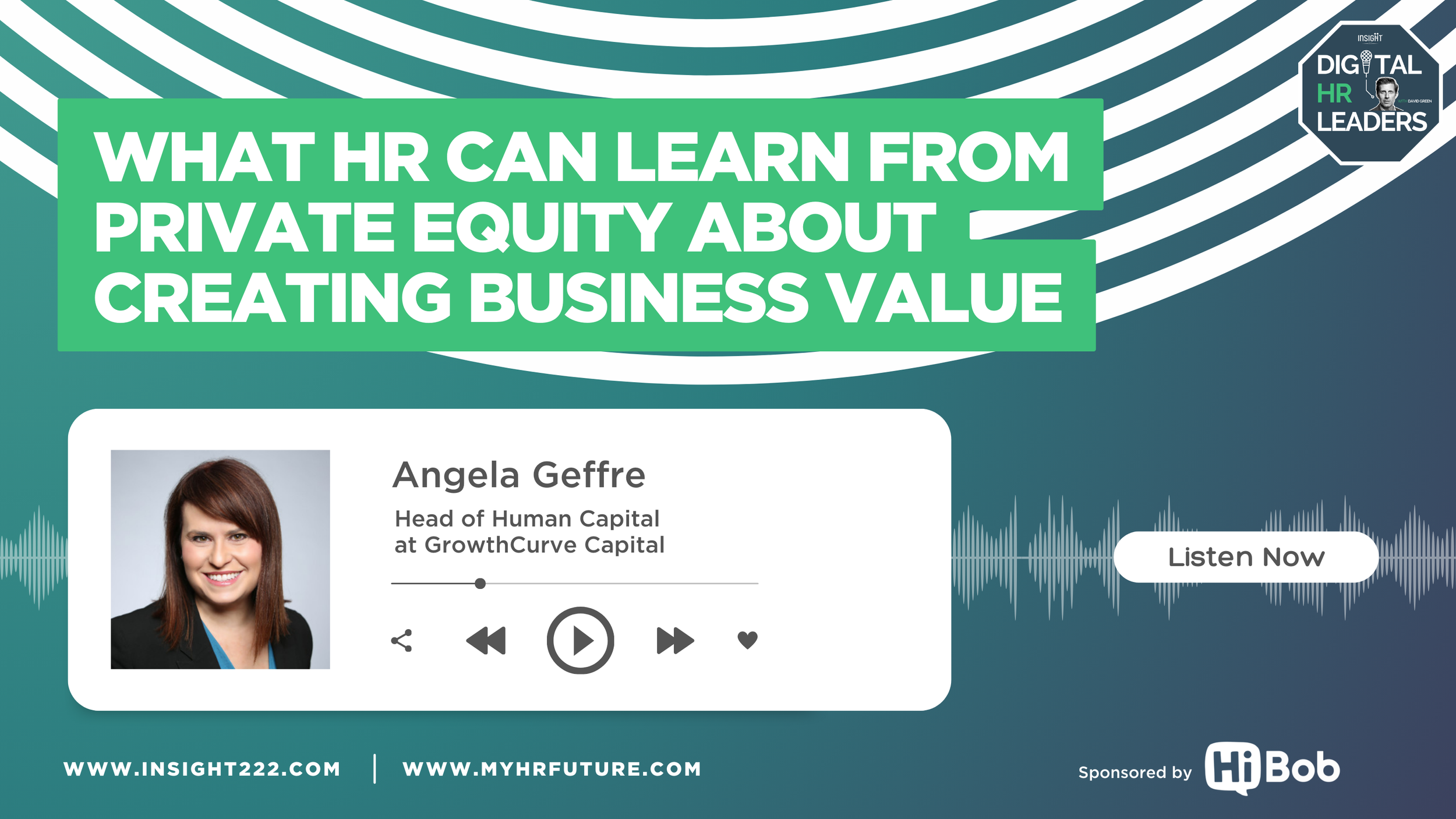
What can HR learn from private equity, where talent, culture, and leadership are part of the deal thesis from day one?
In many organisations, the connection between people strategy and business outcomes is still taking shape. In private equity, however, that connection is immediate and unmistakable, with leadership quality, organisational design, workforce capability, and culture being central to the value-creation plan, with clear timelines, defined expectations, and measurable results.
So, in this episode of the Digital HR Leaders podcast, host David Green speaks with Angela Geffre, Head of Human Capital at GrowthCurve Capital, to discuss what this looks like on the ground.
Together, they explore what it really means to run HR in a private equity environment, and what the broader HR profession can learn from it. So tune in, and learn more about:
The key people questions to ask when assessing a new portfolio company
How HR contributes to value creation during a 3–5 year investment horizon
What truly drives performance and retention across industries and organisation sizes
How HR must adapt when moving from large enterprises to fast-moving portfolio businesses
How AI is reshaping products, operating models, and early-career pathways
Why HR must lead the responsible and ethical adoption of AI, not just manage its impact
This episode is sponsored by Hibob.
HiBob brings HR, Payroll, and Finance together into a single platform that employees actually use. With AI throughout, you move faster, work smarter, and empower your people to power your business.
Sapient Insights recognizes HiBob’s AI vision, citing the Bob AI Companion for making everyday work faster and easier. Fosway Group also names HiBob a 2025 9-Grid™ Core Leader, recognizing the strongest AI vision among Core Leaders.
HiBob. All-in-one HCM for HR, Payroll, and Finance. Learn all about HiBob’s modern HR platform here
This episode of the Digital HR Leaders podcast is brought to you by HiBob.
[0:00:09] David Green: When you think about private equity, HR may not be the first thing that comes to mind. Yet for all the urgency around financial engineering and operational improvement, the people side of the equation often determines whether a portfolio company actually delivers the returns investors expect. So, what does it take to build HR strategies that drive value in that kind of environment? And what can HR leaders in any industry, for that matter, learn from the way talent gets prioritised when time and capital are both finite resources? To help us explore this, I'm delighted to welcome Angela Geffre, Head of Human Capital at GrowthCurve Capital. As an I/O psychologist, Angela has built her career leading HR in global enterprises, and now works across multiple portfolio companies where talent strategy directly shapes organisational value creation.
This is a different conversation from most episodes of the show, as we dig into the realities of running HR in private equity, the critical questions Angela asks when evaluating the people side of a new investment, and how she prioritises talent initiatives when time is compressed. We explore what Angela's learned about performance and retention that holds true, regardless of industry, why HR in smaller portfolio companies requires a completely different approach than in large enterprises, and much more. This is certainly a conversation that will challenge how you think about talent strategy. So, without further ado, let's get the conversation started.
Angela, welcome to the Digital HR Leaders podcast. What I find really fascinating about your background is that you trained as an I/O psychologist, worked in HR for a long time, and you're now Head of Human Capital at a private equity firm. Please could you walk us through and share with listeners your journey that brought you to where you are today?
[0:02:07] Angela Geffre: Yeah, absolutely, David. But first, thank you so much for having me on the show. I really enjoy both the podcast and the great work of Insight222. So, thank you for the opportunity to be here today. So, yes, like many HR leaders, I did not think I would be here. So, I did not plan my life to be a Head of Human Capital and private equity. I started off, as you said, studying I/O psychology at university, learned very deeply exactly what impacts performance appraisal accuracy and how to scientifically predict how people will behave in a lab, so a long, a long way from where I am today. But it gave me a really good foundation of just how people, systems, behavioural science all works, how to apply it. And I started off with like a very, very technical master's thesis on how does mood affect performance rating accuracy. Now, in the real world, you can't control mood, and there isn't much you can do about whether someone is super-accurate or not. So, went on to study work-life balance for my dissertation and tried to predict who are better at handling all the stress at work and life, which seemed far more practical, far more human than controlling every aspect of performance rating accuracy, which probably doesn't happen in the real world.
So, the research did teach me, though, that human behaviour is, while wonderfully predictable in some instances, also very surprising in other instances. So, we can never predict 100% of human behaviour, which makes it far more interesting to keep studying it throughout an entire career. I was planning to become a professor, so had all my all my sights set on that, but decided I needed a little real world work experience before committing to that path. So, I searched the SIOP website, the Society for Industrial Organizational Psychology, and found an internship at Procter & Gamble. So, I knew nothing about Procter & Gamble, I knew nothing about Cincinnati, Ohio, I knew nothing about the people at Procter, but I decided to apply. And next thing I knew, I had the job. I have no idea how, but somehow they awarded me the job. So, I packed up my car, and at the time, I think I had like a Volkswagen Beetle, it was quite a quite a fun little car, and drove down to Southern Ohio and had no idea what I was getting myself into, but was up for the challenge and trying to figure out how does I/O psychology work in the real world?
My first job at P&G was super-academic. So, it was, "Hey, Angela, we want you to figure out how to predict performance in 82 countries". And then, decided that in order to grow in the company, I needed to go off and be a business partner. So, I needed to go do something that showed I could work in manufacturing, I could figure out real people, actually interact with real people, and not just behind a computer screen and behind SPSS. So, the next assignment was to go off to Boston and work on the Gillette acquisition, which at the time was Procter & Gamble's largest acquisition. They paid billions and billions of dollars for Gillette. Then, I had to trade in my heels for steel-toed boots, I had to trade in my dresses for jeans, and actually kind of reinvent myself, because in the plant, they didn't care that I had a fancy PhD. And in fact, it was actually frowned upon. So, they said, "You know what, Angela? Don't say you have a PhD. Just pretend like you're normal".
So, I did my best to pretend like I was normal. But it was trial by fire. It fundamentally did transform the way I understood the challenges that people encounter every day at work. So, it isn't just a math equation. There's a lot of stuff that goes into if people can perform and what the throughput was. This was a blades and razors factory. So, you can imagine the safety protocols, how important integrated work systems were, which is what Procter & Gamble called making sure everything ran exactly as it's supposed to run. So, a lot of emotion, a lot of safety, a lot of things that I just really never thought of before. And it was a huge learning opportunity, a huge adventure, learned a ton.
Then, I got a call to join Kellogg, the cereal company. And someone who I'd worked with at Procter years before said, "Hey, I know this woman who can help us set up global recruiting, and build all the systems, processes, and tools in HR, and help us get off to a great start in recruiting the best talent around the world". So, I moved to Chicago. And so, from Boston to Chicago, that time I flew rather than packed a car. And then, had to actually invent global recruiting at Kellogg, because they had outsourced it before. And that opened the door to an expat assignment in Dublin, Ireland for Kellogg. So, I went over to Dublin to support the European cereal business and got even deeper into leadership. This is the place I had the first real seat at the table. So, I was on the executive leadership team. I was suddenly in charge of making sure the team was working effectively together, that we were bringing all the functions together to make the best decisions on the products and where we sold, how we sold, what products we innovated and invented, which was actually quite different in Europe than in the United States. So, we had different formulas for cereal. And ultimately, all of that learning came to kind of a head when I got the opportunity to join private equity.
So, this is a place where I think every part of my background comes together, the behavioural science, the operation grounding, the global experience, and the conviction that talent actually does drive performance and drives value. In private equity, it's very fast moving, it's analytical, and it's unambiguously performance-focused. So, it is all about EBITDA, ARR, how much revenue are we making annually? And this is where I found the work that just really energises me the most, but I don't think I would be effective in this role without everything that came before it.
[0:08:58] David Green: So, on the podcast, Angela, as you know, and thank you for kindly being a listener as well, which is always great to have listeners as guests, most of the people that listen to this show are working in HR, all the way from CHRO, HR business partners I'm sure as well, and all the areas I think that you touched on on your career journey as well, recruiting, performance, looking at leadership and everything else. What I would imagine though is we have less people listening who actually maybe work in HR in a private equity firm at the moment. So, what's it like running HR in a private equity firm? You said it's faster moving, it's very analytical, there's a big focus on performance. What are your key focus areas?
[0:09:38] Angela Geffre: Yes. So, I would describe it as being an internal consultant, an operator, and a long-term strategic partner all at the same time. I'm responsible in the firm for our talent strategy, leadership development, performance appraisal, and any processes to ensure we attract and retain the right people. But our biggest focus area actually, my biggest focus area is in the portfolio, so how do I increase performance, assess management teams to make sure we have the right leaders in place who are driving the right behaviours, shape the organisation design. So, when we buy companies, often they're founder-led. Often, that founder is wearing multiple hats. So, the founder could be the Chief Product Officer, the Chief Tech Officer, the CEO, and the CFO all in one, so trying to figure out what skills and capabilities do we need across the organisation and in the leadership team. And then also, help CEOs make critical leadership hires, and all connecting back to the value creation plan.
So, if we decide that we're buying this company because we really think we see a huge opportunity around global expansion, for instance, or a huge opportunity to automate something in the products, we have to make sure we have the right people in seat to drive those things in the company. So, my world is really centred around what design do we need, what leadership do we need, and then what are the capabilities that we need deeper into the organisation, and then fill those gaps if we have any gaps in the in the design or in the leadership team.
[0:11:21] David Green: And in what types of company do GrowthCurve Capital work with? Is it all different types or is there specific industries that you're focused on?
[0:11:29] Angela Geffre: Yes, we are focused on financial services, health care and technology companies. All the companies that we partner with are data-rich, because there needs to be something interesting that we can do with the data to ultimately provide a better experience for the client, the customer, the end user.
[0:11:50] David Green: That's really helpful. And again, touching back to our original discussion around your background as an I/O psychologist, as well as maybe having a better understanding of what drives behaviour in CEOs, perhaps, of some of the portfolio companies you're working with and other people, how does your I/O psychology background help you in your role?
[0:12:10] Angela Geffre: Yes, every day, because I think I/O psychologists are very much trained to talk in terms of statistics and numbers. So, private equity works all around numbers, right, so the financial metrics, how are we going to increase EBITDA, increase profitability of the companies overall? And when I can talk in that language, so I can increase retention, I can reduce voluntary turnover, I can help the organisation perform higher than they were when we bought them in terms of EBITDA. And so, when I can speak in that language, it really helps my credibility and gives me a real seat at the table in this industry.
[0:13:00] David Green: Yeah, I mean we see, and as I know you know, Angela, a lot of the companies that we work with, the heads of people analytics, a lot of them, quite a few of them actually are I/O psychologists coming into people analytics and providing exactly that skillset in HR, which isn't commonplace I'd say in HR, the ability to be comfortable with numbers and statistics and connect that to business outcomes as well. You mentioned that you work with financial services, healthcare and technology. What have you learned about what really drives performance and retention, maybe regardless of industry or maybe even specific to different ones?
[0:13:37] Angela Geffre: Yeah, you know, it's interesting because I thought when I moved from consumer products to professional services, I would find different predictors. And while some things were slightly different, depending on the environment, and same thing here in these industries we work with, fundamentally I think three things are important across all companies and all industries, and that's clarity. Do people understand what they are supposed to do? Do they have clear goals? Do they understand the expectations of them? Do they know what they're being held accountable for? Then secondly, meaningful work. And I still remember back in the days when I was doing structural models at Procter & Gamble, I found this to be a huge predictor of both retention and performance. So, do people think their work has a purpose? Do they understand how it connects to the bigger company vision and what the company is trying to do? And do they believe in it, quite frankly?
Then finally, the third kind of component I find across everything is connection. So, do they have a sense of belonging? Do they feel like their leaders care about them? And this is one where I've gone back and forth in my career of like, can we train people to care? But it is super-important. So, that whole feeling of, "I'm being looked after, my manager cares about me as a person", I find to be critically important across industries.
[0:15:11] David Green: Today's HR teams juggle all their processes across disconnected systems. HiBob brings HR, payroll and finance into a single platform employees actually use. Bob already has AI throughout, so you can move faster, work smarter, and empower your people to power your business. That's why Sapient Insights recognises HiBob for its AI vision, highlighting Bob AI companion for helping teams move faster, from drafting job descriptions and communications to getting answers fast. And Fosway Group names HiBob a 2025 9-Grid Core Leader, recognising the highest AI vision among core leaders. HiBob, all-in-one HCM for HR, payroll and finance. Learn more at hibob.com.
And if we apply some of that to when you're looking at a potential portfolio company maybe at GrowthCurve Capital, what are some of the key questions that you're asking about the people side, the talent, the organisation, the culture, some of those things that you've mentioned there really, the clarity, the meaningful work and the connection? And how does that feed into the broader investment thesis and value creation plan?
[0:16:46] Angela Geffre: Yeah, excellent question. So, when we are looking at a company, I try to find out as much as they know about their people. And usually in private equity, you get this massive data room of information, and so you have to kind of sort through it. You will definitely have an employee census file. In that file, you might have a lot of information, you may have very little information, but it's a big part of like, what do we know, and what do we not know? So, around clarity, I look at the percent of the organisation that has clear OKRs or goals, I don't care what they call them. But do people know what they're working on? And do they know how they're going to be measured? And do people know what gets rewarded? So, I ask, "Do you have performance management? Do you know who your critical talent are? And how do you know?" And then, I ask about compensation. So, are we rewarding those who are giving the most performance? So, do we reward performance? Do we have long term incentives in place? And are they going to the people in the most critical roles? So, that's around clarity, because again, if people can see the connection, "If I do this, then I will get more reward, or I will have a bigger piece of the pie", then they're more likely to perform.
On meaningful work, I ask, why does the company exist? Are people excited to be there? And this could come in the form of survey questions. Do they feel like they're contributing to something bigger? What is the real purpose? Like, I'd even look at the website, like what do they communicate of why they exist and what they're all about? And then can the people articulate that? Like, do they know we are here to improve the connection between general contractors and contractors, and the example of the construction software company? Do they have a real sense of purpose of why we exist as a company? And then, on connection, there's a lot of metrics you can look at here. But some companies will have an ENPS score, some don't, like regrettable turnover. So, again, sometimes they don't have regrettable, they can't tell me how much is regrettable, but I have a turnover number that I can at least get some flavour of, are people leaving? Do they feel connected to the organisation? If there is a survey that exists, then how connected do they feel to the leaders? Do they trust their leaders? Do they feel like leaders have their backs? And again, it will vary by company when we start off. But then, once we acquire the company, it's very easy to put these things in place so that we can measure them properly if we don't have them at acquisition.
[0:19:40] David Green: And obviously, you've talked through your experience at the start, obviously P&G, Kellogg, JLL, they're all big companies, effectively. And I know P&G better, I know they've got a fantastic reputation for the HR function that they've got, and I'm sure that's the case with JLL and Kellogg as well. What surprised you most about how HR needs to show up differently in these smaller portfolio companies? Presumably, in some of these companies, HR is barely there. It's maybe one or two people in HR, maybe, when you first engage them, or less.
[0:20:17] Angela Geffre: Yes. No, sometimes it's a team of one, sometimes it's a team of five. Rarely is it over five. And oftentimes the CHRO or the Head of HR, the HR Director is reporting into the CFO. So, I think the big difference is HR has to wear all kinds of hats, right? So, they need to be very, business-savvy, they need to be super hands-on. So, there isn't a team of people that can get it done for them. So, when I think about my time in P&G and in Kellogg and JLL, I didn't really need to know anything about benefits, because we had a whole huge team that worked on employee benefits. And small companies, it is you, right? So, if you don't know anything about benefits, then you have to go figure it out. And you have to figure out, what is the market? What's important to people? What's important to people in your company? Will it make a difference if you offer the platinum plan versus the silver plan? And will it make a difference in performance? Will it make a difference in who joins you? So, it's very hands-on. You have to be ready to figure anything out and speak the language of revenue, gross margin, EBITDA, like I said, unit economics, customer acquisition. So, you are very much just able to do anything, and if not, you have intellectual curiosity to go figure it out and get your hands dirty.
[0:21:53] David Green: So, I sense one of the things that's thrown at us in HR sometimes is we do stuff for HR's sake, or it's an HR project. If you're working in the private equity space and you're one of those portfolio companies, you hinted there that business savviness is one of the most important things, and the ability to get your hands dirty effectively and be able to do everything. There's no time to focus on HR priorities there. Everything's got to be connected to what you're trying to drive as a business and arguably, in those bigger HR functions, those bigger companies, that's something perhaps we could learn from.
[0:22:30] Angela Geffre: Yes, absolutely, 100%. And I think, why are we doing the talent review? Often, I have found this in big companies, they're like, "Oh, God, we have to plot everyone on performance and potential, and this is such a waste of time. And what are we going to do with it?" Well, here, it's if we have vacancies or lack of capability in these critical roles that are going to drive the value creation, then it's not going to get done. And in private equity, you have a very compressed timeline. So, you have three to five years to grow EBITDA and sell this company for hopefully two to three times what you bought it for. So, super-compressed timeline and everything matters that's going to ultimately drive the value creation plan and lead to more profitability.
[0:23:17] David Green: You mentioned that. So, the typical investment horizon in private equity, as you said, is around three to five years. So, how do you prioritise which talent initiatives to focus on? What are some of the metrics that matter most when you're trying to drive value in such a, it is a short timeframe really, isn't it?
[0:23:24] Angela Geffre: Yes. And I have learned, through the last five years in private equity, what drives the most difference. And it does all come back to those things that we talked about already. So, I really focus on that first year of ownership on filling critical talent gaps and providing clarity to the organisation. So, we have lovely ways to roll out OKRs, to get the company focused on how do you write good OKRs. But what really matters, and I have this debate all the time too, is like, I don't care if they're perfectly written. What I care about is people actually know what they're supposed to be doing, how it connects to the larger picture. So, again, percent of OKRs that have been deployed throughout the organisation, how many people know how they're being measured? And then, from there, performance management. And I have found that that takes longer, because a lot of the companies we acquire, they are used to doing 3% increases across the board every year. So, no performance differentiation. They can't even get their heads around like, "Why would we do that? We value all employees, and why would we?" And then, you find there are a lot of low performers in the company because (1) they don't have OKRs, they don't know what they're supposed to be working on, and (2) they're not being measured.
So, these are the critical things, like org design, fill critical capability gaps, set OKRs, make sure everyone's super-clear, and then measure performance. So, that's kind of year-one focus to make sure that we get on the right track. And I think you had a prior guest on your podcast that talked about team performance and driving the clarity of what is the team working on. That's critical. We're all in this together. And when we have norms, when we know what we're supposed to be doing as a team, not just an individual, then you're going to get to better outcomes ultimately.
[0:25:45] David Green: I want to take a short break from this episode to introduce the Insight222 People Analytics Program, designed for senior leaders to connect, grow, and lead in the evolving world of people analytics. The programme brings together top HR professionals with extensive experience from global companies, offering a unique platform to expand your influence, gain invaluable industry insight and tackle real-world business challenges. As a member, you'll gain access to over 40 in-person and virtual events a year, advisory sessions with seasoned practitioners, as well as insights, ideas and learning to stay up-to-date with best practices and new thinking. Every connection made brings new possibilities to elevate your impact and drive meaningful change. To learn more, head over to insight222.com/program and join our group of global leaders.
And a lot of these companies, I'm guessing, they're scaling fast. So, when you acquire them, they might have one or two people in HR. But by the end of those five years, let's say they've gone 10x, 20x, whatever, it could be more, I guess, depending on the type of company that you're working with, and suddenly, they're bigger and they've got more people in HR and culture needs to evolve and everything else. I don't know if you could speak a little bit to that, around how you support and what you've seen from HR in these scaling companies across those industries?
[0:27:32] Angela Geffre: Yeah, it's a really good point. So, many of the companies we acquire, think about it, they have like 50 to 100 people. And then, we could be growing them to as many as 500, 1,000. Our biggest company right now I think has about 1,200 people in it. And so, when you're at 50, You don't really need a whole lot of process and system in place. You could just have your town halls, get on Zoom, individually connect with each team and each individual. As you get bigger, it's very important that the communication is clear, that you keep the channels open, that you do have the process and systems in place, that it's not just a one-on-one conversation. And you make sure that the organisation is getting the same information because, again, bigger, you have the CEO communicate something that might get translated very, very differently in different functions, in different areas of the company, in different countries that the company operates in. And so, making sure that is clear.
[0:28:25] David Green: And I guess one of the other challenges is, again, if I'm thinking about smaller companies that are growing fast, the people, some of the people, and it could even be some of the leaders, frankly, that are really good when the company's new, 50 people, growing fast, might not be the people that you necessarily need when the company's up to 500, 600 people. And how do you support your portfolio companies with those? Theoretically, of course, if it was to happen, how do you manage that, because I guess it's something that many of our listeners might be facing in their own organisations. But obviously, you're supporting many organisations from a people perspective.
[0:29:17] Angela Geffre: Yes. Yeah, we talk about, what got us here won't get us to the next growth phase. So, honestly, there are a lot of people that just self-select out. So, they put up their hand, they say, "You know what, we knew how to get to 50 million. That's what we know how to do. I do not know how to get to 200 million. I don't know how to implement AI or ML into this product. I don't know what it takes". And so, they will actually very oftentimes say, "I don't think I'm your leader for this next phase of growth". And honestly, I think that is a win-win when people come to that conclusion, and we know we need someone who's done this phase of growth before. And honestly, just like everything in life, it's about skill and will, right? So, there are people that have the skills to do it, but don't want to do it; and then, there are people that really want to do it, but don't really have the skills to do it. So, we need to find the right people to kind of scale at each phase of growth along the way.
[0:30:22] David Green: That's really good. You mentioned the two letters that we're all talking about at the moment, AI, and we've managed to get at least halfway through the episode before we even mentioned it, so that's fantastic. But let's turn our attention to that for a minute, to AI and machine learning for that matter. It's clearly front and centre in a lot of value creation stories right now. There's lots of talk about AI, lots of uncertainty around it as well, talk of an AI bubble, all these sorts of things. But in your current role, how are you seeing AI changing both the products your portfolio companies offer, but also the way they're working internally as well?
[0:30:58] Angela Geffre: Yes. So, on the product side, a lot of what we do is enhance the product of the companies we buy with AI ML. That can mean enabling new features, it could be equalling a more personalised experience for the client or the customer. It could mean an entirely new revenue model. So, if we're like a fintech company, if we can give insights to the banks or whoever is the client that they didn't previously have, that would be a whole new revenue stream. So, it is becoming a clear differentiator, not just a nice-to-have at the end of the day. And then, internally, AI is automating repetitive tasks, just like probably in a lot of places, and a lot of leaders you talk to talk about that augmenting decision-making, helping with research, improving analytics. And in many cases, it's enabling a leaner, more productive team, allowing people to work on the things that are uniquely human, and ultimately, are things that we need humans to do. And actually, what I'm most excited about is like, is there going to be a day when we can work reasonable hours?
So, when we started carrying cell phones in our pockets many, many years ago, we started the always-on culture. And quite honestly, I do believe the brain needs a break. And I can tell you when I'm back-to-back for 12 straight hours in a day, I am not at my best.
[0:32:36] David Green: Funny, that!
[0:32:38] Angela Geffre: By 5.00pm, I start to get confused and it's only natural, right, that you only can do so much in a given day. So, I think internally, I get super-excited when I'm like, "Oh, now, that work can be taken away so that people can actually maybe read a book to their kids at night, because they're not working until 11.00pm".
[0:33:03] David Green: Yeah, I think Keynes said, in the 1920s or 1930s, that we'd all be working 15-hour weeks by the end of the 20th century.
[0:33:10] Angela Geffre: Wouldn't that be awesome?!
[0:33:12] David Green: It didn't really come to pass! But hopefully, maybe in this industrial revolution, maybe that will happen.
[0:33:20] Angela Geffre: Yes. We can all hope and dream.
[0:33:22] David Green: We can all hope. History suggests not. And on that, there's been a lot of talk recently, there's quite a lot of data in the US that suggests that you can look at the announcement of ChatGPT and you can start to see a gap with early career. And the stock market is getting bigger when you look at recruitment, but it seems to be having a particular impact in early career work. Obviously, you're a psychologist at heart as well as a CHRO. And again, you're thinking about these portfolio companies. We had Tomas Chamorro-Premuzic on the show a few weeks ago, and he was talking about one of the risks that he sees about having less early-career people in the organisation is you potentially lose some of that innovation that you need. Actually, some of these people are probably better at using some of these tools than maybe some of the older members of the firm as well. I'd love to hear your thoughts about that and think about the importance of, within some of the portfolio companies that you're working with, about developing early-career talent, and how do we do that as AI becomes better and more effective?
[0:34:31] Angela Geffre: Yeah, so I think it is a very valid thing we should all be talking about. So, if AI starts taking away the entry-level work, where do people build those foundational skills? And this is something that I think we're going to continue to learn, because we're in the middle of it and figuring it out as we go. I do think early-career roles will evolve versus disappear, after thinking about it quite a bit. And I think we will need to have more apprenticeship models, more project-based learning, more proactive questioning about how decisions are made, and interrogating the data. So, I mean even the first job I did at Procter & Gamble, I remember spending hours upon hours reading open-ended comments, probably weeks, months reading open-ended comments to summarise it. And would I be less of a person, like less of a successful HR professional if I didn't read every single open-ended comment? I don't think so. So, what would that job have looked like? I would have been able to do different things and more things and add value in different ways than simply reading open-ended comments, which thankfully is being replaced by AI, the great summarisation.
So, that's what I sort of think. We will evolve. What we do as entry-level employees will continue to evolve, but it has evolved. And if you think about, again, if we really look back in history, work's evolved a lot, from producing widgets to knowledge work. And we will continue to go in that direction with, "Okay, AI can do this stuff for us. So, how do we make these really robust entry-level jobs that are doing other things, and adding value in other ways?"
[0:36:33] Angela Geffre: I don't know if you've got any kind of tips you could provide to maybe HR leaders that are listening to this, whether they work in large or smaller organisations, around how to have that conversation with the CEO who's probably excited maybe, I hope not all of them, excited maybe about cutting a lot of costs, because people are typically the biggest cost in most organisations.
[0:36:56] Angela Geffre: Yeah. Even here, where we are deliberately going after automation in some cases, we don't see headcount disappearing. We see just, again, different works. So, that is org design, right? So, today, this is what this role will do. Tomorrow, the work tasks will look different. Today, these are the knowledge, skills, abilities that are needed to do job A. What are the knowledge, skills, and abilities to do job B? And how will that evolve over time? What can we train employees in? And then, what are things that we just can't train as easily or take a lot, a lot of time? And so, what do we need to hire from the outside? But so far, and we've been at this for four years, we haven't found that headcount is decreasing at all. And again, we are proactively working on this. We just find that roles slightly change. So, people might change; they do. So, what we needed to do analytics jobs in the past is different from what we need to do analytics jobs today. And some of it can be trained, and some of it you need to acquire, or buy, we say, versus build. But that's okay. That's as the world evolves. And then, think about what else you can get after, right? So, if we have people that can work on other things, what more can we do? And how much more can we grow? Because they don't have to do some of the manual tasks that they used to have to do in the past.
[0:38:42] David Green: Obviously, you had that fork in the road at one point. You nearly went into academia as a professor and you moved into business. If you maybe put that, what should organisations and universities maybe be doing differently to prepare people for a workplace where AI handles foundational work and work is changing?
[0:39:03] Angela Geffre: Yes, and this is one I think about a lot, because I have an 8-year-old and a 10-year-old. And I ask their teachers, like, "What are you doing to prepare my 8- and 10-year-old to have jobs later in life?" But I thought back to, how do I describe my undergraduate learning? I went to a small liberal arts school called Kalamazoo College, and it taught me how to think. So, when people say, "What did you get out of undergrad?" I learned how to think, how to thrive in new environments, and then just how to think broadly and deeply. When I went to the school I went to, 90% of the students studying in a foreign country and learned a different language. That, to me, teaches flexibility, it teaches humility, curiosity, resilience. Those are all things that are critically important in this new world. So, to survive in a foreign country where you've never been before, what do you do? You need to read eyes, you need to read faces, you need to read body language, you need to understand, because you might not understand every word they're saying. So, you need to kind of interpret.
I remember this summer, I took my family to Italy. I speak French, I don't speak Italian. But I could pretty much tell what people were trying to communicate to me. Because I just read. And I'm like, "They're trying to say this". And my kids are like, "How do you know that, mom?" They were like, "We don't understand this language". And I'm like, "Because you just watch, you listen, you figure it out". And that, to me, is the core capability that is going to be needed going forward. You need to be humble enough to know that you're not the best in the room. There's other things you can learn. You can learn from your agent, your AI agent. You can learn from people with very different skillsets than what you have. If you remain curious and open to, "Hey, what I've learned before may become irrelevant. And that's okay, because I'm going to adjust, and I'm going to pick myself up, and I'm going to learn from my mistakes, and I'm going to learn from those around me".
So, I think all of that continues to be critically important as we move forward. So, we have to shift teaching content, teaching capability and flexibility and, again, throwing people into novel situations over and over again, which a lot of the best companies do really well. Procter and Gamble certainly does, Kellogg, JLL, where like, "Okay, you mastered that, you did two years there. Here, go learn this and go to this country and learn this other thing". That, I think, will be even more important, as well as problem-solving, data-literacy, critical thinking. These are all things we can get better at. Communication will continue to be super-important and something that we can train both at schools, universities and in the workplace.
[0:41:59] David Green: And I mean, you mentioned some of the ingredients there that we certainly need from an organisation's perspective, you know, create a culture of curiosity, continuous learning where people can experiment and maybe fail, that kind of psychological safety that we've talked about in so many episodes of this podcast. What I wonder maybe, Angela, as a CHRO yourself, what about you? What are you doing personally to use AI at work at the moment?
[0:42:25] Angela Geffre: Yes. I do think it is becoming my quiet superpower behind the scenes. And I think I heard this, maybe in one of your podcasts too, how some people won't openly talk about it, like how they're using AI. But I use it a lot for synthesis, as we've talked, summarising lengthy documents, I'll put in like a 200-page deck and say, what are the key questions you would ask based on this? And of course, I give it lots of context on what lens to use and my kind of AI agents, identifying patterns and qualitative data. So, that's what I talked about even with the survey research back in the day, and today like, oh my goodness, I'm doing 360s for a lot of our portfolio right now, because it's the end of the year and I'm doing it for the firm as well. I used to spend, I'm not even kidding you, three straight months trying to get the right summary. And now, I really do spend like 30 minutes per report.
So, I take all the open-ended. And if you construct the 360 right, you're going to have lots of rich data. So, throw it in, and have it say, like, "What are this person's main accomplishments, strengths, opportunity areas?" You would, of course, take that 30 minutes taking that critical lens, is this actually accurate, is there anything missing? But it took, I'm not kidding you, three months of my life that I would work. I even worked all day Christmas in the past to write these very robust reports. And now, I can do it all during the workday, and it only takes me like a week and not three months. So, super, super-amazing. And then I use it as a thought partner too. So, "What am I missing here? Here's what I see in this", whatever it is, so it could be an org design or it could be insights from what I see in the talent or the organisation, "What else do you see? What would you prioritise if you were me?" and use it as a thought partner in that way. And actually, HR jobs I always say are the loneliest place on earth, because you often don't have a thought partner, you're often standing in an island by yourself. And so, to me, it's super-helpful just to say like, "Okay, what am I missing? What else would you recommend here?" And I get really great tips. And then, I use my brain to say, "Well, that's not quite what I'm going to do. But this other point, this is a really good point over here".
[0:45:07] David Green: So, a couple of questions before we close, Angela. As I said, many listening today come from HR, people analytics, some have I/O psychology backgrounds as well, and they might be curious about private equity as a career path. What are the skills or mindset, do you think, that are essential for HR leaders to thrive if they were to transition into the world of private equity?
[0:45:32] Angela Geffre: I do think private equity is perfect for I/O psychologists. So, any I/O psychologists listening, please check it out, because of the data analytics mindset and the clear thinking on what drives outcomes. That's in a lot of HR people. So, critically important is working at pace, commercial acumen, so really understanding drivers of different commercial outcomes. Comfort with ambiguity, because there's going to be times you just don't know a lot. And you need to know what you know, what you can figure out, what you don't know and ask the right questions. As with everything, the ability to influence without authority. Actually, that's probably more important in private equity, because we could influence with authority with hierarchy, because we technically own the companies. But as you can imagine, it's far, far more effective when the people we work with think it's their idea and they take ownership of it completely. So, that how do you influence this person through data and insight to get to the right conclusions themselves and get on the right path and come up with the path themselves? So, that whole influence without authority, I think, is also very, very important when you're in this environment.
[0:46:54] David Green: Great. So, this is the last question, Angela. This is the one we're asking everyone on this series of the podcast. And going back to AI a little bit for it as well, how can HR lead the responsible and ethical adoption of AI, and not just manage it, but lead it?
[0:47:11] Angela Geffre: Yeah, I think HR plays a super, super-critical role here. It isn't just about technology, obviously, which is what we've talked about. It's about people in reshaping roles. Fairness, transparency, accountability is all super, super-important, and that is typically things that HR needs. So, in terms of ethical adoption, making sure we have the guardrails in place. And it's funny, one thing that came up recently is, can we record interviews or reference checks or things that typically you get more information and data when someone doesn't feel like they're being recorded or watched? And I go back to, again, the HR training. So, if the candidate tells me all about their pregnancy, do I want that in writing? I don't want that to enter my decision, and I don't want it in writing anywhere. So, guardrails about what can we record, what should we record, and use our insights from HR. We know what does increase transparency and fairness and, at the end of the day, the right decisions. So, sometimes we do need to put guardrails in place, and we need to make sure that people are thinking and not blindly following.
Sometimes I see reports, and you can tell when it's AI-generated, with even the bolding and the little symbols. And I can tell, and I'm like, "Okay". So then, I know I'll ask some critical questions that will find the flaw in this analysis or this plan. And we need to continue to do that, because that is why we're here. As humans, we see things that AI can't quite see yet. And we add a lens that is critically important to get the business to the right outcomes and on the right path.
[0:49:14] David Green: Angela, it's been an absolute pleasure to speak with you again. Can you share best how listeners can follow you and all the great work you're doing for the field? And also, maybe find out more about GrowthCurve Capital and your portfolio companies?
[0:49:27] Angela Geffre: Yeah, so I am on LinkedIn. I will post things occasionally there. They could check out GrowthCurve's website. And I often, in the private equity world, our big conference of knowledge exchange is called Private Equity International, PEI. So, I present at the conferences there. So, what I present has changed, in what forums, actually, I should say. The content is still quite similar. But really look forward to knowledge exchange. So, if any of these ideas are interesting to you or you want to kind of think through them, I would love a connection on LinkedIn so that we can partner together.
[0:50:09] David Green: Perfect. Well, you heard Angela. If you are talking and working in the same space, then please do reach out and connect with her on LinkedIn. Angela, thanks so much again for being on the show. It's been a real pleasure to talk with you.
[0:50:21] Angela Geffre: Thank you so much, David. Thank you for having me.
[0:50:24] David Green: Thank you again, Angela, for joining me today. I learned a lot from our conversation. For those of you listening, I'm curious, what stood out for you the most from today's episode? Was it Angela's approach to evaluating talent in portfolio companies? Or perhaps it was a challenge she raised about developing early-career talent in an AI-driven world. I'd love to hear your thoughts. So, head over to LinkedIn, find my post about this episode, and let me know what resonated with you. I always read the comments and love learning different perspectives from across the field. And if this conversation got you thinking, please subscribe to the podcast and share it with a colleague or friend who you feel might benefit from hearing it too. It really does help us bring more of these conversations to HR professionals across the world. And for those who would like to stay in the loop with what we're working on at Insight222, follow us on LinkedIn or head to insight222.com. You can also sign up for our bi-weekly newsletter at myHRfuture.com to get the latest thinking on HR, people analytics and everything shaping our field.
Right, that's all for today. Thanks for listening, and we'll be back next week with another episode of the Digital HR Leaders podcast. Until then, take care.