Episode 253: The New CHRO–CEO Partnership: Leading With Insight and Humanity (with Katarina Berg)
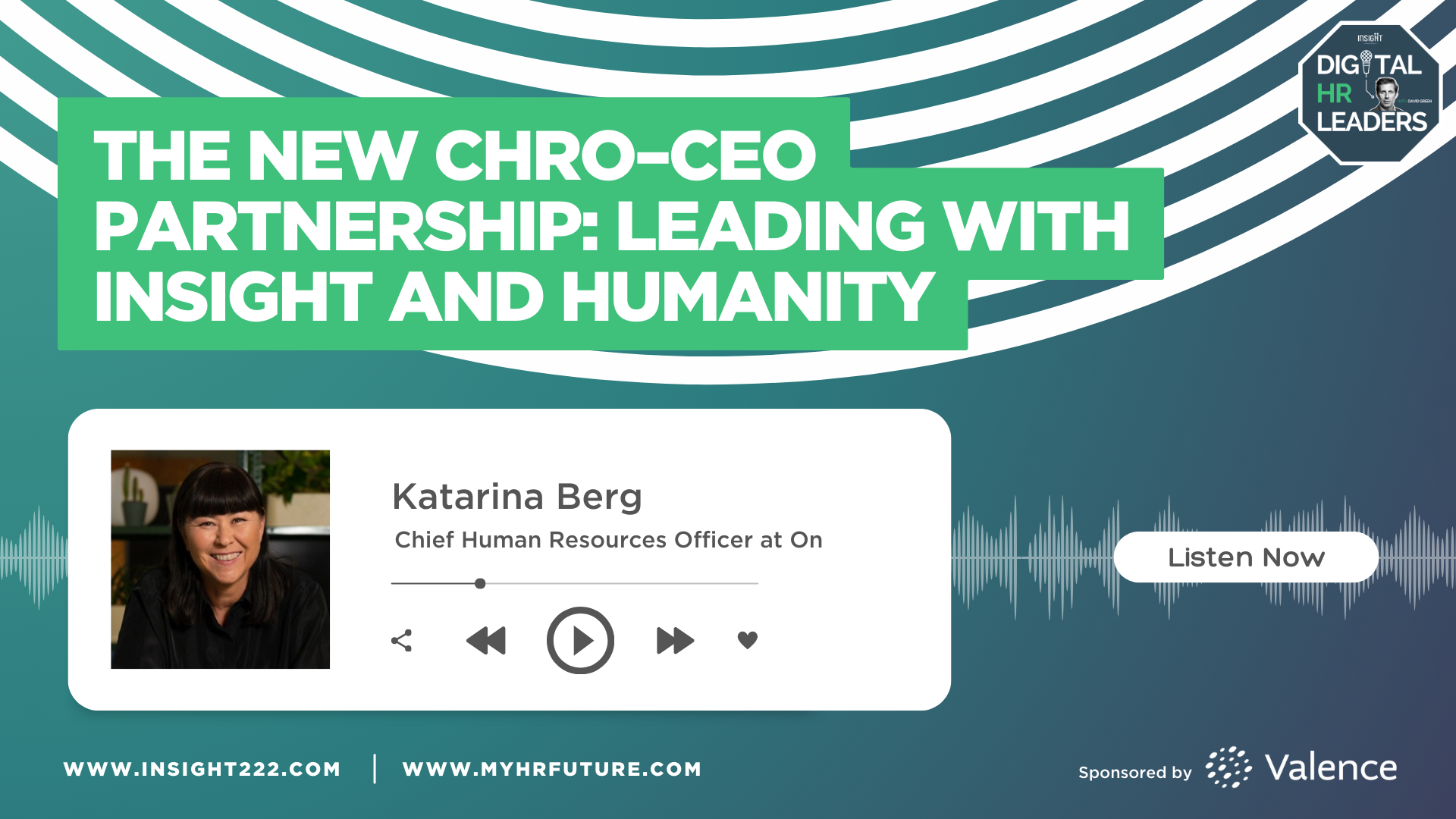
In this episode of the Digital HR Leaders podcast, Katarina Berg — CHRO at On, former CHRO at Spotify, and author of Bold: A New Era of Strategic HR — joins David Green to explore what modern, strategic HR leadership truly requires.
Together, they dive into the evolving partnership between the CHRO and CEO — a relationship that has never been more critical as organisations navigate AI, workforce transformation, culture, and business growth. Katarina shares how HR leaders can bring both insight and humanity to the executive table, shape decisions that drive business outcomes, and intentionally design a culture that empowers people to perform.
The conversation covers:
What a genuinely strategic CHRO–CEO relationship looks like — and how to build it
How Katarina approached her first 100 days as CHRO at On, and the lessons she’s bringing into the next phase of growth
Why “putting the H back in HR” is essential in the AI era
How people analytics teams can evolve into true insight and decision-driving partners
Why intentional leadership — not just tools or trends — will define the next era of HR
This is a must-listen for HR leaders who want to elevate their strategic influence and lead with courage, clarity, and humanity.
This episode is sponsored by Valence.
Imagine if every employee had a world-class coach in their pocket. That’s exactly what Valence has created with Nadia - the AI-powered coach helping Fortune 500 companies scale development, boost performance, and support leaders at every level. Learn more at valence.co/insight222
Links referenced in the conversation:
Bold: A New Era of Strategic HR
2025 HR Predictions: Looking Into the Crystal Ball
This episode of the Digital HR Leaders podcast is brought to you by Valence.
[0:00:08] David Green: It's been said that the first 100 days in a new leadership role can define your impact. But what does that look like when you're stepping in as CHRO at a fast-scaling global brand with sky-high ambitions? Well, my guest today knows a thing or two about that. Katarina Berg, who many of you will know from her time at Spotify, and her brilliant book, Bold: A New Era of Strategic HR, is now CHRO at On, the high-growth performance brand shaking up the sportswear space. It's been six years since Katarina last joined me on the show, so we've got a lot to catch up on.
In this episode, Katarina talks us through how she approached her first 100 days at On, the evolving relationship between CHROs and CEOs, and why she believes HR needs to refocus on the human side of the function. We also get into the role HR should play in keeping inclusion on the agenda, how to build a genuinely strategic CHRO-CEO partnership, and the capabilities people analytics teams need to support today's business challenges. There's a lot to take away from this one. So, without further ado, let's get the conversation started.
I can't believe it's been six years since you were last on as a guest. Can you let listeners know what's been going on in your world since? I know there's been a few changes recently.
[0:01:36] Katarina Berg: First, thank you for having me back. I'm excited to be here, David. And six years, yes, it's crazy to think what has happened that could be maybe for this audience. I worked at Spotify then; and now I work at On. I lived in Sweden, Stockholm, then; now I'm in Zurich, Switzerland. Otherwise, I think I've just got six years older.
[0:02:03] David Green: And haven't we all in that time? Obviously, you were at Spotify for a long time and I've got the book that you published, I think in 2023 in Sweden and 2024 in the UK, here as well, Bold. 'Bold', that's a word I always associate with you, Katarina. Do you want to talk to that word a little bit and why you think it's such an important word for Chief People Officers, Chief HR Officers, frankly anyone in HR to put at the forefront of their mind?
[0:02:34] Katarina Berg: Yeah, I sure would like to because I think I have now a relationship to that word that I was not necessarily anticipating when we put that on the book. It kind of follows me and maybe it's strange that I'm surprised it does, but I think the word that I used to use a lot was 'courage', especially when we talked about leaders, and it's never been as complex, it's never been as hard. I think, therefore, it's something that I think is important because there were no playbooks, which now again with AI and all the development, there is no playbook. You will not have all the answers, but you will have data sets. But more importantly, you will have intuition, which is nothing else than experience, right? And then, sometimes you have to make choices, and nobody will blame you for making the wrong decisions because you're the only one that's going to course correct them. And therefore, I think you need to be bold. And you can't really collect and collect and collect and be kind of a squirrel in that sense, so you just have to be bold. And I think it comes with a couple of statements and also the way that you want to lead, and if you want to put human or people in the centre.
[0:03:55] David Green: Very good. And I love the word 'courage' as well, I think. And it's great to hear the stories of how book titles get formed. I like that one, actually, "Everything Your CFO Should Know About HR", I think that's a really good title as well. So, you mentioned, obviously, you recently moved to On as Chief HR Officer there, and I believe you've been there, I think it's 100 days almost exactly today. And obviously, you have the benefit of having been a Chief People Officer before at Spotify for a number of years. But when you step into a new Chief People Officer role, Katarina, how do you approach those first 100 days, what are the core questions you're trying to answer, and where do you spend your time?
[0:04:36] Katarina Berg: As close as possible to the business. I think now, after plus-30 years within the service of HR, I think I have the HR acumen. So, it's all about trying to understand what I don't understand and trying to plug the gaps of what I do not yet know about the people, but also the way that we operate. I left an admired culture and I joined an admired culture, and it's all about the build. And if I'm going to help them build that and be maybe in some sort of leading role for that too, I need to understand what brought them here.
[0:05:17] David Green: Very good. And obviously, another really strong brand, Spotify, very strong brand. Everyone recognises Spotify and I think On as well. In the industry that On is in, it's definitely got a lot of good brand recognition, I guess, and I guess it's how you capitalise on that within the organisation as well. You mentioned, Katarina, you've operated in HR for 30 years and operated at the top table for a long time now. How do you see the relationship between the CHRO, the CEO, and the rest of the C-suite evolving, especially now given all the advancement in AI and workforce transformation and those being front and centre on board agendas?
[0:06:01] Katarina Berg: I think it's easy to say in a short answer. It's never been as close, it's never been as strategic, and I could stop there. But I also meet a lot of people that have the same job, but that still are struggling to get on the agenda, still struggling to actually sit in the C-suite. So, if I expand that answer a bit, I think it's more about, again, putting those two acumen together. So, you're helping the business evolve, you're helping the organisation to embrace the new technology, and also guiding them into new ways of working. Instead of scaring, I think it's very much about a mind-shift right now, and being the behaviour scientist and the specialist within that area and also bringing all your people along. I think that is really, really key to what you are doing, right? So, it's never been more important. I don't think the relationship has ever been stronger. And I think it's not about either/or when it comes to all the dualities or polarities we talk about these days and the complexity. It's never been an easy feat to do change management. It's never been easy to make sure that everybody gets on board. But then again, then everybody could do the work, right?
But I think this is where we come in and what we bring to the table, because the future work isn't 'man or machine', right? If we talk about tech as machine, it is meaning 'plus machine or tech'. And that meaning, I think, is where we come into play and where we can be very helpful. And also, AI gives all the leaders, all the CEO, all the C-suite the data, right? But culture tells them what to do with it. So, again, if it's not really tangible or applicable by just saying these catchy phrases, I think everybody understands that we play different roles here and it's very, very helpful, hopefully. And then again, I think lastly, AI can map talent in a smart way, but only leaders can unleash it. So, I think it's changing a bit, and it's like a prism. If you tweak it or you turn it, the light will still come out, but maybe in a different way. So, how do we organise ourselves? How do we work? How do we prepare our leaders? But for sure, how do we also address all our team members?
[0:08:26] David Green: And in terms of in your experience, Katarina, both from your own experience, but also what you see with some of your peers, and I know you had this at Spotify and no doubt you're cultivating this On if you don't have it already, what does a genuinely strategic CHRO-CEO partnership look like in practice?
[0:08:45] Katarina Berg: I think you have to choose each other, I think it starts there. And I think it's kind of one of those where people say that, but they maybe didn't. For sure, I choose to work with Daniel actually more than I choose to join Spotify, and it's the same thing here. Meeting the founders at On and Martin, our CEO, was very much about a very deliberate, a very conscious decision that we complement each other and I like the vision and we can do great work together. And I think that is a decision that a lot of HR people tell other people, "You should choose your boss", but might not be as smart when it comes to themselves. And I think that is really centre of a lot of things.
The other thing is, obviously, like in any relationship that is important, I think you need to have kind of the same values of where you're going. Then you should not, and this is me saying this, and people don't have to agree, but you should not agree on everything or the way to get there. But if the foundational is there, and you have the same beliefs, and also you subscribe to the same philosophy, the same kind of principles, the rest will be more dynamic. It's going to be, okay, we don't necessarily come to the same solution or how to get there or what the first and next steps are, but it's kind of organic and it's a partnership and it's very much shoulder to shoulder, and the work will only improve when you sometimes have to debate a bit to get there. And then, the debate is only healthy if you have that kind of safety or you have something to bring where you can argue for it. So, in many ways, we're all in sales, we are also all in marketing, right? You can't just go, "Trust me on this", or, "I'm experienced", or, "I have a gut feeling", right? You need to be able to sell.
So, there's always, I think, and should always be -- because all the things that we bring to table are usually very long arches. It's not like the next semester or the next sales or report. It's more like we set something out here to do something here, and then we're going over here, right? And that could sometimes make C-suite or your managers or your founders a bit nervous like, "When do we see the result?" I think you have to find a way even if it's very hard, and maybe harder in my case, to describe the method to the madness. And I've seen so many people struggle with things that we love to throw around, like culture. But if you don't know how to build and you're not doing it all the time, I usually say that culture isn't a vibe. It obviously is, but it isn't a vibe, it's a verb. And it's not about those foosball tables, right? It's actually being built in the doing and in the hiring and it's in the onboarding and it is in the learning more than anything else and how you show up when it's hard.
So, it can't also be only when you are in hypergrowth, only when everything like the results are coming in and the stock price is nice and happy. It's in every day and like people all with morale or ethics, it's the hardest times that define you.
[0:12:31] David Green: What if everyone at your company had a world-class coach in their pocket? Meet Nadia, the most widely deployed AI coach in the Fortune 500, built by Valence. Nadia is the only AI coach that's fully customisable for any talent priority, from performance reviews and KPI alignment to frontline manager support and relieving HRBP capacity. Global leaders like Nestlé, Delta, General Mills, Prudential and more are transforming talent development at scale with Nadia. Discover how you can give every employee a coach who understands them, their team, and the whole organisation by visiting valence.co/insight222.
Right at the end of last year, you published on LinkedIn your 2025 HR predictions. And I'm not just saying this because I'm talking to you, Katarina, I think I wrote at the time, they were my favourite set of predictions, because you got straight to the point, weren't fluffy, and there was no ulterior motive like there is with some people that put trends on. I'll probably prove myself on that, to be honest with you. But one of the things that you wrote on there, and we'll put a link to those in the show notes, because actually they're still relevant, you know, predictions take a long time to come to fruition in many cases, but in the article, you talked about focusing more on the H than the R in HR. I really like that bit. Can you share more about this with listeners and why you think this shift is so urgent?
[0:14:20] Katarina Berg: I think it is urgent because everybody's talked, going into 2025, I still think a lot of people are talking about, and for good reasons, about efficiency and productivity, because it was more about building stuff and doing cool stuff. Especially if you look into the tech world, old technology and new technology was not meeting each other. And if they had a bit earlier, maybe the bloated-ness and the rifts that we saw around the world, not once, but twice, or maybe even three times in some companies, wouldn't have happened. And there was kind of an over-belief in, "We need to be so many people, because that's how we ship really fast instead of looking into processes". Most of the time, it's also a word that people are like, "Oh, let's not talk about that if you are a startup or scale up", it's something really bad.
But back to your core question, I think there are a couple of things that are true. In that efficiency and productivity, I think sometimes people forget how you get there. It's not by telling people that we need to execute, or that I don't think we get there also with modern kind of workplace and the generations that are in masses in most of the workplaces. I think you have to, at least I believe strongly, that if you want people to perform, you have to let them grow. And learning and development is not just training or courses or bluff or anything that is nice. But I think you have to be people-first in that sense or human-first. And it doesn't mean that it's only about sitting down and being 'Kumbaya'. I think everybody that's worked with me don't think that that's what I'm about. But it is about that human touch and thinking about who will design, who will make sure, where does all this big data come from? It is by somebody, that programme. It is by a lot of people using, you know, ChatGPT and forming it and teaching it and kind of learning the learning
Here, I think, if you are thinking about that -- and also, to be honest, 'use' is quite a harsh word. But if you use your people to be more and to teach you to be more human, I think you will get more efficiency. I think that is how it is. But I think it's so easy for people to go and jump over that step of, "We will get more efficiency by telling people. We will get more efficiency by having people that already can do the job". Yes, but when you've been there, done that, bought the T-shirt, where is complacency closest to the people that can already do the job or the people that are actually learning and enjoying what they're learning? So, if you don't want to be short-sighted, I don't think you should be top-down. I truly believe where people are informed, they will make better decisions, and they will also assume accountability. And they will also, as we know, proud people will perform, right? But if most things are happening like a pope election, that very few people go into a room and think, and think long, and sometimes, well, I guess hard, and out comes either black or white smoke. I'm not really sure if the rest will go like, "Oh, I will follow this and I will be happy doing this. And you know what? I'm going to be proud when I do this".
Nobody's telling me how we got to that conclusion and why we chose him to be the next Pope, or why we chose that to be the next thing that we're going to build or rally around. I just think that we know more about people and what makes them really go the extra mile.
[0:18:14] David Green: So, Katarina, a couple of things you said there. I mean, obviously, that focus on learning, creating that culture of learning, allowing people the time and space and freedom to be curious, to experiment, thinking that technology and implementing technology, it's not just about implementing a technology and telling people to be efficient, you actually have to enable that change through culture and good management as well. And it made me think about a conversation we've had previously around this whole experimentation culture as well. In your experience, what does good experimentation with AI look like and what does bad experimentation look like?
[0:18:57] Katarina Berg: I think what I see and what I hear from most of my peers and their companies is, of course, awareness is very important, because with greater awareness, the fear will go away. But then, when you experiment, or you have like, "Hey, we're going to open up and everybody can use whatever, Claud, or Canva, or ChatGPT, or whatever", it's the same companies that also talk about efficiency, it's also the same company that wants to be financially prudent. So, I think you have to think about a couple of things that also goes with learning or growth. Development is not a perk, right? I think you need to have a bit of structure. Then again, I feel that there is not a big divide in that sense, it's either/or, or versus.
But when I talk to most of my colleagues and when I have had the chance now to look into and also visit companies that are more in JPAC or in China or on that side of the world, they talk more about applied HR, "What will the technology actually do for us, and where is it relevant, and where can we see the gains already? And that's where we kind of develop and make sure that we invest. And when I talk to colleagues and friends and also visit companies more in the Americas or in US, it's very much more technology for technology and how cool it is and what it could do, not so much when or how, and how we will use that if we now apply it to workplace and workspace and the way that we do things. So, I find that to be very, well, almost opposite ways of looking at it.
If you then look at where I started, I find that to be a bit more attractive, because then it's applied AI. And it's easy then to see you go to your own space and your own function. And then it's easy for me now with my team to go, "What should we do? How should we apply it? What technology is interesting?" And within that space, it's not just about pioneering or trying or have like a full week of a fair where you can try everything or you can download any kind of license. Because I think it is, again, with that growth and the awareness and the new technology, it's when you trust your people but you have a structure for it, it's kind of the fuel for the retention, it's fuel for the ambition, and it's the fuel for the loyalty. And when you start to think about applied AI or new ways of working and efficiency gains, but also how it will speed up things and take away repetitive things and where pattern recognition can help us in so many ways, I think it's easy to then start to not imagine, but realise where should we apply this and where can we use this. And already now, that means that we can stop doing this, start doing that, and really lean in and do more of this. And I think that is where it gets interesting.
But then you connect that to what we do for a living. Then you realise this is very much more about learning development, it is more about the culture thing because it's very much connected to change management, and it's also very much connected to kind of a mind shift rather than a tech shift.
[0:22:42] David Green: I want to take a short break from this episode to introduce the Insight222 People Analytics Programme, designed for senior leaders to connect, grow, and lead in the evolving world of people analytics. The programme brings together top HR professionals with extensive experience from global companies, offering a unique platform to expand your influence, gain invaluable industry insight and tackle real-world business challenges. As a member, you'll gain access to over 40 in-person and virtual events a year, advisory sessions with seasoned practitioners, as well as insights, ideas and learning to stay up-to-date with best practices and new thinking. Every connection made brings new possibilities to elevate your impact and drive meaningful change. To learn more, head over to insight222.com/program and join our group of global leaders.
If you had to pick two or three themes that will most fundamentally reshape HR in the next few years, which ones would you single out and why?
[0:24:03] Katarina Berg: I think we will see a lot of things changing quite fast with the help of technology when it comes to talent acquisition. It's very, very easy to see how that could help us with things that today is super-time-consuming, where I think we can see that things that we want to catch or things that we want it to help us recognise in the patterns could be here in a smart way and a very helpful way, and where we can also then free time so that we could put that recruiting into recruiters. So, that is one area. I think another area where we could see a lot of fast-forward, obviously in the space of learning. I think we have heard people talk about blended learning, e-learning and whatever learning. I still think that when we see the biggest result for the longest time has been very much on-the-job learning, meaning that you don't go to a seminar, you don't go to inspirational talk, you don't even go to training camps in that sense where you practice, practice, practice. I think it's more about, and I think we had big high hopes on augmented training, but it hasn't really, in many areas, helped if you're not practising kind of landing a plane over and over again and getting it to a very precise skillset. So, I'm not taking away the things where we have seen it, but I think learning is a very interesting space where we haven't seen it yet, but I think it's going to be pivotal when somebody cracks the code of how we can do that.
Then, if I'm going to just do one more area of all the interesting areas, I think in the space of communication/labour relations, labour law, all these things that are very important that we get right when it comes to contracts-making or doing right by our people. It's been very much manual work and it's been very time-consuming. Even if you have a template, it's still somebody that works through that, and does the right template or contract go to the right person in that part of the world? It's going to be crazy, but there are two things that I still am wondering why we don't see with the technology where it is and where it's been. I don't know how many people in HR, that not on a daily, maybe not on a weekly basis, but every time you do a re-org or you want to explain something, you kind of manually do an org, you know what I'm talking right, shot. And it takes so much time. And with some new tools, it looks nicer and nicer, and it might go faster and faster. But why can't you just say to your operating system, or why don't you just speak, "I want this organisation to be going from functional to business areas?" Can you just rewrite the boxes?" or, "Can you go from that to into 100% the matrix dilemma, or verticals and horizontals, whatever?" Today, you sit and do that. How time-consuming is that? And you go, "How strategic is that?" But if you're going to explain to people, it is a map, right? So, it's not about the hierarchies, it's about the map.
[0:27:45] David Green: Let's move to diversity, equity and inclusion, and obviously we've seen some companies retreating from diversity, equity, inclusion this year, particularly those obviously based in the US because of the executive orders that came out. And I mean, I'm actually seeing a lot of organisations still doing it, but they're just not talking about it as much. What role do you believe HR leaders can play in helping to keep inclusion, equity and diversity front and centre?
[0:28:14] Katarina Berg: I think you will find a lot of people not wanting to talk about it, but I might not be one of them. But the company that dropped it, I think they also then showed that it was never important to them.
[0:28:28] David Green: Last two questions, Katarina, we're going to do one about people analytics, and then we'll come back to the kind of automation versus augmentation piece as well. So, you'd expect me to talk about people analytics, given our focus at Insight222. I'd love to hear, what have you learned from your time as a CHRO about where people analytics should sit and how it should work with HR and the business? And then, on top of that, what are the two or three capabilities that you, as a CHRO, really need in your analytics team?
[0:28:58] Katarina Berg: I'm going to be very honest. I think having a couple of KPIs, that was kind of the traditional ones within HR, I think that was enough for me for the longest time. And when we tried to add what I was looking for, I used to come into something that I describe as HR insights, which is exactly the same thing. I didn't want anybody, or us as a function, to just collect the dots. I wanted somebody or a function or AI to also really connect the dots, meaning I wanted a conclusion, I wanted to get the analysis, I wanted us to discuss the data sets rather than look at them like, "Okay, we have this many. Here's the number for attrition. This is the number of people that choose different things in the total reward kind of framework. This is this and that". And I always thought it was like, yes, it's a matrix like all other functions, and that seems to be very, very important to have, because all the other functions have them.
Not until I got to work, I thought it was quite interesting to see how we can embed ourselves into the more company decisions, in a very global and fast-paced growing company, where everything that you have as data sets of, how does talent density look like? How do we drill into that, and if you lay that with the information of labour law, attrition in that state or in that city or even in that town, right? How long do people stay? Then, you slice it in, what does compensation look like? Then it starts to get really interesting of, where do we open our next store? Where do we open our next office? Why in this city or this country or this region even? And is it easy to find that space for stores there or an office, especially if you're going to go for a triple-A location? And all of a sudden, it's more business decisions, right? And I realised we had all that data. It wasn't really contaminated, it didn't need to be scrubbed, but we didn't use it in a smart way. And we didn't open the kernel and show it to the rest of the business. We kind of sat with it over at HR for the longest time.
Then also, when you look into kind of the org and how it's married, like the data sets is married with each other, and it gets really interesting, right? I usually, when the org is going from one area to another and how you need to kind of close the locks and get that data to flow, this is where most people looked at me like I was a crazy person. And then, I met Gary Munro and he looked at me, "Yes, we can do a lot of things with this". And then he started to describe that and also build things that could be helpful. So, where should it sit? It should sit left, right and dead centre of everything that you do.
[0:32:15] David Green: Yeah, I love that, "Don't just collect the dots, connect them and drive action". I've heard it said, it's not my phrase, I'd love to have said it was me, but it's not, "Insight without outcome is overhead". And I think, you've got to drive decisions with this for a purpose. I think it's really important. So, Katrina, last question, and this is the question we're asking all our guests in the series, including your good friend, Tomas Chamorro-Premuzic, who was a couple of episodes ago, and you've talked a little bit to this, so maybe it's an opportunity to summarise and maybe add a couple of other points as well. How can Chief People Officers influence leaders to use AI to augment rather than replace talent?
[0:33:03] Katarina Berg: Oh, that's such a good question. And I heard it because I listen to all the episodes and people say really brilliant things. But I think it comes down to, and I don't want to copy, it's easy to steal with pride, right, but I think to the point that one of the most important things is we all use it differently because we are all in different environments. And I think it's not one-size-fits-all for me. I think it's really of who are you, what do you want to be, for whom, and how will you use it? I think it's where we need to be a bit clever on how we think about these things. And for sure, whatever I would answer where I'm now at On would not be the answers I would have when I was a Spotify.
But one thing that I always thought was interesting that is connected to this answer is this, the people that left a company that is moving that fast and then answered dead seriously of what it was like, after six months or 12 months or even after a couple of years, and that company changes every quarter. So, I can't even speak to what's happening there anymore. I don't know what's happening there anymore, and it's not my business to talk about that. I think that is connected to your question, "What do you want to do with it, and what makes sense to your people, your company, your business idea?" So, you have to go back every time in my world to the game theory, meaning the business theory and idea. That is where it starts and that's where you will find the answer how to do it.
[0:34:49] David Green: And I think as you said as well earlier in the conversation, Katarina, clearly one of the things that AI is bringing is we need new skills, new capabilities within the organisation. And the traditional way that we do that in companies is we let people go and we hire new people, and I think you've really focused on the importance of learning and re-skilling people and giving people the opportunity to acquire those new skills as well. We spoke to one of your peers, Tanuj Kapilashrami, at Standard Chartered and they focused on re-skilling because (a) it's the right thing to do, but (b) it saves a huge amount of money, and it doesn't have a negative impact on culture of having massive layoffs, and it can drive business results as well. So, I think one of the things that I've heard from you really that helps with this question as well is that focus on learning really becoming a learning organisation. It's really important. And I guess if any executive is going to be having that conversation with the rest of the C-suite, it's the CHRO.
[0:35:54] Katarina Berg: I think it is. And if you're going to double-down on anything right now, I think it is learning. And if you're going to take away something from this conversation, it's make your culture count. Don't do followship, do leadership, and make it intentional.
[0:36:10] David Green: Perfect. That's going to be the quote that appears on the LinkedIn post, by the way. That's really, really good. Katarina, it's always a pleasure to speak to you. Looking forward to hopefully seeing you in person at some point as well. Can you share with listeners how they can follow all the great work that you're doing and maybe learn more about any opportunities at On as well?
[0:36:30] Katarina Berg: Well, I am usually quite transparent on LinkedIn, so I think that is where it's easiest to follow what's happening, where I share a bit of my ideas and things that really either upsets me or things that I'm very passionate about, I think. The VOD that I do with Anne Marie is paused. I think we're going to bring it up again, actually, so be on the outlook for the podcast. But otherwise, I think it's going to be very much related to what we do in the HR and talent space over at On.
[0:37:11] David Green: Perfect. And again, for those that already do follow Katarina on LinkedIn, you'll see that you do a number of walks and talks, which I definitely recommend people connect with as well. Katarina, absolute pleasure to speak with you again. Thank you for being a guest on the Digital HR Leaders podcast for the second time.
[0:37:28] Katarina Berg: It was my pleasure, David. Thank you very much for having me.
[0:37:32] David Green: Thank you again, Katarina, for joining me today. It really was a great conversation. Honestly, there were so many key takeaways, but what stood out for me most was how intentional leadership in those first 100 days can shape everything that follows. I'd love to hear the thoughts of you, our listeners. What stood out most for you in the conversation with Katarina? You can join the discussion on LinkedIn. Just find my post about this episode and share your thoughts there. I always enjoy hearing what you take away from these conversations. And if you found today's episode valuable, be sure to share it with a colleague or friend, and rate it on your podcast platform of choice. It really helps us keep bringing these kinds of thoughtful, forward-looking conversations to HR leaders and professionals around the world.
To stay connected with us at Insight222, follow us on LinkedIn, visit insight222.com, and sign up for our bi-weekly newsletter at myHRfuture.com for the latest research tools and trends shaping the future of HR and people analytics. That's all for now, thank you for tuning in and we'll be back next week with another episode of the Digital HR Leaders podcast. Until then, take care and stay well.