
Episode 255: How UPS Is Using AI to Prepare Its Workforce for the Next Chapter of Work (with Danelle McCusker)
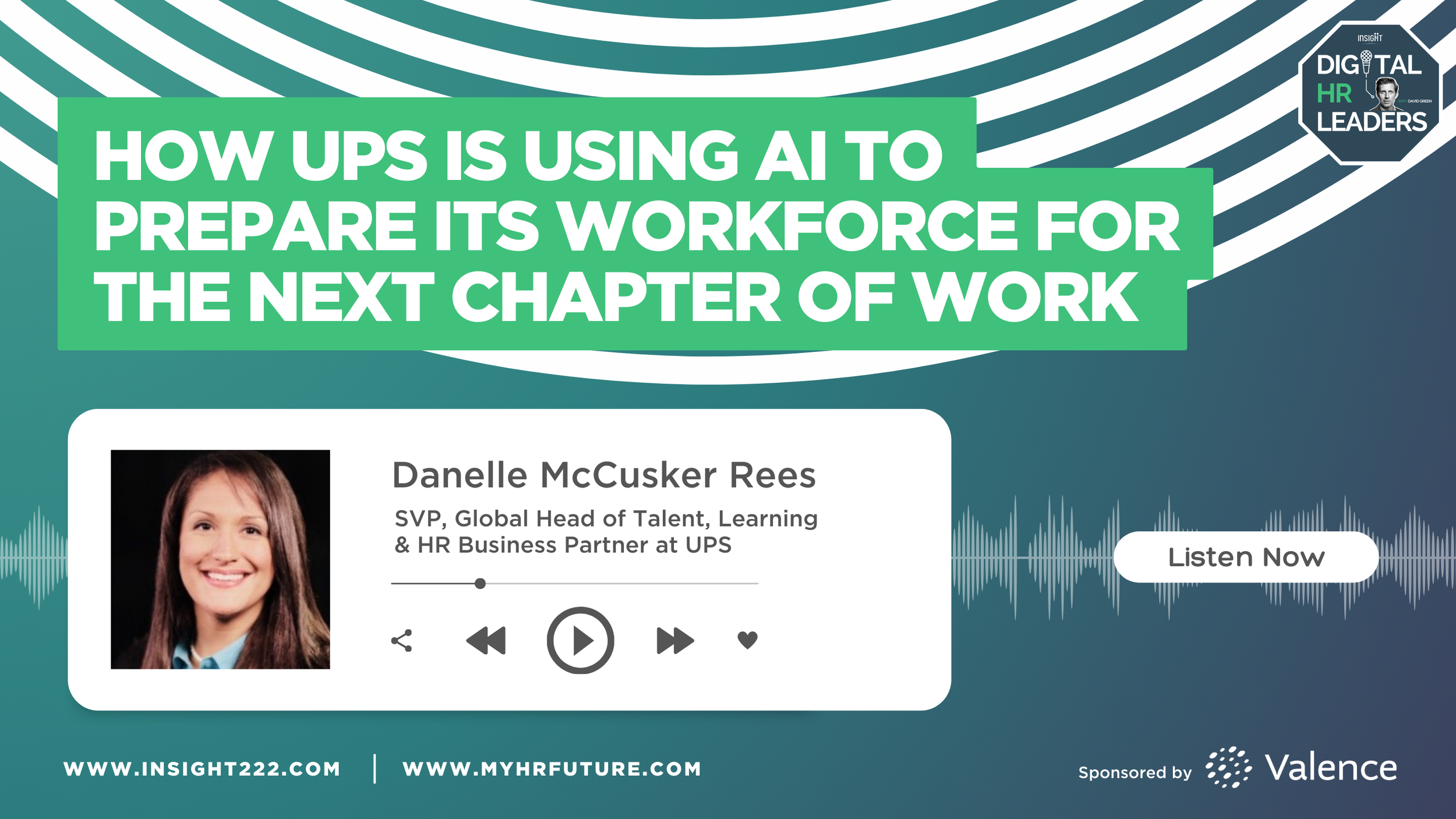
Can AI fuel a people-first transformation at global scale? At UPS, the answer is a resounding yes.
While many companies view AI through the lens of automation and efficiency, UPS is taking a radically different approach: treating AI as an enabler of human growth, not a replacement for it.
In this episode of the Digital HR Leaders podcast, host David Green is joined by Danelle McCusker, Senior Vice President and Global Head of Talent, Learning and Culture at UPS, to explore how the company is redefining what workforce transformation looks like in the age of AI.
With over half a million employees and a deeply rooted culture of promotion from within, UPS faces a unique challenge: how to prepare its people for a future defined by emerging technologies - while preserving trust, purpose, and opportunity.
Join them as Danelle and David explore:
Why UPS is designing AI implementations to relieve frontline burdens and elevate the value of human work - not eliminate it.
How a pilot with Valence’s AI coach Nadia is creating access to consistent, personalised development for employees well beyond the executive tier.
The role of psychological safety and experimentation in successful AI adoption
How HR and technology teams are partnering to drive cultural and capability transformation
What other HR leaders can learn from UPS’s intentional, business-first approach to AI
Whether you're in the early stages of your AI journey or looking for practical ways to align tech with talent strategy, this conversation offers both inspiration and actionable insights from the front lines of change.
This episode is sponsored by Valence.
Imagine if every employee had a world-class coach in their pocket. That’s exactly what Valence has created with Nadia - the AI-powered coach helping Fortune 500 companies scale development, boost performance, and support leaders at every level.
Learn more at valence.co/insight222
This episode of the Digital HR Leaders podcast is brought to you by Valence.
[0:00:09] David Green: For a lot of organisations right now, the pressure to do something with AI is intense. Boards are asking questions, leaders are looking for direction, and HR is right in the middle, without always being given the space to slow down and really think through what the right something actually is. Because adopting AI is one factor, doing it in a way that builds trust, capability and confidence across the organisation is a far more important factor entirely. And now, imagine doing that at scale across thousands of frontline operational and leadership employees. That is exactly what my guest, Danelle McCusker, President of Human Resources and Operational Training for US Domestic and Global Airline at UPS is doing. So, gear up as we explore exactly how Danelle is aligning business strategy with people experience, and how she and her team are building confidence and trust around AI adoption throughout UPS. With that, let's get the conversation started with an introduction from Danelle herself.
Danelle, welcome to the Digital HR Leaders podcast. To kick things off, can you tell us a little bit about yourself and your story and your role at UPS, please?
[0:01:29] Danelle McCusker: David, thank you for having me. I am an avid lover of sports and good, healthy competition, which I actually didn't know, in my younger years, would prepare me so well for the business. So, currently I'm the Senior Vice President and Global Head of Talent, Learning and Culture, and also an HR business partner for our Chief Digital and Technology Officer and our CHRO. And at UPS, we have a promotion-from-within policy and a very long history of developing and investing in our people, and I'm actually a product of that. I think the average reported is still roughly around seven different positions or professional career moves in a lifetime, and I've been very lucky to experience much more than seven moves in my career with UPS. So, a few months back, I actually counted, believe it or not, and in my 23-year career, I have had 17 very different titles. So, in communications, sales, health and safety, operations, a number of our different business units, and I've also worked internationally. So, for all of these rotations, I've always come back to HR. It's really been my passion. And I'm a firm believer that in order to create the best HR professionals, you have to have some exposure and a deep understanding of the business, the revenue drivers, and be incredibly intentional with connecting your HR initiatives to driving business value.
[0:02:54] David Green: Well, that's music to my ears, Danelle. We've had Dave Ulrich as a guest on the show a number of times, and he continually tells us, as HR professionals, make sure you connect what you're doing to the business and the key stakeholders that the business serves. So, that's very good. UBS is obviously a massive organisation and with a vast and diverse workforce, from operators and drivers through to finance directors and managers as well. Obviously, you've been with UPS for a long time. You took 17 different roles, which is incredible. What is your experience of running people operations for a business operating with such pace and complexity?
[0:03:33] Danelle McCusker: What an amazing opportunity to make an impact on people and our business. We are obviously highly complex due to our size, our scope, our scale, and especially the speed at which we operate. And right now, for example, is our busiest time of year, which is really exciting. Over the course of my career, just to give you an example, we've hired hundreds of thousands of people as seasonal help to help fuel our peak season, and we've improved that process every single year. For me personally, my passion and my purpose is really to future-proof our organisation through our people. And I believe that there's two distinct paths that are critical, especially in today's world, to make that happen. First is a bit relatable to Maslow's hierarchy of needs, right? While safety needs are important, I do believe that employers have the responsibility of ensuring that they are enabling their people by supporting them with some of their most basic needs. Second, also in today's world, the future-proofing piece of our organisation means ensuring our people are prepared for the future, by building a comfort level with technology, so they're really equipped to deal with the changes that continue to come at a faster and faster pace every single year.
[0:04:48] David Green: You mentioned as well, Danelle, that you are looking at talent, you're looking at learning, you're looking at culture, and you're also, I think you said you're the HR business partner to the digital-enabling functions as well. That's a really big remit, isn't it? How do you juggle all those balls?
[0:05:06] Danelle McCusker: It is. Honestly, I have an amazing team. I am incredibly proud of my people. I love being in this space personally as an HR professional. I've always come back to human resources, but I love being in this space, where strategy meets execution. And I have responsibility for both, from a COE perspective and then actually seeing how this strategy plays out, and how effective we are from the business perspective, from our customer perspective. So, yes, a big role, one that I enjoy. I love challenges, I love complexity, I love the problems that no one else can solve, but it's truly amazing to go on this journey with a team of people whose heart is really in it, who have a growth mindset, who are pushing the barriers, who push me, and we do it in a wonderfully collaborative way.
[0:05:55] David Green: How has UPS adapted its business strategy, and how involved were you and your team in helping to shape that strategy?
[0:06:03] Danelle McCusker: Yeah, it's a big deal in the macroeconomic environment that we have right now. So, of course, we continue to remain agile with our business strategy while we anchor to our core values. I think that's a critically important piece. Our business strategy is customer-first, people-led and innovation-driven. And as an HR professional, it is critically important to ensure your work aligns with the business strategy and also the future of where the business is going. So, we have a big responsibility in our field to constantly think ahead of the business. And as the Global Head of Talent for UPS, we have done a great job anchoring our business strategy to our talent strategy, and also developing just in the past year the critical capabilities for the enterprise, what's truly going to take our team forward. And of course, this will ensure a strong talent pipeline with the right capabilities, which you can imagine is our critical enabler for a business who has a very long history of promotion from within.
[0:07:04] David Green: In practical terms, you know, how do you in your role and your team, how do you translate UPS's business strategy into what you focus on in HR?
[0:07:14] Danelle McCusker: So, in our business strategy, the customer-first, people-led, innovation-driven, it really simplifies what we need to focus on in HR. Our customer lens is usually our people. And with a global company, of course, depending on the time of year, our size is anywhere from 400,000 to 500,000 people strong. And it's really important that we're clear with our expectations and truly put our people in a position to lead. So, one of the ways that we've done that is through our leadership model, where we really want to drive innovation and growth, especially in this AI world that we're coming into. And we have three pillars across our leadership model. So, it's strategise, inspire, and deliver. And it really helps us to ensure that we focus on the behaviours we want to see in our culture that will ultimately support our business moving forward. No surprise, but one of the key behaviours that we want to see is innovation as an example. So, we've been really focused on that as well.
[0:08:11] David Green: So, let's maybe look at that innovation piece. What are some of the things that you're doing from an HR perspective to, I presume, assess that during the recruitment process and then develop it through the kind of employee lifecycle of a very large number of people that you've got within the company?
[0:08:28] Danelle McCusker: Yeah, it's the skills and the investment that we have in our people from the front end. So, I anchor to that promotion from within, just to give some perspective and some data behind the numbers. Our latest number this year is 81% of our talent has been promoted from within just in the past year. So, you can see how critically important it is. Not everybody starts with the skillset. So, what I'm excited about right now is we are looking at the world ahead of us and we've decided that it was time to redirect and reinvest in our people in a very different way than what we have traditionally done. So, we're taking the time to align our programmes, our benefits that we offer. We're really big on tuition reimbursement, but we want to have that strategy aligned with much more intentionality, and with the critical capabilities I was mentioning that we see for the future. So, I'm really proud to say we've been focused on our leadership development, creating the right culture for our people to thrive. And while creating a culture of innovation where we can experiment, people mention it, but not enough in my opinion, and share the failures that we're learning from, it's really important to reinforce the growth mindset.
[0:09:37] David Green: And Danelle, obviously, you mentioned at the outset that you've had 17 different roles within the organisation. Presumably that experience helps you when you're thinking about mobility within the organisation itself as well?
[0:09:53] Danelle McCusker: Oh, it absolutely does. We are obsessed with our front lines. That's where the value of providing a service is to your customers. But being able to actually walk in the shoes and understand different roles, different business units, different countries and cultures around the globe, and have more of an empathetic approach when you have something as large as a Fortune 50 company and the COE responsibility, it truly has to resonate with everybody. So, those early career rotations and that experience and exposure, it was truly invaluable seeing the responsibilities that I have the opportunity to have today.
[0:10:36] David Green: What if everyone at your company had a world-class coach in their pocket? Meet Nadia, the most widely deployed AI coach in the Fortune 500, built by Valence. Nadia is the only AI coach that's fully customisable for any talent priority, from performance reviews and KPI alignment to frontline manager support and relieving HRBP capacity. Global leaders like Nestlé, Delta, General Mills, Prudential and more are transforming talent development at scale with Nadia. Discover how you can give every employee a coach who understands them, their team, and the whole organisation by visiting valence.co/insight222.
We talked a little bit about how you're translating UPS's business strategy. We talked about how, particularly when you're looking at the leadership development, you're looking at innovation and leading with technology. Of course, leading with technology is so important anyway, but particularly at the moment. So, how is that shaping your thinking around skills, development, preparing leaders and managers and employees for the next chapter of work, or the future of work, as we're very keen to call it?
[0:12:10] Danelle McCusker: It's really that shift. So, we were what I would consider quite traditional in the tuition reimbursement, in supporting the learning. And of course, there's foundational learning that every organisation has to invest in, right? How do you build the widgets? What's the correct method? What's the correct path? But that's where I'm really excited, is being able to look at the investment that we've had over the years, particularly in the lane of what we were reimbursing, for example, a general business degree. Isn't there a point now where we should be evaluating, does it need to go broader or does it need to become much more narrow? Robotics, for example. What are those critical skillsets of the future that we really want to draw our people into and make it an advantage for them to say, "We're going to support you, build your career, hopefully with us, but also have a skillset that we would really consider future-proofed".
[0:13:03] David Green: Yeah. And I guess, again, if you're promoting a lot of your leaders from within, which is fantastic, and that thing obviously is important, as we look at the supply of talent in probably most of the big markets that you're working in is drying out. It's getting harder to find people with the right skills. As well as helping them, I guess, with technical skills, with maybe skills around leadership, are you looking at helping them from a coaching perspective as well, to help them grow into those leaders that you want them to be and will need them to be?
[0:13:36] Danelle McCusker: Yeah, absolutely. One of the pieces, and certainly I'll give you a piece of my personal experience, without the mentorship that I have had over the years, and the people who were willing to lean in and to teach me and to put their arm around me and say, "No, no, no, don't do this, think about that, consider these pieces", it was a very human experience that I was able to have throughout my career with the wonderful partnership that we have at UPS. And I think one of the pieces that we are experimenting now with technology is, how do you get to that intimate relationship and that consistency in some of the content development, right? You can't teach every skill in a webinar. And a lot of what we do, of course, is hands-on and it takes time and repetition to kind of refine the skill. But being able to bring our learning programmes deeper into the organisation and also focus on our frontline, to that criticality of if we're promoting from within, we've got to have support with leaders throughout the entire organisation, and especially earlier in career. So, that's one of the things that is really important to my team.
We've done a lot of experimentation and a lot of pilots with, and we've actually started to work now, it's very early on, very early on, but we've started another pilot just from the professional development with Valence, and they've been wonderful partners; just starting to kick off with their, what we consider an executive coach, Nadia. To be able to scale that across the enterprise in a really positive way and have 24-hour access to the kind of mentor that I describe, as I had the wonderful opportunity to have coming up through my career, that hopefully we can go with a deeper, intimate, more one-on-one-focused relationship, especially for our frontline people.
[0:15:25] David Green: And I guess potentially, by bringing in a digital coach like Nadia, that allows you to have more employees, more potential leaders, more new leaders to actually benefit from coaching, than maybe we would have done in the past when you're relying on a human and a mentor or something, and it tends to be a smaller group of leaders that get access to that sort of mentor.
[0:15:51] Danelle McCusker: That's exactly right, David. And it's the advantage of consistency. So, I mentioned some of the critical capabilities of being able to future-proof our organisation and being able to develop and deliver in a way that is consistent with the expectations on behaviour and culture and our leadership framework. Those are really big, important things. And sometimes, the human isn't as consistent as you want them to be with what they are mentoring. So, we're really looking forward to learning a lot, certainly high, high expectations with this pilot. And it's just one of many that we're kind of experimenting with to say, really, how do you start to augment a human being and make this AI journey that we're all on about true employee centricity? People say, "Human in the loop", it's the human to be able to say, "How do you make their day easier? How do you remove some of the pinch points that they have and how do you bring on some of the true augmentation that we really expect from AI?"
[0:16:53] David Green: Yeah, and I guess as well, certainly again with the technology, it potentially allows you to have that coaching in the flow of work, not wait for an opportunity when you've got your mentor to talk to about it. You can actually be asking the digital coach the question as the question comes up effectively, and then help you maybe have a better conversation, for example, with one of your team.
[0:17:23] Danelle McCusker: Yeah, exactly. And I think you've hit on a critical point for all AI, right? Everything that we are able to touch should be happening in your normal course of work. It should be part of your daily routine. A process should be completely remapped to ensure that it's just brought in very similar to the internet. It's not seen as an extra or another thing that we have to do as humans in our day-to-day lives and in our profession. So, I do think that it's important. And I love the opportunity for the 24-hour access piece. You can imagine, our shifts are 24-7, our people are available. Something is happening somewhere in the world all the time with our great company. So, that's really important as we look at this from a global perspective.
[0:18:07] David Green: So, a lot of companies seem to be approaching AI from a cost or efficiency mindset. What sparked the conversation about AI internally at UPS? And what are the problems that maybe you've been trying to solve using AI? And maybe also, what opportunities are you trying to realise through using AI as well?
[0:18:28] Danelle McCusker: Yeah, we always think about continuous improvement cycle. How do we do more? How do we do better? What needs to be different? How do we improve our customer experience? What's the experience of our people? What value are we bringing to our stakeholders? So, I think we've been able to stay very well focused on just continuous improvement in the business in every aspect that we can have it overall. AI is certainly one of the tools that we consider when we're trying to solve for the business gains. And from our perspective, we've learned very quickly not to believe some of the hype and the headlines quite candidly. We've been moving faster to evaluate solutions and start piloting some initiatives that we can learn from. And directionally, this has been another anchor point back to our business strategy, don't just experiment to experiment; be clear on what problem you are trying to solve; and even then, make sure that that creates business value.
[0:19:22] David Green: And then, before you deploy anything, obviously AI is new to all of us, whether you work in a white-collar role, whether you're on the front line, and leaders particularly need to understand it. And I know that one of your responsibilities is learning, Danelle. How are you helping your senior leaders build confidence and literacy around AI? What are some of the kinds of conversations that you're having as you prepare the organisation for this shift? And maybe, what's some of the training and enablement and communication that you're providing?
[0:19:55] Danelle McCusker: Yeah, it's an excellent point. Leadership, setting up the right environment for their people, is critical. And first, you really have to demystify some of the rumours around AI and be clear on where we are seeing value. So, that communication piece in the change management is a really big highlight and focus. And we've done immersion-type training, specific leadership training, and we have a great structure in our technology group that actually helps to embed technology in every single area of our business. So, we have some expertise that's embedded in some really specific lanes. And I'm excited because we've seen success. We are using, to actually inspire and story-tell and create more success, so we're starting to get on that flywheel and have it moving a bit faster. And we want people in our organisation to understand that AI can augment our individuals as well as the organisation as a whole. So, that's where we've been focused and kind of sharing, as I stated before, some of the great successes, but also some of the failures and focusing on the, "We failed and this is what we were able to learn", and how we pivoted to hopefully lead to success.
[0:21:04] David Green: And again, not only are you responsible for learning in your role, you're actually the HR business partner for the digital functions as well, I think I heard you say as well. So, how does that play out? My hypothesis, and I might be completely wrong, so apologies if I am, is that your digital functions in particular are probably using AI and technology more than the other areas of UPS. Is there a specific focus for you in those areas as well?
[0:21:33] Danelle McCusker: Yeah, it's actually been wonderful to be a partner with our Chief Digital and Technology Officer. We have challenged ourselves always internally, again continuous improvement, to be able to move faster and be much more nimble and how do we and how do we and how do we. So, working through the structural pieces, along with him and his team, to be able to make it a much more nimble environment, make it make sense, and then see the experimentation in the output and the new pilots, and how do we fill our funnel with ideas and how do we lean in to our leaders and what they need to learn and the environment that they need to create. And you've heard, many of the audience has heard, I'm sure there are some companies that are looking at combining the role of the Chief Digital Technology Officer and the Human Resources Officer. Of course, you can make those structural changes. I will tell you in my humble experience, just being able to partner on the technology and the human side and have the collaboration that we've been able to have to build some of the internal classes and build some of the initiatives, it's really brought the human and the technology element together in a great way for UPS. So, really, really proud of that work. I'm very happy with the structure of the things that we've been able to do. And it brings us closer in a way, as the business partner relationship that's much different than the COE side of the world, right? You can move faster, you have a greater impact there.
[0:23:03] David Green: That's really interesting you say that, and it's great to hear your experience about that kind of close collaboration with digital and tech and HR at UPS. And obviously, we've seen a couple of companies this year come out. Moderna, I think, was famously the one that has combined HR and IT, and others seem to be working much closer together. I think at ServiceNow, Jacqui Canney is the Chief People Officer and also the Chief AI Enablement Officer as well, which kind of makes sense, because I guess you're trying to enable all the people within your organisation to be able to use some of these technologies as well. But from what you're saying, how it's playing out at UPS, certainly at the moment, and probably how it's playing out in many organisations, is a much closer partnership and collaboration between HR and technology. Is that something you see continuing into the future as well?
[0:23:51] Danelle McCusker: I definitely do. I think that there are huge advantages in being able, from the strategist side of human resources, to say, "If this is the technology, if this is what is important to the company, how do we continue to ensure our talent supplements that?" And it's the capabilities. I talk much more about capabilities than skills intentionally, because I think that we are lumping skills together in a really big way that your focus has to be on just the critical few capabilities. We really need to bring a discipline there. But being able to inform our talent work of what those future needs are going to be, through the technology lens of what's happening, I mean that's just one of the many advantages that we have with the closer collaborative. And then, you can kind of start to play with the organisational excellence piece and the change management that you're going to need and some of the structural and design pieces and what has to feed and work together. So, it really is a great tip of the hand to say, "Look, if my role and responsibility is to think ahead for the organisation, I've got to have that close connectivity". And that's why I get so excited about the relationship.
[0:25:00] David Green: Well, yeah, and it is exciting for us if we're in HR, and hopefully exciting for our colleagues in technology and IT as well, to work closer together, because it's kind of a new stream of HR maybe from what we've been used to in the past. And you can probably see the impact quite visibly on the workforce as well when it's successful.
[0:25:20] Danelle McCusker: You absolutely can. And I do think it will change our function. I think our HR business partners just broadly, right, not just internal to UPS, just a broad statement from a macro perspective, we still have a question on the tactical and where's the high value of the work. And I think part of this augmentation for our department is to start shifting that story and really look at focusing, what do we do for our customers?
[0:25:46] David Green: I want to take a short break from this episode to introduce the Insight222 People Analytics Programme, designed for senior leaders to connect, grow, and lead in the evolving world of people analytics. The programme brings together top HR professionals with extensive experience from global companies, offering a unique platform to expand your influence, gain invaluable industry insight and tackle real-world business challenges. As a member, you'll gain access to over 40 in-person and virtual events a year, advisory sessions with seasoned practitioners, as well as insights, ideas and learning to stay up-to-date with best practices and new thinking. Every connection made brings new possibilities to elevate your impact and drive meaningful change. To learn more, head over to insight222.com/program and join our group of global leaders.
I just want to get back to one of the things we were talking about a few minutes ago, the pilot that you've started with Valence with using Nadia. I'd love to learn a little bit more about that. As I said, I think that piloting some of these really cool tools and technologies is really important, I think, for HR to show where it can be successful within the organisation. I'd love to learn more about the pilot. What group did you choose to start with? What do you want the experience to feel like for employees? Maybe what were some of the non-negotiables for you?
[0:27:29] Danelle McCusker: So, from an HR lens, one of the problems we were trying to solve that I touched on earlier is really scaling a higher touch developmental support much deeper into the organisation, with an ultimate focus on our front lines. Now, in fairness, when we say early days, we are in the incredibly early days of getting started in this pilot, literally one week in. And I have to say the Valence team have been great partners to this point and have completely understood we're looking for data at the end of this pilot that is tangible and that we can show creates business value. So, any HR professional understands that in our space, it's very hard to do. And I joke, but I'm not joking, I've quite literally made a career out of it. So, we are experimenting with two distinct groups to give us a strong comparison of results. One is more of the sales focus; the other is a bit more of a broader cut across several different areas and functions, so that we can have more of a general view.
I really have to plug my team for just a moment, David. I am so proud of my team for the way that they have socialised the possibilities of the pilots with our stakeholders. As an HR professional, wins come from having our customers in the business ask for more of a service that you're providing. And we're hopeful that Nadia is one of the things that they're asking for more of, and we'll certainly see. And my team also continues to push the boundaries on what's possible and think differently. So, it's selfishly, it's really great to see your team not only identifying the critical capabilities needed to truly future-proof the organisation, but also at the same time, demonstrating those capabilities in their day-to-day work.
[0:29:14] David Green: We really appreciate you speaking to us so early into the pilot. I can only imagine it's really helpful for people listening as well, who are maybe also either in the really early stages, or thinking of embarking on a pilot either with Valence or with other technology partners at the moment. I'd love to ask two questions. So, the first one, as you're early in the pilot, I'm going to ask you this one. If you were to give advice to other listeners who are maybe thinking of setting a pilot up, what would be maybe the two or three things you'd say to them that are really important when you set a pilot up like this? And then, the second question is, and I appreciate it's early stage yet, what's the feedback been so far, even early feedback from leaders and employees engaging with the pilot?
[0:30:03] Danelle McCusker: I think the two pieces of advice, just off of the top of my head, it is early stakeholder engagement. And it draws back to being able to pull in the stakeholders who are going to care about your results at the end of the day, understanding early what is important to them. And then, that way you can base your data set off of what feedback they're giving you. So, I think that is critically important, to have that kind of alignment and understanding of what you're actually doing, what are you experimenting; and it's, again, the drive business value piece of it. The other piece is do not be shy about the talent that you need on your team to execute a real pilot with real results. For me, it was really, really great to have some excellent talent to choose from, people who have been highly engaged, who are my thought leaders, and get the right people on the project.
Now, what that did, and it might have made some people uncomfortable, but I was pulling from different parts of my structure. It wasn't a, "This vertical and this vertical and this vertical". So, I'll put it in a way to say I would really advise you to consider how can you flatten your organisation and really operate in a collaborative way. And my team knows there's no regard for titles or levels or what your day job is. This is our mission together, and it has been really awesome to see them come together in such an agile way and make an impact across our business.
As far as engagement with leaders from the pilot, whenever we went through our socialisation, we were really working with the Valence team, and we were excited to see some of the behaviours coming from their team and from ours to support innovation and curiosity. And we were really coming out strong from our people who we were socialising with, right, "Tell me more about it, I want to know more". So, that curiosity was sparked and that was part of our intention to say, "Is this enough that you would care about it, right? Could we sell this at the end of the day?" We have a lot of people on the front end who are really excited and they raise their hand to be part of our test experiment. And that's important to me as you run a pilot, you never want to force it on people who don't want to participate. So, I think just an early lesson learned and something to share broadly, being able to have the people who are curious enough to volunteer and pull them in and get their feedback, definitely an advantage. So, hopefully in a few short months, we'll be able to have our first results and share some big data.
[0:32:32] David Green: And it sounds like what you're really doing there is you're being very clear with the employees that are part of the pilot, and you're helping them feel comfortable and maybe even optimistic and excited about using the tool. And is there anything else that you would share about that in general terms about how you help employees get excited about maybe using this technology in their day-to-day work?
[0:32:58] Danelle McCusker: I have to say our executive leadership team has been incredibly supportive in making sure that we take a humancentric approach. And as leaders, just focusing on removing some of the fear, the fear of AI and the headlines of, "AI is going to come for every human being and their jobs", it's real. So, we have had intentionally a few sessions to spark curiosity with things like Copilot that they can touch and, "Hey, did you know?" And this has really helped them to experiment in a safe environment and push on what's possible. I mentioned the flattening of the organisation. Our organisation, as you can imagine, is highly matrixed in nature. But being able to drive that collaboration and sharing across the groups that I was talking about, that's really been another way that we've been able to take on this AI world and how do you bring it in into your workflow. And I'm excited to say that's always been a part of our culture. So, at UPS, we actually call it partnership. And it has been great to lean into this core of who we are as UPS'ers, to draw on both the successes and the failures and share those as we learn, so we can kind of be the multipliers of that adventure.
Then finally, I'd say we've done well in encouraging our people to start small. So, with a pilot, it's low stakes, learn, adjust, and then start to scale. And this actually creates something that we haven't talked about yet, which is the psychological safety we really want our people to have. And it helps to build trust and a stronger level of comfort with AI ultimately.
[0:34:39] David Green: I've got three questions left, Danelle. One is the last one, which is the question of the series. The second one, I'm going to ask you to kind of look at CHROs and HR leaders generally. But the first one really is about UPS. What do you hope UPS will look like in maybe two to three years now, because of the choices that you and your fellow executives in HR are making, but also the executives in the business are making as well?
[0:35:08] Danelle McCusker: I really believe we will be seen as more of a technology company and a leader in this space. I think that we're going to have a workforce that makes the augmentation of technology seem like something we've always done. I think that we're going to realise opportunities and efficiencies that we might not think of as even possible today, just by consistently staying focused on the continuous improvement cycle. I think a big part of this is going to be remapping our current processes so that technology can play a stronger role, right, that mapping from beginning to end. For our people, I think that we are going to be able to build capacity for ourselves and spend more time on what really matters. But one of the things I don't see changing is our purpose. And I believe that in two to three years, we'll unlock ways that we didn't even think it possible to make that purpose come to life. And for UPS, it's moving our world forward by delivering what matters. So, I really expect an unlock that we haven't even thought of in bringing that purpose to life.
[0:36:14] David Green: It certainly sounds like a really exciting time for the organisation. Obviously, it's an organisation that's been around for a very long time, and it sounds like it's an exciting new chapter that you're entering at the moment. So, Danelle, for CHROs and HR leaders who may be listening, who may feel under pressure to do something with AI, which I think is a phrase I hear from a lot of people, but they're also trying to protect their people and culture, what are the one or two pieces of advice you'd offer from your experience so far?
[0:36:46] Danelle McCusker: Yeah, first, remain focused on a humancentric approach. We've seen a lot already of the AI mandates that have come out, or the very early guesses on workforce reduction, that honestly aren't exactly coming to fruition. Not to mention, this really puts fear in the middle for our people, rather than innovation at the heart of technology expansion. So, I think when you genuinely focus on eliminating the pain points for your people and allow them to build capacity for higher level work, you're helping them to engage and participate in what's really possible. Second, I would have to say encouraging that growth mindset along with experimentation. It has to be okay, as we mentioned before, to have a hypothesis, test it, fail, most importantly, learn and adjust. And if everything that you are doing is a big bet or expected to scale without learning, it really removes that psychological safety that's so important in setting the right culture and environment.
[0:37:51] David Green: That's great. Some great pieces of advice there, Danelle. Well, we're getting to the question of the series. So, this is the last question of the Valence series, actually, because this is the final episode of the series as well. And it's our final episode before the holidays as well, Danelle, so no pressure on you for this question. I'm just joking! And I think it will talk to some of the things that you've already said as well. So, again, feel free to provide a kind of summary of some of those. How can Chief People Officers and Senior HR Professionals influence leaders to use AI to augment rather than replace talent?
[0:38:28] Danelle McCusker: So, fortunately, I think we've had quite a few proof points in the headlines over the past few months that has hopefully helped to dispel some of the, "Technology will replace all humans tomorrow", thought, and I think we can leverage those proof points. And I do believe that one of our superpowers as HR professionals is truly influence. And in order to do that, you have to have a strong reputation of trust, which usually starts with being credible by providing compelling data, right? You've got to be right, you've got to be accurate. And finally, I think really pushing for pilots to learn. We know in HR, we have some tough customers, and sometimes no matter what we try to do as far as influence or provide data, we're still going to go down a path, but still anchoring to a pilot and let's see what we can learn. So, even if a business leader is really focused on replacing talent, a pilot environment at small scale will certainly help to collect some great proof points, which can help to reshape the focus from replacement to augmentation.
[0:39:33] David Green: I really love that, really emphasising the influential role we can play in HR. Also, love the fact that you were talking about that kind of culture of experimentation and using data. And also, how you talked about linking what we do in HR to the business. I think there's three at least, and there's more in the conversation, Danelle, that I think that people can take away from this. So, thank you very much. I thank you again very much for joining us at your busiest time of year as well at UPS. It's been a real pleasure to speak to you and learn about the work that you and the team are doing at UPS as well. Can you share with listeners how they can follow you on social media, if you do social media, and maybe all the great work that you're doing for the field? And perhaps also for people that are interested, how they can find out more about opportunities at UPS?
[0:40:] Danelle McCusker: David, thank you again for having me and for such a great conversation. You can certainly find me on LinkedIn, that's where on social media I spend most of my time, and I would love to hear what some of the HR professionals in your audience have learned on their own AI journeys.
[0:40:37] David Green: Fantastic. Well, Danelle, it's been an absolute pleasure to speak with you today. I hope to see you at a conference at some point in the future, maybe at UNLEASH in Vegas maybe in March next year. But otherwise, thanks very much for being a guest on the show.
[0:40:52] Danelle McCusker: Thank you.
[0:40:53] David Green: Thank you again, Danelle, for joining me today. What a fantastic conversation. What really stood out for me was how intentional UPS is being, starting with leadership understanding, being clear about non-negotiables, and focusing on how AI can support people, rather than create anxiety or distance. It's a powerful reminder that successful AI adoption isn't about moving fastest, it's about moving wisely, with clarity about the outcomes you're trying to create for both the business and your people. To everyone listening, I'd love to hear your reflections. What resonated most with you from the conversation? You can join the discussion on LinkedIn. Just look out for my post about this episode and share your thoughts. I always enjoy hearing what you take away from these conversations. And if you found today's conversation helpful, valuable, be sure to subscribe, rate, and share it with a colleague or friend. It really helps us keep bringing these kinds of thoughtful, forward-looking conversations to HR leaders and professionals around the world.
To stay connected with us at Insight222, follow us on LinkedIn, visit insight222.com, and sign up for our weekly newsletter at myHRfuture.com for the latest research, tools and trends shaping the future of HR and people analytics. Before we wrap up, I just wanted to say a very big thank you for listening to the Digital HR Leaders podcast in 2025. It really does mean a lot. With that, we'll be taking a short break over the holidays. We'll be back with a new episode on 6 January. Until then, I wish you a happy holiday to those that are taking a well-earned break, and a relaxing end to the year to everyone else. Take care, stay healthy, see you in 2026.