Episode 275: How GSK Built a Skills-Based Organisation in 18 Months (with Zaka Farhat)
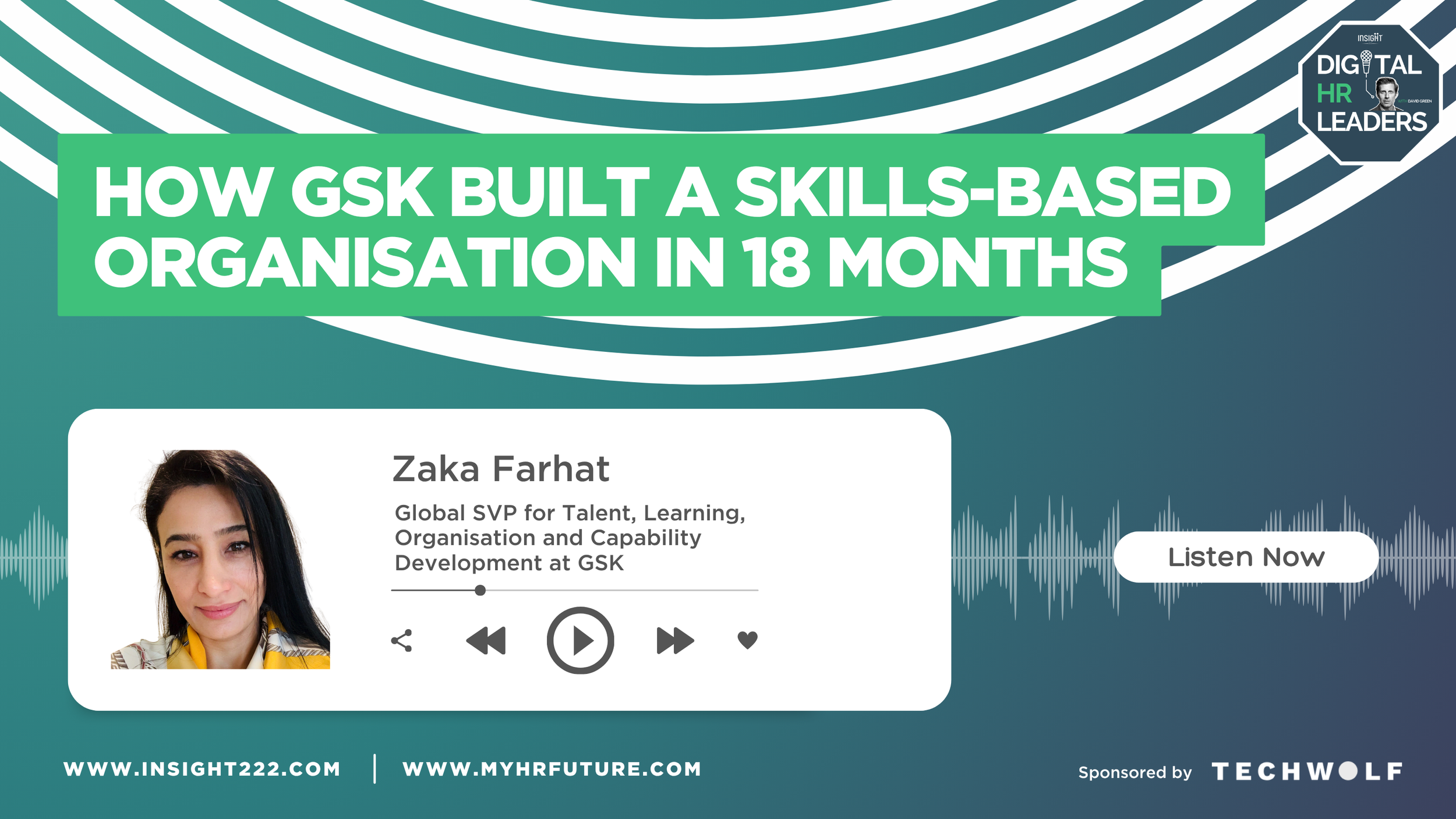
How do you rebuild a company's entire capability infrastructure — and fund the transformation through the savings it generates?
Zaka Farhat is Global SVP for Talent, Learning, Organisation and Capability Development at GSK, where she leads the company's enterprise-wide skills, learning and capability agenda. In this episode, Zaka shares the full story of how GSK rebuilt its capability infrastructure in 18 months - retiring more than 20 legacy systems, building a single skills and learning ecosystem, and funding the transformation through the savings it generated.
Join them as David and Zaka discuss:
Why GSK's skills transformation began with a commercial question about capability and cost
The five conditions for organisational readiness that had to be in place before any platform launched
How GSK approached skills taxonomy, job architecture and inference, and what they had to redo along the way
What personalised learning looks like at scale, and how skills data is now shaping workforce planning decisions
What GSK chose to stop, and why decommissioning is the step most transformations skip
How Zaka's team is measuring impact across three KPI layers
This episode is sponsored by TechWolf.
The world of work is being rewritten faster than HR systems can keep up. Skills age in months. Roles get redesigned quarter by quarter. CHROs have quietly become AI transformation leads, and the data they need to lead it doesn't exist in any HR system.
That's why the world's most forward-looking enterprises such as HSBC, AMD, T-Mobile, GSK, ServiceNow, Pfizer, have built on TechWolf.
As the data layer for the AI era of work, TechWolf gives enterprises the skills, they need to move faster and lead with confidence. Skills Intelligence, Work Intelligence, and Market Intelligence, in one layer. Visit techwolf.ai.
This episode of the Digital HR Leaders Podcast is brought to you by TechWolf.
[0:00:08] David Green: For many companies, the skills transformation conversation starts with a platform. A vendor is chosen, a system is launched, and the hope is that capability will follow. Zaka Farhat, Global SVP for Talent, Learning, Organisation and Capability Development, and her people team at GSK started somewhere else entirely. When Zaka and her team examined why GSK was relying heavily on external hires, seeing limited internal mobility, and struggling to close capability gaps, the answer pointed back to a fundamental business question about capability, and that starting point shaped everything that followed. In just 18 months, GSK retired more than 20 legacy systems, built a single skills and learning infrastructure from the ground up, and did it in a way that was self-funding. I actually got a preview of this work at a TechWolf Skills workshop in Ghent recently, where Zaka's colleague, Tanya Jain, walked the room through what GSK has been building. And it was definitely one of those moments where you think, this is what good actually looks like. So, I was really keen to get Zaka on the show to go deeper on the story.
Today, we get into the five factors GSK focused on to build organisational readiness and capability, how they approach skills taxonomy and inference, how they have transformed learning, what they chose to stop to make room for what was new, and where Zaka and her team are heading next. Whether you're at the start of a skills transformation or already mid-journey, there's a real blueprint here. So, hit save, make sure your earphones are fully charged, and let's get the conversation started.
Today, I'm absolutely delighted to welcome my guest for this episode, Zaka Farhat, Global SDP for talent, Learning, Organisation and Capability Development at GSK. Zaka, welcome to the Digital HR Leaders Podcast. I'm really looking forward to this conversation today. Let's start with an introduction to you. What was your career journey that brought you to your current role, as we said earlier, Global SVP for Talent, Learning, Organisation and Capability Development at GSK? You've had quite an impressive career.
[0:02:26] Zaka Farhat: Thanks, David. It's actually a real pleasure to be on this podcast. I've been a long-time listener. Honestly, my journey wasn't linear. I started actually out in finance, and smoothly into HR in different industries. And the last 15 years, I was in healthcare. What's pulled me through every transition has been really the same underlying question, "What is it that makes people genuinely perform at their best, and what gets in the way?" So, that sounds simple, but it's the question that sits underneath every part of what HR does. Throughout my career, I learned that strategy without behavioural change is just a deck. In the most recent role that I have now with GSK, in my talent role, I saw what genuinely AI-enabled people, solutions, and intelligence could look like at scale.
But however, I would probably share throughout my career three things that stayed consistent with me. So, first, I genuinely believe HR best sits at the intersection of business strategy, data, and deep respect to people's experience. The second one is, I've always been drawn to the messy transformation roles rather than the steady state ones. There is actually a particular kind of energy in building something rather than maintaining it. And thirdly, I've come to believe deeply in purpose-led organisation. And that's why I probably was stuck in healthcare for the last 15 years.
[0:04:06] David Green: Really good. And I saw that you actually early on in your career, you spent some time at the UN as well. So, that kind of purpose-driven career has obviously been a common thread throughout your career, hasn't it?
[0:04:19] Zakaa Farhat: Yeah. And it's really interesting, because definitely, shifting from finance to HR wasn't by purpose, but finding a purpose in HR and also finding a purpose in a company that has a big mandate, it's really doubled the excitement, and also gives me a motivation to even give my best every day in the job I love.
[0:04:43] David Green: And I think, Zakaa, what you said, you were talking about those three threads that are important. When I was looking, you lead the global COE of talent, learning, leadership, and skills enablement at GSK. And I saw that you have talent intelligence, people analytics, culture, performance, AI transformation, organisational effectiveness, and development inclusion there. That's a great collection of things to have to, as you said, help understand what makes people perform, and get the things out the way that prevent them from doing that. That's a great, great position for you to have in terms of having all those sorts of things together and levers that you can pull.
[0:05:25] Zakaa Farhat: Yes, actually, when I took my current role in GSK, this actually brought all of those together, as I earlier mentioned, in a company actually whose purpose I genuinely believe in. My mandate was actually in GSK to modernise the HR offering in our AI era, and to do this in a function that touches every leader, every employee, every workforce decision we make. That's a hard job and a deeply interesting one. I haven't been bored, to be honest, a single day since I started this job.
[0:05:57] David Green: So, Zakaa, I had the privilege recently of attending a skills workshop hosted by TechWolf in Ghent, where your colleague, I think one of your team actually, Tanya Jain, was walking through what GSK has been doing around building around your L&D and skills transformation, and it was super-impressive. And everyone in the room was really impressed with the work that you're doing. So, I was particularly delighted when the opportunity came to speak to you on this show. So, let's go back to the beginning. What was the trigger that made GSK stop and say, "We need to fundamentally rethink how we approach learning and skills?"
[0:06:35] Zaka Farhat: Yeah, thank you. And, yes, I mean Tanya is brilliant. And also, Carlo and the team and the wider team have been doing exceptional work. And I'm glad it actually landed very well in that conference. For us, the trigger wasn't really a skill problem, and actually it even wasn't a learning problem. To be honest, it was a commercial one. Over a relatively short period of time, our R&D engine had really scaled dramatically; our investment had doubled since 2016; we've been really growing also at double digits as a company for the last few years; and more than half of our pipeline has now been shaped by business development, strategic partnership. So, we've actually been scaling externally into areas that demand new capability. And those capabilities exceeded our ability to build them at scale internally as a company. So, most of the time, we've been really hiring a lot of those skills externally, so we're buying those skills. And we know buying external skills comes with a cost and a higher cost. And we've seen our internal mobility was actually very limited. And in a regulated and complex business like us, external hires take a lot of time to productivity.
So, the result basically was higher workforce costs, and slowed time to value. So, that was really the big issue we're trying to address. And when we interrogated why, the answers were actually uncomfortable, but they were clear. We didn't have the enterprise visibility first on the skills, we didn't have the common language on what good looks like across all roles. We have a lot of developmental offering programmes at every level in the organisation and all of the countries, very decentralised, but was very generic, wasn't targeted. And our learning technology, which was the biggest mess, was very fragmented. So, this is costly. And the bigger one, actually, we have a gap in our skill needs. So, once we named that as a business capability and mobility problem, basically the imperative was very obvious. It wasn't about really patching a learning system, it was about moving quickly to close that gap that was costing us money, time, and also losing a strategic advantage that we have.
[0:09:12] David Green: And what really struck me again about the GSK approach, when Tanya was walking through it, and the conversation that we had as well, Zakaa, a week or so ago, is that you didn't just launch a new learning platform and call it a transformation. You actually have first of all had to build the conditions for it to work first. Can you walk listeners through that, please? What did organisational readiness actually look like in practice?
[0:09:40] Zaka Farhat: You're absolutely right actually, and this is part of the story that doesn't get told often enough. Buying a platform and switching it on is actually the easy bit. The real transformation was building the plumbing underneath and the conditions that you just highlighted that have to exist before that platform even stands a chance of landing. So, for us, organisational readiness meant really five things. And maybe there are more than that, but maybe I would highlight the five. First, really, the leadership alignment at the top. So, really, we worked very hard to get that alignment and to speak the same language, although we've done the transformation in 18 months, but the outcome takes more time. And it's not like a 12-month platform launch. That distinction matters because skills work doesn't deliver visible results, as I mentioned. The foundation takes longer than that, which is basically the carrot there. But without leadership that understood what we were investing in, we weren't investing in buying a learning experience system or building a skill taxonomy and a system or buying an insights platform, we are investing in capability infrastructure that is sustainable and it's actually even less costly.
So, second, I think this, and you just mentioned it, is that single data foundation. And I know every company is really looking into this right now. Even with agentic, it's going to be the most important thing we need to build. And in a company that has a lot of legacy of different data sits in a lot of places, it becomes even more complex to really connect the data and make it really usable. So, this is actually the partnership that we've been working with my team. I have also a team that runs people data analytics. So, really, building that platform that is laying on top of our people data, and even bringing more data that we didn't have in that data lake, it's really important, because the skill data, learning data, workforce data, recognition data and mobility data, and much more. So, all of this actually has to talk to each other and has to tell a story. So, they are really giving us a lot of signals, but it's not about really only data, it's really how you pull them together to really understand what you're doing.
I think the third element is really governance. And I think companies who work in a decentralised model, specifically if you have compliance training, product training, technical training sit in different areas of the organisation, we had to work on it, because we built a single platform to really centralise the employee experience, which is basically the go-to. We call it L&D Hub. And basically, to enable what gets into that aggregator, we have to stand up a global learning council and skill council, also to enable us to futureproof our skills taxonomy and not only building it once, like how we can make it agile, how we make our learning content more aligned to what we really need, and also setting minimum standards for learning. So, we had to introduce new tools even to get to increase the quality of the learning and generate learning in a certain way.
So, I think the fourth one is actually decommissioning, so really, how you move forward to decommission and how you move from the past to the new. And this is actually where most organisations skip, but I would argue is actually the most important. So, we made a call early to retire legacy systems, to rationalise our vendor portfolio very aggressively, cleaning up our assignments profile. And by the way, we unlocked millions of dollars. So, with that money, we reinvested in a new AI-powered ecosystem, and we increased the experience tremendously. And we still saved with that transformation, which is actually, who doesn't like this story? For a CFO and CEO, it's probably a very compelling story. And I would say the fifth one, which is underrated, is the capability in our HR team themselves in building that, and really letting go and empower, because we want to empower now our people and leaders to go and use all of those tools themselves with direct access. So, that's why actually we piloted with our HR community last year first before we scaled up, because we want them to understand the journey and what are the changes we really want to make.
So, basically, the plan launch was the visible moment, but the real transformation is lived into that 18 months of alignment, data plumbing, governance, stopping old things, and also building new capabilities.
[0:14:48] David Green: This episode of the Digital HR Leaders podcast is sponsored by TechWolf. The world of work is being rewritten faster than HR systems can keep up. Skills age in months, roles get redesigned quarter by quarter, CHROs have quietly become AI transformation leads, and the data they need to lead it doesn't exist in any HR system. That's why the world's most forward-looking enterprises have built on TechWolf. TechWolf is the data layer for the AI era of work. It connects three data sets that have never lived together, the skills your workforce has, how their work is changing under AI, and where the labour market is heading. Skills intelligence, work intelligence, and market intelligence in one layer. HSBC, AMD, T-Mobile, GSK, ServiceNow, Pfizer, and many more rely on TechWolf to deliver measurable impact, including cutting time to a unified skills foundation from 18 months to three, servicing 800-plus deployable internal candidates in under 30 days, and unlocking more than $8 million in projected L&D savings at one global biopharma. If skills, work, and labour market data is what's standing between your enterprise and its AI transformation, talk to TechWolf, the data layer for the AI era of work. Visit techwolf.AI.
You mentioned a number of things, Zaka, skills taxonomy, governance, job-to-skill mapping, also important in building an effective skills transformation. What was some of the thinking about building that foundation? I mean, again, dive into any of those five areas or the skills taxonomy, for example. It's hard, isn't it? So, that's why you need the leadership support. But yeah, tell us a little bit. How did you think about building that foundation?
[0:17:01] Zaka Farhat: So, the way we actually approached it is starting with really the end in mind. So, the taxonomy itself wasn't the end. It actually enables what we really want. So, we asked some simple questions up front, "What do we need our employees to know? And what decisions do we want to take using this data?" And really, when we answer those questions at the beginning, we can structure the taxonomy and really connect the system in a way to enable us to make better decisions across hiring, development, mobility, and workforce planning. And this is how we start designing it really, like what do we want to get? What kind of data and insights will we want in 18 months from now? And this really shifted the focus to what it could look like. And we started actually with job architecture. We didn't know at that point that actually we need to revamp our job architecture. We just thought that we could use AI to infer the skills from the job architecture and everything will be fine. So, we had to do some rework and say, "Okay, let's go back now, futureproof our job architecture".
I think a lot of companies like us as well, we use our job architecture for just salary benchmarking, grading, not really to define the work and really capture the work. And that was a big aha moment for us, and we took time. But the good thing is that we did it in a very compressed period of time, because we were using AI at all levels. And so, basically, that made it faster. And then, I think working with the SMEs across the company, really not starting from a blank page. We didn't tell them, "Just go and tell us what skills that's attached to those jobs", to really using AI to do all those signals inference, both for the job and the job families, even getting external signals for them to really understand how they really want to look at their jobs and also look at the skills.
We also did some work centrally on the skills that we think are important for our leadership and also the skills that are attached to our culture. I think there is a misconception in that, and I was guilty as well. I didn't think skills could be soft -- or not soft. I would say I didn't think that actually skills could be behaviours. And I think really, we have actually a skill taxonomy that has different layers, could be technical, could be also related to the behaviours we want to embed in our culture. So, I think that was really a good way to start prioritising what's important and not debating the definition, because we had to standardise the vocabulary of the skills. I think the biggest, to be honest, challenge was moving from competencies, and we have those everywhere in the organisation to say, "Now, you don't really need it. Now, you're going one level down. So, you have the capabilities that you really need and you want to translate this to skills, and you don't really need those big competencies model". And that's, I think, the shift.
[0:20:04] David Green: And you talked about skills inference as well. We've had different guests on the show that have also used technologies such as TechWolf for doing skills inference, and then others that have kind of built skills by going out to employees and asking employees for skills, and then looking at having them validated by managers. Can you talk a little bit about the benefits of skills inference and how that's really helped you in this transformation?
[0:20:31] Zakaa Farhat: That definitely cut the time probably by 90% of the time investment you do with the traditional way. I think the learning is that as much as you have good understanding about the jobs you have, you would get a better skill inference. So, that's why we had to go back and look at our job architecture: are those the right jobs, the right roles, the right focus? Is it really futureproof? So, if we get that, I think we will be at an 80%. We already got that caught that, which means the 20% really fine-tuning and really understanding where are those transferable skills, are those our critical skills for the future? So, actually, I wouldn't imagine us doing it without AI in this world, specifically in 18 months. If I have five years, probably I would have done it the old way. But I think definitely with AI, things will become much better. But you need to be clear as a company on what is your level of tolerance of not everything has to be perfect. You are building something agile that might be evolving every day. You will get signals externally and internally as well, and you need to futureproof that all the time. So, building it in an agile way is actually even the most important; it's not building it once.
[0:21:52] David Green: So, a couple of things linked to learning really now. So, I know the initial thing that you were really trying to achieve was that personalised learning experience. So, again, this is based a little bit from our conversation a couple of weeks ago, but also from watching what Tanya presented at the recent TechWolf roundtable. So, firstly, what does a personalised learning experience look like today at GSK? And then, how are you using that skills data to make business-critical decisions about where the investment in L&D is moving forward as well?
[0:22:28] Zaka Farhat: Yeah, and the good thing is that we didn't find it hard to sell the idea of personalised learning, it was more of explaining it, what was hard. So, I would say for an individual, what's the main difference is that in the old way of doing things, I would go and search in a catalogue, search for my training. So, trainings were around the outcome of that specific training, not necessarily on the personal need. And personal need stems from two areas, to be honest, as an employee. Like, "I want to learn a new skill and develop just because I'm interested, or I want to get a promotion, or I'm looking to go for a lateral move", or, "You know what? I don't like my job at all. I want to change my job and I want to do something else, either within the company or externally". So, providing that personalised opportunity, based on where you are, what we know about you right now, what we know from skills needed for your role, and skills that is actually needed for every single job at GSK, made the big difference.
So, suddenly you go to L&D Hub, you see your own skills, you can maintain those skills. And also, it's based on AI inference, so we can actually save a lot of hours from an employee. And also, you can see the skills that are required for your job. So, you can select those focus skills, and immediately, you will get AI, which will basically give you personalised opportunities and learning. And not only learning, it gives you actually different types of opportunities. And we have a talent marketplace that we are looking at, it could give you a job opening recommendation. And doing this in a way that layering on top an AI coach, it's powerful, because then the AI coach would actually help you develop the right skills in a conversational way, help you prepare for development conversation even with your employee, and also doing skill reviews and skill assessment. Because when we launched it, I think last year, we were relying on people to rate themselves in a proficiency. We didn't have an AI to enable people to determine what is the right proficiency level. And that information is really important for us, as a company, to understand the gaps, and also for employees and managers to feed into their mid-year conversation, year-end conversation, because we embedded the skills conversation in those moments that matter from an employee perspective. So, that is the experience that people don't have, and that's basically what we call personalisation.
I would say the level two, which is basically something that is more strategically important, is the data, and I think you asked about skill intelligence and how we can use it. So, it's really giving us insights we never had before on where we need to prioritise learning, where we have a lot of content that nobody uses. So, where do we really need to double-down on content to build the specific capabilities? Where do we not want? Where are the biggest priority gaps, and how we can address this at a team level or a country level or even a business level or even across the organisation? So, that reallocating learning investment, it was really a big moment from a skill intelligence perspective.
The other one is workforce planning. And I would argue for HR and for the organisation, that's the most important element that we use skill intelligence on. I know personalised learning is amazing, but workforce planning is really giving us that, and not only skills insights, it's actually even task intelligence, and really understand where AI is going to impact work, what are the tasks that need to be augmented, automated, boosted by AI. So, those really give us understanding about the evolution of the work, evolution of our employees, and how we can bridge the gap as we go again in an agile way, because in the past we used to do workforce planning once a year. It's a heavy exercise, and we link it to headcount planning, and it was actually only a headcount allocation and collation. And we are now moving to a way, like we have a lot of data and skill intelligence. You can use it to determine what you want to not only build, buy, and borrow, but also bought and where you need to automate. And it's a different skill for the HR community as well, and we are actually trying to really embark on a journey, like how we can upskill our community into that.
[0:27:14] David Green: I want to take a short break from this episode to introduce the Insight222 People Analytics Program, designed for senior leaders to connect, grow, and lead in the evolving world of people analytics. The programme brings together top HR professionals with extensive experience from global companies, offering a unique platform to expand your influence, gain invaluable industry insight and tackle real-world business challenges. As a member, you'll gain access to over 40 in-person and virtual events a year, advisory sessions with seasoned practitioners, as well as insights, ideas and learning to stay up-to-date with best practices and new thinking. Every connection made brings new possibilities to elevate your impact and drive meaningful change. To learn more, head over to insight222.com/program and join our group of global leaders.
You talked a little bit about the decommissioning part, Zakaa, but I'm also interested, what else did you have to let go of to kind of make this work? And I kind of ask that because a transformation of this scale usually means stopping some things as much as starting them.
[0:28:42] Zaka Farhat: Yeah. And genuinely, this is the question most transformations get wrong. Why? Because the conversation is almost always about what's new, what's the new shining tool you want to bring, what's the new platform you want to launch? Very rarely it's about what you want to stop. And we stopped a lot, and I think we spoke a little bit about this, but let me maybe put really the big ones, which I think I alluded before, which is really retiring those legacy systems. And a lot of people actually had an emotional attachment to them, because they are embedded in the organisation for a long time. So, we really want to rationalise this. And with the support definitely of the leadership team, with a big business case, we were able to rationalise that down to one single hub experience. And I would say one of the toughest calls actually was about also coaching, and we are really moving to a digitally-first coaching environment. We are now in a pilot mode with big groups and leaders. We are moving in June to basically make it available to everybody in the company. So, it will be a combination between human-led coaching when it makes sense, to a digitally-first coaching, and that's a different approach, so when people are not used to having an always-on coaching assistant available to them. And it's not AI coaching in a traditional form of sense, it's really a companion to help you even assess your skill, look at your skills and develop, recommend your development plan, help you in every single conversation, help you role-play if you want. So, none of those decisions, I would say, were easy, but every single one of them has definitely a champion, a stakeholder, a passionate, I would say, advocate.
I think the biggest principle that we follow is that you cannot fund the future from the leftovers of the past. And if you try to layer a new world on top of the old world, you end up with both, and your employees will be even more confused and your leaders. And we cannot, from a budget perspective, sustain both as well. So, my recommendation, I mean to the listeners, if it's worth it, is to start naming what they need to stop. Really write it down, communicate it, take the discomfort, because in my experience, naming what stops is as strategic as naming what starts. And it's the test whether you're actually running a transformation or just buying new things.
[0:31:08] David Green: So, I know you've already achieved a lot in 18 months. And I smiled earlier when you said that, "If we hadn't used skills inference, if I'd had five years, I might have done it differently". I'm not sure we ever get five years to do anything in the current world. But you've achieved a lot in 18 months. What are you seeing in terms of outcomes so far that you're able to share with listeners?
[0:31:32] Zaka Farhat: Yeah, I mean, I would be very also honest on that. The main outcome is adoption, is really we see a lot of adoption. Like, more than 80% of our people went into our hub, really rated themselves on the skills, selected their focus skills, start learning more than ever, as we see an uptake in really upskilling as well, and a lot of returning users because of the experience. So, that's all the great things. But is it really driving the outcome? We're still not there yet, and I want to be open about that. So, the development conversation has definitely been equipped more with data, and we've seen that in the focus groups we have. So, we always have a really open channel that we talk to our leaders and employees. So, it's still really early. I think the biggest signal or the biggest outcome is really saving, which we saved a lot last year and this year, I think, which is really the good one, because having a self-funding transformation with the savings really makes the conversation with finance easier, because we want to add more and more. This is not our end. It's going to be an evolving system that we're going to add more functionalities, more tools, as we know.
We've seen some uptake in hiring internally versus externally with the visibility more on, and connecting definitely the systems together. But the deeper outcome, to be honest, like measuring skill growth across priority skills, time to productivity for new hire, internal mobility supported by really skills data at scale, even retention of our top skills holder or business performance with capability investment, it will take probably longer to get this and to really measure it. But we are working on it to really see how we measure it and what's the best way to bring this. But again, I would probably push back on everybody, including me, who claims that short-term transformation outcome really provided business impact level in a short period of time.
[0:33:45] David Green: What's next on your skills journey?
[0:33:48] Zaka Farhat: So, I think me and my team are looking at it from three areas basically, go deep, go broad, go agentic; as simple as that. So, the go deep, I think we are on the right track, really trying to go deep, rationalise more content, expanding our learning offerings, and really rolling out the AI support, skill assessment, and really even unlocking the AI coach to support specific business capabilities, not necessarily enterprise capabilities, like how AI can be actually a tutor, can be your insights assistant. So, all of those areas. So, that's the go deep. Basically, it's more about optimisation, enriching data, and so on. The go broad is really going beyond L&D. And we started doing that last year as we went to skill insights, workforce planning. Now, we are doing it in internal mobility, hiring, talent for sure. So, our aim is to connect more and embed more and more into that, because we have the data layer we really want and we have the connectivity systems that work together. So, basically, when a business leader asks, "What happens if we grow this capability by 20%?" or, "What's the risk profile of this organisation over three years?" we can actually answer. So, it's not a quarter thing, but so the workforce planning is basically the conversation we need to have with the business as we go broader with that.
So, the go agentic is the one I'm really excited about, and we started actually testing an AI agent, a few agents definitely, but on that side specifically, we're testing an agent we call a task intelligence and workforce planning insights agent, which is we are really experimenting, in a conversational way, how we can support our HR business partner and leaders to really redesign their organisation, looking at their work evolution, looking at their skill gap, and even getting data not only from within our system, but also externally, to see what actually companies are doing, what are the emerging skills, like how actually you can transform the work and the workforce. So, we are really excited about that. We are doing definitely other areas, like the AI coach is also agents. We are also exploring expanding this to talent agents and other agents; we are now exploring and testing. Yeah, so it's really very exciting. And if all I think goes well, so HR actually is becoming more and more a science and with a science and tech function, I would say, in its own right. So, it's not a back office anymore and not a compliance function. I think that also comes with a challenge, because upskilling our HR business partner becomes really a challenge on how we can fill that gap quickly.
[0:36:47] David Green: If you had to give one piece of advice to an HR leader who's either in the early stages of their skills transformation or about to embark on, or thinking about embarking on a similar journey, what would be your kind of key recommendation? I'll let you have more than one if you want.
[0:37:03] Zaka Farhat: No, it's actually one. It's don't start with the platform, don't go with your vendor-scouting first. Answer the business question first and start with the data foundation until you get that right. So, don't even also wait for the right things to happen, because I know things take time in a company. Start building your data foundation now. And then, as you answer the business question, really articulate why you want to do a skill transformation, why this matters for your CEO and CFO. Because if you don't, you lose the funding in less than 18 months, I would say. So, that's, I would say, the biggest one. And then, I think how you can do it, I would say any question has to be framed as a business-capability question. It should be a capability risk question. Productivity, it has to be around the economics of building versus buying versus borrowing versus botting, I would say, for your future workforce. So, that's the cost of, I would say, mis-succession.
[0:38:11] David Green: Yeah, that's a great piece of advice. And now, we kind of transition to the question of the series. And I think you might draw on some of the conversation already on this one, Zakaa. Where should HR leaders start if they want to turn AI into real impact at work?
[0:38:29] Zaka Farhat: So, I love this question. And I ask myself this question probably every single day, because every day seems like there's another problem, a new challenge that we need always to keep up with. And sometimes, we pivot quickly, and it's very important even not to stick to a single way of doing things and do what's important, depending on where you are on your journey, which company you're working on. So, there's a lot of variables into that. But I would say the most honest question is that most organisations are doing this in the wrong order, and that's what I think could potentially put risk in a transformation. And also, wasting a lot of money before they even realise this. So, maybe let me try to be useful rather than, I would say, diplomatic.
So, let's start with two questions, not a tool, right? So, the first one, what do my leaders genuinely struggle with? And the second, which of those struggles is a pre-work problem versus a judgment problem? Because sometimes it could be actually a judgment problem. So, that framing, I would say, the most important to ask. So, AI is actually brilliant pre-work. I mean, that gives a lot of pre-work and having those signals before any decision we make in the company, it's important. And then, generating all those coaching prompts ahead of difficult conversations. But I would probably also have been cautious about not jumping to an AI just because it's fashionable, but really it's about, is it going to be really boost and amplify human capabilities and judgment? But the most important is not to wait too much as well for things to be perfect to bring it, because people are already on their phones doing ChatGPT, Claude. So, before we know it, people will come and demand that we need to really accelerate that agenda. So, I think as an HR community, we should not worry so much about things to be perfect. Definitely with the ethical framework, with the right due diligence, with the right reason why it has to be, because we need to build the trust and we need to have that compliance question right, but also understanding the culture we want to build.
I would say pre-work is definitely important, but augment the prep with AI and I think it would be good to protect the judgment. So, treat trust really as a cultural question and start building hybrid leadership capability now, not after the technology has landed. So, this is where I would start actually.
[0:41:22] David Green: I think that's a really good place to end our conversation, Zaka. I mean, the skills transformation journey you're on is super, super-impressive. And as you said, that thing around trust and building that leadership judgment is really, really important. Really fascinating conversation. Just as we end, Zaka, where can people find you and what's the best way to follow your thinking and everything you're doing at GSK?
[0:41:45] Zaka Farhat: So, people can definitely find me on LinkedIn. I really enjoyed the conversation. David, thank you so much for this and hope the questions and the answers were really helpful for our HR community. I'm reasonably active in LinkedIn. And if anyone has any working similar challenges, please reach out.
[0:42:06] David Green: Great. Well, Zaka, thank you very much.
[0:42:08] Zaka Farhat: Thank you.
[0:42:10] David Green: A huge thank you again to Zaka for joining me today. It was one of the most impressive skills transformation stories we had on the show yet. I'm sure this will have helped a lot of our listeners either embarking on, or at the midpoint of their skills and workforce transformation journey. For those of you listening, I'm curious, what stood out for you the most from today's episode? Is there anything you would add to the conversation? Look me up on LinkedIn, find my post about this episode, and let me know in the comments. I read every single one, and honestly, the conversations that happen there invariably build on the conversation with the guest in the episode itself. And if you think a colleague or friend would get something out of this episode, please do share it with them. It really does help us bring more of these conversations to HR professionals across the world. And one last thing before we go. For those who would like to keep up with what we're working on at Insight222, follow us on LinkedIn, or head to insight222.com. You can also sign up for our bi-weekly newsletter at myHRfuture to get the latest thinking on HR, people analytics, and everything shaping our field.
Right, that's us for the day. Thanks for listening, and we'll be back next week with another episode of the Digital HR Leaders podcast. Until then, take care and stay well.