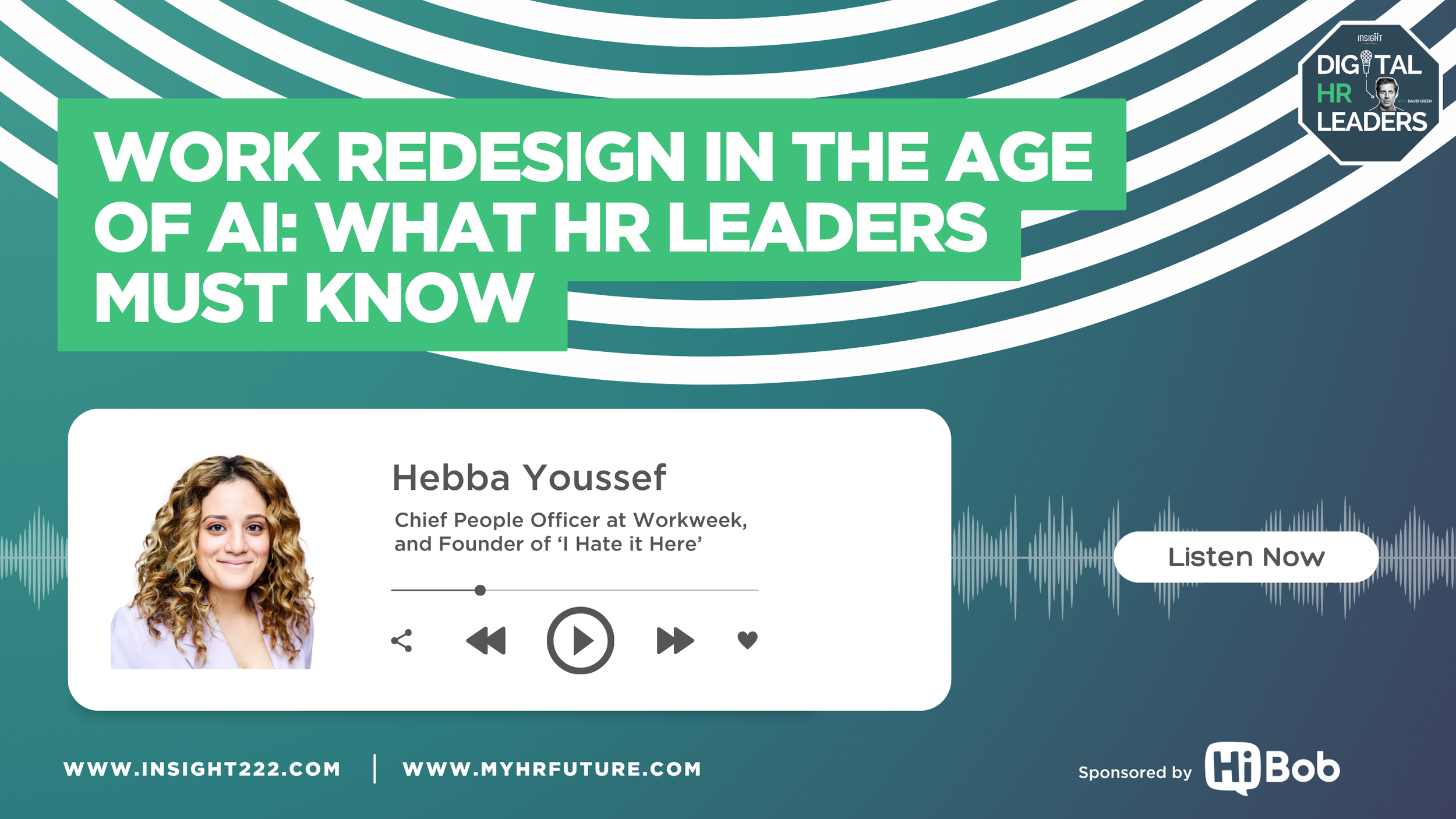
Episode 265: Work Redesign in the Age of AI: What HR Leaders Must Know (with Hebba Youssef)
If parts of a role can be automated or augmented overnight, what does that mean for job design, career development, and the way organisations build the next generation of talent?
In this episode of the Digital HR Leaders podcast, host David Green is joined by Hebba Youssef, Chief People Officer at Workweek and the Founder and creator of the widely followed newsletter I Hate It Here.
Drawing on her experience building and leading HR teams, Hebba shares how she is approaching AI adoption inside her own organisation and what the rise of AI-powered teams means for the future of work.
So, tune in to learn:
Why the traditional job description model may no longer reflect how work actually gets done
How AI-powered teams are beginning to reshape HR operating models
What the rise of AI means for managers, entry-level talent and early career development
How HR leaders can evaluate and prioritise AI investments
Where HR teams can begin automating parts of their function
Why governance and organisational design must evolve alongside AI adoption
This episode is sponsored by Hibob.
HiBob brings HR, Payroll, and Finance together into a single platform that employees actually use. With AI throughout, you move faster, work smarter, and empower your people to power your business.
Sapient Insights recognizes HiBob’s AI vision, citing the Bob AI Companion for making everyday work faster and easier. Fosway Group also names HiBob a 2025 9-Grid™ Core Leader, recognizing the strongest AI vision among Core Leaders.
HiBob. All-in-one HCM for HR, Payroll, and Finance.
Learn all about HiBob’s modern HR platform here
Resources:
This episode of the Digital HR Leaders podcast is brought to you by HiBob.
[0:00:09] David Green: For years, organisations have designed work around relatively stable assumptions, clear job descriptions, predictable career paths, and fairly well-defined skills that people develop over time. But without stating the obvious, in recent years, that has completely changed. With AI becoming more prominent in how work gets done, organisations are being forced to completely rethink how work and jobs are structured. To explore this from a practitioner's perspective, I'm delighted to welcome back to the show Hebba Youssef, Chief People Officer at Workweek and the founder and creator of the hugely popular newsletter and community, I Hate It Here. Through both her writing and work as a people leader, Hebba has built a deserved reputation for being one of the most thoughtful and honest voices in the HR community, and I'm particularly excited to talk to her today, as we'll be exploring how Heather is approaching AI adoption inside her HR team and Workweek, what AI-powered teams mean for traditional job structures, and how leaders can think about developing early career talent in a world where many of the tasks people want to learn through are being automated. We also explore how to evaluate AI investments, where HR teams can begin automating parts of their function, and why governance and organisational design will need to evolve alongside the technology. So, let's get started with a brief introduction from Hebba herself.
Hebba, welcome back to the show. It's been a couple of years since you were last on the Digital HR Leaders podcast. For our listeners that maybe didn't tune in, could you share a little bit of an introduction to yourself and the work you do at Workweek?
[0:01:52] Hebba Youssef: For sure, and I'm so happy to be back. It has been a few years. We have so much to catch up on, let me just say.
[0:01:58] David Green: We have.
[0:01:59] Hebba Youssef: So, much has happened at work since we last talked. I'll tell you a little bit about myself. My name is Hebba Youssef, I'm the Chief People Officer at Workweek. Workweek is a creator-led media company. At its core, we have about five creators in the B2B space, and I happen to also be one of our creators. It wasn't enough to join as the CPO. They thought I was funny and interesting and could consider creating content. So, I write a newsletter called I Hate It Here, I host a podcast by the same name, I have a virtual event series called HR Therapy, and then I travel the world and speak on stages about the work that I'm doing. Because when I'm not creating content, I'm still our CPO. And I've worked at four venture-backed startups, as well as a publicly-traded company. And I worked in HR on all of those and really just fell in love with the idea that we can transform the way we do work and build really good experiences for our employees.
[0:02:50] David Green: Good. Two follow up questions on that, Hebba. So, first of all, how do you juggle all that, because as someone that tries to juggle too much, sometimes all the balls start to fall on the floor? And second, tell us a little bit about I Hate It Here.
[0:03:03] Hebba Youssef: How do I juggle all of it? Not well. Everyone asks me that question and I always say, "Not well". I work sometimes six days a week. I mean, the good thing is I'm deeply passionate about my work and I get to engage the systems thinker and the creative thinker. So, a lot of my work feels less like work and more like fun. I'm analysing my thoughts all day long through writing, I'm thinking about interesting ways to position a podcast or guests and those type of things. It doesn't feel like work some days, but I am working on boundaries. It has been a goal for years. I have not achieved it yet. So, maybe the next time I come back to the pod in two more years, I will have figured out boundaries.
To tell you a little bit about I Hate It here, so I launched the newsletter in 2022 with Workweek, coming up on my four years this year, which is a phenomenal experience. It started as a once-a-week newsletter, an essay style, just all about the things that I'm thinking about with work. One of my first editions was on pay transparency. My second one was about how performance management doesn't actually measure performance. So, every week, it's kind of an essay where I'm thinking about work and what happens. On Wednesdays, I send a newsletter that's kind of, I keep joking and calling it like an amuse-bouche, because it's like very little pieces of things, like a news article, a data point I'm thinking about, and a podcast episode that I want the readers to re-listen to. And then, on Friday, I have a Dear Hebba-and-Friends-style newsletter where people can actually submit questions, and my community of like 10,000 people leaders will answer their questions. So, it's not me, I don't answer any of the questions, actually. A community of HR leaders does.
[0:04:38] David Green: And I love the fact you said you love what you do, which helps you obviously when you've got so many things to juggle, and then your newsletter is called, I Hate It Here. I love that.
[0:04:47] Hebba Youssef: It's because everyone has that real feeling at work sometimes where they're like, "I might actually not love working here". And I think HR people might feel it more, but we're less inclined to share that sentiment. And I wanted to create that kind of safe space for people to feel the way they want to feel about the very hard, real and emotional work we do in HR.
[0:05:09] David Green: So, for those that did listen -- and for those that didn't, it was December 2023 when you last joined us on the show, if I remember rightly, it might even have been the last episode before the Christmas break -- we spoke about why HR tech implementations often fail. I think they often still do. A lot has changed since then. That's probably putting it mildly, to be honest with you. Tell me what has been going on in your world over the last two and a half years, and what are the big topics that you're thinking about at the moment?
[0:05:37] Hebba Youssef: My God, the last two and a half years have felt like 50 years, honestly. I just feel like I've lived so many lives since 2020 in the COVID era, but AI has just taken over every single one of my thoughts lately. I can't escape it. You can't open an app and not read an article about AI, or someone's posting something new they're doing with AI, or an HR leader has developed their own app and they want to tell you about how they did it so you could do it too. I just don't think you can escape it. And two and a half years ago, we were talking about AI, but nowhere near, I feel like, as much as we're talking about it now. Now, it feels like it's a daily, hourly, honestly every-five-minute kind of conversation, whereas back then it was not as much. And we were focused on ways to transform work. Like, we were having more conversations two and a half years ago about remote work and hybrid. Now it feels like we're split 50-50. A lot of people are going back to the office, a lot of people are staying remote, and that conversation is still relevant, but I feel like it has just been overtaken by AI and AI's impact on everything in the world.
[0:06:39] David Green: As someone on the ground in HR, you know, as a Chief People Officer, how are you seeing the rise of AI impacting your team, your operating model, and maybe those, again, of your community as well?
[0:06:51] Hebba Youssef: I think this will be the single most transformative moment in work, potentially since email was introduced into work. And maybe this will actually be more transformative than email, because we were faxing things before, right? Email really did change how we communicate. And then, the introduction of instant messenger at work, where we all are communicating in real time even more, it's pulling us out of email. I think AI is going to have that impact on work, where the way we do things today will look potentially radically different tomorrow, next month, a month later. It does feel like the rate of change is happening so much faster than it's ever happened before. And so, when I'm thinking about how it's impacting me, it's a lot of different forces. It's the outside force of, things are moving faster than ever before. Then, it's the inside force of, how do I manage my employees through this change and actually help them not be scared but excited about what the future could hold? Because we've all seen the headlines like, "AI is coming for your job". It's really hard to combat the fear of that that's bringing up when you are also trying to bring your employees along for that journey and say like, "You're going to learn something so new, it's going to be so different, you know?" And then, they go read the news and it's like, "Oh, you might lose your job". So, that type of thing, I think, is coming up a lot.
So, we're managing not only a technical transformation, we're also managing a workforce transformation, while at the same time also trying to manage the emotions of everybody as we're navigating through this. So, the way it's impacting my team right now, it's actually not massive, because we're all really excited about what this could look like. And we're all on the same page about this. My executive team is very excited about where AI could take us. We have not mandated anything for our employees. We have not said, "You absolutely have to use AI". We actually started last year just pressure-testing AI sentiment in a Pulse survey, just seeing how they were feeling about it, what they were using it for. And then, very slowly, we took that data and started giving them use cases for how they could use AI. And we did some custom learning hours, where we had everyone bring like show and tell, like bring what you've built with AI, show other employees what you're doing.
Now, we're kind of at the next phase where we're really thinking, "How is this going to shape all of our operating inside the organisation?" At first, it was one-off people were using AI. Now it's like, okay, now the whole organisation is going to be impacted by this, which means something as simple as a job description will look very different than it did in the past. So, it's impacting me in so many different ways. Honestly, some days it feels so chaotic, I can't keep up with it all. And I think just it's causing me to think really critically, and everyone around me to also think really critically about how they've always done their work and if it could be done differently.
[0:09:35] David Green: Yeah, I guess that's the thing, isn't it? Things are changing so quickly, it's important sometimes to be able to a step back and think and slow down a little bit before just rushing off and trying to do everything.
[0:09:46] Hebba Youssef: And it doesn't really feel like this moment is made to slow down. Like, you almost feel like you'll be penalised if you take a beat. But I think when it comes to HR, especially HR and AI, you have to take a beat because the humans are at the core of all of this. And you can't forget how different and unique and special each of us is. And if you just try to blanket roll out a mandate or tell everybody, "Here's how your jobs are changing", I think you're just going to fail and you're going to lose your employees on the journey.
[0:10:16] David Green: Today's HR teams juggle all their processes across disconnected systems. HiBob brings HR, payroll and finance into a single platform employees actually use. Bob already has AI throughout, so you can move faster, work smarter, and empower your people to power your business. That's why Sapient Insights recognises HiBob for its AI vision, highlighting Bob AI companion for helping teams move faster, from drafting job descriptions and communications to getting answers fast. And Fosway Group names HiBob a 2025 9-Grid Core Leader, recognising the highest AI vision among core leaders. HiBob, all-in-one HCM for HR, payroll and finance. Learn more at hibob.com.
Is this a time where HR needs to step into a different role around how we architect and redesign work? And if so, what does that entail?
[0:11:34] Hebba Youssef: It's so funny you ask this question. I brought this up with my CEO maybe two weeks ago. And I was like, "Hey, I have this idea I've just been noodling on and I want to hear what you think". And he's like, "Sure, tell me". And I said, "I think HR's job is going to radically change from less of a job about paperwork, processing, responding, that type of work, and more around actual performance of an organisation and a business. I think our core function in the future will be, how do we get every single person to perform to the best of their abilities." And that's always been part of our role, but there's been so many other things that have encompassed this HR role, that performance is just a small piece of it. I think it'll be the biggest piece of the role in the future. And maybe I'll be wrong about this and people will listen to this podcast in ten years and say, "She was so silly to think that". But I think we can automate a lot of the things that have been taking away our attention, and we can really laser in on what does this organisation need to perform at the highest standard of work.
[0:12:34] David Green: I love that. And I think it's almost, if we look at the path of HR over the last decade or so, not in every company obviously, but in many companies, it's kind of been on a journey from being, as you said, that traditional support function that's focused on compliance and everything else, to being more of a strategic partner to the CEO and the leadership team. And there's an argument that AI is the opportunity for us to really drive that forward. But not every HR team will succeed probably in doing that in every organisation. I mean, what are some of the things that you're thinking about how to make that happen from your perspective, and what are you hearing from maybe some of the HR leaders in your community who are succeeding with that?
[0:13:22] Hebba Youssef: I mean, it is all about how the work gets done. And so, if it's about how the work gets done, then HR is in the conversation, no matter what. I think some people are doing really well. The HR leaders that are doing really well embraced AI early on and are really questioning what are some good use cases internally to add value immediately. And so, I always joke about use cases for AI. I think of the most annoying tasks I have. And I also have a scale of the impact these tasks give on the organisation, and I basically rank them, and I'm like, That's what should be automated, the most annoying, most impactful tasks", right? I think HR people who are finding real impact are the ones who are going into their organisation and saying, "How can I think about how the work gets done differently?" There are teams that are genuinely struggling with this, though. It's not even that they're not technical, it's that maybe their organisation just isn't ready for this type of transformation, but they're being forced to get there. And I think that is really hard as well. If you have an HR leader who might not be trusted by the CEO or might not be looked to, to guide, it can create a lot of conflict when you're trying to transform work.
So, people I've seen that have been successful are the ones that are embracing use cases. The ones that I've seen are struggling are the ones that necessarily don't feel like they have the authority or the autonomy to actually make those changes at the organisational level. I asked my communities -- my community has about 10,000 people leaders -- I just did a random poll. So, I was like, "I'm just curious to know who owns AI transformation at your organisation?" And I gave them four options: HR; CTO or technical person; a committee of people; and no one, it's absolute chaos. And I just want you to guess what the majority of people responded.
[0:15:09] David Green: I think it might be number four!
[0:15:11] Hebba Youssef: Yeah, it was. No one, absolute chaos. And the comments, everyone was like, "It's nobody really owns it, we don't know who does this, who does that". And so, I think the average team potentially is actually having that experience. Because if you think about it, it is very cross-functional, because you will need like your tech team involved on how does this impact either internal or external things, like what's the safety, the ethics. It's a very multifaceted type of project to lead. And I was so interested to see the majority of people saying no one's really owning it. And so, there's definitely a void and a gap to be filled for HR leaders.
[0:15:47] David Green: And listening to you there, Hebba, it reminds me of a conversation we had on the podcast a few months ago with Jenny Dearborn. And we were talking about the analytics and HR leading from an analytics perspective. And actually, she talked about something, I think it was in her recently published book. She had a two-by-two model. You've got the CEO and the CHRO, you've got the CEO who sees HR as a strategic partner, and obviously what you want then is you want a CHRO who is able to fulfil that expectation. That's great. Then, you've got the CEO who sees HR as a compliance partner and a support function. And if you've got the CHRO that also that's their expectation and their ambition, that probably works as well. Maybe they're not achieving as much as the other one.
But the worst one is where you've got the CEO, maybe a new CEO that comes in, who actually then sees HR as a support function. But you've got a CHRO who actually has done in the past, maybe in the same company, or wants to be, a strategic partner. What would your advice be to that CHRO? How do you change your CEO's mind and almost, I'm not going to say, "Get a seat at the table", because I hate that thing, I'm sure you do as well; but how does that CHRO get to help change the mind of the CEO, because you can't wait to be asked, you've got to do something, haven't you?
[0:17:17] Hebba Youssef: There are so many CEOs that see HR that way. It actually makes me sad sometimes that I'm on Twitter and it's CEOs that are like, "The first thing I'm going to automate is HR's job. I never want to deal with HR". And every time I'm just like, "You are missing such an opportunity. You are missing out on somebody who very intimately understands your organisation in a way you as CEO might never understand. They understand the humans doing the work, the skills it takes, the challenges they're facing, the collaboration issues they're coming across. That person really understands it". If I was that CHRO talking to my CPO, the first thing I would do is figure out why he views HR like that. I would just ask like, "Historically, what kind of HR person have you worked with?" And I would slowly start to unravel kind of where the assumptions are coming from. And then, I would start trying to show how HR could be impactful. I would position the work in a very strategic way to say, "Here's the outcome we could see from this work".
If you're thinking about a traditional CEO, they want their company to be successful. What a better way for HR to show that they can be strategic than to show the CEO how this work will make this company successful. And it's also a trust-building exercise. Like, if the CEO is also the founder of the company, this is the thing that they have been building their whole life potentially, right? Their DNA, their lifehood, everything is into this company. Getting to trust somebody with major, massive organisational changes or very new things could be really hard for them. So, every relationship is like an exchange of trust. So, you have to figure out, "How do I get this person to trust me, so that I can shift their mind from compliance to actual strategy work, and show them that they have something to gain from working with me in that capacity?" And it's hard.
[0:19:09] David Green: It's hard, yeah. And I mean, we talk about with analytics a lot. Most companies do engagement surveys and some CEOs are happy when they see engagement go from 71 to 73, but surely far better if we can actually connect engagement to customer satisfaction to sales, to stuff like that, and then you start to see the connection and you see the impact that HR can have. And obviously, one area where HR potentially can have a huge impact is the workforce transformation that is going to be happening with AI. So, on that, we touched on this a little bit, AI clearly, you look at it in different roles, and we can look at roles in HR, we can look at roles outside HR. AI has the ability to, and is already, taking on certain tasks within roles, which means we need to think about how we redesign jobs effectively as well. We need to understand that. I'm curious, how are you approaching that at Workweek, maybe as it relates to simple things like job descriptions, but also in terms of how you break down individual roles to understand what should or could be automated versus what shouldn't? And then, maybe there's some new tasks that you would then include in that role moving forward as well?
[0:20:30] Hebba Youssef: For sure. Something that really bothers me about job descriptions is oftentimes, they're very static. If you think about when you get your offer and you get a job description, it's this description. But a lot of times you get in and your role is actually so much more than what initially the five bullets on that job description say they are. So, something we did at Workweek a few years ago, and we continue to try to do at least once a year, is we review every job description once a year. I ask the manager to read it and say, "Is this the work that your employee is doing at this level? If it's not, what do we need to add or remove from this job description?" And that starts a lot of good conversations around the job description being fluid. Now, I'm also incorporating this additional layer where I really want our job descriptions to be segmented by human-led work and AI-augmented work, so we have a good sense at an organisational level of what roles are AI augmented to what percentage. And that also takes a lot of work.
The job description cannot be static anymore. They need to be really fluid. And this is a time where work is changing so fast, right? You could be looking at job descriptions every three months, every six months. I don't think that's outrageous. As AI evolves and we're shifting skills and people are taking on more, I think job descriptions will be edited and become more of like a quarterly check-in on people's jobs, like maybe it becomes part of the performance review process. I don't know, that's a little wild, but maybe it should, because then we can actually assess and understand what are our employees working on, and are they working on the most valuable work we need them to work on. Then you can better understand, okay, there's a whole subset of their work that they don't need to be spending time on. Like, "David doesn't need to be doing these tasks. Let's get that AI-automated. Let's have him focus on the things that are super-important". And now, we have these job descriptions that are more reflective of the hard work being done, often invisible work being done, and really clearly where we have automated pieces of our work that we don't need to focus on as much.
[0:22:32] David Green: I want to take a short break from this episode to introduce the Insight222 People Analytics Program, designed for senior leaders to connect, grow, and lead in the evolving world of people analytics. The programme brings together top HR professionals with extensive experience from global companies, offering a unique platform to expand your influence, gain invaluable industry insight and tackle real-world business challenges. As a member, you'll gain access to over 40 in-person and virtual events a year, advisory sessions with seasoned practitioners, as well as insights, ideas and learning to stay up-to-date with best practices and new thinking. Every connection made brings new possibilities to elevate your impact and drive meaningful change. To learn more, head over to insight222.com/program and join our group of global leaders.
I'd love to dive into two topics. We'll come to entry-level talent in a minute, because obviously there's a lot of talk about that in the moment, but I'm thinking about managers. So, in the conversation I had with Sandra at McKinsey, we started talking about managers, because as usual, it's managers that bear a lot of the brunt of this as things change. We started talking a little bit about managing agents, and then obviously, managing people versus managing agents. It's different skills. Interestingly, Sandra said that from some of the research they've been doing, they've found that people are good at managing people are also good at managing agents. I don't know if you're thinking around that at the moment at Workweek, but I'd love to hear your thoughts around that.
[0:24:28] Hebba Youssef: I'm really not surprised by that, because so few people are really good at managing people. I would say the average manager has some areas of opportunity. Even me, as a manager, I think I could learn and grow in more ways. And it's really interesting to me that they can manage agents just as well. Because if you think about the core parts of being a good manager, it's setting the right expectations. So, if you're thinking about managing an AI agent, you need to set expectations with that AI agent. They need to understand the context in which they are operating, and the task in which they are doing, like how things are changing. That is very much a core manager capability. So, I'm truly not surprised. The managing agents thing is fascinating to me. I don't know what our management teams will look like. Over the past year, we've seen the middle-management layer kind of get decimated, where a lot of big companies are saying like, "We're going to cut that middle-management layer", or, "We think managers can actually manage more". So, are we going to look at a future where maybe a manager has like ten direct reports that are humans and they're also managing maybe three to five AI agents or three to ten AI agents? Could that be what our future looks like? I think potentially.
That means we need to double-down on making sure our managers are trained and capable to handle that, because the average manager isn't. And that's what worries me the most about this future, is we're decimating this middle-management layer. We're giving people more people to manage. We're also asking them, "Okay, now figure out how AI is going to improve your team's workflow and manage these agents". It's too much. Already managing the humans was too much. So, how are we supporting the managers as we're giving them even more work to do?
[0:26:13] David Green: One of the things that we are seeing, you mentioned obviously there's a trend that we're seeing and that many companies are reporting, where managers' spans of control are increasing and some middle managers are being pulled out or ripped out, as it were. We're also seeing a lot of impact around early talent as well. I'd love to hear your thought around that. If AI augments many of the tasks that historically entry-level workers have maybe done and learned a role, found their feet within an organisation, how do those organisations ensure that the next generation of talent, their future leaders presumably, are still developing the experience they need? And is that something you're looking at, again, at Workweek?
[0:26:55] Hebba Youssef: This question is keeping me up at night. Genuinely, I'm worried for the lack of early-talent roles and those going away. Because when you ask people, "Would you rather have an early-career person you can manage, or a more senior person who can augment with AI?" I think a lot of companies would actually pick the more senior person who could augment with AI, than an early-career person that they have to invest in and grow. And so, I start to wonder like, what's going to happen for, like you said, the next generation of talent? We need those people to learn at work because then they become the next generation. And we're looking right now, the majority of leaders are, what, Gen X or Baby Boomers, Gen X, Millennials. We'll see in the next ten years, it'll be less Gen X, more Millennials, Gen Z. But what happens to Gen Alpha? They also have to enter the workforce and learn. And so, this part really keeps me up at night because I'm like, how do we solve this problem if people are just like, "Well, AI could just do that. And that's why I don't need to hire a junior-level person"?
I think it means we have to think really critically about our org, where it makes sense to add early-level talent. We need to be deliberate about it in a way that is even more deliberate than we've ever been before about opening roles. And we need to think clearly, like, is this a role that AI could do, could be augmented with AI? What does that look like? We need to build more structures of mentorship. How do we bring people along and grow and develop them? It doesn't just need to be their manager. There needs to be an opportunity for them to access mentors where they can learn from, and enter a career path potentially at different spots. And I think it makes us rethink completely what career-pathing even looks like. I don't know how to solve this problem, David, and I think about it every day!
[0:28:39] David Green: And on that, and you've talked a little bit about this, Hebba, but how are you seeing AI adoption at Workweek, and what's the involvement of HR in helping the CEO and wider organisation understand that adoption and ultimately, I guess, how it drives impact and value?
[0:28:55] Hebba Youssef: Yeah, I think our employees are excited and curious about it. They've always been that way, which I feel really lucky for. They have a lot of questions about tools they can have access to, how can they improve their workflows, problems they're trying to solve. It's a bit uneven across the organisation because we have not mandated anything. We have been staunchly against the mandating. It just feels like once you force people to do something, they almost lose curiosity or interest in it. And so, our way of approaching it is asking people to think really critically about their work and what tasks take up their time that might not need to take up their time. A lot of our managers are doing one-on-one type research with their team leads to figure out where they're spending a lot of their time and how they can optimise and be more efficient. Our CEO writes about AI at least once a week. He sends a weekly newsletter on Sunday nights to our entire company. And he shares his thoughts about how he's thinking about how AI could change or an interesting use case about AI that he read about. And I think that has really helped our organisation have more appetite for embracing the tech. We haven't gotten really staunch pushback on anybody.
I think because we went about it the way that we did, we pressure-tested in Pulse surveys for a few months, we made it a fun show-and-tell kind of situation like, "Look at what AI can do". Now, we're sharing more use cases and unlocking access to tools. It feels very natural and less forced. And so, we're seeing a lot of people are raising their hands and saying, "I have questions about this. Can someone help me do that? I want to build this, is that possible?" and it's been working out really great. And our product and eng team is always available. While they are building product and engineering stuff for us, they also have made themselves available to employees who might be less technical, who want to figure out how they can incorporate AI into their workflow.
[0:30:42] David Green: Really good. And obviously, what you've described there with the CEO posting stuff regularly around questions and thoughts and stuff that he is finding interesting. I think that's important that leaders are role-modelling this, I guess, as well, and having an open conversation, so you're driving that trust, that transparency, that curiosity, I guess, amongst the team, which is again good change management.
[0:31:13] Hebba Youssef: We truly tried to make it fun. Like this week, we had on our company all-hands, an employee built a -- if you've ever taken a BuzzFeed quiz, which we also learned that the majority, a good portion of our company has never taken a BuzzFeed quiz, because there's a bunch of Gen Z people who that wasn't really a thing; but in my era, everybody took a BuzzFeed quiz. So, we started off our company all-hands talking about that. And one of our product designers built a fun app where you answer questions and then you find out what kind of Pokémon you are. And he did it all using AI and he walked the company through how he did it, and it was just like a really fun and interesting use case where people were like, "That's actually interesting. I have questions about that. Could I use it to do this? Could I incorporate it with a client like this?" And so, it started the conversation in just a really fun and organic way. So, I just want to say, you can still have fun at work. And while AI is disrupting the work and our environment in a very real way, I think there are ways to use it that can also hopefully be fun, inspirational, and help move your company forward in a healthy way.
[0:32:16] David Green: And how do you assess the right AI investments for Workweek?
[0:32:21] Hebba Youssef: Oh my God, what a good question! Okay, I have three things I like to think about. Does this remove friction from something my team hates doing, my annoyance question; if I am annoyed by it, can I stop doing it? Does it free up my capacity for more higher judgmental, like, the work that I need to be spending my time on, the human being work; does it free up my time to do that? And the last thing is, can I actually measure the before and the after? If I cannot show that this thing is actually going to improve the thing that I am trying to do, what is the point of me investing in this tool?
[0:32:56] David Green: Very good, because I guess that's always a challenge, isn't it, how do we prove that this is worth the investment?
[0:33:04] Hebba Youssef: Yes. I mean, you know how hard it is for HR people to get budget. I'm going in with so many proof points. I'm like, "Here's the thing. Here's another thing. Here's a third thing. Here's a fourth thing. I found you all the proof points possible to get my budget". And so, I don't take it lightly if I'm going to go to bat for an AI investment I need to make, or the company needs to make. I'm always going to make sure that there's some justification for how we're going to leverage it, and then make sure that we absolutely understand the usage of the tool. There's nothing worse than paying for a bunch of people to have pro licenses and then nobody's using it.
[0:33:37] David Green: Yeah, I think they're three great questions to ask before you make any type of investment, that might bias the answer to the next question. Hebba, if you were advising an HR leader, and obviously you've got this 10,000-person community of HR leaders, who wants to start automating parts of their function, where have you found the highest impact areas to start, or what are you hearing from your network as well around where, because I guess it's not always going to be the same for every company, is it?
[0:34:07] Hebba Youssef: Yeah, that's such a good one. If you're recruiting a lot and you're hiring a lot, which actually, I don't know if the average company is doing that a lot right now, because I do feel like after the news with Jack Dorsey and Block cutting 40% of their workforce, I'm intrigued to see what does that mean for our hiring market. Like, we already have more job seekers than jobs available, so I'm really curious about this. But if you happen to be a company who's hiring a lot, or even hiring a few roles a quarter, I think AI can be an incredible value-add there, from things like screening to scheduling to writing your first pass of comms to just speeding up the process in a way that doesn't feel like you have to send an email every time a candidate moves to a different flow. So, I always say if you're hiring, recruiting is an excellent place.
Repetitive questions. I don't get this a lot because we have really clear written documentation in Notion where employees can know, but if you get the same repetitive question over and over again, like the same question five times, you could build something either in Slack, either in Notion now too, where the employees can actually go self-service and you don't ever have to do it again. Like, "How do I take leave? What do I do if I need to request special medical leave?" All of that can also be automated. And then, the last place I would say to think about is if you're working in like a heavy performance culture, where you're giving feedback every two weeks to a month, finding a tool that can help keep a really good record of all the feedback you're giving, and then prepare the managers to better enter the conversation, could be a huge value-add. So, I think I gave three big areas, but I would say you have to look at your organisation and assess where you are struggling the most, and then start there with rolling out use cases.
[0:35:53] David Green: Yeah. And I think that's important. We can learn and be inspired by what other organisations are doing, but we always must apply that to our own organisations and our own challenges that we're trying to solve for, as you said.
[0:36:05] Hebba Youssef: Yeah. Also ask your employees. You could always survey them. Like, "What is the most annoying HR thing you have to do every week?" or, "What could we help you do faster as HR?" And I think that could also give you really good questions. I have employees that one is really passionate about onboarding. And she's like, "Can I please help you? I can set up this cloud project. We can work on it together". And she's just so passionate about helping move onboarding along in a better way that she wants to play an active participant in it. And I said, "Absolutely". That's exactly what I want to hear. Like, I don't need to be the only person architecting the future. If your employees have a part in it, it can make it so much more impactful down the line.
[0:36:44] David Green: What are the governance structures that you think need to evolve alongside the technology?
[0:36:51] Hebba Youssef: This is such an interesting question. I was thinking about this for so long because words that came up to me were like, 'accountability' is so important when you're thinking about governance like, where is the accountability for the AI decisions? My worst-case scenario would be somebody implementing AI to make a hiring decision. AI should not be doing that. It should help you get to the hiring decision, but a human very much needs to be involved. I don't want AI to necessarily tell me who are the top performers or who needs a raise or who's ready for a promotion. It can help get all the components in place so that I, a human, review it and figure out what happens. So, I think when you're talking about governance, you have to understand what is the accountability for the AI-based decisions; what should AI actually be making decisions on; and what should a human always be involved in? And I think that is a very big piece of it, but so few organisations actually define who the key decision-makers are.
So, if you're thinking about just the average organisation and you're listening, do you have a governance structure for who makes final decisions on anything? If your answer is no, before you start leveraging AI to make decisions, you should probably write that structure first and then move on to what kind of decisions can AI make.
[0:38:08] David Green: Yeah, very good. Yeah, I think it's important. It should be decision to support; help you make better decisions, but not make the decision, and I think that's a really good distinction.
[0:38:18] Hebba Youssef: Give you all the data you need to actually make a clear decision and use your best judgment, rather than you letting it decide for you.
[0:38:25] David Green: Yeah, I like that. And that leads quite nicely, I think, to the question of the series. How can HR lead the responsible and ethical adoption of AI, and not just manage it, not just be a part actor in it, but actually help lead that responsible and ethical adoption?
[0:38:44] Hebba Youssef: That is such a huge responsibility, on top of a job that has already ballooned to be responsible for so much. So, I want to answer this with that type of context in, like we should always play a role in that type of work around ethical AI adoption, because we know our organisation. We sit at the intersection of people, culture, org design. Nobody is better positioned to make good decisions about ethical AI adoption, what it could look like, other than us. And we also write policies and procedures for our organisation. So, nobody's better positioned to also say, "Here's how we should be evaluating vendors. Here's when we say no. Here's what we do when we find out, after we've picked a vendor and we've launched with them, that it might not actually do the things they said that they did when we were doing our initial search for them". So, I think it's a loaded question to a certain extent, because it is a huge responsibility on top of the responsibilities we already have. But I think it flows very naturally with the work we already do. And we have to be the people who are speaking up and have a voice on this work, because who else would do it if not us?
Also, in America, there are certain states passing laws around AI. And so, when I'm thinking about how that complicates everything for us and AI adoption, it's like who better knows the laws being passed and how to follow the procedures and what we need to do, than HR. And so, we should play a part and honestly lead around the work for how do we adopt AI in our organisations in an ethical and safe way.
[0:40:25] David Green: Very good. And I think you talked earlier a bit of some of the stuff that you're doing at work, the trust and transparency that you're creating, the kind of safe space for people to experiment and learn. Those sorts of things are all really important. And as you said, there's more and more regulation coming in. In Europe, we've got the EU AI Act coming in, and obviously there's been legislation passed in places like New York, particularly as it relates to recruiting technology and other states as well. As you said, you've got to continually be on top of that. So, our partnership with our legal partners, whether they're inside the firm or they're external partners, is so important in understanding this.
[0:41:07] Hebba Youssef: You cannot go into AI blind. We already saw there was a lawsuit with Eightfold AI, Workday also. You can't go into this with the best assumptions, you should go into it with our HR mind, where we should know what's the worst possible thing that could happen. And then, we need to work backwards to set the right guardrails in place so that we don't get to that worst possible scenario. Because if nobody is leading it, I guarantee you you're inching closer to the bad scenario than you are to the good outcome.
[0:41:38] David Green: Hebba, before we wrap up, what excites you most about the future of HR? And then maybe -- actually, no, let's end on a positive. What excites you most about the future of HR, and then tell me what you're most worried about? You could say what you're most worried about first, and then tell us what excites you most.
[0:41:56] Hebba Youssef: I'm most worried that we miss out on the opportunity to lead this work. I have never been more excited to be in HR. We are undergoing a massive workforce transformation. What an exciting time to be a leader in this space. Truly, I wake up every day and I'm like, "Oh my God, I'm excited to do today". Yes, a million things go wrong before noon, but it doesn't matter because we're in the motion of things changing, and I love change. I'm also a change management nerd. So, the thing that excites me about right now is workforce transformation is, at its core, just a massive change management project. And the fact that I could get to lead that work, that I can be an active participant in shaping the future of my company, the future that the employees experience, brings me like so much joy and fulfilment every day.
[0:42:46] David Green: And it sounds, again, listening to you then, it reminded me of an episode we recorded just before Christmas with Katarina Berg, now at On as the Chief People officer, one of your peers. And she talks about bold HR, courageous HR, and I think that's what you're saying. We've got to grasp this opportunity with both hands.
[0:43:04] Hebba Youssef: We cannot be scared. I mean, first of all, it's okay to be scared. But we should not. We have all the capabilities, we know work better than anyone else. We just have to believe that we are the people capable of leading this change. And I do think the average HR person is.
[0:43:20] David Green: What a great way to end our conversation, Hebba. It's been a pleasure, as it was last time. I'm almost looking forward to two and a half years' time. I imagine what would have changed since then. Can you share how listeners can follow you and all the work that you're doing? Obviously, we'll put links in the show notes as well, but just a synopsis of how people can find out more about your work, and what you're doing at Workweek and what you're doing for the field.
[0:43:44] Hebba Youssef: I'm always on LinkedIn, I'm being silly on LinkedIn every day. I treat it like any social media app. You can find me on LinkedIn. Sometimes I make TikToks. You can subscribe to the newsletter. It's called I Hate It Here. It comes into your inbox every Monday, Wednesday, and Friday, and it's a really good time. And I have a community of 10,000-plus HR leaders. It's called Safe Space. You can join it as well. All my info is on LinkedIn.
[0:44:07] David Green: Fantastic. Well, we'll put that in the show notes as well for people that want to find out. And, Hebba, it's been an absolute pleasure speaking with you today. Looking forward to what you do next at Workweek, and help lead our field into the future, I guess.
[0:44:23] Hebba Youssef: We can do it. It's now. We're going to do it. It's going to be great. Thank you, David, this was so much fun. I can't wait for another two and a half years.
[0:44:32] David Green: Thank you again, Hebba, for joining me today. It really was a pleasure to talk with you. For those of you listening, I'm curious, what stood out for you the most from today's episode? I'd love to hear your thoughts. So, head over to LinkedIn, find my post about this episode, and let me know what resonated with you. I always read the comments and love learning about the different perspectives in the field. And if this conversation got you thinking, please subscribe to the podcast and pass it along to a colleague or friend who might benefit from hearing it too. It really does help us bring more of these conversations to you, HR professionals, across the world. And for those who would like to stay in the loop with what we're working on at Insight222, follow us on LinkedIn, or head to insight222.com. You can also sign up for our bi-weekly newsletter at myHRfuture.com too.
Right, that's us for today. Thanks for listening and we'll be back next week with another episode of the Digital HR Leaders podcast. Until then, take care and stay well.